Buyer Fit Snapshot
| Best fit | compare spot uv vs embossing finish for branding for packaging buyers comparing material specs, print proof, MOQ, unit cost, freight, and repeat-order risk where brand print, material, artwork control, and repeat-order consistency matter. |
|---|---|
| Quote inputs | Share finished size, material target, print colors, finish, packing count, annual reorder estimate, and delivery region. |
| Proofing check | Approve dieline scale, logo placement, barcode or warning zones, color tolerance, and any recyclable or compostable wording before bulk production. |
| Main risk | Vague material claims, crowded artwork, or missing packing details can create delays even when the unit price looks attractive. |
Fast answer: Compare Spot Uv vs Embossing Finish for Branding: Dieline, Finish, Proof, and Buyer Review should be specified like a repeatable production item. The safest quote includes material, print method, finish, artwork proof, carton packing, and reorder notes in one written spec.
What to confirm before approving the packaging proof
Check the product dimensions against the actual filled item, not only the sales mockup. Ask for tolerance on folds, seals, hang holes, label areas, and retail display edges. If the package carries a logo, QR code, warning copy, or legal claim, reserve that space before decorative graphics fill the panel.
How to compare quotes without losing quality
Compare board or film grade, print process, finish, sampling route, tooling charges, carton quantity, and freight assumptions side by side. A lower quote is only useful if the supplier can repeat the same color, closure quality, and packing count on the next order.
Compare Spot UV vs Embossing: Best Finish for Branding
If you compare spot UV vs embossing on a rigid gift box, mailer, or folding carton, the answer usually shows up faster in a real sample than it does in a design meeting. One finish flashes under light and reads quickly from a distance. The other holds its value closer to the hand, where texture, shadow, and pressure do the talking. I’ve had plenty of projects where the mockup seemed undecided, then the press sheet made the choice obvious in about five seconds.
That matters because packaging is doing more than carrying a product. It is setting expectations before the seal is broken, and it is whispering something about price, care, and attention to detail before anyone reads the back panel. A glossy accent can make a logo jump off the shelf. A raised mark can make the whole package feel quieter, slower, and more considered. When you compare spot UV vs embossing properly, you are really comparing two different ways of building confidence.
My practical rule is simple. Spot UV works best when contrast, shine, and visual pop need to carry the message. Embossing works best when touch, understatement, and a more tactile premium feel matter more than reflection. If the choice still feels fuzzy, compare spot UV vs embossing on the final substrate, not on a screen. Paper thickness, coating stack, and artwork density can shift the result more than any render ever will. And yes, that can be kinda annoying, but it saves money later.
Quick Answer: Compare Spot UV vs Embossing on Packaging
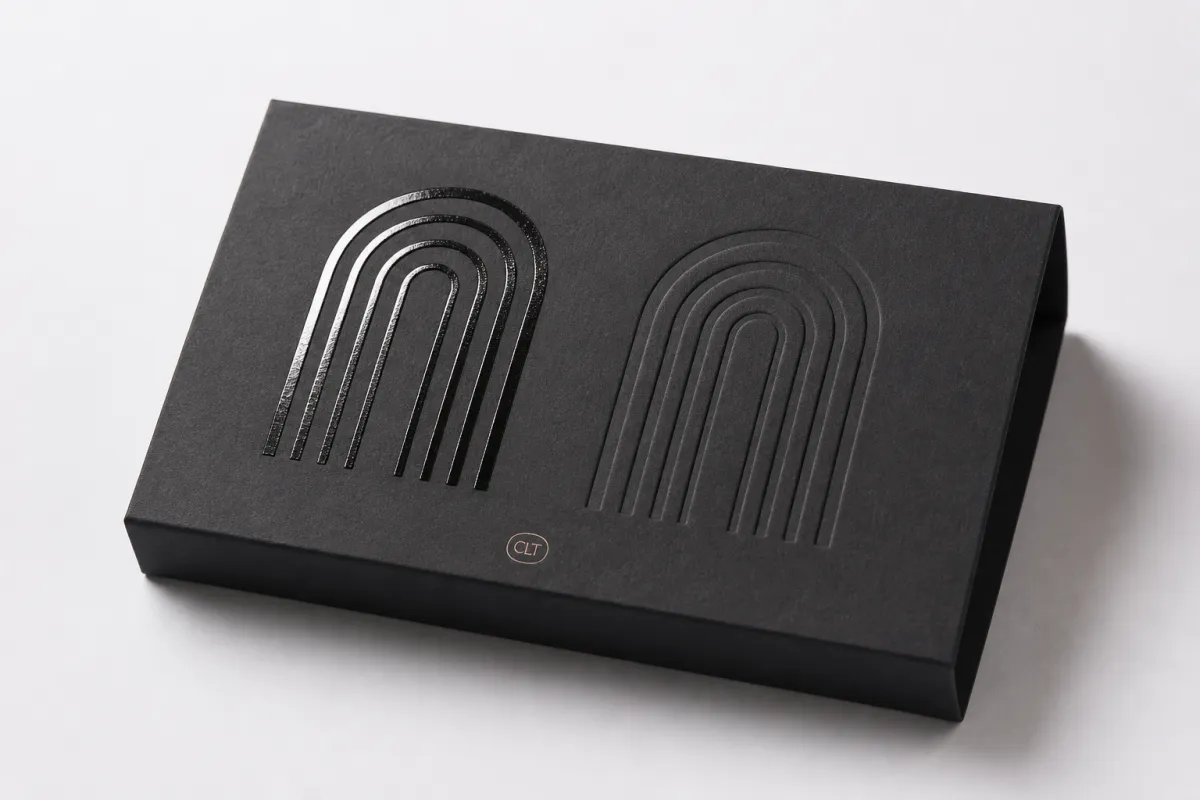
Picture a premium skincare box sitting on a retail shelf. The brand wants a finish that feels considered, not fussy. If you compare spot UV vs embossing in that setting, spot UV usually wins on instant visibility while embossing wins on quiet luxury. One finish works through reflected light. The other works through depth and shadow.
The customer journey should drive the choice. If the box needs to stand out in a thumbnail, under bright store lighting, or across a crowded shelf, spot UV often earns its place. If the package is opened more slowly, handed from one person to another, or judged up close, embossing can leave the stronger memory. Buyers sometimes compare spot UV vs embossing and miss the basic point that the finish should match the moment of contact, not only the artwork file.
Substrate behavior matters just as much as the look. Heavier paperboard, rigid chipboard, and matte or soft-touch lamination usually support both finishes well. Thin folding stock is less forgiving, especially when the embossed area is large or the artwork is crowded. So compare spot UV vs embossing against the actual production limits, not just a polished concept board. A finish that looks elegant on a mockup can become awkward once the dieline tightens up and the logo suddenly has less breathing room.
If the hero element has to be seen from six feet away, spot UV usually earns the budget. If the hero moment happens after the box is picked up, embossing often feels richer.
My honest answer to most buyers is to compare spot UV vs embossing through five lenses: appearance, touch, durability, turnaround, cost. Those five are usually enough to separate the finish that sounds premium from the finish that actually behaves like it should on press.
Top Options Compared: Compare Spot UV vs Embossing at a Glance
When clients compare spot UV vs embossing, I like putting the differences side by side before anyone falls in love with a sample. The finish that looks strongest in a render is not always the finish that survives shipping, photography, or a noisy retail shelf. A clean comparison forces the right trade-off: brightness versus depth, gloss versus texture, and shelf drama versus hand-feel.
| Feature | Spot UV | Embossing |
|---|---|---|
| Visual effect | Glossy highlight against a matte or coated base | Raised or sculpted surface with depth and shadow |
| First impression | Louder, brighter, more noticeable from a distance | Subtler, more restrained, more tactile up close |
| Best artwork | Logos, bands, patterns, and selective accents | Monograms, emblems, seals, and simple marks |
| Photography | Strong under direct light and retail displays | Better when angles and shadows reveal the relief |
| Tooling sensitivity | Moderate, but file prep still matters | Higher, especially on fine detail and tight registration |
| Brand tone | Modern, bold, high-contrast | Elegant, quiet, premium, heritage-friendly |
That table helps, but it still leaves out the way light behaves once the package is in the real world. When you compare spot UV vs embossing on packaging that will be photographed, spot UV tends to carry better because the gloss survives compression and stays visible in online imagery. Embossing can be beautiful in person and still flatten out in a listing photo. That is not a flaw. It is just how surface and shadow work.
Embossing often wins on perceived craftsmanship. A raised logo on a thick carton or rigid box can feel more expensive than a glossy accent, especially if the rest of the design stays quiet. People compare spot UV vs embossing and sometimes assume the shinier option is the stronger one. In practice, the more restrained option can carry more authority if the brand position supports it.
Trend pressure causes another common mistake. Teams see a premium unboxing video and want the same effect without checking art density, stock weight, or finish stack. That is how spot UV starts to look busy and embossing starts to look timid. If you compare spot UV vs embossing honestly, the better choice is usually the one that gives the logo space to breathe.
Production also shapes the result. Spot UV pairs well with matte lamination, soft-touch lamination, and dark printed panels because the contrast already exists in the surface. Embossing pairs well with heavier board and minimal graphics because the raised form needs room to read. When people compare spot UV vs embossing only by price, they miss the structural limits that decide whether the finish looks intentional or forced.
Detailed Reviews: What Spot UV and Embossing Feel Like in Real Use
Spot UV is the louder finish of the two, and that is not a knock against it. On a matte black folding carton, a selective gloss logo can feel sharp, modern, and expensive from the first glance. If you compare spot UV vs embossing on that kind of box, spot UV usually grabs attention faster because the eye catches the shift in sheen before it registers the shape. That works well for cosmetics, tech accessories, subscription boxes, and any product that needs quick recognition.
Embossing moves differently. It asks the customer to slow down. The raised surface creates a shadow line, and the hand notices the change almost before the eye does. When I compare spot UV vs embossing on luxury sleeves, rigid presentation boxes, and stationery-style packaging, embossing often feels more disciplined. It does not depend on shine. It depends on form. That makes it a strong fit for heritage branding, minimal labels, and anything that wants to signal confidence without extra explanation.
The most revealing test is to imagine the package on a loud counter and then in a quiet unboxing moment. Spot UV wins the loud counter. Embossing wins the quiet moment. That does not make one finish better overall. It means compare spot UV vs embossing according to how close the customer gets to the box before they decide whether the brand feels worth the price.
Durability is where the decision becomes less romantic. Spot UV can scuff if the coating stack is weak, the board flexes too much, or the box rubs hard in transit. It also depends on the surface underneath. A rough print base will not give the same crisp contrast as a smooth laminated one. Embossing, meanwhile, can lose visual strength if the stock is too thin, too flexible, or too heavily printed. So when you compare spot UV vs embossing, ask not only which one looks better, but which one survives the route your packaging will travel.
For shipped boxes, I usually care more about abrasion resistance than first-glance drama. Heavy transit changes the equation. If the finish is going through corrugation, stacking, or frequent handling, spot UV may need a stronger coating strategy. Embossing can hold up well, but only if the substrate supports the raised form. If you compare spot UV vs embossing on an e-commerce program, the better answer may be the one that still looks clean after parcel compression, not the one that dazzles on the sample table.
A finish is only as premium as it survives the journey. If it looks expensive in the approval room and tired after distribution, the brand paid for the wrong impression.
There is an emotional difference here that buyers feel before they can name it. Spot UV often says modern and polished. Embossing often says crafted and considered. In packaging terms, compare spot UV vs embossing by asking whether shine or tactility should carry the story. I have seen spot UV feel perfect on a youthful consumer brand and awkward on a refined heritage label. I have also seen embossing undercut a highly visual, digitally native brand that needed stronger shelf contrast.
Combining finishes can work beautifully, but only when the design stays disciplined. A subtle emboss with spot UV on the logo can be excellent. A crowded panel with both effects everywhere usually feels overworked. If the eye has nowhere to rest, the finish becomes noise. When you compare spot UV vs embossing, restraint matters more than novelty.
One more practical note: embossing is not magic, and spot UV is not a shortcut. I have watched both finishes go sideways when the file was too busy, the stock was wrong, or the approval chain kept nudging the logo around by a millimeter at a time. A clean decision on paper can become a headache on press if nobody respects the process.
Process and Timeline: What Affects Turnaround
The production path for spot UV is usually more direct, but that does not make it simple. File prep comes first: the printer needs a clean spot layer or mask that isolates the exact areas receiving the coating. Then comes plate or screen setup, application, curing, and inspection. If you compare spot UV vs embossing from a scheduling standpoint, spot UV often moves faster once the art is locked because the process depends less on custom tooling. The catch is that the mask has to be accurate. Even a small registration miss can make the highlight feel sloppy instead of premium.
Embossing follows a different rhythm. The die has to be made, the press has to be set up, and the stock has to be tested so the raised area reads clearly without crushing the board. Fine type, thin lines, and busy graphics are all risk points. When buyers compare spot UV vs embossing and assume embossing is just pressing the paper, they miss how much alignment and pressure control it actually takes. On a heavy rigid board, it can look beautiful. On a thin carton, it can look timid or overworked.
Timeline differences matter most when the launch date cannot move. A new emboss die can add days, sometimes more if the artwork changes late. Spot UV can also lose time if the artwork is not separated properly or if the base print needs rework. In real production, compare spot UV vs embossing with one eye on the finish and one eye on revision risk. The biggest delay is often not the finish itself. It is the extra approval round after someone decides the logo should be a little larger, a little bolder, or a little more centered.
For jobs that need clearer distribution validation, it helps to think beyond decoration. If the packaging is going through drops, compression, vibration, or parcel handling, check the structural spec against a distribution test standard such as the ones referenced by ISTA. That does not tell you whether spot UV or embossing looks better, but it does tell you whether the package is likely to arrive in a condition that makes the finish worthwhile. And if you are sourcing paperboard with environmental claims, confirm the stock certification at FSC before final approval.
Sampling early is not optional. It is the cleanest way to avoid late-stage panic. I would rather see one realistic sample of each finish on the final stock than three digital mockups that all look a little too perfect. If you compare spot UV vs embossing on real boards, you catch issues like overbuilt gloss, shallow relief, or artwork that disappears at normal viewing distance. That kind of discovery is cheap in sampling and expensive in production.
Cost, Pricing, MOQ, and Quote Differences
Pricing is where a lot of people simplify too much. When you compare spot UV vs embossing, the quote usually reflects more than the finish itself. It reflects setup time, tooling, coverage area, substrate choice, and how many units spread the fixed cost. For small runs, embossing often carries the sharper setup hit because the die is a dedicated tool. Spot UV can also get expensive if the highlighted area is large, heavily detailed, or needs extra passes and proofing.
On a run of 5,000 folding cartons, a selective spot UV treatment might add roughly $0.08-$0.20 per unit, depending on coverage and print complexity. Embossing on the same run might land closer to $0.10-$0.28 per unit once tooling and press setup are included. Those are practical ranges, not promises. If the design is simple and the press is already configured for the material, the quote can move lower. If the art is intricate or the board is premium, the cost can climb quickly. So when buyers compare spot UV vs embossing, they should ask for matched specs instead of a rough estimate.
| Cost Factor | Spot UV | Embossing |
|---|---|---|
| Tooling/setup | Lower to moderate | Moderate to higher because of die creation |
| Best scale | Medium to large runs | Medium to large runs, but setup can sting on small orders |
| Artwork sensitivity | Fine if the mask is clean and coverage is controlled | Higher, especially with thin lines and small type |
| Material impact | Often pairs well with lamination and coated stock | Needs enough board thickness and stiffness |
| Cost risk | Extra proofing or large coverage areas | Die changes, re-registration, or stock adjustments |
Minimum order quantities matter as much as the unit price. A buyer comparing spot UV vs embossing for multiple SKUs can quickly find that the quote changes because each variant needs its own setup. Multiple logo positions, multiple panel treatments, and mixed finishes on one packaging program create cost creep. That is not a failure of the printer. It is the math of setup-driven manufacturing. If the project has six product variants, the finishing strategy should be as disciplined as the line architecture.
Hidden costs tend to show up in the boring places: artwork prep, dieline corrections, revised proofs, premium board upgrades, soft-touch lamination before spot UV, and extra testing because the stock changed late. Even the best finish can become a budget problem if the file work is weak. Compare spot UV vs embossing with the full prepress burden included, or the cheaper-looking option can become the most expensive by the time the job is ready to ship.
My practical budget rule stays simple. If the finish is meant to drive shelf impact, spend where the customer will notice it first. That usually favors spot UV on a front panel or a logo zone. If the box is mostly shipped and only lightly displayed, protect margin and avoid over-finishing the entire structure. Embossing can be elegant here, but it should earn its place through touch and restraint. When you compare spot UV vs embossing, do not pay for drama the customer will never see.
One pricing detail I always ask about is remake risk. A cheap quote can turn expensive fast if the team ends up rerunning a proof because the raised area reads too weakly or the gloss lands slightly off register. That is the part nobody likes to budget for, and it is the part that shows up anyway if the file prep is rushed.
How to Compare Spot UV vs Embossing for Your Brand
Brand personality is the fastest filter. If the brand is bold, graphic, and high-contrast, compare spot UV vs embossing with an eye toward visual punch. Spot UV usually fits better because it amplifies print contrast and makes a logo or pattern feel active. If the brand is more understated, heritage-led, or luxury-oriented, embossing often fits better because it can express confidence without leaning on shine. The finish should match the voice of the pack.
Viewing distance matters too. Spot UV wins across the aisle. Embossing wins when the customer picks up the box. That simple rule explains a lot of real packaging decisions. If a carton must stand out on a crowded shelf next to many competing SKUs, a gloss highlight can do more work than a subtle relief mark. If the packaging is opened slowly at home, or handed from one person to another, embossing may leave the stronger memory. So compare spot UV vs embossing based on the real physical distance between the product and the buyer.
Artwork complexity is another honest filter. Detailed patterns, tiny type, and dense visual systems usually favor spot UV because the coating can sit cleanly over a broader area without the same pressure sensitivity as embossing. Clean marks, simple shapes, and monograms favor embossing because the relief needs room to breathe. I would not force a complicated illustration into embossing just because it sounds upscale. That is how a premium idea turns into a muddy impression. Compare spot UV vs embossing by letting the art itself tell you which finish it can support.
Packaging environment should not be ignored. High-handling boxes, humid storage conditions, and shipping-heavy programs can punish a fragile finish stack. A spot UV layer may need support from a stronger lamination or coating schedule. Embossing may need a thicker board or a more rigid structure to preserve the form. If a box is likely to be flattened, stacked, or rubbed repeatedly, compare spot UV vs embossing with durability in mind rather than mood-board appeal. The finish that looks more expensive on paper can become less convincing after transport.
There is one more practical step that saves a lot of regret: prototype both finishes on the exact final substrate. Not a similar stock. Not a render. The final board. When teams compare spot UV vs embossing on actual samples, they see the real shadow, the real gloss, and the real tactile response. That is the moment when opinions sharpen. A finish that looked subtle in a mockup may suddenly feel too aggressive. Another may feel unexpectedly luxurious. The sample table has a way of correcting assumptions.
- Choose spot UV if the packaging needs contrast, visual pop, and quick recognition.
- Choose embossing if the packaging needs tactility, restraint, and a quieter luxury cue.
- Choose both only when the design is simple enough to keep the effects from fighting each other.
- Test first when the substrate is thin, heavily printed, or likely to travel far before delivery.
Some brands also ask about foil stamping here, and it is a fair question. Foil can work beautifully with embossing, especially on rigid premium packaging, because the raised form and metallic reflection can reinforce each other. Once foil stamping enters the mix, the design needs even more discipline. More effects do not automatically create a better box. They can just add more risk. When you compare spot UV vs embossing, keep foil stamping as a separate decision unless the brand system truly needs it.
One thing I tell buyers who are on the fence: if the logo disappears when the room lighting changes, go back and simplify before you choose the finish. A good finish supports the design. It does not rescue a layout that was already doing too much.
Our Recommendation and Next Steps
My recommendation is direct. Choose spot UV if the goal is stronger shelf contrast, sharper photography, or a modern graphic feel. Choose embossing if the goal is tactile prestige, quieter confidence, or a more refined unboxing moment. If you compare spot UV vs embossing in those terms, the answer usually becomes clear pretty quickly. The right finish is the one that supports the brand promise without forcing the packaging to do extra emotional work.
For first-time buyers, the safest path is also the smartest one: one hero design, one substrate, one sample round. That gives you enough information to compare spot UV vs embossing without multiplying variables. Once the finish is approved, then you can think about broader rollout, extra SKUs, or a second treatment zone. Until then, keep the system tight. A clear logo on a well-chosen board will often outperform an elaborate concept with too many moving parts.
If you are requesting quotes, ask for the same board, the same print coverage, the same lamination, and the same quantity on both finish options. That is the only fair way to compare spot UV vs embossing. Then check the dieline tolerance, confirm the proof schedule, and lock the production dates before final artwork approval. The quote should tell you more than the price. It should tell you how much risk each finish adds to the launch.
There is no universal winner here, and that is exactly why the decision deserves care. Compare spot UV vs embossing on actual samples, judge the result under normal light, and choose the finish that best supports your packaging story, margin, and timeline. If you do that, you are far less likely to buy an effect that looks good only in a render and far more likely to ship a box that feels intentional from the first touch to the final unboxing.
The most actionable takeaway is this: if your packaging needs instant visual punch, start with spot UV on the most visible panel; if it needs a quieter premium signal, start with embossing on a simple, well-spaced mark. Test both on the final board, under the same light, before the order is locked. That one move usually settles the debate faster than any spreadsheet ever will.
Is spot UV cheaper than embossing for small packaging runs?
Usually, yes at first glance, because embossing often needs dedicated tooling and setup that hits small runs harder. Spot UV can still get expensive if the highlighted area is large, heavily detailed, or needs extra proofing. The cleanest way to compare spot UV vs embossing on a small order is to request both quotes at the same stock, quantity, and coverage so the setup cost is visible.
Does spot UV or embossing hold up better on shipping boxes?
Embossing usually holds up better visually on shipped boxes because it does not depend on a glossy top layer that can scuff. Spot UV can still work well if the coating stack is built properly for handling and the box is not getting crushed in transit. For heavy distribution, compare spot UV vs embossing by asking which finish survives abrasion and compression, not which one looks strongest in a mockup.
Can you combine spot UV and embossing on the same box?
Yes, and the combination can look excellent when the layout stays restrained. The risk is cost creep and production complexity, so each finish should have a clear job. A strong approach is to use embossing for structure and spot UV for contrast. When brands compare spot UV vs embossing, the best hybrid solution usually comes from keeping both effects focused instead of spreading them across every panel.
Which finish has a faster turnaround: spot UV or embossing?
Spot UV is often faster once the file is approved because the workflow is more straightforward than die-based embossing. Embossing can take longer if a new die is needed or if registration has to be tuned for a thin stock. In practice, the largest delay is usually artwork approval. So when you compare spot UV vs embossing, sample early and lock the design sooner rather than trying to save the schedule at the end.
How do I decide between spot UV vs embossing for luxury packaging?
Choose spot UV if the luxury signal should come from shine, contrast, and stronger shelf drama. Choose embossing if the luxury signal should come from restraint, texture, and a premium hand-feel after pickup. If the brand story is still evolving, compare spot UV vs embossing on the final substrate before committing to a full production run. Real samples will usually make the best choice obvious.
Related packaging resources
Use these related guides to compare specs, costs, quality checks, and buyer decisions before making the final call.
- Custom Candle Labels for Cosmetics Brands Quote Checklist
- Custom Candle Labels for Coffee Roasters: Quote Checklist
- Branded Candle Labels for Cosmetics Brands Quote Checklist
- Printed Candle Labels for Skincare Launches Supplier Quote


