Compare Woven Labels Unit Cost for Wine Shops Before Buying
Small Labels Can Make Budget Wine Gifts Look Expensive
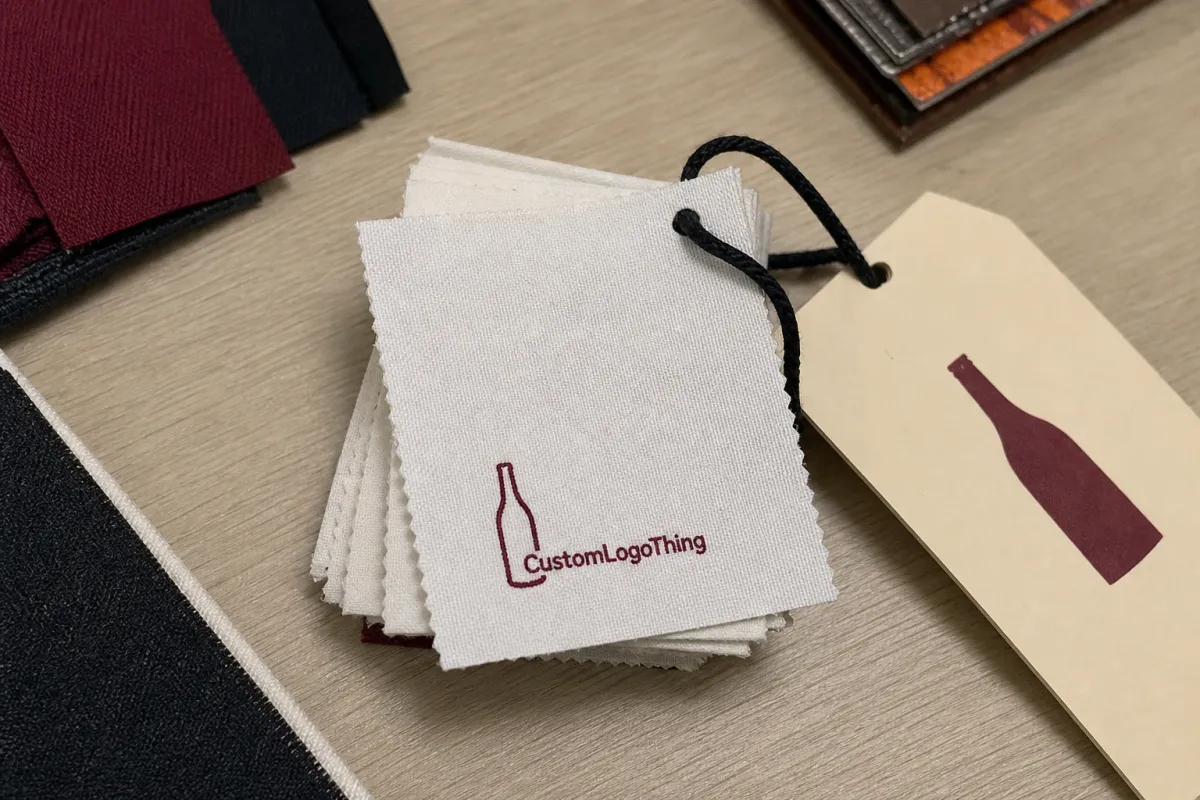
A wine shop can spend heavily on good bottles, tissue, kraft bags, tasting cards, staff labor, and polished counter presentation, then lose the effect with a label that curls, fades, or looks temporary. The object is tiny. The visual impact is not. Buyers searching for Woven Labels Unit Cost for wine shops are usually not shopping for decoration; they are trying to price a branded detail for wine totes, bottle sleeves, apron programs, club shipments, ribbon tags, and private-label merchandise.
That is the right lens. Woven labels are not merely clothing trims. They are compact brand assets with texture and durability. Compared with a paper sticker, they signal that the item was built to last, even if the item itself is just a canvas tote carrying two bottles and a receipt.
Used well, they fit bottle-neck ribbons, tasting kits, reusable gift bags, staff aprons, picnic blankets, corkscrew pouches, and club welcome items. Used badly, they can look like a brand trying too hard. A woven label on a waxed canvas carrier feels deliberate. The same label on every disposable insert just creates clutter.
They also outperform plain printed stickers in a few predictable ways. They do not smear. They do not wrinkle as easily. They do not read as an afterthought. That matters in a shop where presentation is part of the upsell and not just a wrapper around the product.
Still, these are not the cheapest branding pieces at very low quantities. If the need is 25 labels for one tasting event, a printed tag or sticker is usually smarter. Woven labels start to make economic sense when the artwork stays stable and the quantity is high enough to spread setup cost across many pieces. Most useful orders begin around 500 pieces, with better per-piece pricing at 1,000, 2,500, and 5,000.
The useful question is not “Can we add a woven label?” It is “Where does the label earn its keep?” That answer is usually on reusable goods, premium packaging, and repeated seasonal programs.
Where Wine Shops Use Woven Labels Without Overdoing It
The best woven label programs are selective. A label on everything looks nervous. A label on the right touchpoints looks intentional.
Wine shops usually get the strongest return from woven labels in these uses:
- Neck ribbon labels for premium gift bottles and club shipments.
- Canvas wine totes, especially one-bottle, two-bottle, and six-bottle carriers.
- Fabric bottle sleeves used for corporate gifting or bundled sets.
- Staff aprons for tastings, checkout, classes, and events.
- Picnic blankets, accessory pouches, tasting mats, and similar merchandise.
- Wine club gift items, including reusable bags and seasonal inserts.
- Event badges or fabric tags for private tastings and release parties.
Functional branding and decorative branding are different jobs. Functional labels identify the shop, club tier, collection, or collaboration. Decorative labels add a tactile premium cue to packaging. Both are useful. Mixing them without a plan usually produces visual noise.
Customer perception is doing quiet work here. A woven label tells the buyer the item was considered, not improvised. That matters if the tote is sold for $18, bundled with two bottles at $75, or used as a loyalty gift for a high-spend customer. Small items carry big signals.
There are also poor fits. Woven labels are usually not ideal for direct adhesion to wet bottles, ice bucket use, one-night promotions, variable vintage data, lot numbers, barcodes, or compliance details. For those, printed paper, film, belly bands, or hang tags are more practical and easier to change.
The smartest programs pair woven labels with the rest of the package rather than treating them as standalone decoration. A clean system may include printed wine bags, foil-stamped gift boxes, ribbon, kraft inserts, and custom hang tags. If the project needs those adjacent pieces, the Custom Labels & Tags category is a sensible starting point.
A practical buyer rule: if one woven label can work across aprons, totes, and gift packaging, order that version first. Do not invent five near-identical versions before demand is proven. Unused inventory is just future clutter in a carton.
Label Construction Choices That Change the Final Result
Construction drives look, feel, and cost per piece. The three most common woven label constructions are damask, satin, and taffeta.
Damask woven labels are usually the safest default for wine shops. They handle fine detail better, feel smoother, and work well with crests, serif typography, narrow borders, and small location text. Fine wine branding often leans on tiny elements. Looms, less so. That is why damask is so often the sensible middle ground.
Satin woven labels have a shinier surface and a dressier finish. They can look elegant on gift packaging and premium apparel, but the sheen can weaken readability if the logo already has low contrast. A satin label can look expensive and still fail the basic test: can someone read it from arm’s length?
Taffeta woven labels are generally more economical and a bit more textured. They suit simple marks, basic staff apparel, and lower-cost merchandise. They are not ideal for ornate wine-shop logos with fine scrollwork or delicate type.
Format matters almost as much as weave. Common options include flat labels, center-fold labels, end-fold labels, loop-fold labels, Manhattan fold labels, and custom cut shapes. Flat labels work for patches, gift tags, and ribbon accents. Center-fold labels insert neatly into seams. End-fold labels give a clean face for sewing onto totes or aprons. Loop-fold labels are useful for side seams. Manhattan folds look more finished and premium, though they usually add cost and are not necessary for every order.
Edges matter too. Heat-cut edges are common for flat labels. Woven edges feel softer and more finished. Folded edges are better for sewn applications because the raw edge is hidden. These are small choices, but they shift the overall finish and sometimes the price more than buyers expect.
Attachment options include sew-on, iron-on adhesive, pressure-sensitive adhesive, safety pin backing, or no backing for later assembly. Sew-on is the best choice for totes, aprons, blankets, and sleeves. Iron-on can work for simple fabric applications, but the fabric still has to tolerate heat. Adhesive woven labels are convenient for packaging inserts or temporary display use, yet they are not magic. Curved glass, condensation, textured kraft stock, and chilled bottles all change the equation.
Practical rule: woven labels are made from threads, not ink. Gradients, tiny script, photographic vineyard art, and ultra-thin lines often need simplification before production.
A dependable wine-shop setup is usually a damask woven label, 2 to 4 thread colors, medium density, and a flat or folded format. That combination keeps the label premium without turning the order into a technical argument.
Size, Color, Fold, and Attachment Specifications to Decide
Before asking for pricing, gather the boring details. Boring details save money. They also keep the quote from coming back with seven clarification questions and a revised timeline.
- Label size, measured width by height.
- Fold style: flat, center fold, end fold, loop fold, or Manhattan fold.
- Base color and thread colors.
- Quantity target and any tiered quantity breaks.
- Backing: none, sew-on, iron-on, adhesive, or pin.
- Intended item: tote, apron, sleeve, ribbon, gift box, or accessory.
- Handling conditions and packaging use.
- Shipping location and deadline.
Common sizes are fairly consistent. Small side labels often run around 0.5 x 1.5 inches. Standard brand labels are often around 1 x 2 inches. Larger gift or merchandise labels often sit near 1.5 x 3 inches. Bottle sleeves, fabric tags, and premium gift wraps may need custom dimensions.
Smaller labels are less expensive and feel discreet, but they reduce logo readability. Larger labels can carry more brand information, but they may look bulky on elegant packaging. Bigger is not automatically better. It is just bigger.
Color count should stay controlled. Most woven labels work best with 2 to 6 thread colors. More colors can increase complexity and sometimes cost. Thread matching is also different from ink matching. A burgundy thread on a black apron and the same thread on a cream tote will not read the same way. That is not a defect. It is textile reality.
Fold selection depends on the application. Center fold works for seam insertion. End fold creates a clean sewn face. Loop fold is useful for side-seam branding. Straight cut works for patches, ribbons, and gift tags. Manhattan fold gives a premium finished look, but it is not required unless the item will sit in a high-visibility retail setting.
Test against the actual surface. Natural canvas, black apron fabric, kraft gift boxes, satin ribbon, and insulated wine bags all affect contrast. A cream label can look elegant on black cotton and nearly disappear on natural canvas. A label that looks crisp on screen may look too small or too pale in the real room. Printing habits train people to expect exactness that woven thread cannot deliver.
Woven Labels Unit Cost for Wine Shops: What You Actually Pay
The honest answer is simple: Woven Labels Unit Cost for wine shops depends on quantity, size, weave type, thread count, number of colors, fold style, backing, edge finish, artwork complexity, sampling needs, and shipping method. Anyone quoting one number without specs is guessing.
For planning, these ranges are useful:
- Simple small woven labels: about $0.08 to $0.25 each at higher quantities.
- Mid-size damask labels: often around $0.18 to $0.55 each, depending on size, color count, fold, and quantity.
- Complex, larger, folded, adhesive, or low-volume labels: roughly $0.60 to $1.50+ each.
These are planning numbers, not a binding quote. Final pricing still depends on artwork, size, material, quantity, fold style, backing, and delivery requirements. Shipping can matter more than buyers expect, especially if the event date is close and air freight enters the picture.
MOQ often starts around 500 pieces for basic woven labels, though exact minimums depend on construction and production setup. Better unit pricing usually appears at 1,000, 2,500, 5,000, and 10,000 pieces. Small runs may be possible, but the unit price will not be shy about it.
Setup charges, tooling fees, artwork conversion, or sample fees can appear depending on the order. Those costs hit harder on small runs because they are spread over fewer pieces. A $60 setup charge on 500 labels adds $0.12 per label before production cost. On 5,000 labels, it adds $0.012. Same fee. Different math. Different mood.
| Order Type | Typical Quantity | Planning Cost Per Piece | Good Fit |
|---|---|---|---|
| Basic small label | 2,500 to 10,000 | $0.08 to $0.25 | Simple totes, basic staff apparel, low-detail logos |
| Standard damask brand label | 1,000 to 5,000 | $0.18 to $0.55 | Wine totes, aprons, sleeves, club gifts |
| Premium folded or adhesive label | 500 to 2,500 | $0.60 to $1.50+ | Luxury gift sets, special collaborations, retail merchandise |
The smartest wine shop strategy is often one versatile woven label that works across totes, aprons, and gift packaging. That spreads setup cost and simplifies reorders. It also reduces the chance that the shop ends up with three nearly identical label versions and no clear reason to use any of them.
Lowering price without making the label look cheap usually comes down to a few disciplined choices: reduce the size slightly, use fewer thread colors, skip adhesive backing unless it is necessary, keep one fold style, approve artwork cleanly, and order enough to cover more than one campaign. The cheapest label is not always the best buy. If it frays, blurs fine type, or feels scratchy, the savings vanish fast.
Production Steps, Proofing, and Lead Time Before You Order
A clean woven label order follows a familiar path. Submit artwork and specs. Confirm the intended application. Receive a quote. Approve the digital proof. Approve a physical sample if needed. Start bulk production. Complete quality checks. Pack and ship.
Artwork review is where practical decisions happen. The manufacturer checks whether the logo details, text size, border thickness, and color count will weave cleanly. If the logo includes a vineyard illustration with dozens of fine lines and a tiny script tagline, some simplification is almost inevitable. That is better than discovering after production that the design turned into thread noise.
Proofing usually comes in two forms. A digital proof confirms layout, dimensions, fold markings, and color placement. A physical sample confirms hand feel, thread clarity, backing performance, edge finish, and real-world appearance. For premium merchandise, new brand launches, or high-visibility gift sets, a physical sample is often worth the extra time.
Typical timing looks like this:
- Quote: 1 to 2 business days when specs are clear.
- Digital proof: 1 to 3 business days.
- Physical sample: 5 to 10 business days.
- Bulk production: 10 to 20 business days after approval.
- Shipping: depends on destination, service level, and customs if applicable.
Rush production may be available, but it can limit customization, increase cost, or reduce sampling time. A holiday deadline is not a manufacturing shortcut. Planning matters for wine club shipments, tasting events, seasonal merchandising, employee uniform updates, and year-end gifting.
Approval responsibility matters too. Production starts after proof or sample approval. Late artwork changes reset the clock and can add cost. If several people need to sign off, get them in the loop before the proof stage. Very few orders are slowed by the factory. Most are slowed by indecision.
Build a buffer. Order extra labels for damaged goods, last-minute gift sets, staff replacements, and unplanned promotional use. A 5% to 10% overage is sensible for active merchandising and gifting programs.
For shipping durability and handling, broader packaging tests such as ISTA procedures can be useful in larger fulfillment programs. For paper pieces used alongside woven labels, FSC-certified materials aligned with FSC standards may support more responsible sourcing claims.
How Custom Logo Things Keeps the Quote Practical
Custom Logo Things keeps the conversation grounded in usable specs, not vague luxury language. Wine shops need numbers, timelines, and labels that fit the product. “Premium feel” is pleasant. A clear unit cost, MOQ, sample plan, and production schedule are better.
The quoting process starts with the logo, intended use, budget target, event date, and packaging system. From there, the recommendation can be narrowed down: damask or satin, flat or folded, sew-on or adhesive, 1 x 2 inches or larger, 1,000 pieces or 2,500 pieces. Practical decisions. Not mood board theater.
Manufacturing options include woven labels for apparel and fabric goods, packaging labels, gift presentation pieces, wine totes, bottle sleeves, aprons, and branded accessory programs. If the project also needs stickers, printed tags, or related branded pieces, review Custom Labels & Tags so the woven label fits into the broader packaging system instead of competing with it.
A practical quote should show unit cost by quantity tier, visible tradeoffs, setup charges or sample fees if applicable, and ways to reduce cost without making the label look cheap. For instance, moving from 500 to 1,000 pieces may drop the unit cost enough to justify holding inventory. Or it may not, if the shop only uses 200 labels a year. That depends on storage, cash flow, and campaign frequency.
Artwork support matters. Fine details may need simplification. Contrast may need adjustment. Thread colors should be selected from real thread libraries, not screen colors that vanish in production. Minimum text size should be checked before production begins. That prevents the usual disappointment of elegant branding turning into unreadable thread soup.
Quality control should include dimensions, folds, edge finish, color consistency, backing performance, and pack accuracy before shipment. For reorders, approved specs make the process faster and easier. That is useful for seasonal wine clubs, holiday packaging, employee uniforms, recurring merchandise, and collaboration launches.
The point is not to push every option. It is to choose the label that fits the use case, budget, and brand positioning. Sometimes that means a premium folded damask label. Sometimes it means a simple flat label and a better hang tag.
Next Steps to Get a Clean Quote and Avoid Rework
Before contacting sales, gather the details that actually drive price. Upload vector artwork if possible, such as AI, EPS, SVG, or a clean PDF. Share the desired label size. Choose a likely fold style. List the product or packaging surface. Estimate quantity. Provide the deadline. Note whether a physical sample is required.
Photos help more than most buyers expect. Send the apron seam, canvas tote corner, gift box ribbon, bottle sleeve, staff uniform, or packaging insert that will receive the label. A photo reduces wrong assumptions and speeds up quoting. It also reveals scale problems early. A 1.5 x 3 inch label may look ideal on a tote and absurd on a narrow neck ribbon.
Ask for three quantity tiers. Good comparison sets are 500, 1,000, and 2,500 pieces or 1,000, 2,500, and 5,000 pieces. That makes the pricing break visible and helps decide whether inventory makes sense. If the shop runs quarterly gift campaigns, the larger tier may pay off. If the label is for a one-time collaboration, it may not.
Do not request pricing with only a logo and the phrase “standard size.” Standard to whom? A wine tote and a bottle-neck ribbon are different problems.
Define the label’s job before choosing specs. Is it for premium retail merchandise, staff identification, gift packaging, wine club branding, or an event giveaway? The job determines the weave, size, fold, attachment, and acceptable price range.
Order a physical sample for premium merchandise, new launches, or high-visibility gift sets. For a basic reorder with approved specs, a digital proof may be enough. If durability matters, especially for reusable goods, consider how the item will be cleaned, handled, and stored. Woven labels are durable, but application method still decides how well they hold up.
Custom Logo Things can quote woven labels, printed labels, tags, and related branded packaging together so the final presentation feels deliberate instead of pieced together. Start with the Custom Labels & Tags options if more than one branding component is involved.
When buyers compare Woven Labels Unit Cost for wine shops against actual specs, they get faster quotes, fewer surprises, and labels that fit the product. That is the real advantage. Pretty labels are nice. Correct labels are better.
FAQs
What is the typical woven label unit cost for wine shops?
Basic small woven labels may range from about $0.08 to $0.25 each at higher quantities. Mid-size damask labels often fall around $0.18 to $0.55 each, depending on size, color count, fold, and quantity. Low-volume, oversized, adhesive-backed, or complex labels can reach $0.60 to $1.50+ each. Final pricing depends on artwork, size, quantity, fold style, backing, and delivery requirements.
What MOQ should a wine shop expect for custom woven labels?
Many woven label projects start around 500 pieces, though exact MOQ depends on construction and production setup. Better unit pricing usually appears at 1,000, 2,500, 5,000, and 10,000 pieces. If the same label can be used on totes, aprons, and gift packaging, a higher quantity often makes more sense financially.
Can woven labels be used directly on wine bottles?
Usually not. Woven labels are not the best choice for direct bottle adhesion, especially on curved glass or chilled bottles with condensation. They work better on neck ribbons, fabric bottle sleeves, wine totes, gift packaging, aprons, and merchandise. For bottle glass, printed paper, film, or textured adhesive labels are usually more practical.
How long does production take for woven labels for wine shops?
Quoting usually takes 1 to 2 business days when specs are complete. Digital proofing often takes 1 to 3 business days. Physical samples may take 5 to 10 business days. Bulk production commonly takes 10 to 20 business days after approval, plus shipping time.
How can wine shops lower custom woven label pricing without making them look cheap?
Use one versatile label design across multiple products instead of several small runs. Keep the size practical, often around 1 x 2 inches for many merchandise uses. Limit thread colors to the ones that matter most for brand recognition. Avoid adhesive backing unless it is truly needed. Order at meaningful quantity breaks such as 1,000 or 2,500 pieces when storage and usage allow.