Buyer Fit Snapshot
| Best fit | Compostable Packaging Supplier for projects where brand print, material claims, artwork control, MOQ, and repeat-order consistency need to be specified before quoting. |
|---|---|
| Quote inputs | Share finished size, material target, print colors, finish, packing count, annual reorder estimate, ship-to region, and any compliance wording. |
| Proofing check | Approve dieline scale, logo placement, barcode or warning zones, color tolerance, closure strength, and carton packing before bulk production. |
| Main risk | Vague material claims, crowded artwork, missing packing details, or unclear freight terms can make a low unit price expensive after revisions. |
Fast answer: Compostable Packaging Supplier for: Material, Print, Proofing, and Reorder Risk should be specified like a repeatable production item. The safest quote records material, print method, finish, artwork proof, packing count, and reorder notes in one written spec.
Production checks before approval
Compare the actual filled-product size with the drawing, then confirm tolerance on folds, seals, hang holes, label areas, and retail display edges. Reserve space for logos, QR codes, warning copy, and material claims before decorative graphics fill the panel.
Quote comparison points
Review material grade, print process, finish, sampling route, tooling charges, carton quantity, and freight assumptions side by side. A quote is only useful when the supplier can repeat the same color, closure quality, and packing count on the next order.
Quick reality check: a compostable packaging supplier guide only helps if it keeps pretty claims from collapsing on a filling line, in a warehouse, or after the first customer complaint. Marketing can make almost anything sound clean. Production still has to seal it, print it, ship it, and defend the claim without turning into a fog machine. If you are buying branded packaging or eco-friendly packaging for a real launch, the boring details matter more than the buzzwords. They usually do.
Brands that also need matching retail packaging or Custom Packaging Products run into the same problem. The supplier has to support the structure, the artwork, and the disposal claim. A pretty sample is nice. It is not the job.
Compostable Packaging Supplier Guide: What It Really Covers
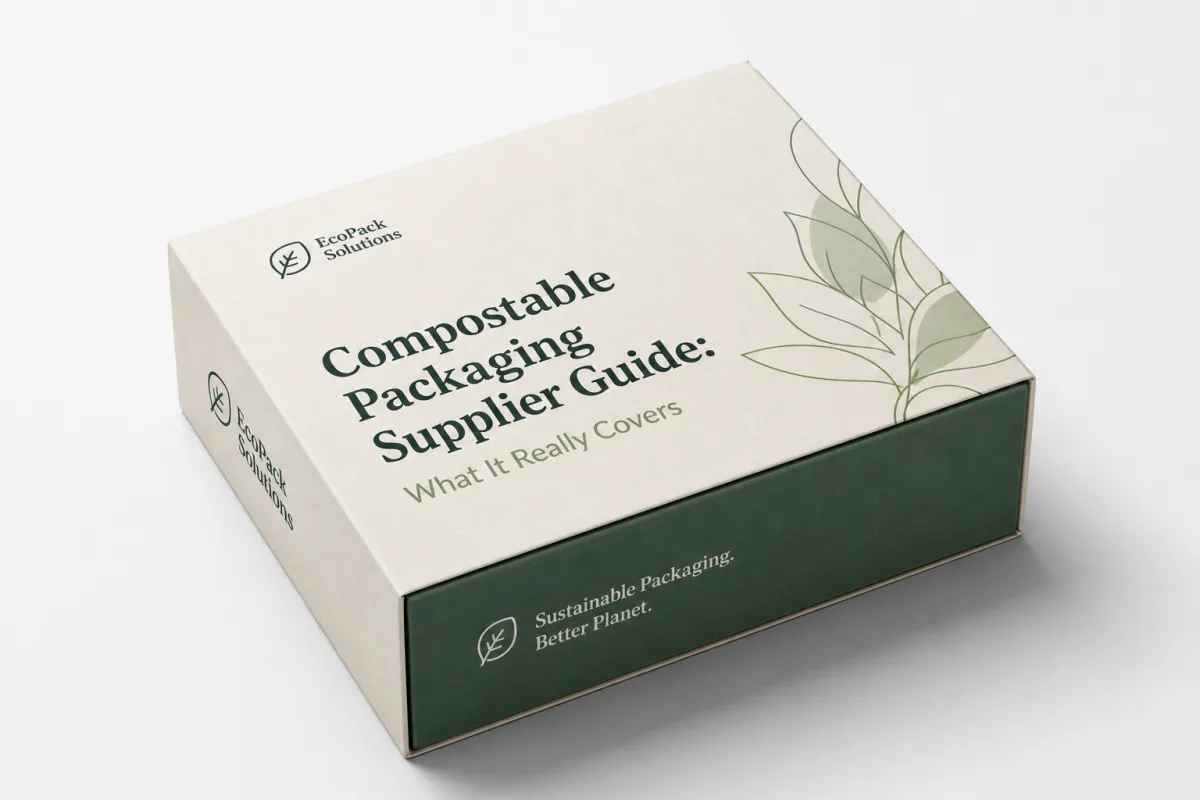
A compostable packaging supplier guide starts with the part people skip: most packaging labeled compostable only works if the material, the converting process, and the disposal pathway all fit together. Break one piece and the claim gets shaky fast. A pouch can look perfect on a desk and still be wrong for product packaging because the barrier layer, adhesive, or seal window does not match the real use case.
So what does a compostable packaging supplier actually sell? Usually some mix of certified films, mailers, labels, or containers, plus the paperwork that keeps the claim from becoming wishful thinking. That sounds tidy. The buying process is not. A supplier should be able to tell you whether the material is compostable under ASTM D6400, ASTM D6868, EN 13432, or another recognized standard, then explain what that means for your product, not just for their brochure.
The gap between a material claim and a system claim is where buyers get burned. A film can be compostable as a raw substrate, then lose the claim once it is laminated, inked, heat sealed, or paired with the wrong liner. That is why a compostable packaging supplier guide has to cover structure, print, and end of life together. Otherwise you are buying a promise, not packaging.
For branded packaging, the claim and the construction have to match. If the package is for retail packaging, appearance is only one slice of the job. Shelf life, scuff resistance, and seal reliability matter just as much. Too many buyers fall for the mockup and forget the real work: protect the product, support package branding, and avoid a compliance mess later.
Here is the frame that makes sense: the right supplier is not just a printer or a converter. It is a technical partner who can match product needs, compliance needs, and disposal goals. If they cannot explain the material stack, the test standard, and the likely failure points in plain language, that is not a compostable packaging supplier guide worth trusting. That is sales copy with a greener outfit.
If the supplier cannot prove the material, the conversion method, and the disposal route, the compostable claim is just expensive optimism.
How Compostable Packaging Works on a Real Line
A compostable packaging supplier guide only becomes useful once you follow the production path from resin or fiber to finished package. Compostable materials do not behave like conventional plastic in every step. Some run hotter. Some need a tighter sealing window. Some are stiffer and crack differently when folded or creased. That matters whether you are buying Custom Printed Boxes, labels, mailers, or flexible pouches.
Sealing usually changes first. Many compostable films need tighter control around dwell time, pressure, and temperature. If your conventional line is tuned to a wide sealing window, a compostable structure may force a reset. A supplier who knows the territory will talk about sealing range, not vague confidence. That is the difference between a launch plan and a guess with a purchase order attached.
Barrier performance is next. Compostable substrates handle moisture and oxygen differently depending on whether the barrier is fiber-based, PLA-based, cellulose-based, or a multilayer blend built for industrial composting. Dry, shelf-stable products give you more room. Oily, aromatic, or humidity-sensitive goods do not. A compostable packaging supplier guide should make that tradeoff easy to see. No package is magic. Some just fail politely.
Print methods, adhesives, inks, and coatings matter just as much as the base material. One bad component can kill the claim or weaken performance enough to trigger returns. Water-based inks may fit better in some builds. Pressure-sensitive adhesives may need special selection. Coatings can improve grease resistance, then complicate compostability if the chemistry is off. If your supplier cannot walk through the stack layer by layer, keep looking. A polished sample is not a specification.
Storage and handling are not side notes. They are part of the real test. Moisture, temperature swings, and long dwell times can change performance before the package ever reaches a customer. I usually tell buyers to store compostable packaging cool, dry, and away from direct sunlight, with relative humidity kept under 60% where possible. That does not solve every problem, but it prevents a lot of curl, blocking, and weak seals. The EPA composting guidance also serves as a useful reminder that compostability depends on the full disposal environment, not a marketing wish.
Compostable does not mean indestructible. It means the package is built for a specific product, a specific process, and a defined end-of-life pathway. That is why a compostable packaging supplier guide should cover transit, filling, storage, and customer handling together. If the supplier only talks about feel and print quality, they are skipping the hard part.
Compostable Packaging Supplier Guide: Pricing and Cost Drivers
Pricing is where a compostable packaging supplier guide earns its keep. Buyers often ask for a single unit price and expect a neat answer. Reality does not care. Material type, minimum order quantity, tool requirements, print complexity, barrier needs, and certification or testing costs all move the number. If the quote looks too tidy, something is probably missing.
As a rough buying range, simple compostable mailers or flat bags in mid-volume runs can land around $0.18-$0.40 per unit at 5,000 pieces, depending on print coverage and thickness. Custom compostable pouches with stronger barrier performance often move into the $0.35-$0.95 range. Molded fiber trays or rigid fiber containers can sit anywhere from $0.45-$1.20 or more, especially if the geometry is custom. These are not random numbers. They are the ranges buyers actually run into before freight, testing, and rework get added.
Order volume shifts the unit price fast. A 1,000-piece pilot can look expensive because setup, proofing, and conversion time are spread over fewer units. At 10,000 or 25,000 pieces, the price usually improves, sometimes sharply. That is why a compostable packaging supplier guide should warn you not to compare a short-run quote to a larger-run quote as if they are the same job. They are not. The math is not generous, and it should not be.
Here are the common price traps: vague quotes that exclude freight, hidden plate or cylinder charges, sample fees that do not get credited later, and expensive rework when the spec was never locked down. If the supplier says the price is "estimated" and refuses to say what is excluded, assume they are leaving room for surprises. There are usually surprises.
| Packaging Option | Typical MOQ | Indicative Unit Price | Typical Lead Time | Best Fit |
|---|---|---|---|---|
| Stock compostable mailer with light print | 1,000-5,000 | $0.18-$0.35 | 2-4 weeks | E-commerce, low-complexity branded packaging |
| Custom compostable pouch with moderate barrier | 5,000-20,000 | $0.35-$0.95 | 4-8 weeks | Retail packaging, dry goods, launch programs |
| Molded fiber tray or clamshell | 5,000-25,000 | $0.45-$1.20+ | 6-10 weeks | Food service, protective product packaging |
| Certified custom structure with special coatings | 10,000+ | $0.60-$1.50+ | 8-12 weeks | High-spec launches and compliance-sensitive programs |
To compare quotes properly, use the same format every time. Ask for material spec, thickness or basis weight, decoration method, MOQ, setup cost, freight terms, sample policy, testing included or not, and the exact claim language the supplier is willing to support. That is how a compostable packaging supplier guide keeps you from comparing apples to oranges and calling it procurement.
If you are also balancing packaging design against margin, ask the supplier where simplification is possible. One fewer layer, one less ink pass, or a less aggressive barrier can shave meaningful cost without wrecking performance. A smart quote is not the cheapest quote. It is the one that leaves the fewest open questions.
Compostable Packaging Supplier Guide: Step-by-Step Supplier Vetting
A compostable packaging supplier guide should push you to vet the supplier before you fall in love with samples. Start with a needs checklist. Write down product type, shelf life, fill method, storage conditions, branding needs, and the disposal target. If you are not clear about whether the package is meant for industrial composting only or something broader, the supplier cannot give you a useful recommendation. That sounds obvious. It still gets skipped.
Ask for proof before you ask for samples. Certifications, test reports, material specifications, and examples of similar applications should come first. If the supplier cannot produce documentation for the film, adhesive, ink, or coating, they are asking you to trust a label without the engineering behind it. That is not a serious buying process. A real compostable packaging supplier guide makes documentation the entry ticket, not an afterthought.
Test the conversation itself. Can they talk about seal initiation temperature, barrier tradeoffs, print compatibility, and machine performance? Or do they just forward PDFs and hope the problem goes away? The best suppliers know where the limits are. Better than that, they are willing to say, "This structure will work," or "No, this spec is not realistic." That honesty saves money. It also saves embarrassment.
Use outside standards as part of your vetting, not as decoration. If you need transit performance or shipping durability, the ISTA testing framework is a useful reference point. Packaging that looks great in sample form can still fail in drop, vibration, or compression. That is one reason I tell buyers to request a sample test plan that covers fit, seal strength, transit damage, and real use conditions, not just a photo-ready pouch on a desk.
Score suppliers on three simple things: responsiveness, transparency, and willingness to push back on unrealistic requests. Fast replies are nice. Clear replies are better. A supplier that says, "This compostable structure will not survive your hot-fill process," is doing you a favor. That is what a compostable packaging supplier guide should reward. Straight answers are worth more than cheerful nonsense.
Compostable Packaging Supplier Guide: Timeline From Sample to Shipment
Timing is where a compostable packaging supplier guide turns practical instead of theoretical. The normal path runs through discovery, spec review, sample development, testing, revisions, approval, and production. A simple stock-format order can move quickly. A custom structure with certification questions and artwork changes will take longer. That is not incompetence. That is manufacturing.
Here is a realistic timeline range. A stock compostable mailer or label program with clear artwork might move from brief to shipment in 2-4 weeks. A custom flexible pouch or molded fiber design often needs 4-8 weeks if the spec is straightforward and samples approve cleanly. More complex barrier structures, unusual sizes, or multi-step compliance reviews can stretch to 8-12 weeks or more. If someone promises faster without caveats, they are probably omitting a step. Usually the step that matters most.
Sample rounds are where schedules slip. Common delay points include unclear specs, artwork revisions, certification questions, and material substitutions. One change in the adhesive or coating can trigger a new sample. One changed dimension can affect the cutting tool. That is why a compostable packaging supplier guide should include a buffer round in the schedule. Build one revision cycle into the plan. It costs less than pretending the first sample will be perfect.
Lead time is not just manufacturing time. It also includes shipping, documentation review, and any internal approvals on the buyer side. If your organization takes five days to approve artwork and three days to review a quote, that is part of the lead time whether procurement likes it or not. Good suppliers will tell you the factory timeline and the total elapsed timeline. Better ones will separate them clearly. That kind of clarity is one reason I value suppliers who understand product packaging beyond the press room.
If your launch date is fixed, lock the spec early. Do not chase the last percentage point of cost if it means changing the structure a week before production. A compostable packaging supplier guide should protect the launch before it tries to squeeze every dollar. There is always another chance to improve the packaging. There is not always another chance to hit the release date.
Common Compostable Packaging Mistakes Buyers Make
A compostable packaging supplier guide is also a mistake list, because the same errors show up over and over. The first mistake is assuming all compostable materials are interchangeable. They are not. One material may seal well and look beautiful but fail under humidity. Another may pass disposal criteria but perform poorly in a high-speed line. The wrong choice can fail in sealing, strength, or appearance.
The second mistake is buying on price only. That sounds disciplined. Usually it is not. If you ignore certifications, you can end up paying twice: once for the initial order and again for rework when the claims need to be corrected. A cheaper sample can become very expensive when compliance, artwork, and customer trust are on the line. That is why a compostable packaging supplier guide should treat documentation as part of the cost, not a free bonus.
The third mistake is skipping real-world testing. A nice sample on a table is not the same thing as production speeds, freight vibration, warehouse stacking, or humid storage. If the package is going into retail packaging, customers will also handle it roughly and ignore any polite instructions. Test under actual use conditions, not showroom conditions. The sample should earn its place on the shelf.
The fourth mistake is writing vague RFQs. If the spec is fuzzy, the quote will be fuzzy too, usually in the seller's favor. Say what the product is, how it fills, what shelf life you need, what the disposal goal is, and what artwork coverage you expect. A strong compostable packaging supplier guide puts this boring detail front and center. Boring details are how you stop buying problems.
The fifth mistake is forgetting disposal reality. If your target market has no practical composting access, the claim needs scrutiny. A compostable package that ends up in regular trash is not the same as a package that reaches a facility designed for the material. If your supplier cannot explain the disposal pathway clearly, the carbon footprint story may be weaker than the marketing deck suggests.
Expert Tips for Choosing the Right Supplier
A good compostable packaging supplier guide should make one thing obvious: the best supplier is rarely the one with the loudest sustainability pitch. It is the one who explains tradeoffs plainly. Good partners tell you what will work, what will not, and what the compromise costs. That kind of candor saves budgets, timelines, and pride.
Look for packaging experience in your category. Food, retail, and e-commerce all have different failure points. Food needs barrier and compliance discipline. Retail Packaging Needs shelf presence and print durability. E-commerce needs drop resistance and shipping stability. A supplier who understands your category will ask better questions before sending a quote. They will also know whether compostable packaging, a fiber tray, or a different structure is the smarter fit for the job.
Push for documentation on every critical component. That means inks, adhesives, coatings, and any third-party certifications. If the supplier cannot trace those parts, the compostability claim becomes fragile. Ask for the material stack-up in writing. Ask what changes would void the claim. Ask what the package is tested against. A compostable packaging supplier guide that leaves those questions out is incomplete on purpose, and that should bother you.
Use pilot orders on new programs. A pilot of 3,000 to 10,000 units is often enough to expose weak spots without tying up too much cash. If the application is new, that pilot is cheap insurance. It also gives you a chance to check line performance, customer handling, and packaging design details before you commit to volume. If you need a starting point for broader packaging work, browse our Custom Packaging Products and compare how compostable options fit beside other formats.
Prefer suppliers who simplify the design when simplification helps. Fewer layers, fewer custom parts, and fewer unnecessary coatings usually mean fewer problems. That does not mean stripping the package down blindly. It means focusing on the structure that protects the product and supports the brand with the least amount of drama. That is the quiet, practical side of package branding that gets overlooked because it is not flashy.
Compostable Packaging Supplier Guide: Your Next Three Moves
If you want a compostable packaging supplier guide that actually moves a project forward, start with a one-page spec sheet. Include product dimensions, barrier needs, fill method, order volume, storage conditions, and disposal goal. If suppliers are quoting different assumptions, the numbers will be useless. Align the brief first. Then ask for pricing.
Next, shortlist two to four suppliers and ask each one for the same package of proof: certifications, samples, material Specs, Lead Time, and a written quote that separates tooling, freight, and unit price. A good compostable packaging supplier guide is not about collecting the most quotes. It is about getting comparable quotes. Without that, the lowest number is often just the least honest number.
Finally, test samples under real conditions. Run them through your fill process. Store them in your warehouse. Ship them. Inspect the seal, the print, the handling, and the customer-facing finish. Then compare performance, compliance support, and communication speed before you commit. That last part matters more than many buyers admit. A supplier can make a decent sample and still be a bad project partner. A calm, accurate, responsive supplier is usually worth more than a slightly cheaper one.
Decision rule: choose the supplier that can prove the claim, meet the timeline, and explain the tradeoffs without hand-waving. If you need compostable packaging for a launch, that is the standard. Not glossy language. Not a sustainability slogan. A real compostable packaging supplier guide should help you launch cleanly, legally, and on time.
How do I know if a compostable packaging supplier is legitimate?
Ask for third-party certifications, material specifications, and test reports instead of relying on marketing language. A legitimate supplier can explain seals, coatings, inks, and disposal conditions without dodging the question. They should also be able to show examples from similar applications and tell you where the limits are. If they cannot do that, the compostable packaging supplier guide answer is simple: keep shopping.
What is the difference between compostable, biodegradable, and recyclable packaging?
Compostable packaging breaks down under defined conditions and should leave no toxic residue within the claim standard. Biodegradable is much looser and can mean almost anything, which is why it is a weak buying term. Recyclable depends on local collection systems, not just the material itself. A compostable packaging supplier guide should push you to verify the actual disposal route, not the label alone.
How much does compostable packaging usually cost compared with standard packaging?
Expect a premium when you need certified materials, custom structures, or lower-volume runs. The biggest cost drivers are material choice, MOQ, printing complexity, and testing requirements. The real comparison should include failure risk, compliance work, and reprint costs, not just unit price. A cheap quote that breaks claims later is not cheap.
How long does it take to go from sample to production with a supplier?
Simple stock-format projects can move quickly if the spec is clear and artwork is ready. Custom structures usually need extra time for samples, testing, and revisions. The slowest step is often approval, not manufacturing, so lock decisions early. Any serious compostable packaging supplier guide should treat approvals as part of the schedule, because they are.
What should I ask for before placing an order with a compostable packaging supplier?
Ask for certifications, product specs, artwork requirements, lead time, and a written quote that separates tooling, freight, and unit price. Request sample units and test them in your real filling and shipping setup. Confirm what disposal claims are allowed in your target market before you print anything. That is the practical version of a compostable packaging supplier guide, and it is usually the difference between a clean launch and a messy one.
Bottom line: start with the product conditions, not the sustainability headline. If the supplier can prove the structure, support the claim, and survive your actual line test, you have something worth ordering. If they cannot, the package is not ready, no matter how nice the sample looks.


