Buyer Fit Snapshot
| Best fit | Custom Reusable Packaging Wholesale for Brands That Ship projects where brand print, material claims, artwork control, MOQ, and repeat-order consistency need to be specified before quoting. |
|---|---|
| Quote inputs | Share finished size, material target, print colors, finish, packing count, annual reorder estimate, ship-to region, and any compliance wording. |
| Proofing check | Approve dieline scale, logo placement, barcode or warning zones, color tolerance, closure strength, and carton packing before bulk production. |
| Main risk | Vague material claims, crowded artwork, missing packing details, or unclear freight terms can make a low unit price expensive after revisions. |
Fast answer: Custom Reusable Packaging Wholesale for Brands That Ship should be specified like a repeatable production item. The safest quote records material, print method, finish, artwork proof, packing count, and reorder notes in one written spec.
Production checks before approval
Compare the actual filled-product size with the drawing, then confirm tolerance on folds, seals, hang holes, label areas, and retail display edges. Reserve space for logos, QR codes, warning copy, and material claims before decorative graphics fill the panel.
Quote comparison points
Review material grade, print process, finish, sampling route, tooling charges, carton quantity, and freight assumptions side by side. A quote is only useful when the supplier can repeat the same color, closure quality, and packing count on the next order.
Custom Reusable Packaging wholesale is not a branding flourish. It is a supply chain decision with consequences. A brand ships a fragile item in a flimsy mailer, the corners crush, the return goes sideways, and the customer remembers the damage long after they forget the product name. Swap that for a reusable box, pouch, or tote that can survive more than one trip, and the math gets a lot less wishful. That is the real case for custom reusable packaging wholesale: better protection, cleaner returns, stronger branded packaging, and a lower cost per use once the pack stays in circulation.
Most buyers start with price. Fair enough. Price matters. But the better question is how many trips the package can survive, how well it fits the product, and whether the custom reusable packaging wholesale order matches the shipping route instead of just looking nice in a mockup. Cheap-looking packaging usually turns into expensive packaging after replacements, damage claims, and emergency reorders. Packaging design should solve the transport problem first. Pretty comes second.
Why custom reusable packaging wholesale pays off fast
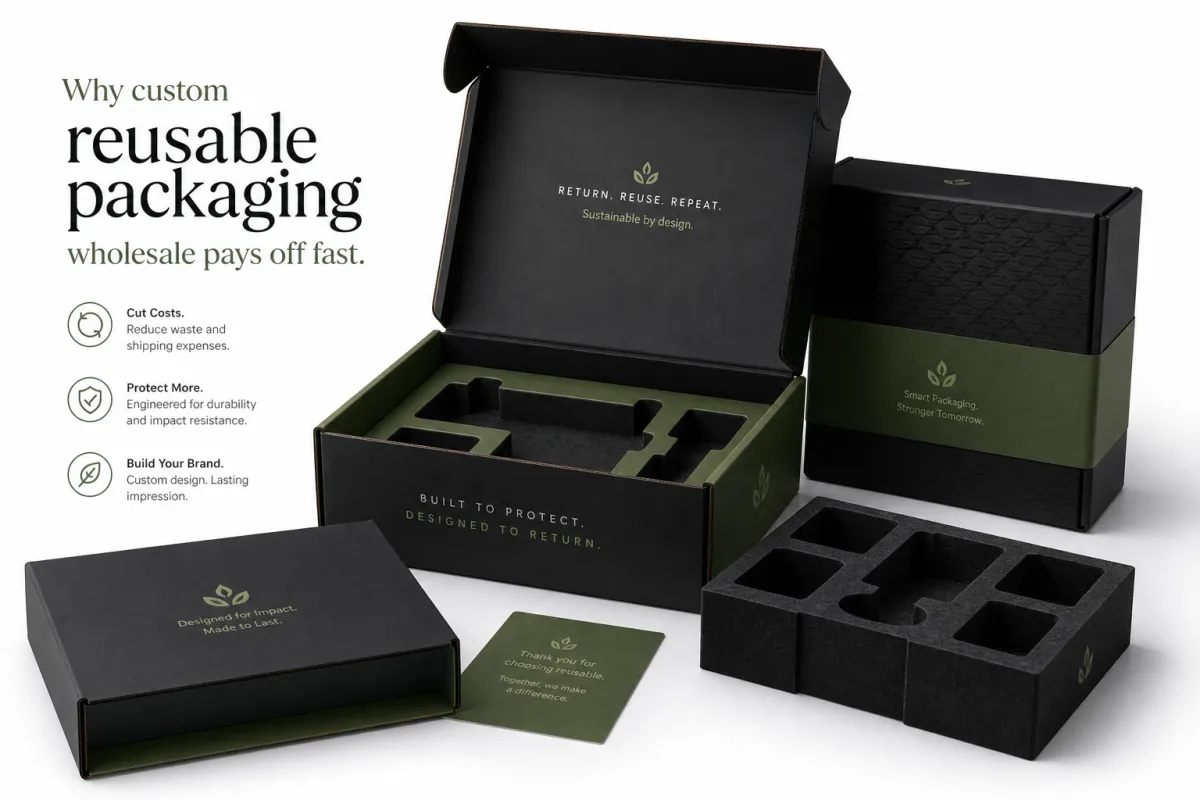
The logic is straightforward. Custom reusable packaging wholesale costs more up front, then gets cheaper every time the package is used again. That is why brands with subscriptions, returns, retail resale programs, event kits, or loyalty shipping keep moving toward reusable formats. One durable box that survives five or six uses can beat a pile of disposable packs that get crushed, replaced, and tossed after a single trip. The first invoice feels heavier. The total spend usually looks smarter.
Picture a fashion label sending apparel in a thin one-time mailer. The return process is messy, the mailer tears, and the customer ends up stuffing the item into whatever bag is nearby. Now switch to custom reusable packaging wholesale with a reinforced mailer or a foldable rigid box. Returns stay cleaner. The unboxing feels intentional. The package can travel back with the product or move into another use. That is not theory. That is what happens when the box has some backbone.
The value shows up in places buyers often miss:
- Return logistics: stronger closures and better structure reduce torn seams and bent corners.
- Subscription programs: repeat shipments justify durable package branding and a more premium open-close cycle.
- Retail resale: reusable packs hold shape on shelf and during back-of-house handling.
- Corporate gifting: the box becomes part of the gift instead of a throwaway shell.
- Event kits: gear can be stored, carried, and reused after the show.
That is why custom reusable packaging wholesale often beats disposable product packaging in categories where the package itself has work to do. A reusable pouch for accessories, a rigid presentation box for skincare, or a returnable mailer for a membership kit can keep carrying brand value long after the first delivery.
“The cheapest pack is rarely the cheapest pack after the third shipment.”
People get stuck on sustainability language and stop there. Waste reduction matters. So do lead times, damage rates, and protection specs. Custom reusable packaging wholesale works best when it protects the product, looks good enough to keep, and survives enough cycles to justify the spend. That is the actual brief. Everything else is window dressing.
For buyers comparing formats, lifetime cost matters more than one-off price. A reusable carton that ships flat, locks securely, and holds up through repeated use can outperform a stack of cheaper custom printed boxes that head straight to recycling after one trip. That is the part people ignore until damage claims show up and ruin the mood.
If you need a starting point for structure, browse the broader Custom Packaging Products lineup or check the Wholesale Programs page to see how volume pricing is typically organized.
What custom reusable packaging wholesale includes
Custom reusable packaging wholesale covers more than one format. The package should fit the use case, not the mood board. A reusable shipping box is not the same thing as a rigid gift box, and a drawstring pouch is not the same thing as a zippered travel case. If the product moves often, gets handled by different people, or needs to be stored between uses, the structure should reflect that reality.
Common formats include reusable shipping boxes, rigid presentation boxes, foldable totes, drawstring pouches, zippered bags, insulated carriers, and returnable mailers. Each one supports a different level of product packaging and a different amount of wear. A canvas tote can be a strong fit for retail packaging or member kits. A laminated pouch may work better for cosmetics, accessories, or sample sets. A rigid box still makes sense for premium gifting where the unboxing matters as much as the item inside.
Branding options are broad, but they should not be random. A strong custom reusable packaging wholesale order usually includes one or more of these:
- Spot color printing for clean logo placement.
- Full-wrap graphics for stronger branded packaging.
- Debossing or embossing for tactile finish.
- Woven labels or stitched tags for fabric packs.
- Inside printing for a better reveal.
- Molded or die-cut inserts for product fit.
That last part matters more than most buyers think. A reusable pack without proper inserts can still look good in a sample photo and fail in transit. If the product shifts, the package gets bruised, or the interior looks sloppy after opening, the whole packaging story falls apart. That is why packaging design needs protection built in, not just graphics pasted on top.
Custom sizing is another big decision. Standard sizes usually reduce tooling and speed up turnaround. Fully custom dimensions improve fit and can lower void fill, especially for odd-shaped products. For custom reusable packaging wholesale, the choice comes down to whether the package needs to fit a family of products or one exact item. If you are shipping a mixed kit, the tolerance matters. If you are shipping one SKU, fit can be much tighter.
Some buyers also need a pack that folds flat between uses. That is not a small detail. A returnable mailer or collapsible box that stacks well in a warehouse or retail back room saves space, and space is money. Nobody wants a beautiful pack that quietly burns budget by the pallet.
For reference, groups like the International Safe Transit Association are useful when you want to think seriously about shipment testing, drop resistance, and transit abuse. Nobody gets paid extra because a box only looked good on a desk.
Materials, construction, and specifications that matter
The material choice drives the lifespan, the feel, and the landed cost of custom reusable packaging wholesale. There is no single best option. There is only the right balance for the product, the route, and the reuse target. A pack that gets handled indoors only has different needs from one that travels across courier networks or gets wiped down after each return.
Common materials include recycled polypropylene, coated paperboard, kraft rigid board, recycled PET fabric, canvas, nylon, nonwoven polypropylene, and laminated textiles. Each one sits in a different durability band. Paper-based structures usually cost less and feel familiar, but they do not love repeated moisture or hard abrasion. Fabric-based options cost more up front, yet they hold up better under repeated use and cleaning. Custom reusable packaging wholesale should specify the surface, the core, and the closure as one system, not as separate guesses.
Here is a practical way to think about durability tiers:
- One to three uses: light reusable mailers, paper-based wraps, simple presentation boxes with moderate reinforcement.
- Four to eight uses: reinforced foldable boxes, coated boards, stitched pouches, or laminated wraps.
- Eight-plus uses: heavy-duty fabric carriers, rigid returnable systems, premium zippered bags, or structured totes with reinforced seams.
Spec sheets should be checked line by line before an order is approved. Ask for board thickness, GSM, seam strength, closure type, handle reinforcement, water resistance, stackability, print finish, and surface cleanability. Those are not boring details. They decide whether the pack keeps circulating or looks tired after a few handoffs. A glossy finish may photograph nicely, but a matte or coated surface often hides scuffs better. Practical beats pretty when the package actually ships.
Security also matters. Magnetic flaps, snaps, hook-and-loop closures, zippers, and drawstrings all create different use patterns. For custom reusable packaging wholesale, the closure should match the user behavior. If customers need to open and close the pack often, easy actuation matters. If the pack must stay closed in transit, closure strength matters more. The wrong closure creates complaints that no print finish can fix.
Compliance is another place where buyers should slow down. Food contact, moisture sensitivity, child-safe components, and load limits are real issues. If the packaging holds food, cosmetics, or anything that touches skin, confirm the material spec before approval. If the pack is reusable, cleaning instructions matter too. Not every material likes alcohol wipes, heat, or heavy scrubbing. That is not drama. That is surface chemistry.
For sourcing and sustainability context, the FSC site is a useful reference when you are comparing paper-based options and want a clearer view of certified fiber claims. Buyers should still ask for actual documentation, not just a nice line in a quote.
Another detail that saves money: if the format will move through a warehouse, choose stackable shapes and rounded edges where possible. Sharp corners scuff more. Puffy, unstable structures waste space. Custom reusable packaging wholesale should work in storage, not just on a white background.
How to choose the right reusable format for your product
Start with protection. Then fit. Then branding. If the pack cannot survive the shipping route, the design brief is upside down. That is the hard truth behind custom reusable packaging wholesale. The product has to arrive intact, and the packaging has to survive enough cycles to justify the spend.
Apparel usually works well with lighter reusable mailers, tote-style carriers, or foldable boxes. Cosmetics often need rigid packaging or a pouch with an insert to stop movement. Subscription kits can go either way depending on how often the pack is reused and whether the customer keeps the outer shell. Accessories may fit into drawstring pouches or zippered bags, while premium gift sets often need stronger structure and a more polished reveal. In each case, the pack should support the product, not fight it.
Closure choice changes the user experience more than people expect. Zippers feel secure and familiar. Snaps are quick. Magnetic flaps feel premium but can add cost. Hook-and-loop is practical and fast, though it can look less refined if the rest of the pack is high-end. Drawstrings are flexible and light. For custom reusable packaging wholesale, the right closure is the one customers will actually use multiple times without getting annoyed.
Branding should also follow the channel. E-commerce packaging can be more direct and functional. Retail packaging may need a stronger shelf presence and more refined custom printed boxes. Gift packaging can justify richer textures, deeper color coverage, and more layered presentation. Membership kits sit somewhere in the middle. The common mistake is overbuilding an e-commerce pack with expensive details that never get seen, or underbuilding a retail pack that has to fight louder competitors on shelf.
Use a decision framework that is simple enough to survive the meeting:
- Set the target reuse count.
- Estimate the shipping method and abuse level.
- Define the product weight and dimensions.
- Pick the material family.
- Choose the closure and insert system.
- Price the pack against per-use value, not sticker shock.
That framework keeps custom reusable packaging wholesale tied to business logic. It also keeps the conversation focused on product packaging performance, which is where it belongs. Fancy packaging design that fails in use is just expensive clutter.
Some brands also ask whether reusable should mean premium only. Not really. A practical reusable mailer for a subscription brand can be more useful than a heavy rigid box with nowhere to go after opening. A well-built tote can beat a brittle, overfinished box if the goal is repeated carrying and daily visibility. Right tool, right job. Shocking concept, I know.
Custom reusable packaging wholesale pricing, MOQ, and unit economics
Pricing for custom reusable packaging wholesale depends on material grade, print coverage, size, closure hardware, inserts, and whether the order needs custom tooling. That sounds obvious, but too many buyers compare two quotes that are not even the same animal. A basic nonwoven pouch and a rigid zippered box are both reusable packaging. They are not priced the same, and they should not be.
Expect the quote to include a few buckets: sample cost, setup or plate fees, unit price, freight, and any assembly or kitting service. If the order needs special stitching, reinforced handles, magnetic closures, or extra print passes, those costs show up somewhere. Better to see them in black and white than to discover them after the PO is already signed.
| Reusable format | Typical MOQ range | Estimated unit price range | Best use case |
|---|---|---|---|
| Nonwoven reusable mailer | 500 to 2,000 pieces | $0.80 to $2.20 | Light apparel, promo kits, simple returns |
| Reinforced foldable box | 1,000 to 3,000 pieces | $1.50 to $4.50 | Subscription packaging, retail kits, e-commerce gifts |
| Canvas or PET tote | 500 to 5,000 pieces | $1.20 to $5.00 | Retail packaging, events, brand merch, member kits |
| Zippered pouch | 1,000 to 5,000 pieces | $0.90 to $3.80 | Accessories, cosmetics, travel sets, samples |
| Rigid presentation box | 500 to 2,000 pieces | $2.50 to $9.00 | Premium gifting, luxury product packaging, long-life use |
Those ranges are not gospel. They move with size, decoration, and freight. Still, they give you a real-world frame for custom reusable packaging wholesale planning. If a supplier gives a price far outside the range, ask why. Maybe the print is heavy. Maybe the construction is overbuilt. Maybe the quote includes assembly or export packaging. Maybe it does not. Ask Before You guess.
The smarter way to compare is per use. Divide the landed unit cost by the expected reuse count. If a $4.00 pack lasts eight uses, the per-use cost is $0.50 before freight or handling adjustments. If a $1.00 disposable pack gets replaced every time, the math is not nearly as charming as it looked on the first quote. This is where custom reusable packaging wholesale starts to make sense for buyers who care about total spend, not just initial spend.
Here is the part that saves budgets: ask for tiered pricing, alternate materials, and shipping estimates before you approve the final quote. Good suppliers can often show a lower-cost surface finish, a different closure, or a standard size that trims tooling. That is how you build a cleaner landed cost. And yes, custom reusable packaging wholesale should always include freight in the real comparison. Otherwise the quote is fiction with better typography.
MOQ is tied to construction complexity. Simple stock-adjacent shapes usually allow lower minimums. Fully custom sizes, specialty hardware, and layered finishes usually push the threshold higher. If you are testing a new concept, a smaller first run can be the smart move. Just accept the higher per-unit price and use the sample round to confirm demand. If the item is already proven, larger runs bring the unit cost down. That is the tradeoff. No magic.
Also factor in storage. Buying a huge run of custom reusable packaging wholesale makes sense only if the warehouse can hold it and the launch plan can use it before it ages out of the season. Packaging inventory is still inventory. It takes space, and space costs money.
Order process, sampling, and production timeline
A clean custom reusable packaging wholesale project follows a predictable path: brief, concept review, dieline or template confirmation, artwork setup, sampling, revisions, production, quality check, and shipment. Skip a step and you usually pay for it later. Packaging projects do not like vague dimensions, and they definitely do not reward rushed approvals.
Sampling is non-negotiable if the pack needs to perform. A sample shows color shift, closure behavior, print alignment, weight, and hand feel. It also shows whether the product actually fits the way the spec sheet says it should. That matters for custom reusable packaging wholesale, because a reusable pack that is off by a few millimeters can become annoying every single time it is used. That is a polite way of saying: test before the big order.
Typical timing depends on structure and finish. Simple reusable packs can move faster. Custom rigid construction, specialty fabrics, and branded hardware add time. If a project includes extra stitching, custom inserts, or multiple print layers, build more time into the plan. Rushing the artwork stage is how a launch gets delayed by preventable mistakes. It is cheaper to wait for the right sample than to correct a thousand units after production.
The slowdowns usually come from a small set of issues:
- Missing or low-resolution artwork files.
- Unclear product dimensions.
- Too many revision rounds with different decision-makers.
- Special finishes that need extra setup.
- Late approval after the production slot is already reserved.
For custom reusable packaging wholesale, the best planning move is simple: gather product dimensions, target reuse count, preferred material, estimated quantity, and artwork files before asking for a quote. That shortens the back-and-forth and makes the quote more accurate. It also helps the supplier recommend a realistic spec instead of guessing.
Quality control should also be part of the schedule. A pack that ships flat but pops open the wrong way, a zipper that catches, or a print that shifts off-center can all be caught in sample review if somebody actually checks the sample. That sounds basic because it is basic. Basic still saves money.
One more practical point: if the launch date is fixed, reserve buffer for freight, customs, and warehouse intake. I have seen plenty of custom reusable packaging wholesale orders get approved on paper and arrive too close to the campaign because the schedule had no cushion. That is a planning problem, not a production miracle. Build in room.
Why choose us, and what to do next
Custom Logo Things is built around practical packaging decisions, not glossy nonsense. If you are sourcing custom reusable packaging wholesale, you want clear specs, honest lead times, and a team that can tell you which format fits your product instead of pushing the most expensive one. That is the point. Good wholesale support should make the order easier, not noisier.
What buyers usually care about most is consistency. The first sample has to match the bulk order closely. The material should feel right. The closure should work the same way across the run. The branding should look intentional, not slapped on at the last minute. That is true whether you are ordering custom reusable packaging wholesale for retail, gifting, subscriptions, or corporate programs.
These are the signals worth looking for in a supplier:
- Sample support before bulk approval.
- Artwork checks that catch obvious production problems.
- Material recommendations based on actual use, not just appearance.
- Pack formats that ship flat or nest efficiently.
- Reorder consistency when the program scales.
That is especially useful for custom printed boxes and branded packaging programs that need repeatability. A one-off can be forgiven. A reorder that shifts in color, fit, or finish usually cannot. Custom reusable packaging wholesale should support the brand long term, not just one launch photo.
If you are ready to move, start with the basics: product dimensions, desired lifespan, packaging design references, quantity target, and any functional requirements like moisture resistance or returnability. Then request a quote and ask for a sample recommendation. From there, the process is straightforward: spec review, sample approval, production sign-off, and a reorder plan if the pack performs the way it should.
Custom reusable packaging wholesale is a smart buy when the package keeps doing work after the first delivery. That is the whole game. Better protection, better repeat impressions, lower cost per use, and fewer headaches when the shipment route gets rough. If you want a packaging system that looks sharp and lasts through real use, start with the spec, not the slogan.
The cleanest next step is not “buy more packaging.” It is choosing the reuse count, the shipping route, and the material that can actually survive both. Once those three are set, the rest of the order gets a lot simpler, and a lot less expensive in the long run.
FAQs
What is the minimum order for custom reusable packaging wholesale?
MOQ depends on structure, material, and print method, but custom reusable packaging wholesale usually starts higher than basic mailers because the construction is more involved. Standard sizes and simpler branding tend to allow lower minimums. Fully custom shapes, hardware, and specialty finishes usually raise the threshold. Ask for tiered pricing so you can compare a test run against a larger first order without guessing at the economics.
Which materials work best for custom reusable packaging wholesale orders?
The best material depends on how many times the package will be reused, how heavy the product is, and whether the pack needs to resist moisture or scuffing. Rigid board, recycled PET fabric, nonwoven polypropylene, laminated textiles, and coated paper-based structures are common choices for different durability levels. If the packaging will be wiped down or returned often, choose a surface that cleans easily instead of one that only photographs well.
How do you price custom reusable packaging wholesale per use?
Divide the landed unit cost by the expected reuse count to get a realistic per-use number. Include freight, setup, inserts, and any assembly cost; leaving those out makes the packaging look cheaper than it is. This method usually makes custom reusable packaging wholesale look stronger over time than cheap single-use options that need constant replacement.
How long does custom reusable packaging wholesale take to produce?
Lead time depends on sampling, revisions, material availability, and order size; simple projects move faster than fully custom structures. Build in time for artwork approval and sample review because rushing those steps is how expensive mistakes happen. If your launch date is fixed, start with dimensions and files early so the production slot can be reserved before the schedule gets tight.
Can I get samples before placing a wholesale order?
Yes, and you should. Samples show the real feel, fit, print quality, and closure behavior before the full run is approved. Use the sample stage to test shipping, stacking, and repeated opening if the packaging is meant to survive more than one trip. A good sample saves money by catching spec issues before they become a warehouse-sized problem.

