Buyer Fit Snapshot
| Best fit | Compostable Pouch Packaging Manufacturer projects where brand print, material claims, artwork control, MOQ, and repeat-order consistency need to be specified before quoting. |
|---|---|
| Quote inputs | Share finished size, material target, print colors, finish, packing count, annual reorder estimate, ship-to region, and any compliance wording. |
| Proofing check | Approve dieline scale, logo placement, barcode or warning zones, color tolerance, closure strength, and carton packing before bulk production. |
| Main risk | Vague material claims, crowded artwork, missing packing details, or unclear freight terms can make a low unit price expensive after revisions. |
Fast answer: Compostable Pouch Packaging Manufacturer: Film, Print, MOQ, and Carton Packing should be specified like a repeatable production item. The safest quote records material, print method, finish, artwork proof, packing count, and reorder notes in one written spec.
Production checks before approval
Compare the actual filled-product size with the drawing, then confirm tolerance on folds, seals, hang holes, label areas, and retail display edges. Reserve space for logos, QR codes, warning copy, and material claims before decorative graphics fill the panel.
Quote comparison points
Review material grade, print process, finish, sampling route, tooling charges, carton quantity, and freight assumptions side by side. A quote is only useful when the supplier can repeat the same color, closure quality, and packing count on the next order.
Compostable pouch packaging manufacturer sounds neat and tidy until you actually put a product in the pouch and start asking uncomfortable questions. Will it seal? Will it hold up in shipping? Will it sit on a shelf without curling, leaking, or looking tired after a week? Will it break down after disposal the way the label claims? A pouch can look environmentally friendly and still fail the basics. That happens more often than brands like to admit.
The right compostable pouch packaging manufacturer is not just selling film. They are balancing shelf life, odor control, moisture resistance, heat sealing, print quality, and end-of-life claims without turning the whole thing into a mess. Brands trying to cut waste without creating customer complaints need that balance. A green headline means nothing if the product goes stale or the seal gives out.
If your packaging strategy also includes broader branded packaging or other formats such as Custom Packaging Products, the same rule still applies: protect the product first, then tell the story. Pretty packaging is nice. Packaging that actually works is nicer. A good compostable pouch packaging manufacturer should explain why a structure makes sense instead of hiding behind sustainability buzzwords.
What a Compostable Pouch Packaging Manufacturer Does
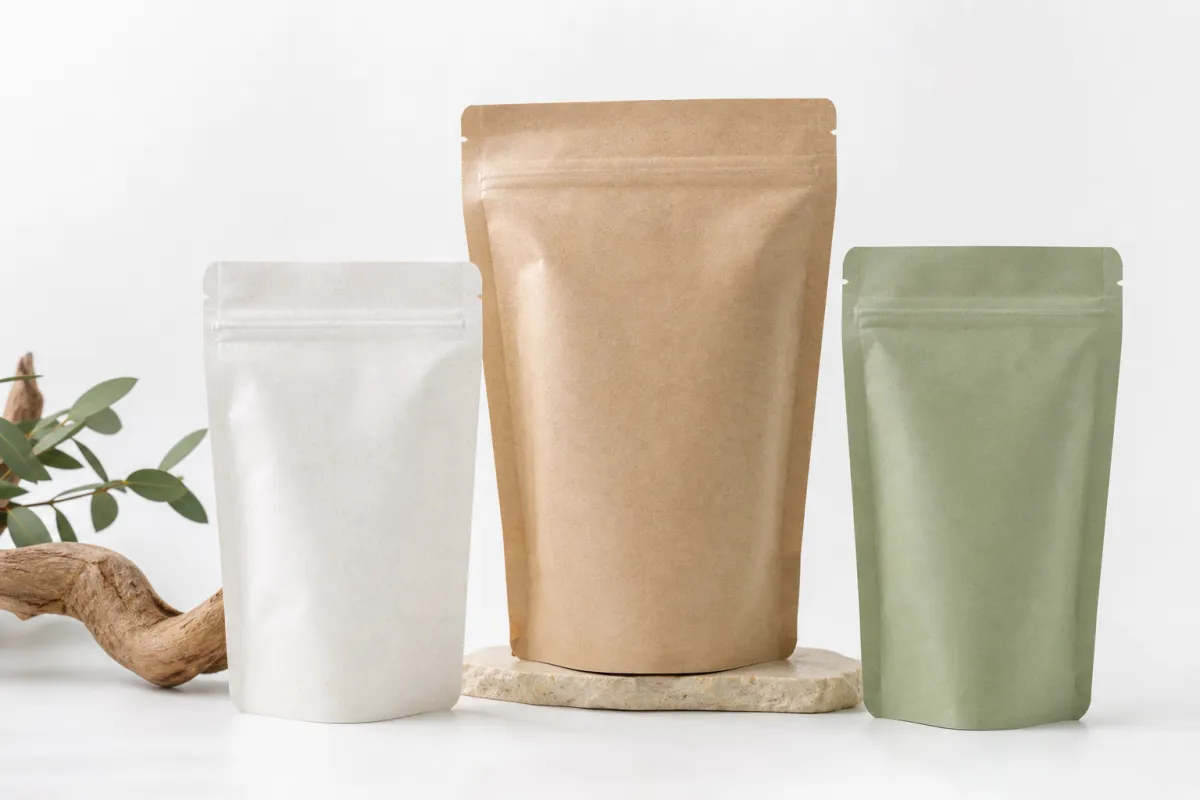
A compostable pouch packaging manufacturer takes a product brief and turns it into a pouch that can be filled, sealed, displayed, shipped, and disposed of in the way the brand says it should be. That starts with the base material, but it never stops there. Film thickness, barrier layer choice, sealant behavior, ink system, adhesives, zippers, and tear features all shape whether the final pouch works or just photographs well.
Here is the blunt version: compostable does not mean right for every product. A pouch can be compostable under the proper conditions and still be a bad fit for oily, aromatic, acidic, or oxygen-sensitive products. I have seen brands fall in love with the idea and then get surprised when the product logic does not cooperate. A compostable pouch packaging manufacturer should ask the annoying questions early. They save money later. What is the fill weight? What temperature does the product see? Is it hot-filled? Does it need a zipper? Is it sold through retail packaging, e-commerce, or both?
Plain language helps. Compostable means the material is intended to break down into natural components under a defined composting environment, usually with certification support such as ASTM D6400 or ASTM D6868 in the United States. In practice, buyers may also see third-party certification programs like BPI or TUV Austria used to support those claims. Biodegradable is looser and often too vague to mean much in packaging unless the breakdown conditions are spelled out. Recyclable means the material can enter a recycling stream, which is not the same as local systems actually accepting it. And recyclable-with-complications is a fair label for many flexible formats. Technically possible. Operationally annoying. Often ignored.
That is where a compostable pouch packaging manufacturer earns the fee. The right partner matches the material to the use case, not the other way around. In practice, that means choosing a structure that protects the product long enough to do its job, then supports an honest disposal claim after use. A well-built compostable pouch can fit inside a wider eco-friendly packaging plan, but it still has to earn its shelf space on performance.
From a packaging buyer's point of view, consistency is the real value. If the pouch seals the same way on Monday and Friday, if the print stays sharp, if the product stays fresh, and if the claim language can stand up to scrutiny, then the compostable pouch packaging manufacturer has done the job. That matters for new launches and for existing product packaging that needs a lighter footprint without a lot of drama.
How Compostable Pouch Packaging Works
A pouch usually has several layers even when it looks like one simple film. The base layer gives the pouch body and print surface. A barrier layer slows oxygen or moisture transfer. A sealant layer makes heat sealing possible. Then there are optional features: tear notches, reclosable zippers, hang holes, matte finishes, and windows. A compostable pouch packaging manufacturer has to decide which of those belong in the design and which ones only add cost and risk.
The better compostable films are engineered, not improvised. They are built to give enough oxygen barrier and moisture resistance for real products while staying inside the limits of compostable chemistry. That is a different challenge from making a standard multilayer plastic pouch. Traditional structures may depend on nylon, EVOH, metallized films, or other components that deliver strong protection but make end-of-life claims harder to defend. Compostable materials usually ask for a simpler structure, tighter product control, and a more careful shelf-life conversation.
Heat sealing is one of the biggest variables. A narrow seal window slows production and increases scrap. Too much heat can distort the film or weaken the seal. Too little heat can leave a seal that looks fine but fails under stress. A good compostable pouch packaging manufacturer will ask about the filling line because the pouch has to work with the actual machine, not a glossy sales slide. Fill temperature matters too. Hot-fill products, or products carrying residual heat, may need different sealant behavior than dry snacks or powders.
Product chemistry matters just as much. Acidic fillings, oily ingredients, and strong aromas can challenge compostable structures. Tea, coffee, dried herbs, protein powders, and snack mixes are often easier than wet foods or rich sauces, but even easy categories still need testing. If the brand wants a barrier pouch that protects aroma and moisture while staying compostable, the manufacturer has to balance performance with the disposal path. Physics still shows up. Every time.
Industrial compostability and home compostability are not the same thing. Industrial composting uses controlled heat, oxygen, moisture, and active microbial conditions. Home composting is slower, cooler, and far less predictable. A pouch certified for industrial composting should never be marketed as if it vanishes in a backyard bin next week. The disposal path has to match the certification, and the certification has to match the claim language. The U.S. Environmental Protection Agency has useful guidance on composting basics and material handling at epa.gov, which is a good reminder that disposal systems matter as much as material chemistry.
After disposal, microbial activity begins breaking the material down under the right conditions, but that process depends on local collection systems and contamination rules. Some communities collect food scraps and compostables. Some do not. A compostable pouch packaging manufacturer should not oversell the end-of-life story. The material may be certified, while the local system still refuses it. Honest claims are usually more useful than aggressive ones.
For buyers comparing compostable pouch packaging with other formats, system fit is the thing to watch. A pouch for dry food, a pouch for powdered supplements, and a pouch for moisture-sensitive snacks may look similar from the aisle, but their barrier needs are not remotely the same. A compostable pouch packaging manufacturer is really a packaging systems engineer, not just a converter of film.
Choosing a Compostable Pouch Packaging Manufacturer: Key Factors
Choosing the Right compostable pouch packaging manufacturer starts with proof, not promises. Ask for certification details, material specifications, and written clarity on whether the pouch is industrial compostable, home compostable, or both. If the supplier cannot explain the difference without wandering into jargon, that is a warning light. Certifications are not decoration. They are the paperwork that keeps sustainability claims honest.
Traceability matters too. Buyers Should Know where the base film comes from, what the sealant layer contains, and whether inks and adhesives fit the compostable claim. If a pouch uses compostable film but the print system, zipper, or adhesive brings in an incompatible component, the claim gets shaky fast. A serious compostable pouch packaging manufacturer should document the full structure and call out the tradeoffs without flinching.
Performance testing deserves the same attention as certification. I usually push buyers to ask four practical questions: Will the pouch hold up in transit? Will the seal survive filling? Will the print stay crisp? Will puncture resistance match the product's shape and weight? A pouch that composts well but leaks in a shipping carton is not sustainable. It is a replacement cycle waiting to happen.
For e-commerce or club-store shipments, ask for testing that reflects the real distribution environment. The ISTA testing framework is widely used to evaluate package durability, and even when a project does not need formal certification, the logic still helps. Drop, vibration, compression, and handling all belong in the discussion. A compostable pouch packaging manufacturer that understands distribution testing is usually more helpful than one that only talks about resin names and certificate logos.
Minimum order quantities matter too. Some compostable pouch packaging manufacturers can support smaller trial runs. Others are built for larger production volumes. If you need custom sizes, zippers, spouts, or special finishes, ask what happens to cost and lead time when the design gets more complex. A low MOQ may look attractive, but if the manufacturer cannot support repeat runs or line validation, the savings evaporate quickly.
A pouch that passes compostability paperwork but fails on the filling line is still the wrong pouch.
Technical support is often the clearest sign of quality. A serious compostable pouch packaging manufacturer should show sample structures, explain barrier levels, and recommend a format based on shelf-life goals instead of guesswork. Send a brief with product type, fill weight, storage conditions, and distribution method, and the response should be specific. Vague answers usually mean the supplier is selling general packaging, not solving a packaging problem.
Sustainability questions should go past the headline claim. Are the inks compostable-compatible? Are the adhesives traceable? Does the structure use post-industrial content or only bio-based feedstock? Are any additives included that affect compostability? If the answer gets fuzzy, the claim probably does too. That matters a lot for branded packaging, where the front-panel message is part of the marketing plan. A clean design means very little if the technical story falls apart.
Finally, think about the overall fit with your product packaging strategy. If your range includes custom printed boxes, pouches, and other retail packaging, consistency matters across formats. The compostable pouch packaging manufacturer should understand how the pouch fits into the bigger package branding system, not just the one SKU in front of them. That wider view usually saves rework later.
Compostable Pouch Packaging Manufacturer Pricing and Cost Drivers
Pricing from a compostable pouch packaging manufacturer is driven by more than film cost. Material type, barrier requirements, pouch size, print coverage, finishing options, and order volume all shape the quote. A simple one-color pouch for dry goods can cost very differently from a high-barrier, full-color pouch with a zipper and specialty finish. The material is only one line in the budget.
As a practical range, many buyers will see custom compostable pouches land somewhere around $0.18 to $0.45 per unit for moderate volumes, with simpler structures on the lower end and more demanding barrier builds on the higher end. Smaller runs, specialty features, or heavy print coverage can push the number up. That is not a promise. It is a workable market range that helps you read a quote without pretending every project is identical.
There are also hidden costs that get missed the first time around. Artwork setup, plate charges, prepress proofing, material testing, freight, and packaging line adjustments can all raise the real total. If the pouch needs a new seal bar setting or a slower fill speed, the hidden cost may show up as line downtime instead of an invoice line item. A compostable pouch packaging manufacturer with real experience should be willing to talk about those details before you sign off.
Higher barrier usually means higher cost. That is true for oily, aromatic, or moisture-sensitive products where the pouch has to protect freshness over a longer shelf life. In some cases, the safest recommendation is to simplify the format instead of chasing a feature list that the material cannot support well. A compostable pouch packaging manufacturer that is honest about that tradeoff is worth more than one that says yes to everything.
The best way to compare quotes is to measure the total cost per filled pouch, not just the unit price. If one supplier has a lower quote but creates more scrap, more test failures, or a shorter shelf life, the real economics can be worse. Packaging is never just about film cost. It is about what the package does to throughput, product quality, and customer satisfaction once it reaches the shelf.
| Structure Type | Typical Use | Illustrative Price Range at Moderate Volume | Cost Pressure Notes |
|---|---|---|---|
| Simple compostable pouch with light print | Dry goods, powders, low-risk retail packaging | $0.18-$0.28 | Lower print coverage and simpler sealing usually keep costs down |
| Custom printed compostable pouch with zipper | Snacks, tea, supplements, resealable product packaging | $0.28-$0.45 | Zipper integration and higher artwork complexity raise the quote |
| Higher-barrier compostable pouch with specialty finish | Aromatic, moisture-sensitive, or premium branded packaging | $0.40-$0.70 | Barrier demand, puncture resistance, and tighter process control add cost |
| Short-run sample or pilot build | Testing, line validation, market trials | Varies widely | Setup and proofing can matter more than the pouch itself |
One more thing buyers miss: lead times usually track complexity. If your pouch structure needs extra testing or a custom print process, a compostable pouch packaging manufacturer may need more time to approve the material and stabilize the run. That is not a red flag. It usually means the supplier is taking the engineering seriously instead of winging it.
Process and Timeline From Brief to Finished Pouches
The process usually starts with a discovery brief. A good compostable pouch packaging manufacturer will want the product category, fill weight, shelf-life target, storage environment, filling temperature, distribution method, and the sustainability claim you want to make. If the supplier does not ask those questions, they are probably not sizing the structure correctly. The brief is the foundation for everything that follows.
Next comes material selection and structural recommendation. This is where the manufacturer decides whether a simpler pouch, a higher-barrier film, a different sealant, or a different closure is the better path. Sometimes the smartest move is to simplify the format so the pouch seals more reliably and the compostable claim stays clean. The best compostable pouch packaging manufacturer will explain why fewer features can be the stronger solution.
Artwork and prepress come after that, and they matter more than many buyers expect. Ink coverage, barcode placement, certification marks, legal claim language, and even small type size can affect print clarity. If the artwork needs to carry an industrial compostability statement, a recycling note, or disposal instructions, the copy should be reviewed before production starts. Packaging design is not just about appearance. It is information architecture on the package.
Sampling and validation are where the project turns real. A manufacturer may provide lab samples, converted samples, or pilot runs for testing on the customer's own equipment. This is the stage to check seal strength, drop durability, wrinkle behavior, fill speed, and product compatibility. If the pouch is meant for shipping cartons or subscription boxes, ask for transit-style testing that mirrors the actual route to the customer. The goal is to catch problems before a full production run, not after the first pallet leaves the dock.
For Brands That Ship direct to consumer, it helps to review packaging standards with movement and compression in mind. Even a compostable pouch that looks perfect on a bench test can fail once it rides in a carton with other items. Practical testing matters more than theory. A few smart checks now can save thousands of units later.
Production usually follows proof approval and sample signoff. The pouch is converted, printed, slit, formed, inspected, packed, and shipped. Depending on complexity, simple custom projects may run in roughly 12 to 15 business days after proof approval, while more technical or larger-volume projects often need 3 to 5 weeks or longer. That range moves with material availability, artwork complexity, and how much line validation is required.
If the timeline feels too fast for the amount of engineering involved, the project is probably under-scoped.
That is where a compostable pouch packaging manufacturer proves whether they are just a converter or an actual partner. A converter takes the order. A partner helps keep the order stable through sampling, testing, and production. For brands that care about launch timing, that difference matters just as much as the pouch itself.
Common Mistakes When Working With a Compostable Pouch Packaging Manufacturer
The first mistake is assuming compostable automatically means suitable for every product, every climate, and every storage condition. It does not. A pouch that works well for dry tea in a cool warehouse may struggle with a moisture-sensitive snack in a warm distribution center. A compostable pouch packaging manufacturer should be able to tell you where the limits sit instead of pretending the material can do everything.
The second mistake is choosing the pouch based on sustainability claims alone. That usually leads to a pretty sample and a disappointing production run. Barrier performance matters. Seal performance matters. Puncture resistance matters. If the product leaks, stales, or loses aroma, the packaging switch has not helped the brand. It may have made waste worse.
The third mistake is ignoring the filling line. That is one of the costliest oversights because it tends to show up after production starts. A pouch can seal beautifully in a lab and still wrinkle, misfeed, or seal unevenly on the line. A compostable pouch packaging manufacturer should ask about equipment, dwell time, and fill temperature. Line compatibility is not a side note. It is central to the project.
The fourth mistake is using vague end-of-life language that confuses customers. Words like "earth-friendly" or "eco-safe" may sound nice, but they do not tell the buyer what to do with the pouch. If the product is industrial compostable only, say that clearly. If a community does not accept the pouch, do not imply that it disappears in any backyard pile. Confusing claims can create compliance issues and damage trust faster than a plain label ever would.
- Don't assume the claim is universal: industrial compostability and home compostability are different outcomes.
- Don't skip product testing: oily, acidic, or aromatic products need more validation than dry fillers.
- Don't ignore distribution: shipping, stacking, and vibration often expose issues a bench test will miss.
- Don't overstate disposal: recyclable-with-complications is not the same as actually recyclable.
- Don't rush the proof stage: weak barcodes, bad copy, or unclear certification marks create avoidable rework.
The fifth mistake is skipping validation and shelf-life testing. Buyers sometimes assume the compostable material is the main challenge, but the real failure may be oxygen ingress, seal creep, or moisture gain over time. A compostable pouch packaging manufacturer worth hiring should be open about testing, and a brand should be willing to wait long enough to see a real result.
There is also a quieter mistake that shows up in branding conversations: treating the pouch as if it operates alone. It does not. It sits beside label systems, shipping cartons, inserts, and other package branding decisions. If the rest of the packaging ecosystem sends a different message, the pouch becomes harder to explain. Consistency is part of credibility.
For companies comparing formats, it can help to think about the whole packaging mix rather than just one sleeve or pouch. A compostable pouch may be the right choice for one line, while custom printed boxes or another format makes more sense for a different product. A good compostable pouch packaging manufacturer should respect that broader strategy instead of forcing a one-size-fits-all answer.
Expert Tips for Next Steps With a Compostable Pouch Packaging Manufacturer
Start with a one-page product brief. Keep it simple, but make it complete: product type, fill weight, shelf-life target, storage temperature, sealing method, distribution path, and the disposal claim you want to make. If possible, include the rough look and feel you want for the pouch. Matte, soft-touch, clear window, zipper, hang hole, or retail-ready finish all affect the structure. A clear brief helps the compostable pouch packaging manufacturer recommend the right path faster.
Request samples of the actual film structure, not just mockup artwork. A nice digital render does not tell you how the seal behaves or how the pouch feels in hand. Test those samples on your own filling equipment if you can. Even a short trial run can expose practical issues like wrinkling, static, feeding problems, or seal inconsistency. Those are much easier to solve before full production.
Ask for written confirmation of certifications, material composition, and intended use cases. If the pouch is industrial compostable, make sure that is stated in writing. If the supplier is making a claim about home composting, that should be backed by the proper certification path and language. This is where trust gets built. A compostable pouch packaging manufacturer should welcome those questions, not dodge them.
Build a comparison matrix before you decide. Rate each supplier on price, barrier performance, lead time, certification support, conversion flexibility, and willingness to test on your line. Then rank them by total fit. A lower unit cost helps only if the pouch protects the product, supports the sustainability claim, and runs cleanly in production. That is the real economy of the project.
If you want to broaden the conversation, review related pages like About Custom Logo Things and compare how the brand handles Custom Packaging Products across formats. That context can sharpen the brief and stop decisions from getting trapped in one silo. Packaging usually performs better when the team thinks in systems instead of isolated SKUs.
There is also a branding angle worth keeping in view. A pouch is not only a container. It is part of the customer's first physical encounter with the product, and that means color, typography, finish, and claim placement all matter. Good package branding should make the sustainability story legible without turning the pouch into a lecture. Strong design, clear copy, and real performance can work together.
My practical advice is to keep the project grounded. Ask for evidence. Ask for samples. Ask for timelines in writing. Ask the compostable pouch packaging manufacturer what happens if the barrier needs to change, if the zipper delays the run, or if the disposal claim needs to shift for a particular market. Those answers usually separate a smooth launch from a frustrating one.
If you are ready to move, the sequence is simple: confirm the pouch format, request a quoted spec, approve testing, and reserve the next production window with your compostable pouch packaging manufacturer. That is how a compostable concept turns into a package that actually does the job, protects the product, supports eco-friendly packaging goals, and keeps the sustainability claim credible from first shipment to final use.
FAQ
How do I know if a compostable pouch packaging manufacturer is legitimate?
Ask for third-party certification details, full material specifications, and a clear explanation of whether the pouch is industrial compostable, home compostable, or both. A legitimate compostable pouch packaging manufacturer should also be able to discuss inks, adhesives, barrier layers, and disposal instructions without drifting into vague marketing language. If the answers are specific and documented, that is usually a good sign. If they get slippery, that is your cue to slow down.
What products work best with compostable pouch packaging manufacturer solutions?
Dry goods, powders, snacks, tea, and some non-oily products are often the easiest fit because they put less stress on barrier performance and sealing. Moisture-sensitive, greasy, or highly aromatic products can still work, but they usually need more testing and a more careful material choice. The best match depends on shelf-life goals, fill temperature, and the seal requirements of the pouch. A good manufacturer will tell you straight if your product is a stretch.
Why does compostable pouch packaging manufacturer pricing vary so much?
Price changes with material type, barrier needs, pouch size, print coverage, and order volume. Testing, tooling, and artwork setup can add cost, especially for custom structures or specialized finishes. A lower unit price may not be cheaper if it causes scrap, short shelf life, or line downtime, which is why the full production picture matters. Cheap packaging that fails is just expensive packaging wearing a fake mustache.
How long does it take to get compostable pouches made?
Simple stock-style projects can move faster than custom engineered pouches, but sampling, testing, and artwork approval usually add time before production starts. For many projects, a compostable pouch packaging manufacturer may need about 12 to 15 business days after proof approval for a straightforward run, while more complex builds can take several weeks. Lead time depends on structure complexity, order size, and whether the design needs line validation. If someone promises an engineered pouch in a blink, I would be skeptical.
What should I ask before placing an order with a compostable pouch packaging manufacturer?
Ask about certifications, barrier performance, shelf-life expectations, filling-line compatibility, and the exact disposal claim that should appear on the pack. Confirm whether the pouch works for industrial composting, home composting, or both, if applicable. Request a written quote that separates unit price, setup costs, testing, and freight so you can compare suppliers on real numbers rather than broad promises. If you keep those questions in front of every compostable pouch packaging manufacturer you evaluate, the final choice is usually much clearer.


