Buyer Fit Snapshot
| Best fit | Compostable Pouches Wholesale projects where brand print, material claims, artwork control, MOQ, and repeat-order consistency need to be specified before quoting. |
|---|---|
| Quote inputs | Share finished size, material target, print colors, finish, packing count, annual reorder estimate, ship-to region, and any compliance wording. |
| Proofing check | Approve dieline scale, logo placement, barcode or warning zones, color tolerance, closure strength, and carton packing before bulk production. |
| Main risk | Vague material claims, crowded artwork, missing packing details, or unclear freight terms can make a low unit price expensive after revisions. |
Fast answer: Compostable Pouches Wholesale: Pricing, MOQ, Specs should be specified like a repeatable production item. The safest quote records material, print method, finish, artwork proof, packing count, and reorder notes in one written spec.
Production checks before approval
Compare the actual filled-product size with the drawing, then confirm tolerance on folds, seals, hang holes, label areas, and retail display edges. Reserve space for logos, QR codes, warning copy, and material claims before decorative graphics fill the panel.
Quote comparison points
Review material grade, print process, finish, sampling route, tooling charges, carton quantity, and freight assumptions side by side. A quote is only useful when the supplier can repeat the same color, closure quality, and packing count on the next order.
A launch can look responsible on a spreadsheet and still fall apart on the filler, on the pallet, or on the shelf. That is why compostable pouches wholesale deserves careful review: the right pouch can cut packaging waste, support a lower-impact packaging program, and keep ready-to-ship inventory from turning into a costly round of revisions. The wrong pouch can split at the seal, curl under heat, lose barrier strength too early, or miss the shelf-life target before the first reorder even lands.
Why compostable pouches wholesale changes the launch math
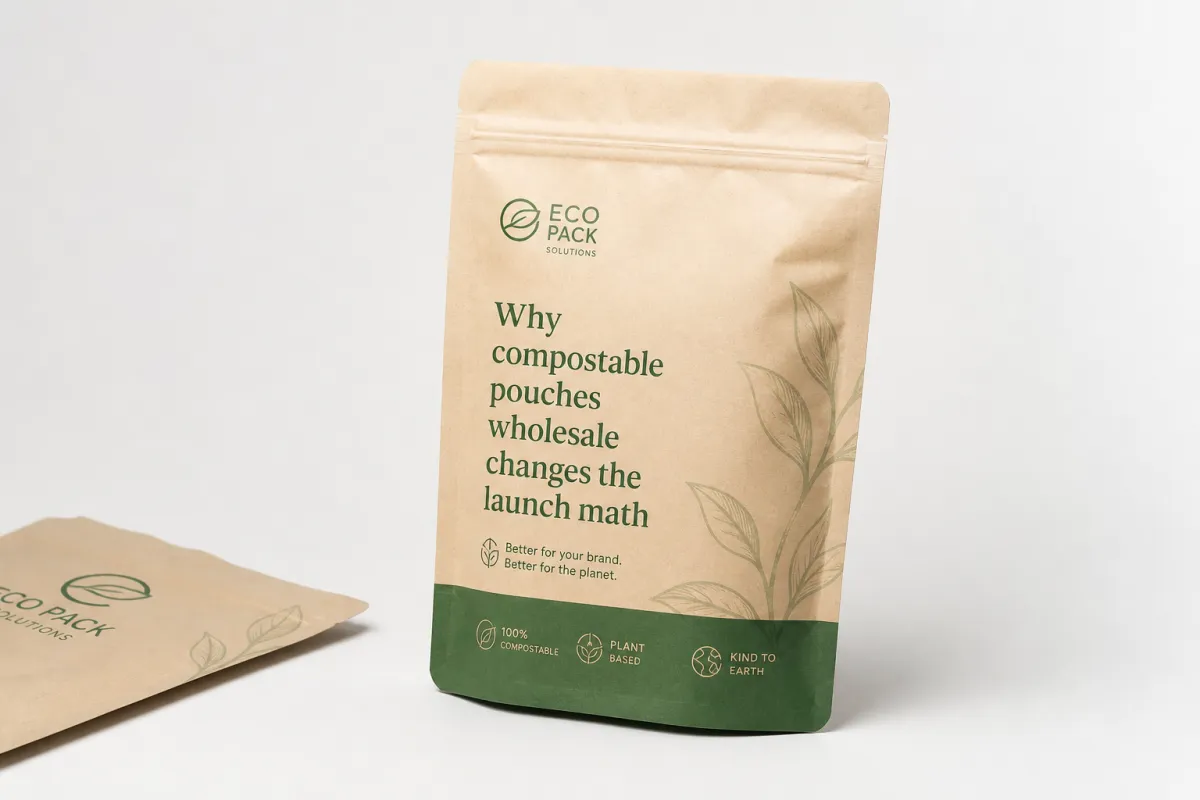
For a packaging buyer, compostable pouches wholesale changes the economics in a very practical way. A brand is not just purchasing a pouch; it is buying a conversion process, a seal behavior profile, a freight profile, a retail presentation, and a set of claims that need to remain accurate once the cartons leave the dock. A unit price that looks attractive can disappear fast if the pouch creates rejects on the line, slows filling speed, or requires rework after sampling. The first question should not be whether the material sounds eco-friendly. It should be whether the pouch will run cleanly, protect the product, and arrive in repeatable quality.
Wholesale buying helps because it spreads setup costs across a larger production run. With compostable pouches wholesale, a buyer can lock in one film stack, one zipper or valve choice, and one print specification instead of juggling small one-off orders from different vendors. That consistency matters more than many teams expect. A snack brand that changes pouch suppliers in the middle of a season can see shifts in fill weight control, seal temperature, shelf presentation, and labor time, all of which affect returns and production rhythm. Wholesale volume keeps that drift in check and makes forecasting easier, especially for seasonal launches that need to move quickly once demand hits.
There is also a planning advantage. Buying through compostable pouches wholesale instead of piecemeal orders lets a team map inventory around production cycles rather than emergency reorders. That usually means fewer surprises in lead time, tighter control over artwork revisions, and less risk of paying rush freight because a SKU sold faster than expected. For brands building greener packaging programs, that predictability is not a bonus feature. It is the difference between a packaging story that holds up in the market and a stack of cartons in receiving because the pouch spec shifted after approval.
Sustainability claims only carry weight if the pouch still performs. Compostability is not a pass on the basics. The pouch still needs seal integrity, puncture resistance, and barrier performance that fit the product. A pouch that composts in theory but leaks aroma, tears at the zipper, or loses moisture protection after a week on shelf does not help the brand. It hurts it. That is especially true in food packaging, where the retailer, the consumer, and the operations team all see the failure. The best purchasing decisions treat compostability as one requirement among several, not the only requirement in the room.
"A compostable pouch that cannot hold a seal or protect aroma is not a sustainability win; it is a return rate waiting to happen."
compostable pouches wholesale works best when the buyer weighs three things at the same time: product protection, retail appearance, and the end-of-life claim as it will actually be used in market. That is a more disciplined way to buy eco-friendly packaging, and it usually produces a better total cost than chasing the lowest quoted unit price. I have seen teams get pulled toward a cheaper pouch only to spend the savings on line downtime and relabeling. That is a bad trade, plain and simple. For teams that want a structured buying path, our Wholesale Programs page outlines how custom orders move from quote to production.
Product details: pouch styles, materials, and use cases
The structure of the pouch controls how it looks, how it fills, and how it behaves in shipment and retail. With compostable pouches wholesale, the most common formats are stand-up pouches, flat bottom pouches, three-side seal pouches, and side gusset pouches. A stand-up pouch is often the easiest sell on shelf because it displays well and uses space efficiently. Flat bottom pouches add stability and create a cleaner block shape, which many coffee and tea brands prefer. Three-side seal formats are simpler and often lighter in material use, while side gusset pouches work well when the product needs more volume and a more traditional bag silhouette.
compostable pouches wholesale also requires a decision on the material stack. Some programs use paper-based outer layers with compostable barrier components. Others rely on PLA blends, cellulose films, or laminated barrier layers designed for composting pathways that meet industrial standards. The choice is not cosmetic. Paper-based structures can feel more premium and align naturally with earthy brand language, but they may need a barrier layer to manage moisture or oxygen. Cellulose films can deliver a cleaner compostable story and strong clarity, though they are not the right fit for every product. PLA can work well in some applications, but heat resistance and shelf-life expectations need careful review.
Use case matters just as much as film. Coffee needs aroma control and, in many cases, a one-way valve. Tea needs odor protection and a polished presentation. Snacks often need moisture control and puncture resistance because sharp edges or brittle inclusions can test the seal. Powders need strong seals and a pouch body that resists dust contamination during filling. Dried produce sits between snacks and dry goods, with barrier needs that vary widely by moisture sensitivity. Non-food goods such as bath salts, supplements, and samples can be easier in some respects, but they still need clear print, sturdy seals, and a pouch structure that fits the retail channel.
Small details change the whole buying decision. A zipper can improve reclose performance, but it adds cost and can raise MOQ. Tear notches improve opening, but only if the consumer can tear cleanly without ripping the pouch below the seal. A window can show the product, but it can also weaken barrier performance if the window film is not chosen carefully. Matte finishes can soften the look of green packaging and make a brand feel more premium; gloss finishes can sharpen color contrast and help graphics stand out under store lighting. If the product will be stacked, shipped in multipacks, or displayed in humid retail environments, those details matter more than many first-time buyers expect.
- Stand-up pouches work well for coffee, snacks, and premium retail products.
- Flat bottom pouches suit brands that need extra shelf stability and a stronger block shape.
- Three-side seal pouches are often efficient for samples, powders, and lighter-weight goods.
- Side gusset pouches fit higher-volume fills and more traditional bag presentations.
For buyers comparing compostable pouches wholesale across multiple SKUs, the smartest move is to standardize as much as possible. One pouch size can often serve two or three related products with different fill weights if the density stays close enough. That reduces artwork complexity, lowers the chance of inventory mismatch, and usually makes future reorders easier. Our custom wholesale packaging options are built around that kind of practical consolidation, not around adding unnecessary complexity.
Specifications that decide performance on shelf
The spec sheet is where compostable pouches wholesale either becomes a serious program or a pile of vague promises. The key items are straightforward, but they need to be written down: pouch dimensions, film gauge, seal width, puncture resistance, closure type, and the barrier targets for oxygen, moisture, and aroma. If those numbers are missing, the buyer is guessing. A guess can work for a prototype. It should not support a production run.
Film gauge is one of the first things to confirm. Many compostable structures land in a range that feels thicker than standard flexible packaging because the barrier is often built through layering rather than a single high-performance plastic film. Seal width matters just as much. A narrow seal can reduce material use, but wider seals often improve consistency for powders, granular fills, and products that are hot-filled or sealed immediately after filling. In many retail pouches, a 6-10 mm seal band is common; brittle or dusty products may need more. That depends on the filling line, the jaw pattern, and the product itself.
Barrier performance is where the conversation gets serious. Coffee usually needs strong aroma retention and low oxygen exposure. Snacks often need moisture control first, then oxygen control. Powders care more about seal integrity and contamination resistance. For any compostable pouches wholesale order, the right question is not "Can this pouch compost?" but "How long does this pouch keep the product in spec?" That is a shelf-life question, not a sustainability slogan. Buyers who keep those two questions separate make better decisions.
Compliance is another non-negotiable. Industrial compostability claims should be backed by the relevant standard, such as ASTM D6400 or EN 13432, and by documentation that shows the whole package stack, not just one layer, fits the claim. Food-contact requirements also need to be checked, along with region-specific labeling rules. A pouch that sells in one market may need a different label or a different claim statement in another. The same caution applies to paper sourcing. If the structure uses fiber-based material and the buyer wants responsible sourcing, the FSC framework is a useful reference point; see FSC for chain-of-custody and certification guidance. For composting basics and consumer-facing end-of-life information, the EPA composting guidance is a practical reference.
Print and converting constraints deserve equal attention. Compostable films can behave differently under heat, pressure, and drying time. Ink adhesion may require a different primer or a slower cure. Registration tolerance can tighten because certain film surfaces stretch or shift more during conversion. If the artwork has fine type, reverse-out details, or small legal copy, that tolerance can make the difference between a clean package and a blurry one. A good supplier will spell out the real limits instead of promising every graphic effect will reproduce exactly the same way on every compostable substrate.
Here is the decision framework I would use for compostable pouches wholesale: set the shelf-life target first, then choose the minimum barrier that meets it, then confirm the seal behavior on the actual filling line. Do not overbuild the pouch just because a heavier structure feels safer. Overbuilding raises cost, can complicate compostability claims, and sometimes reduces consumer appeal. Underbuilding is worse, of course, because a compromised barrier can ruin product quality. The sweet spot is the structure that protects the product without paying for performance you do not need.
Compostable pouches wholesale pricing and MOQ explained
Pricing for compostable pouches wholesale is driven by a short list of variables: material type, pouch size, print coverage, barrier requirements, closure hardware, and order volume. Material choice usually has the biggest effect because compostable barrier structures can be more complex to source and convert than conventional flexible packaging. A larger pouch also uses more film, which pushes unit cost up quickly. Full-coverage print, specialty finishes, and added features such as zippers, valves, or windows all add incremental cost. None of that is mysterious; it is simply how conversion works.
MOQ changes with structure and print method. Stock formats can often start lower because the dieline already exists and the supplier may already have the substrate in the production flow. Custom dimensions usually need a larger commitment because setup, cutting, and proofing all increase. Multi-color print often raises MOQ as well, especially if the job needs tight registration or if the buyer wants several SKUs in one run. A first-time buyer should ask whether the MOQ applies to the total order, the per-SKU count, or the production minimum per artwork version. That detail affects the real buying decision more than most teams realize.
| Option | Typical MOQ | Indicative unit cost | Best fit | Notes |
|---|---|---|---|---|
| Stock stand-up pouch | 1,000-3,000 pieces | $0.18-$0.32 | Pilots and fast launches | Limited sizes and fewer print choices |
| Semi-custom printed pouch | 3,000-5,000 pieces | $0.24-$0.45 | Small retail programs | Good balance of flexibility and cost |
| Fully custom barrier pouch | 5,000-10,000 pieces | $0.30-$0.70 | Coffee, snacks, and premium launches | Higher setup, stronger control over specs |
| Flat or three-side seal pouch | 5,000-20,000 pieces | $0.12-$0.28 | Powders, samples, dried goods | Lower material use, simpler construction |
Those ranges are directional, not a quote. A pouch with a one-way valve, heavy barrier build, and full print coverage can move to the upper end or beyond it. Freight can also shift the landed number, especially if the packaging is bulky relative to the product weight. When buyers compare compostable pouches wholesale, they should ask for four numbers, not one: unit price, setup or tooling, sample cost, and freight. That is the only way to see the real landed cost.
There are a few practical ways to save money without hurting the product. First, consolidate SKUs where fill weights are close enough to share a pouch size. Second, standardize one closure style instead of testing three different zipper options. Third, consider printing on one side for an initial run if the front panel already carries the brand story. Fourth, keep artwork changes to a minimum on the first order so proofing does not stretch the schedule. These steps may sound obvious, but they often cut the first-run bill by a meaningful amount.
compostable pouches wholesale is also where buyers sometimes spend too much trying to solve a branding problem with packaging structure. If the pouch only needs to carry a clear label and one or two claims, a complex custom build may not be the best use of budget. If the product needs premium shelf presence, a custom structure can be justified. The right answer depends on the retail channel, the margin structure, and the shelf-life target. There is no universal shortcut.
One rule keeps showing up in buyer conversations: compare unit cost only after the spec is locked. A cheap quote on an under-specified pouch is not a win. The better comparison is simple: does the pouch meet performance requirements, match the brand, and stay within a realistic landed cost? If yes, then the order is moving in the right direction. If not, the quote is just noise.
Process and timeline for a wholesale pouch order
The order flow for compostable pouches wholesale is usually more predictable than buyers expect, provided the spec is clear. It starts with inquiry and product review. The supplier needs the pouch size, fill weight, product type, shelf-life target, and any retail or regulatory constraints. Then comes structure selection, where the buyer decides whether the pouch needs a zipper, a valve, a window, or a plain finish. After that, artwork prep and dieline review begin. That is often where problems surface, because a beautiful design that ignores bleed, seal zones, or barcode placement will delay the job.
Sampling is the next gate. Good sampling does more than show color. It checks hand feel, seal behavior, fill fit, and whether the pouch stands correctly after filling. For compostable pouches wholesale, sample approval is also where the buyer should review claim language and confirm the exact wording for compostability, recycled content, or FSC-based sourcing if those claims apply. The fastest projects are the ones where the buyer sends vector artwork early, confirms the dieline quickly, and signs off on the sample without a long trail of internal revisions.
Lead times depend on whether the order is stock, semi-custom, or fully custom. Stock runs can move quickly once the artwork is ready, often in roughly 7-12 business days before freight depending on volume and location. Semi-custom runs are commonly in the 12-18 business day range after proof approval. Fully custom compostable structures can push to 18-30 business days or more if there are barrier tests, certification checks, or multiple proof rounds. For larger projects, international freight may add another layer of timing, and that is before customs, holiday cutoffs, or production queue pressure enter the picture.
The slowest step is rarely the machine time. It is usually proofing, testing, or waiting on decision-makers. If the buyer keeps changing artwork late in the process, the timeline stretches. If the supplier has to verify a compostability document or rerun seal checks because the closure hardware changed, the timeline stretches again. If the product is temperature-sensitive, or if the filling line needs a trial run before release, the clock moves further. That is why a clean approval process matters as much as the film selection.
To avoid delays, lock the dieline early, supply high-resolution vector art, and define the claim language before sampling starts. If your team expects to add a zipper later, say so early. If you may need a valve for coffee, mention it before proofing. If your brand uses multiple sell-through regions, tell the supplier where each region ships so labeling and compliance questions are not discovered at the last minute. In practice, compostable pouches wholesale moves faster when the buyer treats packaging as a production project, not as a final design flourish.
A short internal checklist helps:
- Confirm product type, fill weight, and shelf-life target.
- Lock pouch dimensions and closure style.
- Approve claim language and compliance notes.
- Send vector artwork and barcode files.
- Review the sample against the filling line, not just on a desk.
Why buyers choose us for compostable pouch programs
At Custom Logo Things, the value is not just supplying pouches. It is helping buyers Choose the Right structure for the product, the market, and the claim set. That matters because compostable pouches wholesale can be oversold very easily. A supplier can always push a more expensive pouch. The better partner asks a more useful question: what does the product actually need to survive shipping, shelf display, and consumer use? That is how you avoid paying for features that do not improve performance.
We also focus on documentation and clear communication. Buyers Need to Know what they are getting, what the material stack includes, how the claim should be stated, and what the timeline really looks like. If a compostability claim applies only to industrial composting, that should be said plainly. If the pouch includes a zipper or valve that changes the structure, the buyer should know whether that affects the documentation. That kind of transparency is basic, but it is not universal. In compostable pouches wholesale, it should be standard.
Quality control is another major reason buyers stay with a supplier. A pouch may look identical on screen while behaving differently in production. Seal consistency, film curl, print registration, and odor barrier all have to hold up in real use. We pay attention to those details because the customer sees them, the retailer sees them, and the filling line sees them. A good wholesale partner should be able to explain tolerances, recommend a simpler structure if it performs better, and call out the tradeoffs instead of hiding them.
Buyers also appreciate pilot support. A small test run can expose issues that a quote sheet cannot. Maybe the pouch needs a wider seal. Maybe the zipper height is too close to the top edge. Maybe the artwork needs stronger contrast on the back panel. Those fixes are far cheaper when they happen before a full production run. For brands building a repeatable green packaging program, that early learning is valuable. It lowers waste, reduces rework, and gives the team a cleaner path to scale.
If you are comparing suppliers, start with our Wholesale Programs page and look for the process, not just the price. A reliable compostable pouches wholesale partner should make it easier to evaluate options, not harder. And if the first recommendation is always the most expensive structure, that is usually a signal to ask for a second option.
Next steps to place a compostable pouches wholesale order
If you are ready to move forward with compostable pouches wholesale, the best next step is to define the product before asking for a quote. Write down the fill type, target shelf life, pouch size, closure style, print needs, and the market where the product will sell. That single page of information does more for quote accuracy than a long email thread full of general goals. It also reduces back-and-forth during sampling.
Then ask for two or three structure options. One should be the simplest version that meets the brief. Another can be the stronger barrier or premium retail version. If the product is sensitive, ask for a sample kit and a landed-cost estimate that includes unit price, setup, freight, and any tooling. That lets you compare compostable pouches wholesale options on real numbers instead of on headline pricing alone. If you are launching multiple SKUs, consider starting with one SKU or one region first so the first run can validate performance before you scale the whole line.
The cleanest orders usually start with a clear artwork file, a locked dieline, and a fast sample review. Send vector art, outline the legal copy, and tell the supplier which claims must appear on pack. If your team needs to adjust the creative later, do it before proof approval. If the pouch must match a retail planogram or a club-store case pack, say so early. Those details make a big difference in how the pouch is built and how fast it ships.
For many brands, the right move is not to chase the most complex pouch on day one. It is to select the pouch that protects the product, supports the brand, and creates a realistic path to reorders. That is how compostable pouches wholesale becomes a durable packaging program instead of a one-off experiment. If you want to start, gather your spec sheet, request samples, and use our custom wholesale ordering path to move from quote to production with fewer surprises.
What is the MOQ for compostable pouches wholesale orders?
MOQ varies by pouch size, structure, and print method; stock formats are usually the lowest. Custom dimensions or multi-color printing typically raise MOQ because setup work increases. Ask for a quote that separates sample, setup, and production quantities so you can compare options accurately. For many buyers, compostable pouches wholesale becomes more economical once the artwork and structure are standardized across multiple SKUs.
How do I know a compostable pouch is really compostable?
Request certification documents and the exact standard used, not just a marketing claim. Verify the full material stack, including closures, inks, and any barrier layers. Check whether the claim applies to industrial composting, home composting, or both. If the supplier cannot explain the full stack, the safer assumption is that compostable pouches wholesale needs more documentation before you place the order.
Can compostable pouches wholesale work for coffee or snacks?
Yes, if the barrier specs match oxygen, moisture, and aroma needs for the product. One-way valves, zippers, and seals must be chosen for the fill type and shelf-life target. Shelf-life testing should confirm performance before a full order is placed. In coffee especially, compostable pouches wholesale works best when aroma control and seal integrity are treated as the first priorities.
How long does a wholesale compostable pouch order take?
Simple stock or semi-custom orders move faster than fully custom runs. Artwork approval and sample sign-off are usually the main timing variables. Freight, testing, and certification review can extend the schedule. If your internal review is slow, compostable pouches wholesale will take longer no matter how fast the converter is running.
What affects the price most in compostable pouches wholesale?
Material type and barrier level usually matter more than small graphic changes. MOQ, pouch size, and closure hardware are major cost drivers. Total landed cost should include shipping, setup, and any tooling. When buyers compare compostable pouches wholesale quotes on a landed basis, the real winners are usually the ones with the cleanest spec and the fewest late changes.
If you are building a packaging program that needs to look good on shelf, hold up in transit, and support a real compostability claim, compostable pouches wholesale can be a smart buying lane. The practical takeaway is simple: define the product requirements first, choose the lightest structure that still protects the product, and lock the claim language before production starts. That keeps the order grounded in real performance instead of wishful thinking.