Buyer Fit Snapshot
| Best fit | Printed Rigid Box Supplier projects where brand print, material claims, artwork control, MOQ, and repeat-order consistency need to be specified before quoting. |
|---|---|
| Quote inputs | Share finished size, material target, print colors, finish, packing count, annual reorder estimate, ship-to region, and any compliance wording. |
| Proofing check | Approve dieline scale, logo placement, barcode or warning zones, color tolerance, closure strength, and carton packing before bulk production. |
| Main risk | Vague material claims, crowded artwork, missing packing details, or unclear freight terms can make a low unit price expensive after revisions. |
Fast answer: Printed Rigid Box Supplier: Board, Finish, Dieline, and Unit Cost should be specified like a repeatable production item. The safest quote records material, print method, finish, artwork proof, packing count, and reorder notes in one written spec.
Production checks before approval
Compare the actual filled-product size with the drawing, then confirm tolerance on folds, seals, hang holes, label areas, and retail display edges. Reserve space for logos, QR codes, warning copy, and material claims before decorative graphics fill the panel.
Quote comparison points
Review material grade, print process, finish, sampling route, tooling charges, carton quantity, and freight assumptions side by side. A quote is only useful when the supplier can repeat the same color, closure quality, and packing count on the next order.
A Printed Rigid Box supplier is not just selling cardboard, and if you have ever opened a premium box that felt strangely loose in the hand, you already know why. The real value sits in the labor, the control, and the repeatability behind the finished box, which is why the quote rarely resembles the price of a simple folding carton. A lid that sits 2 mm high, a corner wrap that puckers, or an insert cut 1 mm too loose can make a premium candle set feel cheap the second someone lifts it.
Buyers see that difference most clearly when they compare boxes only by unit price. Jewelry, candles, cosmetics, electronics kits, influencer mailers, and limited-edition retail packaging all rely on the box as part of the product experience, not as a shipping afterthought. A strong printed rigid box supplier behaves like a printer, a packaging engineer, and a logistics partner rolled into one, because the problems show up in the details. That part never really changes.
The cheapest mistake in rigid packaging is a sample you approve too fast. The expensive mistake is pretending the sample was “close enough.”
Rigid boxes work because they signal value before anyone reads the label. That only holds up if the structure is tight, the wrap is clean, and the finish looks intentional from three inches away and from the other side of a retail shelf. A sloppy printed rigid box supplier can wreck a decent design faster than bad copy ever could.
What a printed rigid box supplier actually does
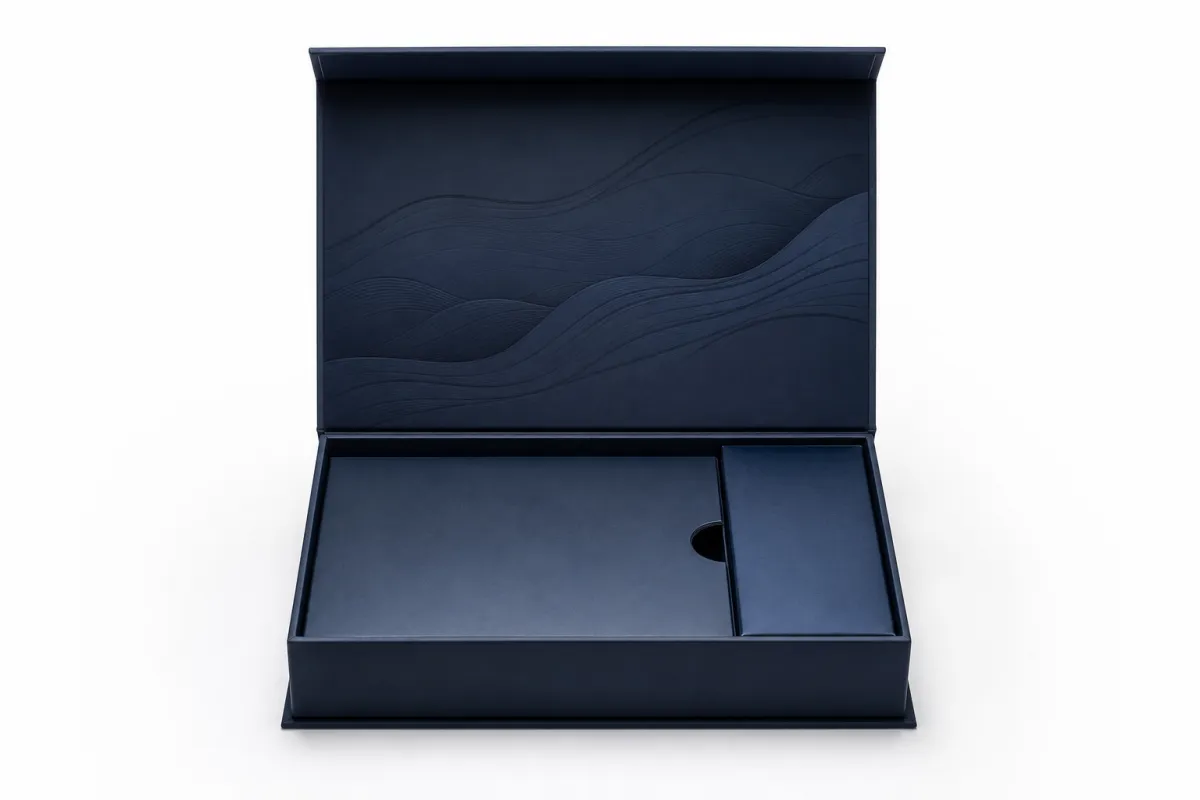
A printed rigid box supplier handles much more than ink on paper. The board is usually greyboard or chipboard in the 1.5 mm to 3 mm range, then wrapped with printed paper, specialty paper, or laminated stock. That wrap gets die-cut, folded, glued, and pressed over the board with enough precision that the seams disappear or nearly disappear. If that sounds fussy, good. It is supposed to be fussy.
The expensive part is often not the board itself. It is the wrapping, finishing, hand assembly, and quality control that separate a box that looks premium from a box that looks like it survived a bad day. A printed rigid box supplier coordinates board selection, print setup, finishing, inserts, magnet placement, corner folding, and final inspection. If any of those steps drift, the whole box feels off.
That is why a printed rigid box supplier fits products where the first impression matters: fragrance sets, skincare bundles, gift kits, premium tea, watches, headphones, special edition books, and presentation boxes for corporate gifts. A 2-piece set with a loose lid may work fine for storage. It does not work fine for luxury.
In my experience, the good suppliers ask about the product before they talk about finishes. That is the right order. A heavy glass jar needs a different insert strategy than a set of folded textiles, and a magnetic closure that feels elegant on a light box can become annoying on a box that already has a lot of weight in the lid. Small choices pile up.
- Board selection: choosing thickness, stiffness, and recycled content target.
- Print and finish: offset print, foil stamping, embossing, debossing, matte or soft-touch lamination.
- Assembly: wrapping, corner folding, magnetic closure alignment, and insert fitting.
- Quality control: checking color, fit, corner wraps, glue lines, and packing count.
A good printed rigid box supplier also asks questions that inexperienced buyers do not expect. What is the product weight? Does the insert need to hold glass, metal, or soft goods? Will the box sit on a retail shelf, ride through parcel shipping, or go straight into a gift bag? Those details change the spec, and they change the risk. Skip them, and the box may look fine right up until the first packed order starts moving through the warehouse.
The best suppliers act like packaging problem-solvers rather than parts sellers. That matters because a rigid box is judged as a finished object, not as a list of materials. The buyer sees the lid fit. The customer sees the corners. The shipping team sees whether the outer pack survives transit. The supplier has to care about all three.
How printed rigid box production works
The production path looks simple on a whiteboard and annoying in real life. A printed rigid box supplier usually starts with your brief, then builds a dieline, prepresses artwork, produces a sample, gets approval, runs mass production, and packs the finished boxes for freight. Delays usually hide in the middle, not at the end.
- Brief: dimensions, product weight, quantity, finish, insert type, and target date.
- Dieline: the flat template that locks panel sizes, folds, bleeds, and cut lines.
- Prepress: color corrections, file checks, and any layout fixes before print.
- Sample: a physical proof or pre-production sample to confirm fit and finish.
- Mass production: printing, die-cutting, wrapping, gluing, and assembly.
- QC and packing: spot checks, carton packing, palletizing, and freight prep.
Each stage has its own failure points. Bleed issues usually show up at artwork stage. Color drift appears when brand colors are judged off a screen instead of a printed proof. Corner wrinkles happen during wrapping. Loose inserts appear when the product is heavier than expected or the cavity was cut to the wrong tolerance. Magnet closures can look aligned from the outside and still be off enough to annoy every single person who opens the lid. That kind of problem is tiny on paper and very obvious in the hand.
A good printed rigid box supplier does not rush the sample stage just to save a few days. That move creates fake savings. If the sample reveals a wrong panel size, weak hinge, bad insert fit, or a paper stock that scratches too easily, you fix it once. If you skip the sample and find the problem after the full run starts, you pay for it twice. Sometimes three times, if freight is already booked and the launch date is not negotiable.
Timelines vary more than buyers expect. Simple builds can move in roughly 2 to 4 weeks after artwork and sample approval. More complex structures, specialty finishes, or extra revision rounds often stretch into 4 to 6 weeks or longer. Add shipping time on top. A lot of “fast” packaging plans only work on a spreadsheet, which is a lovely place to fail.
For boxes that will travel through parcel networks, ask whether the supplier thinks in terms of transit risk and test profiles. A printed rigid box supplier that understands ISTA expectations is usually better at protecting the final presentation, because the box is not only supposed to look good. It also has to arrive that way. If the outer carton or insert design is weak, the nicest print in the world will not save it.
Pricing and cost drivers from a printed rigid box supplier
Rigid box pricing has less to do with box size than most buyers think. A printed rigid box supplier is pricing board grade, wrap stock, print coverage, finishing, inserts, labor, tooling, freight, and how much hand work the box needs. That is why two boxes with the same outside dimensions can land miles apart in price.
The simplest quote usually includes a basic greyboard shell, printed wrap, standard glue assembly, and a simple insert. The price climbs when you add soft-touch lamination, foil stamping, embossing, magnets, custom foam, ribbon pulls, specialty paper, or unusual structures like book-style lids and multi-compartment inserts. None of those are free. They all add setup time or manual handling, and rigid box labor adds up quickly.
Short runs cost more per unit because setup time gets spread across fewer boxes. That is not a scam. It is math. A printed rigid box supplier still has to set plates, prepare materials, check alignment, and hand-assemble or machine-assemble the boxes, whether you order 500 pieces or 5,000. The smaller the run, the heavier the setup cost lands on each unit.
I also tell buyers to keep an eye on where the work happens. If a design depends on a lot of hand assembly, the price may stay reasonable at first and then climb faster than expected once the labor is actually counted. That is the part people miss when they only look at the first quote.
| Option | Typical spec | Approx. unit price at 1,000 pcs | Best for | Main tradeoff |
|---|---|---|---|---|
| Basic | 1.5 mm board, printed wrap, standard paper insert | $1.10-$2.00 | Simple retail kits, low-risk launches | Less premium hand feel |
| Mid-range | 2.0 mm board, full-color wrap, matte or soft-touch lamination | $2.10-$4.20 | Candles, beauty, gift sets, branded PR boxes | Higher finishing cost, longer lead time |
| Premium | 2.5 mm board, foil, embossing, magnet closure, custom insert | $4.50-$8.50+ | Luxury launches, jewelry, collector editions | More QC risk and more assembly labor |
These numbers are directional, not a promise. Region, material availability, labor costs, carton requirements, and freight can move them around pretty fast. At 5,000 pieces, a simple structure can often drop 15% to 30% versus a 1,000-piece run, but only if the spec stays sane. If you add a second foil color, custom foam, or a more complicated closure, the savings shrink fast. That is why asking for low, mid, and premium quote tiers is smart. It shows you what happens if you simplify one layer at a time instead of guessing.
Watch the hidden costs. Sample revisions cost money. Artwork corrections cost time. Oversized shipping cartons, palletizing, and import charges can quietly change the real landed cost. A printed rigid box supplier may send a quote that looks fine until freight gets added, and suddenly your “good deal” is just a nice-looking line item with a bad ending. I have seen projects look affordable right up until the final logistics sheet showed up.
If sustainability is part of the brief, ask for FSC-certified paper and clear chain-of-custody documentation. A vague “eco-friendly” claim is not a spec. If the supplier cannot explain the paper source, ask them to put it in writing or use a certified option from the start. For paper sourcing context, fsc.org is the cleaner reference than a marketing buzzword with a leaf icon.
Key factors that separate average from strong suppliers
The first thing I check is board thickness. A difference between 1.5 mm and 2.5 mm is not cosmetic. It changes stiffness, protection, and the way the box feels in hand. A thin board can still look elegant if the construction is clean, but it will never feel the same as a heavier shell with proper corner support.
Then I look at print consistency. Can the printed rigid box supplier hold color across the run? Can they keep registration clean? Can they reproduce the same result on a reorder six months later without turning your brand red into a weird orange-maroon compromise? Good suppliers document color targets, confirm proofs carefully, and do not treat repeat work like a brand-new mystery every time.
Structural details are where cheap boxes betray themselves. Lid fit, hinge strength, corner wrap quality, magnet alignment, and insert stability are the real telltales. A box may look acceptable from a distance and still feel wrong the moment someone opens it. I have seen one sloppy corner wrap do more damage to a premium presentation than a minor print flaw ever could. The eye forgives more than the hand does.
Production discipline matters too. A reliable printed rigid box supplier keeps QC checkpoints on file, checks the sample against the approved spec, and catches issues before the whole run is locked in. That means measuring panel sizes, checking glue lines, confirming magnet polarity, and verifying that the product does not rattle inside the insert. It sounds tedious because it is tedious. That is why it works.
Capability matching is the final filter. Not every supplier can handle your finish, your volume, your compliance needs, and your destination without drama. Some are great at simple beauty boxes but stumble on engineering-heavy inserts. Others can handle complex structures but price themselves out of short runs. A strong printed rigid box supplier knows what they are good at and does not fake confidence just to win the order.
Trust also shows up in what a supplier admits they cannot do well. A partner who says a finish is risky, or that a particular board weight may show corner crush, is usually more dependable than one who says yes to everything. That honesty saves money later.
How to choose a printed rigid box supplier step by step
Start with a clean spec sheet. If you send only a product photo and a vague idea, you are inviting confusion. A serious printed rigid box supplier needs dimensions, product weight, insert type, finish, quantity, target ship date, and a rough budget range. Without that, every quote is just a guess wearing a tie.
Next, compare 3 to 5 suppliers using the same brief. That is the only way the numbers mean anything. If one quote includes a magnetic closure, another includes a paper insert, and the third quietly swaps to thinner board, you are not comparing suppliers. You are comparing three different jobs.
Ask for physical samples or previous work with similar construction. PDF mockups are fine for layout, but they do not tell you how a lid closes, how the corners fold, or how the wrap feels under your thumb. A printed rigid box supplier with real sample depth is usually easier to trust than one with a polished sales deck and no tactile proof. I still believe that if someone cannot show you a box that behaves well in the hand, you are buying a promise, not a product.
Communication is not fluff here. It is risk control. Does the supplier answer in one day or does every question drag into the next week? Do they explain tradeoffs, or do they hide behind vague “yes, no problem” language? If they cannot explain why a 2.0 mm board is better than 1.5 mm for your product weight, they probably do not know enough to protect your order.
Score each printed rigid box supplier on price, sample quality, timeline reliability, and problem-solving ability. The cheapest number is only useful if the boxes arrive on time and match the approved sample. Otherwise, that quote is just an expensive surprise with a discount sticker on it.
Here is a practical screening order:
- Spec fit: can they build exactly what you need, or only something close?
- Sample quality: does the sample feel like the brand you are selling?
- Timeline reliability: do they give realistic lead times, not fantasy dates?
- Problem handling: do they fix issues quickly, or do they argue with the tape measure?
If you want a blunt rule, use this one: the right printed rigid box supplier is the one that can protect the brand experience at unboxing without blowing up the budget or turning the schedule into a negotiation. Pretty simple. Not easy. Those are different things, and people confuse them all the time.
Common mistakes buyers make with rigid box suppliers
The first mistake is approving artwork before the dieline is locked. That is how bleed errors happen, how logos land too close to a fold, and how text ends up in the wrong panel. A printed rigid box supplier can rescue some of that in prepress, but not all of it. If the template changes after you approve the art, the box changes with it.
The second mistake is choosing the cheapest quote and ignoring the spec behind it. A lower number can hide thinner board, fewer finishing options, a weaker insert, or a supplier that plans to hand-wave quality control. Cheap is fine if the job is simple and the expectations are modest. Cheap is a bad plan when the packaging has to sell the product before the customer even opens it.
The third mistake is skipping fit tests and relying only on a dummy sample. A product can look fine in a mockup and still rattle, jam, or crush the insert in production. That is especially true for glass jars, metal devices, and any item with awkward edges. A printed rigid box supplier should test the real product, not just the idea of it.
The fourth mistake is ignoring outer cartons and pallet protection. A perfect inner box can still arrive dented if the master cartons are weak, the pallet wrap is sloppy, or the stacking plan is lazy. Ask about shipping cartons, compression resistance, and the supplier’s packing method. If the box spends three weeks in transit and arrives scuffed, nobody will care that the print proof looked beautiful.
If the package must survive parcel handling, ask how the supplier thinks about transit durability and compare that thinking to ISTA standards. You do not need to turn the job into a lab project. You do need to avoid pretending that a luxury box will survive rough handling just because the render looks expensive.
The last mistake is assuming every supplier defines luxury the same way. They do not. One supplier may mean clean corners and decent color. Another may mean heavier board, cleaner foil, and tighter tolerances. The difference shows up in the corners, in the lid closure, and in how much confidence the box gives the customer before they touch the product. That confidence is part of the product, whether the finance team likes that or not.
Expert tips and next steps for choosing a printed rigid box supplier
Ask for a small test run or a pre-production sample if the structure is new. A good sample is not paperwork. It is your cheapest chance to catch problems before they turn into a full run of boxes you do not want to open, let alone ship. A printed rigid box supplier who resists samples is telling you something, and it is not flattering.
Request a written checklist that covers finish, insert, tolerance, carton count, and freight method. That way nobody later claims the missing ribbon, wrong insert, or weak carton “was not included.” A clean checklist also helps when you reorder, because you are not hunting through old emails like a detective in a low-budget mystery.
Verify reorder behavior. Ask whether the printed rigid box supplier keeps the cutting files, board spec, and finishing references on file for repeat production. Good suppliers do. It saves time, reduces drift, and makes the second run more consistent than the first. Reorders should get easier, not more confusing.
Use a three-part decision rule: the supplier has to hit your quality bar, your timeline, and your landed cost target. Miss one and the packaging is not really working. Miss two and you are likely buying stress with a logo on it. That is not branding. That is a tax on bad planning.
Think about the unboxing moment as a business asset. The customer sees the lid, the fit, the color, the texture, and the way the insert holds the product. A strong printed rigid box supplier protects that moment. A weak one turns it into a reminder that cutting corners is always visible in the corners.
If you need a fast way to compare options, judge each printed rigid box supplier on five questions:
- Can they prove the box structure before the full run?
- Can they hold color and finish consistency across quantity?
- Can they explain why the quote is what it is?
- Can they give a realistic date without guessing?
- Can they protect the product during shipping and storage?
That is the whole game, really. A printed rigid box supplier is worth keeping if they make the process clearer, not noisier. If they make every step feel like a negotiation, they are probably not the right partner for a brand that cares about presentation. And if they keep dodging sample questions, I would walk away pretty fast.
FAQ
How do I choose a printed rigid box supplier for a small order?
Look for a printed rigid box supplier that accepts lower minimums without forcing ridiculous setup fees. Start with a simple structure, standard board, and a basic insert so the run stays realistic. Ask for a sample or proof before you commit, because a small order still deserves a box that actually fits the product.
What affects printed rigid box supplier pricing the most?
Board grade, wrap paper, and finishing choices usually move pricing faster than the printed artwork itself. Short runs cost more per unit because setup and hand assembly get spread across fewer boxes. Custom inserts, magnets, foil, embossing, and specialty coatings can push the price up quickly.
How long does a printed rigid box supplier need to produce custom boxes?
Simple jobs may be ready in about 2 to 4 weeks after artwork and sample approval. Complex structures, special finishes, or multiple revision rounds can stretch the timeline much longer. Always add shipping time on top of production time so your launch date is not fantasy.
What files should I send to a printed rigid box supplier?
Send dieline-ready artwork, vector logos, linked images, and exact size specs. Include Pantone references or color expectations if brand color matters. Add notes for finish, insert type, and any must-hit placement details so the supplier is not guessing.
Is a local or overseas printed rigid box supplier better?
Local suppliers usually win on communication, faster samples, and easier troubleshooting. Overseas suppliers can be cheaper at scale, but freight, lead time, and import charges can erase the savings. If the launch is tight or the structure is new, local often reduces risk.
If you choose a printed rigid box supplier on sample quality, structure control, and landed cost instead of chasing the lowest quote, you usually get packaging that does its job the moment the customer lifts the lid. The takeaway is pretty plain: lock the dieline, approve the physical sample, and keep the written spec close, because those three things protect the final box far better than a pretty render ever will.
Related packaging resources
Use these related guides to compare specs, costs, quality checks, and buyer decisions before making the final call.


