Buyer Fit Snapshot
| Best fit | Compostable Void Fill Supplier projects where brand print, material claims, artwork control, MOQ, and repeat-order consistency need to be specified before quoting. |
|---|---|
| Quote inputs | Share finished size, material target, print colors, finish, packing count, annual reorder estimate, ship-to region, and any compliance wording. |
| Proofing check | Approve dieline scale, logo placement, barcode or warning zones, color tolerance, closure strength, and carton packing before bulk production. |
| Main risk | Vague material claims, crowded artwork, missing packing details, or unclear freight terms can make a low unit price expensive after revisions. |
Fast answer: Compostable Void Fill Supplier: Material, Print, Proofing, and Reorder Risk should be specified like a repeatable production item. The safest quote records material, print method, finish, artwork proof, packing count, and reorder notes in one written spec.
Production checks before approval
Compare the actual filled-product size with the drawing, then confirm tolerance on folds, seals, hang holes, label areas, and retail display edges. Reserve space for logos, QR codes, warning copy, and material claims before decorative graphics fill the panel.
Quote comparison points
Review material grade, print process, finish, sampling route, tooling charges, carton quantity, and freight assumptions side by side. A quote is only useful when the supplier can repeat the same color, closure quality, and packing count on the next order.
When a carton lands on a porch and the product is rattling around inside, the problem is bigger than a broken item. It is wasted cube space, higher freight cost, more handling pressure in the warehouse, and a customer who can tell the pack-out was treated like an afterthought. That is why a compostable Void Fill Supplier matters more than many teams first assume. A good compostable void fill supplier does not just ship filler material; it helps reduce damage, keeps pack lines moving, and supports a stronger unboxing experience without falling back on fossil-based foam or loose-fill peanuts.
From a packaging buyer's point of view, void fill sits in a strange middle ground. It looks minor on the expense report, yet it can shape dimensional weight, warehouse speed, and the credibility of your eco-friendly packaging story. In practical terms, the right compostable void fill supplier is helping with a materials decision, a logistics decision, and a brand decision at the same time. That is a lot of responsibility for something that disappears into a shipping box.
Fragile glass, cosmetics, candles, snack packs, electronics accessories, and mixed-SKU e-commerce orders all put different demands on a shipment. I have seen the same filler perform well in one program and fall apart in another simply because the product weight, carton size, or warehouse humidity changed the equation. This guide covers what a compostable void fill supplier actually provides, how the material behaves in transit, what pricing tends to look like, and how to tell whether a claim supports a circular economy or only sounds polished on paper. If your team cares about green packaging that holds up in the real world, the details matter.
Why a Compostable Void Fill Supplier Matters More Than Empty Space
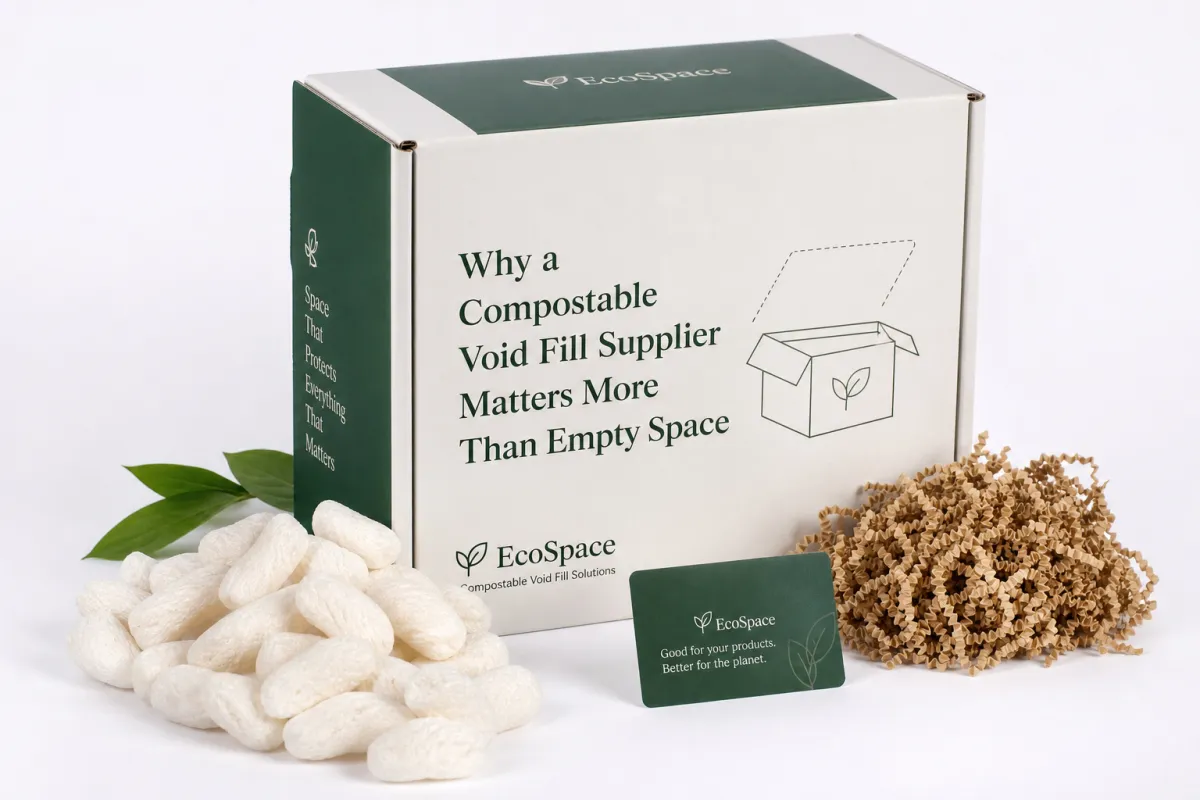
Empty space inside a carton is never really empty. It is unused volume you still pay to ship, a gap that lets product momentum build during transit, and a signal to the end customer that the package was not sized with care. A compostable void fill supplier helps convert that wasted space into a controlled buffer, and the result can be lower breakage, fewer returns, and a cleaner opening experience. A compostable void fill supplier is not simply selling filler; it is helping you defend the shipment.
That matters most when box sizes vary widely. In a mixed-SKU e-commerce operation, one day may call for a small bottle in a mailer, and the next may involve stabilizing a candle set in a larger corrugated carton. The same compostable void fill supplier can support both, but only if the material choice matches product weight, fragility, and fill pattern. A light kraft shred that works for cosmetics may be too soft for a glass jar with a tall center of gravity.
Freight is another side of the equation that many teams underestimate. Void fill affects how small a carton can be while still protecting the product, and smaller cartons often reduce dimensional weight charges. That does not happen by accident, yet a knowledgeable compostable void fill supplier will talk through box optimization, not just filler volume. The filler and the carton should be treated as one system.
Sustainability alone does not make a material useful. A product can be compostable and still be a poor fit if it sheds dust, crushes too quickly, or adds extra labor at the pack station. The best compostable void fill supplier understands that brand trust depends on performance first. If the package arrives damaged, the sustainability claim becomes little more than a consolation prize.
That is why procurement teams should ask a broader question than, "Is it green?" They should ask, "Will this compostable void fill supplier help us reduce damage, keep labor steady, and support the carbon footprint goals we already set?" In practice, that framing usually gets better answers from suppliers and cleaner results from trials.
- Best fit cases: fragile glass, cosmetics, candles, gift sets, subscription boxes, and accessories with lots of unused carton space.
- Operational value: better product stability, less carton movement, smoother pack-out, and a more consistent customer experience.
- Brand value: stronger eco-friendly packaging claims, better perceived quality, and less tension between sustainability and performance.
"A compostable label does not pay freight bills, and it does not replace transit testing. If the box fails, the packaging story fails with it."
What a Compostable Void Fill Supplier Actually Does
A compostable void fill supplier may manufacture the material, convert it into a specific format, distribute stock from a warehouse, or private-label a product made elsewhere. That distinction matters because the part of the supply chain you are buying from shapes the kind of support you receive. A manufacturer may have more control over fiber, blend, and certification data, while a distributor may offer faster shipments and lower minimums. A good compostable void fill supplier will tell you plainly where it sits in that chain.
The material families are usually straightforward, but the details are where procurement teams get tripped up. Common options include recycled kraft paper, molded paper shreds, starch-based loose fill, and other compostable formats that can behave differently depending on humidity, compression, and transit time. Not every compostable option fits every use case, and some are compostable only under industrial conditions. That is exactly why a compostable void fill supplier should provide data, not slogans.
Performance is easiest to judge in plain language. You want cushioning, interlocking, decent recovery after compression, low dust, and enough structure to stay in place while the parcel moves through sorting, stacking, and carrier handling. If the material settles too much, the protection disappears. If it is too springy, packers may overfill the carton. A skilled compostable void fill supplier will talk about all of that before price enters the conversation.
It also helps to separate industrial compostability from backyard compostability. These are not interchangeable terms, and they are not just marketing language. The disposal path depends on the actual certification, the local waste stream, and whether the customer has access to the right composting facility. Standards and test methods matter here, and buyers should look for documentation tied to recognized frameworks such as ASTM D6400, ASTM D6868, or EN 13432 when those are relevant to the material. For broader packaging context, the EPA recycling and composting resources are a useful starting point, especially when a team is mapping end-of-life claims.
Packaging compatibility matters more than the brochure
The best compostable void fill supplier does more than send sample bags. The supplier should match the material to your packing method. Hand-dispensed loose fill works well in low-to-mid volume operations where packers need flexibility. Pre-expanded loose fill can be convenient if it stays fluffy in storage and does not break down under light compression. Automated systems are a different conversation entirely, because particle size, flow rate, and dust control all affect uptime.
In a high-throughput facility, the wrong filler can slow labor by seconds per carton, and those seconds add up quickly. A good compostable void fill supplier should know whether the product will be used at a single bench, across multiple stations, or on a semi-automated line. If that question is hard for them to answer, keep asking. I have reviewed enough packing stations to know that a material that sounds great in a quote can become annoying very fast once the shift gets busy and the crew is moving at full speed.
Testing is another useful reference point. The best compostable void fill supplier will not hesitate if you want shipping validation aligned with transit profiles like ISTA test standards. Real shipping is messy, and the testing should reflect that mess. Drop, vibration, compression, and edge-corner exposure all help reveal whether the material behaves the way it should.
How Compostable Void Fill Works in Real Packaging
Protection begins with motion control. A box that rattles lets the product build momentum, then strike the corrugate wall or another item. A compostable void fill supplier helps stop that movement by creating a compressible buffer that absorbs shock and keeps the product centered. That is the basic physics, and it stays the same whether you are packing a single bottle or a full gift assortment.
Different shipping profiles need different fill behavior. A single-item e-commerce order may need enough fill to block movement at the top and sides, while a subscription box with multiple components may need the filler to keep nested items from grinding against each other. A fragile gift set often benefits from a combination of inner stabilization and outer void fill, while bulk distribution may call for a denser, more structured paper format. A capable compostable void fill supplier should ask about the product mix before recommending anything.
Box design changes the equation too. Right-sized cartons lower the amount of filler required, and well-designed inserts can reduce the need for void fill at all. If you can trim headspace by half an inch or adjust the product nest, you may use less filler and still improve protection. That is where a good compostable void fill supplier becomes part of a broader packaging optimization exercise rather than a one-line purchase order.
Humidity and compression deserve real attention. Paper-based materials can behave differently in a damp warehouse than they do in a dry one, and some starch-based materials may lose resilience if they sit too long under pressure. That does not make them bad; it simply means the storage and transit conditions need to be known. The best compostable void fill supplier will tell you the storage window, pallet stacking guidance, and any cautions about temperature or moisture. That kind of honesty is what keeps a procurement team from getting surprised six weeks after the first shipment.
Sustainability claims only hold up when they support performance. A material can be compostable and still be the wrong choice if you need to stuff so much of it into the carton that labor time rises and the pack-out gets messy. A wise compostable void fill supplier helps you find the middle ground where protection, speed, and disposal story all make sense. That is better than buying the greenest-looking option and discovering later that it creates more waste in the form of damaged product.
For brands trying to support zero waste goals, the material itself is only part of the picture. You also need realistic carton sizing, honest end-of-life guidance, and a packing process that does not encourage overuse. That is how compostable materials support a circular economy in practice rather than just in a pitch deck. If the customer cannot actually compost the material where they live, say that clearly instead of dressing it up.
Cost, Pricing, and MOQ: What a Compostable Void Fill Supplier Charges
Pricing for a compostable void fill supplier usually breaks into a few parts: the material itself, the packaging format, freight, storage, and any service fees tied to custom converting or dispensing equipment. If you compare only the quoted unit price, you may miss the real cost. A supplier that charges a little more per cubic foot but delivers better pack consistency can still be cheaper once damage reduction and labor are included.
Minimum order quantity is one of the first things buyers should ask about. Lower MOQs help with trials, especially for smaller brands or seasonal products, but the unit price often improves at higher volumes. That is normal. What matters is whether the compostable void fill supplier can support your growth path without forcing you into more inventory than you can store. There is a real difference between a test run of a few pallets and a program designed for steady replenishment across multiple fulfillment centers.
Freight can be sneaky. A lightweight loose-fill material may look inexpensive until you factor in shipping volume, pallet density, and the number of boxes required to move the same amount of product. A denser paper format might cost more per unit but ship more efficiently. A smart compostable void fill supplier will help you compare landed cost, not just list price. That is the number your finance team will care about after the first invoice lands.
Custom print, special certifications, rush orders, color matching, and private-label packaging can also push price up. Seasonal spikes can do the same, especially if the material is tied to limited production capacity. If your packaging program depends on a specific compostability certification or a branded look, build that into the budget from the start. The cheapest quote is not always from the best compostable void fill supplier; sometimes it comes from the one that left out the hard parts.
| Option | Typical Use | Indicative Price Range | Line Compatibility | Notes |
|---|---|---|---|---|
| Recycled kraft paper roll or sheet fill | General e-commerce, cosmetics, light fragile goods | $0.08-$0.22 per packed carton, depending on fill volume | Manual or semi-automated | Good for flexibility and clean presentation; often a strong first trial from a compostable void fill supplier |
| Molded paper shred | Gift sets, bottles, jars, premium shipper boxes | $35-$70 per bale or equivalent bulk unit, varying by fiber content | Manual | Helps lock products in place; can feel more upscale than loose-fill styles |
| Starch-based loose fill | Lightweight cushioning, low-volume shipper protection | $0.18-$0.35 per cubic foot | Manual | Light, fast to use, but check dust, crush resistance, and compostability claim scope |
| Paper-based automated void fill | Higher-volume fulfillment centers | $0.12-$0.30 per carton equivalent, plus equipment or service fees | Automated or semi-automated | Useful where throughput matters; test feed behavior before converting an entire line |
Those ranges are only starting points, and they vary by region, order size, and whether the quote is stock or custom. Even so, they give buyers a much better footing than vague language about being "affordable." A serious compostable void fill supplier should be able to explain price breaks at multiple volumes, typical freight assumptions, and what happens to cost if you change carton size or annual usage.
If you want the cleanest buying decision, ask for a landed-cost comparison that includes freight and storage. Then add damage rate and pack time to the equation. A material that saves two seconds per box may justify a higher unit price if your team packs tens of thousands of orders each month. That is the kind of math a practical compostable void fill supplier should be willing to discuss, because the sticker price alone never tells the full story.
Process and Timeline: From Quote to First Shipment
The buying process usually starts with a discovery call, and that call should feel more like a technical intake than a sales pitch. A good compostable void fill supplier will ask what you ship, how fragile it is, how much headspace exists in the carton, and whether your packing is manual or automated. If those questions are skipped and the discussion goes straight to price, caution is warranted.
After that comes sample selection and testing. You may receive one or two formats first, then run them against real products and real packers. The goal is not to judge the material in a vacuum; the goal is to see how It Works Inside your actual process. The best compostable void fill supplier will encourage this, because a sample that looks good but slows the line is not a good fit.
Lead time depends on stock availability, custom converting, certification paperwork, and freight lane distance. A distributor shipping from a warehouse can often move faster than a plant that needs to produce a fresh run. If you need private-label packaging, the schedule may stretch further because art approval and pack-out specs add steps. In many cases, a stocked program can move in about 1-2 weeks after approval, while custom programs may need 3-6 weeks or more depending on complexity. The point is not to promise a fixed number; it is to understand what your compostable void fill supplier can actually control.
Buyers should prepare a few things early: annual volume estimate, carton dimensions, average fill per order, desired compostability standard, pallet or truckload needs, and any warehouse constraints. Those details shorten the quote cycle and reduce the chance of misunderstandings later. A well-prepared customer usually gets a much sharper recommendation from a compostable void fill supplier, because the supplier is not guessing at the application.
Communication matters after the PO is placed too. Good suppliers share order status, production steps, and expected arrival windows. That sounds basic, but it makes a real difference for labor planning. If your team knows when a pallet of filler is due, they can stage space and staffing accordingly. A reliable compostable void fill supplier should make planning easier, not harder.
- Discovery: product profile, carton size, pack method, compostability target.
- Sampling: side-by-side material trials in real cartons.
- Approval: confirm performance, pricing, and documentation.
- Launch: schedule shipment, train packers, monitor first orders.
Common Mistakes When Choosing a Compostable Void Fill Supplier
The first mistake is treating compostable and biodegradable as if they mean the same thing. They do not. In packaging procurement, that difference matters because one term may point to a specific composting standard while the other may be far less precise. A good compostable void fill supplier will define the claim clearly and back it up with documentation. If the wording stays fuzzy, the risk usually does too.
The second mistake is buying on claims alone. A glossy sample and a sustainability statement do not tell you how the material behaves after vibration, drop impact, or days inside a moving parcel network. Without test data or a real pilot, you are guessing. A dependable compostable void fill supplier should welcome sample trials and should not be surprised when you ask for certification details, material safety information, and storage guidance.
Overpacking and underpacking both get expensive. Too little void fill means more breakage and more returns, which can erase any environmental win fast. Too much fill slows pack-out, increases material consumption, and can even raise freight cost if it forces a larger carton. The right compostable void fill supplier helps you find the fill level that protects the product without turning the box into a pillow factory.
Compatibility mistakes are common too. Some materials generate dust, some collapse in humid warehouses, and some are awkward for automated dispensers. If a team rolls out a new material without line testing, they may create bottlenecks in the first week. A smart compostable void fill supplier should discuss feeding behavior, storage conditions, and whether the material works in the actual device or only on a sample table.
Disposal guidance is easy to overlook and hard to recover later. If end users do not know where to compost the filler, the sustainability story weakens right at the point of use. Clear labeling helps, and honest messaging helps even more. The best compostable void fill supplier will tell you what the claim means, where it applies, and how to communicate it without overpromising. That is better for trust and better for the brand.
For packaging teams trying to support zero waste goals, this is the point where discipline matters. A real sustainability program is not built on good intentions alone; it is built on material selection, verified claims, and packaging formats that match the shipment. In practical terms, your compostable void fill supplier should make the circular economy easier to support, not harder to explain.
Expert Tips for Working with a Compostable Void Fill Supplier
Request samples in the exact carton sizes and product combinations you ship every day, not in idealized demo boxes. That sounds simple, but it changes the quality of the trial dramatically. A material that performs beautifully in a showroom may behave very differently when a packer is moving quickly on a live line. A thoughtful compostable void fill supplier should support realistic testing from the start.
Measure more than damage rate. Track pack time, material use per order, customer feedback, and any impact on warehouse cleanliness. If the filler creates litter, extra sweeping, or line interruptions, those costs belong in the evaluation too. The right compostable void fill supplier should improve more than one metric if the switch is going to be worthwhile.
Ask for documentation up front. Certifications, storage instructions, shipping specs, and any disposal guidance should all be easy to review before you place a purchase order. If the supplier hesitates, that is a signal. A credible compostable void fill supplier should have no trouble showing how the product is classified and what conditions are needed for the claim to hold up.
Roll out in phases whenever possible. Start with one product family, one fulfillment center, or one shipping lane, then expand after the material proves itself. This reduces risk and gives your team time to tune pack instructions. A phased launch also helps a compostable void fill supplier learn your needs in a practical way, which can lead to sharper recommendations later.
Here is a procurement habit I recommend: negotiate annually, but evaluate quarterly. Freight, seasonal demand, and product mix can shift the economics of void fill quickly. A compostable void fill supplier that was the best fit in January may need a different order pattern by the time peak season arrives. Keeping the review cycle moving helps you avoid stale assumptions, and it keeps everyone honest about what the material is actually doing.
"The best packaging choices are the ones that hold up under real labor, real freight, and real customer handling. If a filler cannot survive that, it is not the right filler."
One more practical point: if you work with branded cartons, inserts, or printed shipper systems, make sure the void fill decision supports the whole package architecture. Brands with custom logo packaging often care about the visual story as much as the protective function, and that is fair. The filler should complement the brand, not fight it. A capable compostable void fill supplier should understand that visual, operational, and environmental goals often have to share the same box.
Next Steps for Buying Compostable Void Fill
Start by building a shortlist of suppliers that can match your shipping format, compostability requirements, and expected volume. That shortlist should not be based only on website claims. A good compostable void fill supplier can explain what material they provide, where it is produced or converted, and how it behaves in the sizes you actually use.
Then collect three inputs before you ask for quotes: carton dimensions, average fill per order, and monthly usage. Those numbers make the pricing conversation much more grounded. If a supplier knows you pack 8,000 orders a month with an average void fill need of 0.25 cubic feet, they can get much closer to a useful quote than if they only hear "we need something sustainable." A serious compostable void fill supplier will appreciate the detail.
Run a simple trial plan. Compare damage rate, pack time, material use, and customer response across at least two compostable options. Keep the shipping lanes and product mix as consistent as possible so the results are meaningful. If you can, compare them against your current material too. That gives you a true baseline and helps the compostable void fill supplier see where the material stands in your process.
Ask for a landed-cost comparison that includes freight and storage, then decide whether stock, custom, or hybrid sourcing makes the most sense. For many teams, a hybrid program works well: stock material for normal demand, with a custom or private-label option reserved for larger or branded programs. That kind of arrangement is often easiest to manage with a compostable void fill supplier that has both warehouse availability and technical support.
Once you choose a material, approve samples, confirm lead time, train the packing team, and monitor results after launch. Those steps sound basic, but they keep the project from stalling after the first shipment. The real win is not just finding a compostable void fill supplier; it is building a repeatable packaging process that protects product, supports green packaging goals, and holds up under real volume.
If you are balancing branded presentation, product protection, and sustainability, a compostable void fill supplier is one of the few partners that touches all three. Get the spec right, test it honestly, and keep the economics visible. That is how a compostable void fill supplier becomes part of a durable packaging system instead of a one-time experiment. The simplest actionable takeaway is this: compare suppliers on real cartons, real freight, and real pack time, then choose the one that reduces risk without muddying your end-of-life claim.
What should I ask a compostable void fill supplier before ordering?
Ask about compostability certifications, recommended use cases, MOQ, lead time, freight options, storage conditions, and whether the material works in your current packing process. A strong compostable void fill supplier should be able to answer each one without hand-waving.
Is compostable void fill more expensive than traditional packaging fill?
It can be higher on unit price, but total cost may still be competitive once you factor in lower damage claims, smoother pack-out, and reduced sustainability risk. The best compostable void fill supplier will help you compare landed cost instead of just list price.
How do I know if the void fill is truly compostable?
Request certification details, test standards, and written disposal guidance, then verify whether the claim applies to industrial composting, backyard composting, or both. A reputable compostable void fill supplier should make the scope of the claim very clear.
Can a compostable void fill supplier support automated packing lines?
Some can, but you need to confirm particle size, dust levels, feeding behavior, and compatibility with your dispensing equipment. A compostable void fill supplier that works well for manual packing may need additional qualification before you place it on a faster line.
What is the best way to test a new compostable void fill supplier?
Run a pilot with real cartons, real products, and real transit conditions, then compare damage rates, pack time, and material usage against your current solution. That is the most dependable way to tell whether a compostable void fill supplier is actually improving the package, not just the paperwork.