Buyer Fit Snapshot
| Best fit | corner boards with logo print for packaging buyers comparing material specs, print proof, MOQ, unit cost, freight, and repeat-order risk where brand print, material, artwork control, and repeat-order consistency matter. |
|---|---|
| Quote inputs | Share finished size, material target, print colors, finish, packing count, annual reorder estimate, and delivery region. |
| Proofing check | Approve dieline scale, logo placement, barcode or warning zones, color tolerance, and any recyclable or compostable wording before bulk production. |
| Main risk | Vague material claims, crowded artwork, or missing packing details can create delays even when the unit price looks attractive. |
Fast answer: Corner Boards with Logo Print: Branding That Protects should be specified like a repeatable production item. The safest quote includes material, print method, finish, artwork proof, carton packing, and reorder notes in one written spec.
What to confirm before approving the packaging proof
Check the product dimensions against the actual filled item, not only the sales mockup. Ask for tolerance on folds, seals, hang holes, label areas, and retail display edges. If the package carries a logo, QR code, warning copy, or legal claim, reserve that space before decorative graphics fill the panel.
How to compare quotes without losing quality
Compare board or film grade, print process, finish, sampling route, tooling charges, carton quantity, and freight assumptions side by side. A lower quote is only useful if the supplier can repeat the same color, closure quality, and packing count on the next order.
Corner Boards with Logo Print: Branding That Protects
A pallet can leave the warehouse looking plain and still arrive looking intentional if the corners carry a logo, a handling cue, or a short brand message. That is the actual job of corner boards with logo print: they protect edges from strap pressure, stretch-wrap force, and the usual knocks of transport, while turning a structural packaging part into a branded surface that earns its place on the load.
That matters for packaging teams twice over. The board has to survive compression and rough handling. The print has to survive the same trip without smearing, cracking, or fading into a dull gray blur. A printed corner board is not decoration. It is part of the load-securing system, and it should be judged that way from the start.
The best pallet branding is not the loudest one. It is the kind that still looks sharp after wrapping, stacking, dock handling, and a long ride through the supply chain.
Packaging engineering and visual identity meet here, and they do not always agree on the first draft. Board profile, thickness, print method, ink coverage, and artwork all need to fit together. Miss one piece and the shipment may still go out, but the finish starts looking cheap, rushed, and a little too optimistic.
What Corner Boards with Logo Print Really Do
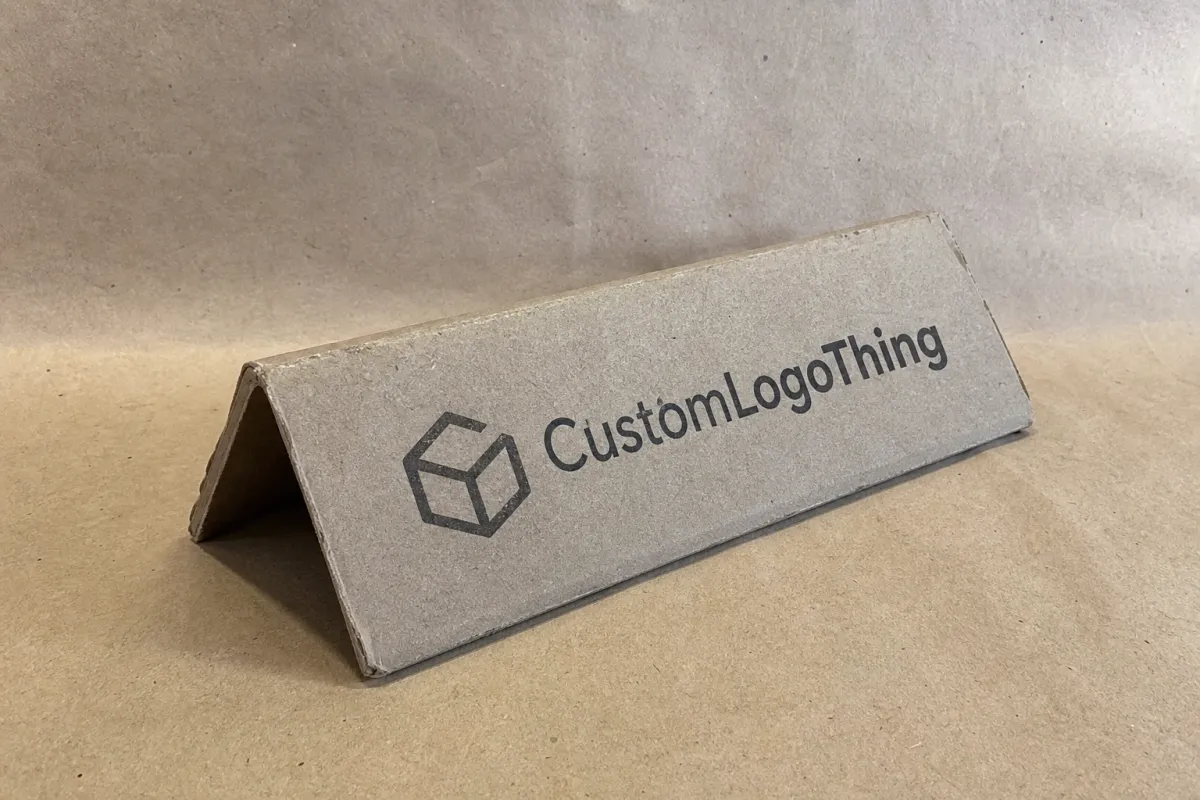
Picture a pallet stacked with case-packed product, ready for a distributor or retail partner. The cartons may be perfect, but the corners are usually the first place damage shows up. A strap can bite into the edge. Stretch film can pull inward and leave pressure lines. Fork tines can nick a corner during a fast warehouse move. That is where corner boards earn their keep, and why corner boards with logo print do more than look tidy.
Corner boards are structural packaging components made to reinforce pallet edges. They are commonly formed into an L-shape or V-shape and placed along the vertical corners of a load before wrapping or banding locks everything together. Their job is to spread pressure across a wider area, reduce crush at the edge of cartons, and help the load keep its shape during storage and transit. In real operations, that can mean better top-to-bottom stability, fewer crushed case corners, and less rework at receiving.
Printing adds a second layer of value. A plain protector says the load needs support. A branded protector says the shipment was prepared with care. That sounds subtle, but in B2B shipping, subtle details change how a pallet is received. A branded corner board can reinforce recognition at a glance, keep shipments consistent across multiple lanes, and make bulk freight feel more deliberate to distributors, retailers, and internal teams moving product through a facility.
There is a useful difference between decoration and functional branding. Decorative branding tries to stand alone. Functional branding rides on a part that already has a job, so the logo becomes part of the protection system instead of a separate marketing layer. That is one reason Printed Corner Boards are often smarter than loose signs or random add-on labels. The message sits exactly where the load already needs reinforcement.
For buyers who care about transport performance testing or recycled fiber claims, it helps to work from recognized references. The International Safe Transit Association publishes useful package performance resources at ista.org. FSC also provides clear chain-of-custody and certification information at fsc.org. Those sources do not replace a practical packout test, but they help when a buyer needs packaging that is both presentable and defensible.
The real question is not whether the logo looks good in a mockup. The real question is whether the board still performs after compression from stretch-wrap tension, repeated handling, and stacking in a warehouse that may be humid, cold, or simply busy. That is the standard worth using from the first quote.
How Corner Boards with Logo Print Work on the Line
The workflow is simple enough on paper. Boards are cut to size, printed or labeled, then placed at the pallet corners before wrapping, strapping, or banding secures the assembly. Once the load is locked in, the board becomes part of the package structure, not just a surface treatment.
Material choice drives a lot of the performance. Many corner boards use recycled paperboard, multi-ply linerboard, or laminated paper structures designed to resist compression. Some are built from single-wall or multi-layer constructions, while others use denser, compressed paperboard for better edge recovery. Thickness often lands somewhere in the 2 mm to 8 mm range, depending on the load and the protection target. Leg lengths commonly range from about 1.5 inches to 4 inches per side, though heavier loads can call for more substantial dimensions.
Flute structure and board rigidity matter because corner boards do not just sit there looking pretty. They need enough stiffness to spread load from the strap or wrap, yet they still have to fit cleanly into the palletizing workflow. A board that buckles too early loses its value. A board that is too stiff for the application can be awkward to place, especially on high-speed lines or mixed-SKU operations.
Print method changes the buying experience too. Flexographic printing is common for repeat runs, simple graphics, and larger quantities because it is efficient once the setup is in place. Digital printing works well for shorter runs, multiple versions, or faster turnarounds, especially when a brand wants to test a design before a larger order. Applied labels are useful when artwork changes often or a buyer needs low minimums, but they can be more vulnerable to abrasion depending on the warehouse environment.
Color strategy matters just as much. Some brands only need a one-color logo, which keeps costs under control and often reads better from a distance. Others want CMYK graphics for richer artwork, while a brand mark with one or two spot color inks can strike a practical balance between clarity and cost. On a narrow board surface, simplicity usually wins. Fine text, tiny legal copy, and dense graphics can disappear once the board is wrapped or partly covered by film.
Print methods at a glance
| Print Method | Best For | Setup Profile | Practical Notes |
|---|---|---|---|
| Flexographic printing | High-volume, repeatable artwork, simple logos | Moderate setup, efficient on larger runs | Good for clean brand marks and stable color output |
| Digital printing | Short runs, multiple versions, quick approvals | Low setup, faster artwork changes | Useful for proofing, test orders, and variable messaging |
| Direct print with spot color | Simple identity graphics and strong logo visibility | Setup depends on color count and press format | Often the most cost-effective route for a single or two-color mark |
| Applied label | Flexible branding, fast revisions, low-volume needs | Minimal print setup, label application added later | Can be less durable if exposed to abrasion or moisture |
Print finishing can matter too. Some boards ship with no extra finish because the print already reads cleanly. Others use a water-based varnish or a matte overprint to improve rub resistance. Heavy coating is not always necessary, and in some cases it can work against recyclability or add cost without much benefit. The right finish is the one that fits the handling conditions, not the one that sounds fancy on a quote.
Visual impact is strongest in places where pallets are seen before cartons are opened: dock-to-dock transport, cross-docking environments, retail-ready shipments, and B2B deliveries where receiving teams interact with the load before anyone sees the product itself. If the pallet is part of your brand story, the corner board is one of the few surfaces that stays visible at the load perimeter for the entire trip.
Cost, Pricing, and MOQ Factors for Corner Boards with Logo Print
Pricing for corner boards with logo print comes down to a handful of practical variables, and most of them are easy to understand once they are laid out. Board size, caliper or thickness, color count, ink coverage, artwork complexity, and finish all shape the final number. If the board needs a specialty construction, moisture resistance, or a more demanding print finish, cost usually rises with it.
Quantity matters just as much. Setup costs are easier to absorb on larger runs because the press, tooling, and prepress work are spread across more pieces. Smaller orders can carry a higher unit price because the supplier still has to build the job, make the plates or file setup, and confirm the proofing. A buyer ordering 25,000 boards will usually see a very different per-piece number than a buyer ordering 500 or 1,000, even if the artwork is similar.
Typical pricing for custom printed corner boards can vary widely, but for planning purposes, a simple one-color run might land around $0.18-$0.40 per unit at larger volumes, while more complex printed or thicker boards can move into the $0.35-$0.80 range or higher depending on the specification. Short-run digital work can be higher on a per-piece basis, but it may still be the right choice if the order is small or the artwork will change often. Those numbers are only planning ranges, not promises, because board dimensions, freight, and print coverage can shift them quickly.
MOQ expectations are another part of the conversation. Some suppliers are comfortable with a few hundred pieces for test programs, while others prefer 1,000, 2,500, or more because that is where the setup makes sense. A good quote should tell you the minimum order quantity, what happens if you reorder later, and whether pricing changes if you want split shipments instead of one full drop.
There are also hidden costs that catch buyers off guard. Artwork revisions can add time and expense if the logo is not supplied at a usable resolution. Rush production may require overtime or a changed schedule. Sample approvals can be charged separately. Freight can be a major line item if the boards are bulky and ship in large cubic volume. If the dimensions change after the quote is issued, the price can move too, because even a small size change can affect board yield and pallet counts.
Here is the practical truth: the cheapest board is not always the lowest-cost choice overall. If a thin board crushes too easily, fails in humid storage, or prints poorly, the warehouse may spend more time reworking loads or replacing damaged material. A slightly better board can be cheaper in the full shipping process because it lowers waste and keeps the pallet looking professional all the way through transit.
Practical buying tip: ask for a quote that separates board construction, print, setup, freight, and any proofing charge. That makes it easier to compare suppliers on the same terms instead of comparing one all-in number against another without knowing what is included.
What usually changes the price most
- Board dimensions: longer boards and wider legs increase material usage and freight volume.
- Thickness and construction: heavier caliper or laminated builds cost more but often improve compression resistance.
- Color count: one-color branding is usually simpler than full CMYK graphics.
- Artwork coverage: a small logo mark costs less than full-panel print coverage.
- Order volume: higher quantities usually reduce unit cost.
- Finish and handling: special coatings, labels, or packaging requirements can add cost.
Process and Timeline: From Artwork to Production Steps
The path from first request to finished shipment is usually more orderly than buyers expect, but only if the artwork and specifications are clean from the start. A standard process begins with dimensions, load details, print requirements, and delivery timing. From there, the supplier can confirm whether the requested board is practical and what production route fits the job best.
The first checkpoint is load definition. How tall is the pallet? How far does the product extend beyond the pallet edge, if at all? Will the load be wrapped, banded, or both? Is the warehouse dry, humid, refrigerated, or exposed to temperature swings? Those answers tell the supplier how much board strength is needed and whether the print has to survive moisture or abrasion.
Once the basic spec is known, artwork moves into prepress. This is where the file is checked for resolution, bleed, size, logo placement, and color mode. If the logo is supplied as a low-resolution image, the printed result will usually look fuzzy, especially on a long, narrow board. If the brand uses exact colors, the supplier may need to match a spot color or translate a design into CMYK for digital or process printing. Clean vector artwork makes life easier for everyone.
After prepress, the supplier may send a proof or sample. That step is worth the time because it reveals whether the logo is visible at pallet distance, whether the type is too small, and whether the board dimensions actually fit the load. A digital proof can catch layout mistakes, while a physical sample is better for checking stiffness, fit, and how the board behaves once tensioned under wrap or strapping.
Production usually moves through a sequence like this: material preparation, cutting or die cutting, printing, curing or drying, finishing if needed, packing, and shipment. Delays often happen at the handoff between artwork approval and production release, especially if the brand team wants multiple revisions or if there are several versions of the logo for different customers or programs.
Lead time depends on print method and quantity. Short-run digital work can sometimes move faster because it avoids plate-making and complex setup. Flexographic jobs often take longer upfront but can run efficiently once approved. A simple order with clean artwork may be ready in around 10-15 business days after approval, while a more complex job, a larger quantity, or a tighter color match can stretch beyond that. The safest planning move is to start before the finished goods are waiting for outbound packaging.
That timing point matters more than many teams realize. Corner boards are often one of the last packaging components ordered, yet they sit on the critical path of shipping. If they arrive late, the product may be ready but stuck on the dock. Planning the printed board early avoids that bottleneck and gives the warehouse team time to test fit and handling before the full run lands.
For teams tracking sustainability claims or fiber sourcing, it is smart to confirm whether the board can be supplied with recycled content documentation or FSC-certified material. That is especially useful for brands that need customer-facing documentation, retailer compliance, or internal ESG reporting. A certificate is not a substitute for performance, but it does help align the packaging story with purchasing requirements.
How to Choose the Right Board for Your Load
Choosing the Right board starts with the load itself. Measure the pallet height, the width of the packed product, and the amount of corner exposure. If cartons extend past the pallet edge, the board has to protect that overhang. If the load is flush with the pallet, the board still needs enough leg length to cover the actual corner and distribute pressure where the strap or wrap will hit.
Compression strength is one of the biggest performance questions. A board that is fine for a light, single-stack shipment may fail under a taller stacked pallet or a load that sits in a humid warehouse for several days. Moisture resistance also matters more than people expect. Paper-based structures can handle a lot, but they do not like prolonged damp conditions, condensation, or wet floor contact. If the load moves through cold storage or a humid dock, build that into the spec.
Edge recovery is another useful term. It refers to how well the board resists being permanently crushed at the corner after pressure is applied. A board with good edge recovery protects the load repeatedly instead of flattening out after the first strap tension event. That matters for internal transfers, multi-stop freight, and any situation where the pallet may be handled more than once before final delivery.
The branding choice should match the use case. A simple one-color logo is often the cleanest answer for high-volume industrial shipping, where legibility and cost control matter most. A richer design may be justified for retail-facing freight, branded promotional shipments, or premium distribution programs where the pallet is part of the presentation. More color is not automatically better. On a narrow corner board, clarity usually beats decoration.
Load securing method changes the spec too. Heavy strapping puts concentrated pressure on the edge, so the board needs enough rigidity to spread that force. Stretch wrap creates a different kind of load, pulling inward and helping hold the board in place, but it can also create tension lines and rubbing. Higher stacking height means more compression from above, which pushes the board toward a stronger structure. In other words, the board should be chosen as part of the entire packaging system, not as an isolated accessory.
There is also a workflow question. Will the warehouse apply the boards by hand, or will they go through a semi-automated palletizing line? If labor is manual, easy handling and consistent sizing matter. If the operation is more automated, consistent cut length and stable board profile become even more important. A beautiful printed board is not much help if it slows the line or keeps snagging during application.
Here is the cleanest way to think about the purchase: define the board by load, environment, and brand purpose. That gives you a spec that is easier to quote, easier to test, and easier to repeat without redesigning the package every time the shipment changes.
Simple selection checklist
- Measure pallet height and corner exposure.
- Identify whether the load is wrapped, strapped, banded, or a mix.
- Confirm the storage environment: dry, humid, refrigerated, or long-haul.
- Decide whether the brand needs one-color identity or fuller CMYK artwork.
- Ask for board strength details, not just size.
- Request a proof or sample before committing to production volume.
Common Mistakes When Ordering Printed Corner Boards
The most common sizing mistake is simple: ordering a board that is too short to protect the load properly. If the board does not cover the actual height of the product stack, the strap or wrap will still hit vulnerable edges. The second mistake is the opposite one, ordering a board that is too long and awkward for the palletizing flow. Excess length can slow down application, interfere with wrap placement, or create unnecessary material cost.
Artwork mistakes are just as common. A logo that looks strong on a computer screen can become muddy on a narrow board if the lines are too fine or the type is too small. Thin strokes, detailed gradients, and tiny taglines often lose clarity once they are printed on board stock and viewed from a few feet away. It is usually smarter to design for distance and motion than for close inspection.
Another error is ignoring the shipping environment. A board specified for a clean, dry warehouse may perform very differently in a chilled space or a damp receiving area. Moisture, temperature swings, and repeated handling all change the stress on the board. If the operation sees rough dock work or stacking pressure, the spec should account for that from the beginning.
Buyers also get into trouble by approving a quote before checking the practical details. Lead time, freight assumptions, artwork requirements, and color matching limits should all be clear before the order is released. If a supplier is quoting a narrow color range or one print method, that needs to be understood early so the team is not surprised later by a different look or a longer schedule.
There is a workflow mistake too: buying printed boards in isolation. If the load is strapped one way but the board is sized for another, or if the warehouse wrap pattern changes every shift, the board may not fit the real process. The most reliable programs look at wrap tension, strapping position, pallet type, and board placement together. That is what keeps the printed surface aligned with the actual handling pattern.
One more thing: do not let the quote replace the test. Even a well-priced board needs to be checked on an actual pallet. A trial run with the real product, the real stretch wrap, and the real warehouse handling pattern will tell you more than a glossy sample sheet ever will. If the board survives that, you have something worth scaling.
A good printed corner board should disappear into the workflow and only become noticeable when someone sees the pallet and thinks, “this shipment was handled with care.”
Expert Tips and Next Steps for Smarter Ordering
Start simple. One load profile, one logo file, one use case. That approach usually gets you to a better first order than trying to design a board that serves every shipping scenario at once. Once the first version is in the plant, you can refine size, print placement, and strength based on actual handling feedback rather than guesswork.
Ask for a proof, and if the order is meaningful enough, request a sample. A digital proof helps with layout and spelling. A physical sample helps with stiffness, fit, and how the brand reads once the board is wrapped and placed on a pallet. If the logo disappears under film or the type is too small, it is much cheaper to fix that before production than after a full run is complete.
A simple spec sheet saves time on both sides. Include board dimensions, material expectations, print requirements, pallet size, loading environment, delivery schedule, and any certification needs such as recycled content or FSC documentation. The clearer the brief, the more accurate the quote, and the fewer back-and-forth messages you will need before approval.
Test in the real world before standardizing. Wrap a trial pallet. Strap one by hand. Stack another one if that is how the load moves in your facility. Then inspect the corners after handling. That is where you learn whether the board needs more rigidity, a different leg length, or a cleaner print layout. Real warehouse conditions are the final proof, not the art file.
For brands like Custom Logo Things, the point of printed packaging is not just brand visibility. It is presentation with discipline. A pallet that looks organized and protected tends to move through the supply chain with fewer questions because receiving teams can see that it was prepared carefully. That kind of consistency matters more than a flashy design that falls apart under wrap.
If you are planning a new run of corner boards with logo print, the clearest next steps are practical: measure the load, gather clean artwork, compare quotes with setup details spelled out, and confirm timing before the product is ready to ship. That keeps the board from becoming a last-minute scramble and turns it into a reliable part of the packaging system.
FAQ
What are corner boards with logo print used for in shipping?
They protect pallet edges from strap pressure, wrap tension, and handling damage while also adding clear brand visibility on outbound shipments. They are especially useful for distributor, retail, and B2B deliveries where the pallet is seen before the product is unpacked.
How much do corner boards with logo print usually cost?
Pricing depends on board size, thickness, print complexity, quantity, and any setup or proofing charges. Unit cost usually drops as order volume rises, so it helps to compare quotes at different run sizes before deciding which spec makes the most sense.
What is the MOQ for custom corner boards with logo print?
Minimum order quantities vary by supplier and print method, and they often depend on setup efficiency and material availability. If your volume is low, ask about prototype runs, short-run digital options, or phased purchasing to reduce risk.
How long does the process take for printed corner boards?
Timeline depends on artwork readiness, proof approvals, print method, and current production scheduling. Rush orders may be possible, but the safest plan is to confirm lead time early so the boards arrive before shipment.
Can corner boards with logo print be recycled or reused?
Many paper-based corner boards can be recycled if they are not heavily contaminated with tape, plastic, or moisture. Reusability depends on how much compression and handling they endure, so stronger boards may last through multiple internal moves. For many buyers, that makes corner boards with logo print a practical way to combine protection, reuse potential, and brand presence in one part of the shipping system.


