Corporate Uniform Caps Embroidery Cost Guide for Buyers. The same logo can produce different quotes before anyone threads a needle, usually because the job was not specified tightly enough. Cap style, stitch count, placement, and blank quality do most of the work. A 200-piece rollout on a structured performance cap is a different production run from a 50-piece mesh trucker order, even when the artwork looks identical on screen.
Why Cap Quotes Change Before the First Stitch
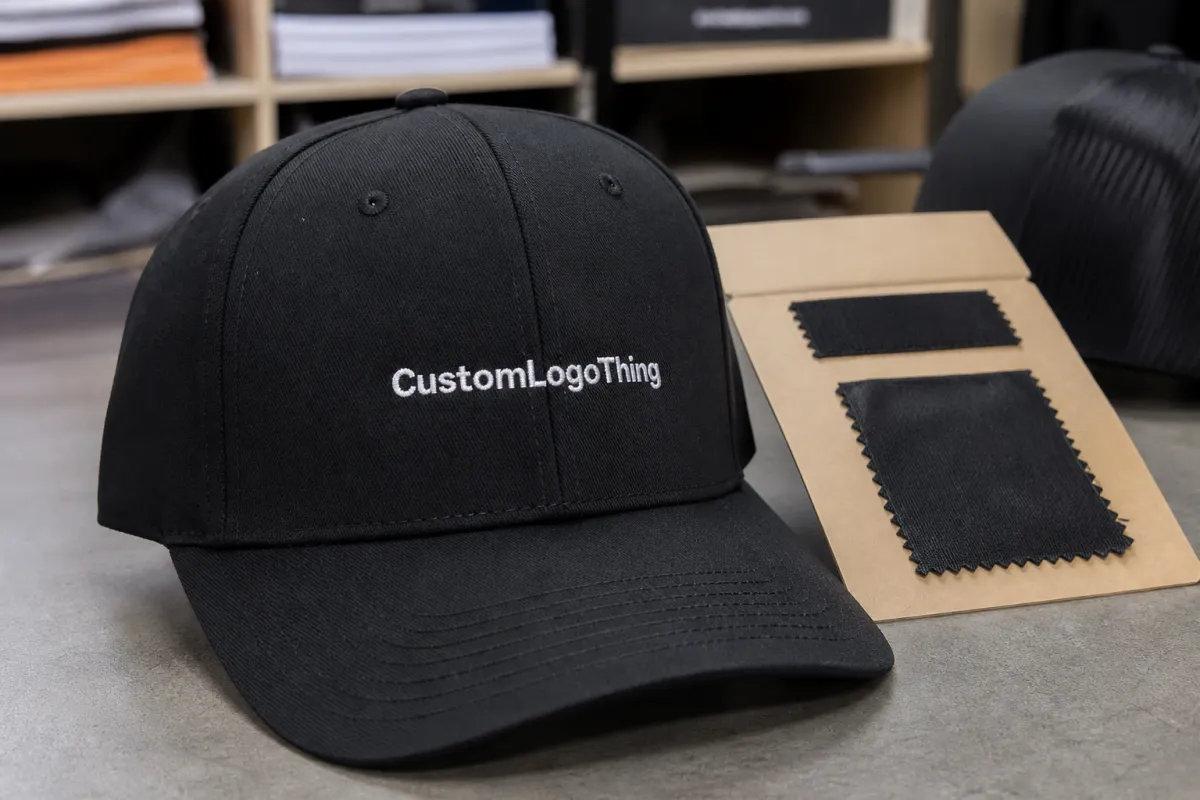
A useful cost guide starts with a simple truth: cap pricing is built from variables, not a flat rate. The blank matters. The crown shape matters. Stitch count matters. Placement matters too, because a front panel behaves differently from a side panel, and a logo that sits cleanly on one cap can distort on another.
The same art can price differently on a structured performance cap, a low-profile dad cap, or a mesh-back trucker. Structured caps give the digitizer a stable front panel and a cleaner stitch path. Softer caps bend more, which can require a simplified logo, adjusted density, or a softer fill so the design does not buckle across the curve. Buyers who standardize cap body, thread colors, and placement early usually get tighter quotes and fewer revisions.
A spec sheet is worth more than a teaser price. If two suppliers quote the same logo on different cap bodies, you are not comparing the same job.
The quote is not just embroidery labor. It also reflects setup, digitizing, blank sourcing, and the machine time needed to make the design hold up on a curved surface.
Choosing the Right Cap Style for a Uniform Program
Cap style sets the tone before anyone notices the logo. A field crew needs durability and sweat control. Hospitality staff usually needs a cleaner, more polished look. Office teams often prefer something softer and less conspicuous. Event staff need a cap that still looks sharp after six hours under lights, heat, and movement.
The common options are straightforward, but the trade-offs are not. Structured caps hold shape and suit supervisors, contractors, and retail floor teams. Unstructured or dad caps feel more relaxed and work well for office wear or lower-key brand apparel. Mesh-back truckers breathe better for outdoor work and summer events. Performance caps handle moisture and heat better, which makes them practical for crews that move all day. Flat-brim caps push the brand tone younger and more fashion-forward, while curved-brim caps remain the safest corporate default because they read as familiar and professional.
Placement changes the order too. Front embroidery gives the strongest brand visibility. Side placement can identify departments or roles without crowding the front. Back placement works for secondary branding or safety text, but it is less visible and can be harder to execute cleanly around closures, seams, or mesh panels.
- Front only: best for most uniform programs and easiest to compare across vendors.
- Front plus side: useful for department names, branch IDs, or role-based segmentation.
- Front plus back: good for secondary marks, though it adds cost and visual density.
If one look has to work across several departments, pick one cap body, one front placement, and one thread palette first. Everything else gets easier after that decision is locked.
Embroidery Specifications That Affect the Final Look
Embroidery on a cap is not a flat logo lifted onto fabric. The crown is curved, stitched, and often reinforced, so the artwork has to be adapted to the surface. Digitizing quality is the hidden driver here. A good digitized file tells the machine where to start, stop, underlay, and pull back so the logo reads cleanly on a cap rather than only on a screen.
Stitch density matters because too little density leaves the art thin and patchy, while too much can make letters stiff or fill in small openings. For most corporate logos, a front design in the range of roughly 5,000 to 8,500 stitches is common, although detailed crests or heavy fills can run higher. Fine text is the next risk. Small lettering under about 0.18 inches tall can close up on a cap, especially if the font is narrow or the logo has several words.
Vector art is the best starting point. Clean line weights, separated shapes, and simplified text reduce back-and-forth before proof approval. Raster files can be used as reference art, but they usually create more revision time. Three-dimensional puff embroidery can work for bold initials or short names, yet it is a poor fit for tiny text and delicate scripts. A second placement can look polished, but it can also crowd the cap if the front logo is already busy.
Thread choice matters as well. Polyester thread is usually the safer uniform option because it holds up better to wear, sweat, and repeated washing than decorative alternatives. Tonal thread can look refined on premium programs, but it still needs enough contrast against the cap color to stay readable in daylight.
Most buyers discover the same thing after a sample run: the best cap logo is rarely the most detailed one. It is the one that survives production without losing definition.
Trying to fit too much copy onto a cap usually makes the decoration look smaller, not richer. Simpler artwork often reads as clearer at a glance.
Corporate Uniform Caps Embroidery Cost Guide, MOQ, and Unit Cost
Most quotes break into four or five parts: cap blank, digitizing, embroidery labor, setup charges, and shipping. Some suppliers call the one-time startup line a tooling fee; others fold it into digitizing. Ask for each line item separately. If a quote is bundled, it becomes harder to compare suppliers on equal terms.
| Order Size | Likely Cost per Piece | Why the Price Moves |
|---|---|---|
| 25-49 caps | $12-$20 | Setup charges and digitizing spread across fewer units |
| 100-249 caps | $8.50-$13 | Better bulk pricing and lower overhead per cap |
| 500+ caps | $6-$9 | Lower unit cost, steadier machine time, less manual handling |
The blank cap itself can range from about $2.25 to $6.50 or more, depending on whether the buyer chooses a basic cotton cap, a performance style, or a premium structured profile. Digitizing is often a one-time cost in the $25-$75 range for a standard logo, though complex crests can run higher. Embroidery labor may add another $2-$6 per cap, with higher pricing for 3D puff, multiple placements, or heavy stitch counts.
MOQ is not an arbitrary hurdle. It reflects whether setup charges can be absorbed without pushing the unit price too high. Small runs are fine if the program is clear, but the cost per piece will almost always be higher than on a larger run. That is normal, not a markup trick.
For a fair comparison, ask every vendor for these five items:
- blank cap price
- digitizing or setup charges
- embroidery price by placement
- thread color count and any extra-color fee
- shipping estimate to each destination ZIP code
That is the fastest way to separate a true quote from a headline number. A lower figure may hide a setup charge, a premium blank, or a shipping bill that appears later. For buyers managing multiple branches, that gap is where budgets drift.
Production Process and Lead Time: From Art File to Ship Date
The schedule usually starts with art review and digitizing. If the file is clean, that step may take one to two business days. If the logo arrives as a flat JPEG, low-resolution image, or crowded design with tiny type, expect revisions. Then comes proof approval, and this is where the clock often stops. A buyer who waits three days to sign off on a proof can lose a tight launch window before production even begins.
Once the proof is approved, standard production often lands around 10-15 business days for moderate runs. Larger orders, specialty caps, or complex embroidery can stretch that timeline. Rush orders may be possible, but they work best when the art is ready, the cap style is locked, and the quantity is final. Late changes to cap color, logo placement, or thread palette are the fastest way to lose time.
Common delay points are predictable:
- unclear artwork with too much fine detail
- late changes to the logo or department names
- cap stock shortages on a preferred color or size
- approval delays across multiple stakeholders
For branch rollouts or seasonal launches, lock the spec before the order enters the queue. A two-week buffer is a practical minimum when the caps must arrive together. Shipping matters more than many buyers expect too; one carton to a warehouse dock is simple, but multiple branch drops require better coordination.
Proofing, Thread Matching, and Quality Checks Before Bulk Run
The proof is not paperwork. It is the last chance to catch a mistake before it becomes 250 mistakes. The main checkpoints are placement, thread color, logo scale, and seam alignment. If the design sits too close to a seam or curve, a proof on the exact cap style will show it. A flat mockup will not.
Thread matching deserves a practical approach. Screen colors rarely translate perfectly into physical thread, so ask for the closest available match in daylight, not only on a monitor. If a company wants a precise brand color, it helps to decide whether the priority is visual match or production consistency. Those are not always identical.
A stitched sample is worth the extra time on complex jobs. It catches issues that digital proofs miss, especially on caps with tall crowns, low profiles, or unusual materials. It also helps compare how the same design behaves across cap colors. Dark caps can swallow detail. Light caps can expose underlay or pull if the stitch density is too aggressive.
Packaging and sorting matter for distribution-heavy programs. If an order needs to go to eight branches, ask for cartons labeled by location and department. Inner bagging by size or role reduces receiving errors. For long distribution chains, carton strength should be treated the same way packaging buyers think about transit protection; ISTA publishes transport-testing guidance at ista.org. If the program includes printed inserts or mailer cartons, FSC-certified paperboard is a clean procurement option and the standard is explained at fsc.org.
That control sounds small, but on a multi-branch order it is the difference between a tidy rollout and a pile of mismatched boxes on a receiving dock.
How to Keep Repeat Orders Consistent
Repeat business in caps is won by consistency, not by the lowest quote alone. Buyers want the same stitch file, the same thread callouts, the same placement, and the same cap spec every time a branch reorders. If the first order was approved on a structured cap, the second order should not arrive on a looser silhouette just because the color name was similar.
Good records save time. The art file should be archived. The approved proof should be stored. The cap body should be identified clearly. Thread codes should stay on file. A buyer should never have to rebuild the same uniform program because the vendor cannot find last quarter’s settings.
Speed still matters, but not at the expense of review. A supplier that responds quickly to proof questions, small revisions, and production updates is more useful than one that sends a generic quote and disappears. The best programs also have someone watching for obvious risk: too much stitch density, a cap style that will distort the logo, or a department name that is too long for the available space.
That is the practical difference between a one-time order and a working uniform system. One is a transaction. The other is a repeatable process that can be reordered without surprises.
Next Steps: What to Send for an Accurate Quote
If you want a clean quote on the first pass, send the spec, not a vague request. The faster the supplier understands the job, the fewer revisions you will chase later.
- vector logo file, ideally AI, EPS, or PDF
- cap style and color choices
- quantity by color and size, if applicable
- thread color targets or brand references
- deadline and shipping ZIP codes
- any reorder or branch rollout needs
Ask for three things together: a line-item quote, a digital Proof, and Reorder pricing. That combination tells you what the order really costs, what the logo will look like, and how easy the second run will be. If a supplier cannot answer those three points clearly, the quote is not ready.
How is corporate uniform caps embroidery cost calculated?
Pricing usually combines the cap blank, digitizing, embroidery labor, thread colors, and any rush or shipping fees. Ask for setup charges and unit pricing separately so you can see what changes if the quantity rises or the design is simplified.
What MOQ should I expect for embroidered corporate caps?
MOQ depends on the cap style and decoration method, but the real driver is whether setup charges can be spread across enough units. If you need a small run, ask whether the supplier can price a short production test without changing the art spec.
How long does a corporate cap embroidery order take?
A standard order usually moves from proof approval to production in about 10-15 business days, but artwork revision is what slows it down. Rush options may be available, yet they work best when the logo is already vector-ready and the cap style is finalized.
Can I mix cap colors in one embroidered uniform order?
Yes, if the embroidery artwork and placement stay the same, many suppliers can mix body colors within one program. Expect pricing to vary by cap blank, especially if one color or style is harder to source than the others.
What artwork do I need for a fast corporate cap quote?
Send a vector logo file if possible, plus the cap style, quantity by color, thread color targets, and required delivery date. Including shipping ZIP codes and any reorder needs helps the quote come back with fewer revisions and fewer surprises.

