Buyer Fit Snapshot
| Best fit | Corrugated Box Pricing per Pallet projects where brand print, material claims, artwork control, MOQ, and repeat-order consistency need to be specified before quoting. |
|---|---|
| Quote inputs | Share finished size, material target, print colors, finish, packing count, annual reorder estimate, ship-to region, and any compliance wording. |
| Proofing check | Approve dieline scale, logo placement, barcode or warning zones, color tolerance, closure strength, and carton packing before bulk production. |
| Main risk | Vague material claims, crowded artwork, missing packing details, or unclear freight terms can make a low unit price expensive after revisions. |
Fast answer: Corrugated Box Pricing per Pallet: What Drives Cost should be specified like a repeatable production item. The safest quote records material, print method, finish, artwork proof, packing count, and reorder notes in one written spec.
Production checks before approval
Compare the actual filled-product size with the drawing, then confirm tolerance on folds, seals, hang holes, label areas, and retail display edges. Reserve space for logos, QR codes, warning copy, and material claims before decorative graphics fill the panel.
Quote comparison points
Review material grade, print process, finish, sampling route, tooling charges, carton quantity, and freight assumptions side by side. A quote is only useful when the supplier can repeat the same color, closure quality, and packing count on the next order.
Corrugated box pricing per pallet looks simple until you ask what is actually inside the pallet price. Box size, board strength, print coverage, pallet count, and freight terms can push the number in very different directions. A buyer comparing corrugated box pricing per pallet needs more than a single figure. They need to know what the quote includes, what it leaves out, and which assumptions are doing the heavy lifting behind the scenes. A light-duty brown carton and a heavy printed shipping box can both be priced per pallet, but they are not even close to the same product.
From a packaging buyer's point of view, corrugated box pricing per pallet affects landed cost, warehouse planning, and vendor comparison. One supplier may quote factory price only. Another may include delivery. A third may bury freight, pallet charges, or accessorial fees in the fine print where nobody looks until the invoice shows up. That is how budget surprises happen. Clean comparisons start with the same spec, the same destination, and the same pallet count. Anything less is theater.
In real buying work, corrugated box pricing per pallet is not one cost. It is a stack of costs: board, converting, setup, pallet build, handling, and shipping. If the supplier does not separate those pieces, the buyer is left guessing. That is fine if the goal is to waste procurement time. It is not fine if the goal is to buy boxes at a fair price. For anyone sourcing Custom Shipping Boxes, that breakdown is the difference between a useful quote and a number that falls apart the second production starts.
Corrugated Box Pricing per Pallet: What It Really Means
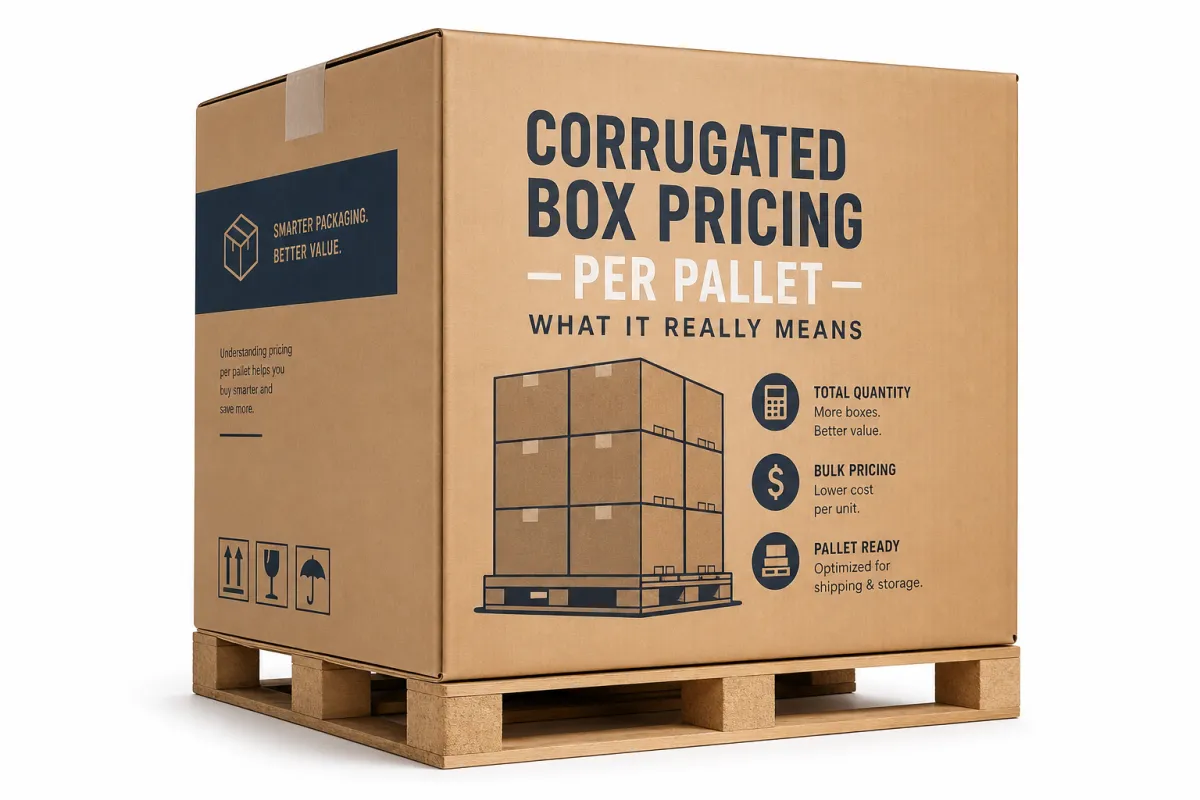
When someone says corrugated box pricing per pallet, they usually mean the price for a palletized lot of corrugated boxes, not the cost of one carton. That sounds obvious until you see how often it gets misunderstood. A pallet price can reflect the number of finished boxes per pallet, the wrap used to secure the load, the labels attached to it, and whether freight is part of the deal. Two quotes that both say corrugated box pricing per pallet can still be miles apart if one is delivered and the other is factory pickup only.
The phrase matters because pallet pricing is how a lot of buyers manage inventory. If the receiving team knows how many cartons arrive on each pallet, they can plan floor space, dock time, and truck frequency without guessing. That is useful for any program with repeat demand and extra useful for seasonal spikes, when box usage jumps and nobody wants to be the person calling for emergency freight. Corrugated box pricing per pallet gives you a warehouse unit that is practical. A raw per-box price does not always tell you enough.
Small spec changes move the number more than most people expect. A half-inch shift in finished dimensions can change board usage and pallet density. A move from a standard single-wall carton to a stronger test liner can change the material cost enough to make the quote feel like a different product. Add a logo, add a second ink color, or cut in a handhold, and corrugated box pricing per pallet starts reflecting converting complexity, press time, and setup risk. Cardboard is never just cardboard once someone starts charging for it.
A good quote should show the manufacturing side and the logistics side separately. The manufacturing side covers board, converting, print, and tooling. The logistics side covers pallet build, stretch wrap, labels, and freight. When those pieces are visible, the buyer can see whether corrugated box pricing per pallet is being driven by board thickness, decoration, or shipping distance. That is the kind of clarity procurement can use without sending three follow-up emails and an irritated spreadsheet.
| Quote Style | What It Usually Includes | Best Use | Common Blind Spot |
|---|---|---|---|
| Board-only or factory price | Material, converting, and basic pallet build | Internal cost review and supplier comparison | Freight may be extra, so the landed cost is higher |
| Delivered pallet price | Factory price plus delivery to a named location | Budgeting and receiving planning | Delivery accessorials may still be excluded |
| Full landed cost | Manufacturing, palletizing, freight, and known extras | Final sourcing decision | Often needs exact ship-to details to stay accurate |
If you remember one thing, make it this: corrugated box pricing per pallet is a quote format, not a universal standard. The cleaner the definition, the easier the comparison. The messier the definition, the easier it is for a low number to look great right up until the freight bill arrives.
The fastest way to misread corrugated box pricing per pallet is to compare two quotes that do not share the same board grade, print, pallet count, and freight terms.
How Corrugated Box Pricing per Pallet Is Calculated
At the base level, corrugated box pricing per pallet comes from a handful of cost buckets: material, converting, labor, setup, pallet build, and any extra charges for print or special handling. Board cost is usually the biggest variable. If the carton needs a stronger board grade or a different flute profile, the price changes before anyone even starts printing. The converting shop then adds its own costs for die cutting, slotting, gluing, folding, or stitching, depending on the box style.
Print moves the math faster than most buyers expect. A plain brown shipping carton is one thing. A one-color logo adds another layer. Multi-color flexographic print, large ink coverage, or a coated finish adds press time, setup, and waste. That is why corrugated box pricing per pallet can vary so much between suppliers even when the outside dimensions look nearly identical. The finished box may look similar. The production path may be nothing alike.
Then there is the question of how many boxes fit on the pallet. A dense pallet of small cartons spreads fixed costs across more units, which usually lowers the effective cost per box. A pallet of large cartons may hold far fewer finished pieces, so the pallet price looks higher even if the individual box is not especially expensive to make. In other words, corrugated box pricing per pallet depends on both the design and the packing pattern.
Here is where buyers get tripped up: some suppliers quote by thousand, some by bundle, and some by pallet. Compare those numbers without normalizing them and the results turn into a fake argument about price. The right move is to convert everything into the same unit. For pallet purchases, that usually means asking for price per pallet, cartons per pallet, and delivered cost to the same zip code. That keeps corrugated box pricing per pallet from becoming a spreadsheet crime scene.
Minimum order quantities and setup fees matter too. A first order often absorbs plate charges, die charges, or make-ready time. On a small run, those costs get spread over fewer boxes, which makes the pallet price look steep. On a repeat order, the setup may already be paid for or reduced, which improves the effective per-box cost. That is one reason corrugated box pricing per pallet often drops on the second or third purchase if the spec stays put.
Freight can distort the picture more than the box itself. One quote may be factory price only. Another may be delivered. A third may include liftgate service, residential delivery, appointment scheduling, or a limited-access fee. Those extras add up quickly. That is why I always tell buyers to ask whether corrugated box pricing per pallet includes shipping, pallet exchange, detention risk, and any charge that might appear later with a straight face and no warning.
For companies using Custom Shipping Boxes, a clean quote should show how much is tied to board, how much is tied to print, and how much is tied to the trip from the plant to the dock. That is the only way to know whether the lower number is actually lower or just missing a cost bucket. Missing costs are not savings. They are delayed annoyance.
Cost Drivers That Move the Number
Several variables can push corrugated box pricing per pallet up or down, and most of them are visible long before production starts. The first is box size. Bigger cartons use more board, plain and simple. They also tend to reduce pallet density, which means fewer finished boxes ship on each pallet. That double hit makes large cartons feel expensive even when the per-sheet material change is modest. Add just a little extra interior space and the ripple shows up in the pallet quote.
Board grade and flute selection come next. A light-duty RSC built from single-wall board will usually price differently than a double-wall carton designed for heavier stacking or rough transit. In practical terms, you are balancing crush resistance, puncture resistance, and weight. Some buyers ask for the heaviest board they can get their hands on, then act surprised when the price climbs. That extra material is not free, and it does not always solve the real shipping problem. Corrugated box pricing per pallet should match the actual use case, not a guess made by someone staring at a spec sheet between meetings.
To get technical for a second, board strength is not one number. You will hear ECT, Mullen, and burst strength used in the same conversation, and they are not interchangeable. A 32 ECT carton is not automatically the same thing as a 200#/275# Mullen box, even if the packaging line sounds confident while saying it. That kind of mismatch is exactly how buyers end up comparing apples, oranges, and one very expensive crate.
Print complexity changes the number too. One-color flexo is common and usually straightforward. Add more colors, tighter registration, heavy ink coverage, or a premium finish, and the press setup gets more involved while waste can rise. If branding matters, fine. If the carton is mostly a transit container, decoration should earn its place. Many packaging buyers are surprised by how much corrugated box pricing per pallet shifts once print coverage goes from small branding marks to full-panel graphics.
Order quantity also matters because production gets more efficient when the press can stay on one setup longer. A larger run can reduce changeovers, lower handling time, and improve pallet packing efficiency. Smaller runs absorb more setup cost per pallet. That is why suppliers often reward steadier buying patterns with better rates. From a buyer's perspective, corrugated box pricing per pallet usually improves when the schedule is planned instead of thrown together at the last minute after someone notices the warehouse is empty.
- Box dimensions affect board usage and pallet density.
- Board grade changes strength, weight, and raw material cost.
- Print coverage adds setup time, waste, and press complexity.
- Freight distance can outweigh small manufacturing savings.
Shipping distance, accessorials, and delivery timing can matter just as much as the box itself. A quote that looks sharp at the plant can become less appealing after freight gets added for a long zone, a liftgate, or a narrow delivery window. If your dock is easy to unload and your pallets move fast, that helps. If not, the quote should reflect the reality. Corrugated box pricing per pallet is not just a carton number. It is a logistics number too, which is inconvenient for anyone hoping to ignore transportation.
Material sourcing preferences can also shape the conversation. If recycled fiber content or responsible forestry matters to your company, ask for documentation and certification. The FSC system is one of the common references buyers use when they want traceability around forest-based materials. That does not automatically make a box cheaper or better. It does make the spec conversation more complete, especially when corrugated box pricing per pallet needs to support both budget and sustainability goals without making either side miserable.
Performance matters too. Boxes that travel through drop, vibration, compression, and humidity may need more than a basic stock spec. If transit risk is real, the packaging should be built around the test method, not around a number pulled from a rough estimate. The ISTA test standards are useful for buyers who want to connect packaging design to distribution reality. That is often where corrugated box pricing per pallet becomes easier to defend internally, because the design choice is tied to a known performance requirement instead of a shrug.
What usually has the biggest impact
Three items do most of the damage in a lot of purchasing conversations: board grade, freight, and print. If the board stays the same, the freight lane stays the same, and the print stays simple, corrugated box pricing per pallet tends to behave predictably. Move all three at once and the quote can jump enough to trigger another approval round. That is not a mystery. That is what happens when one packaging spec is trying to do several jobs at once.
The Ordering Process and Timeline From Quote to Delivery
A good buying process keeps corrugated box pricing per pallet from turning into a moving target. It starts with a clean request for quote: box dimensions, box style, board spec, print details, pallet count, and ship-to location. If the buyer says “standard shipping box” and leaves it there, the supplier has to guess at the board and construction. Guessing produces quotes that are either padded or incomplete. Neither is useful.
Once the spec is defined, the supplier can estimate material usage, converting time, and freight. If artwork is involved, the proof step matters. A simple one-color mark may move quickly. A detailed printed design may require back-and-forth, layout adjustments, and more review than anyone planned for. If the sample or drawing changes after the quote is issued, corrugated box pricing per pallet can shift because the plant may have to reschedule, re-cut, or replace tooling. Buyers often think the number is locked too early. It usually is not. The spec is what locks the price.
After approval, the board is scheduled, the boxes are converted, and the finished cartons are built into pallets, wrapped, labeled, and staged for pickup or delivery. Lead time depends heavily on complexity. A plain brown carton can move faster than a custom printed box with special dimensions, extra die cuts, or heavier board. In a lot of shops, line complexity matters more than absolute quantity. That is why corrugated box pricing per pallet and lead time tend to move together. Easier run, easier price. Harder run, harder price. Packaging is not trying to be poetic about it.
One point that should never be skipped is the clock start. Some suppliers count lead time from proof approval. Others count it from purchase order release. Others wait for final artwork sign-off or deposit clearance. If you do not ask, you may get a surprise later when the promised ship date is measured from a starting point you never agreed to. That is a common source of friction in corrugated box pricing per pallet discussions, especially on custom work where everyone assumes the other side is reading their mind.
The best buyers treat the ordering process like a sequence of checkpoints:
- Confirm dimensions and box style.
- Lock the board grade and flute profile.
- Approve art, samples, or drawings.
- Confirm pallet count and freight terms.
- Release the order only after the quote matches the spec.
If a supplier is offering shipping boxes built to spec, ask how they handle revision cycles. A good partner will tell you which changes are harmless and which ones force a repriced run. That keeps corrugated box pricing per pallet honest and saves both sides from avoidable delays, which is rarer than it should be.
From a production standpoint, the most efficient orders are the ones that arrive with a stable spec and a realistic schedule. Last-minute changes are expensive. They create waste, slow the line, and complicate pallet build. If you want corrugated box pricing per pallet to stay predictable, give the manufacturer enough lead time to plan the run cleanly and enough detail to avoid guesswork.
Common Comparison Mistakes
The biggest mistake buyers make is comparing offers that are not actually comparable. One quote may use a different board grade, another may use a different flute, and a third may include print or freight that the others omit. On paper, it looks like one vendor is dramatically cheaper. In reality, the specs are different. That is why corrugated box pricing per pallet should never be judged from the bottom line alone.
Freight surprises are another repeat offender. A factory price can look excellent until delivery, liftgate service, or appointment scheduling adds several hundred dollars. Palletized freight is easy to misread because the box cost and the transportation cost often appear on separate lines. If one vendor includes trucking and another leaves it out, corrugated box pricing per pallet is not a fair comparison yet. It is just two different quote styles pretending to be one answer.
Buyers also ignore pallet configuration more often than they should. A quote based on fewer cartons per pallet can make the unit economics look better than they are, but the receiving team still deals with the same number of pallets and the same storage footprint. That matters in warehouses with limited dock doors or tight rack space. If the pallet count is wrong, corrugated box pricing per pallet can create a fake sense of savings while adding handling work downstream. That is a great way to annoy operations.
Tooling and setup charges are easy to miss on a first order. A plate charge may be folded into the price, shown separately, or waived on a repeat buy. The same goes for die charges and sample costs. That means the first pallet can look expensive while the second one looks much better even though the box itself did not change. When you see a big swing in corrugated box pricing per pallet, check whether setup costs are being spread across the run or hidden in a line item nobody mentioned out loud.
In packaging procurement, the quote with the lowest pallet number is not always the lowest total cost. The winning quote is the one that matches the spec, the freight lane, and the actual job the box has to do.
It also helps to align performance expectations with the shipment method. If a box is meant to survive parcel networks, distribution centers, and mixed freight handling, the buyer should be looking at test performance, not just appearance. The packaging team can reference distribution test thinking through the ISTA standards and related ASTM methods. That helps prevent the classic mistake of chasing a low corrugated box pricing per pallet number that fails before the product reaches the customer.
Finally, do not compare quotes without matching ink count, closure style, and destination. A glued carton and a stitched carton are not always priced the same. A ship-to zip code in one zone can cost much more than a nearby dock. If the details are not identical, then corrugated box pricing per pallet is not a clean apples-to-apples exercise. It is just two people using the same words to describe different things.
Ways to Improve the Quote
There are a few practical ways to improve corrugated box pricing per pallet without cutting corners that matter. The first is standardization. If you can keep multiple SKUs on the same footprint, the supplier may be able to share board widths, simplify tooling, and reduce changeover waste. That does not mean every box has to be identical. It means the family of boxes should be built with some actual thought instead of whatever shape looked nice in a meeting.
Another smart move is to simplify the print and structural features when the box is mostly doing transit work. If the carton is meant to protect, stack, and ship, then strength and consistency usually matter more than decorative detail. One clean logo, a readable part number, and the necessary handling marks often do the job. Every extra ink color or special cut should earn its place. That discipline helps keep corrugated box pricing per pallet in a range that makes sense for the application instead of drifting upward because someone wanted the box to “pop.”
Ask for alternates. That is one of the best habits a packaging buyer can build. Request a lighter board option, a slightly different flute, or an alternate print approach so you can see the tradeoff in black and white. Sometimes the performance difference is tiny and the cost difference is not. A good supplier should be able to show more than one path so you can evaluate corrugated box pricing per pallet from several angles instead of treating the first offer like a law of nature.
Steadier ordering helps too. If you can place more predictable production blocks instead of a pile of small urgent orders, the plant can plan its schedule better and reduce wasted setup time. That often improves pallet economics over time. It does not mean you should overbuy inventory. It does mean erratic ordering is rarely the cheapest pattern. Consistency is a quiet lever in corrugated box pricing per pallet, and it is one buyers can control more often than they think.
Last, insist on a line-item quote. Material, conversion, freight, and extras should be visible. Even if you plan to negotiate the total, the breakdown shows where the money is hiding. That is useful for future buys too, because it tells you whether the issue is board cost, labor, transportation, or a specific embellishment. When the quote is transparent, corrugated box pricing per pallet gets easier to manage, and the supplier relationship usually gets better because neither side has to pretend the numbers are self-explanatory.
For branded or custom programs, this is where the real savings usually live: spec discipline, repeatability, and clean freight assumptions. Not in squeezing a supplier for a one-time number that cannot be repeated later without someone quietly changing the rules. That trick is old, and frankly, it is kind of tired.
Next Steps for a Smarter Quote Request
If you want corrugated box pricing per pallet to make sense from the start, gather the basics before you send the request. You will need the exact inside and outside dimensions, the box style, the board grade or test requirement, the number of colors, the ship-to zip code, and the pallet count you expect to buy. If there are storage limits, dock restrictions, or timing constraints, include those too. A quote built on complete information is far more useful than a low estimate built on assumptions and optimism.
Then send the same spec sheet to every supplier. Do not let one vendor quote a slightly different carton size while another quotes a heavier board. That is how pricing gets muddy fast. A clean comparison starts with the same drawing, the same pallet count, and the same freight destination. If one vendor suggests a better structure, ask for the revised spec in writing so corrugated box pricing per pallet can still be compared on equal terms instead of by vibes.
Ask each supplier to separate manufacturing, freight, and setup charges. That one habit makes the landed cost easier to review and exposes where the real differences sit. If the pallet price is low but the freight is high, you will see it. If the first order carries a tooling charge, you will see that too. The more transparent the quote, the easier it is to decide whether corrugated box pricing per pallet is actually competitive or only looks that way for a few minutes.
A practical buying process usually looks like this: request two or three quote options, compare the per-pallet math, check the board and print assumptions, and then choose the version that balances cost, strength, and lead time. You do not always need the cheapest box; you need the box that performs at the right price. That is the point behind corrugated box pricing per pallet. Once the specs, pallet count, and delivery assumptions are aligned, the numbers become much easier to trust.
For teams managing Branded Shipping Cartons, the best move is pretty straightforward: lock the spec before you compare price, then measure every quote on the same freight lane. If the board grade, pallet count, and destination match, the quote starts behaving like a real number instead of a guess. That is the cleanest way to handle corrugated box pricing per pallet without getting dragged into a month of preventable back-and-forth.
How do I estimate corrugated box pricing per pallet before I request quotes?
Start with box dimensions, board grade, print needs, and the number of boxes you want per pallet. Add freight destination and lead time, because those two items can change corrugated box pricing per pallet more than most buyers expect. If you can share a drawing or spec sheet, the estimate will usually be much tighter and a lot less annoying to clean up later.
What information do suppliers need for an accurate corrugated box pricing per pallet quote?
They need inside and outside dimensions, style, board specification, print details, and pallet quantity. They also need the ship-to zip code and whether you want freight included or billed separately. Without those details, corrugated box pricing per pallet is usually only a rough placeholder, not a number anyone should make budget decisions with.
Does a full pallet usually lower corrugated box pricing per pallet?
Often yes, because setup and labor get spread across more boxes and production runs more efficiently. The actual savings depend on box size, board choice, and whether freight or tooling costs are part of the quote. In many cases, corrugated box pricing per pallet improves when the run is large enough to reduce changeover waste and keep the line moving.
Why do two corrugated box pricing per pallet quotes look different even with the same box size?
One supplier may be quoting a different board grade, ink count, or pallet count. Freight inclusion, setup fees, and delivery distance can also make the totals look very different. That is why corrugated box pricing per pallet has to be checked against the same spec sheet every time, not a half-remembered version of it.
What is the best way to compare corrugated box pricing per pallet from multiple vendors?
Use one spec sheet for every supplier and make sure the board, print, pallet count, and shipping destination match. Compare total landed cost and lead time, not just the base pallet price. That approach keeps corrugated box pricing per pallet honest and makes the final sourcing decision much easier to defend when someone asks why you picked the box you picked.


