Buyer Fit Snapshot
| Best fit | Corrugated Boxes Supplier Lead Time projects where brand print, material claims, artwork control, MOQ, and repeat-order consistency need to be specified before quoting. |
|---|---|
| Quote inputs | Share finished size, material target, print colors, finish, packing count, annual reorder estimate, ship-to region, and any compliance wording. |
| Proofing check | Approve dieline scale, logo placement, barcode or warning zones, color tolerance, closure strength, and carton packing before bulk production. |
| Main risk | Vague material claims, crowded artwork, missing packing details, or unclear freight terms can make a low unit price expensive after revisions. |
Fast answer: Corrugated Boxes Supplier Lead Time: What Impacts It should be specified like a repeatable production item. The safest quote records material, print method, finish, artwork proof, packing count, and reorder notes in one written spec.
Production checks before approval
Compare the actual filled-product size with the drawing, then confirm tolerance on folds, seals, hang holes, label areas, and retail display edges. Reserve space for logos, QR codes, warning copy, and material claims before decorative graphics fill the panel.
Quote comparison points
Review material grade, print process, finish, sampling route, tooling charges, carton quantity, and freight assumptions side by side. A quote is only useful when the supplier can repeat the same color, closure quality, and packing count on the next order.
Corrugated Boxes Supplier Lead Time: What Actually Moves It
A launch can look locked on paper and still slip because the cartons were late. Ugly, but common. That is why corrugated boxes supplier lead time matters so much. It sits between artwork approval, board availability, machine scheduling, and freight, and any one of those can blow up the calendar if nobody is watching.
From a packaging buyer's side, lead time is not just the hours a corrugator spends running a job. It is the full stretch from approved order to delivered boxes. That means prepress, tooling, production, packing, and transit all count. If you are comparing stock cartons, custom printed cartons, or fully engineered packaging with inserts, the corrugated boxes supplier lead time can look very different even when the box count stays the same.
Most people miss the real trick. A shorter schedule usually comes from simpler specs, cleaner approvals, and better planning, not from shouting at the factory to move faster. The smartest way to manage corrugated boxes supplier lead time is to know which piece of the order is actually eating the calendar.
What corrugated boxes supplier lead time really means
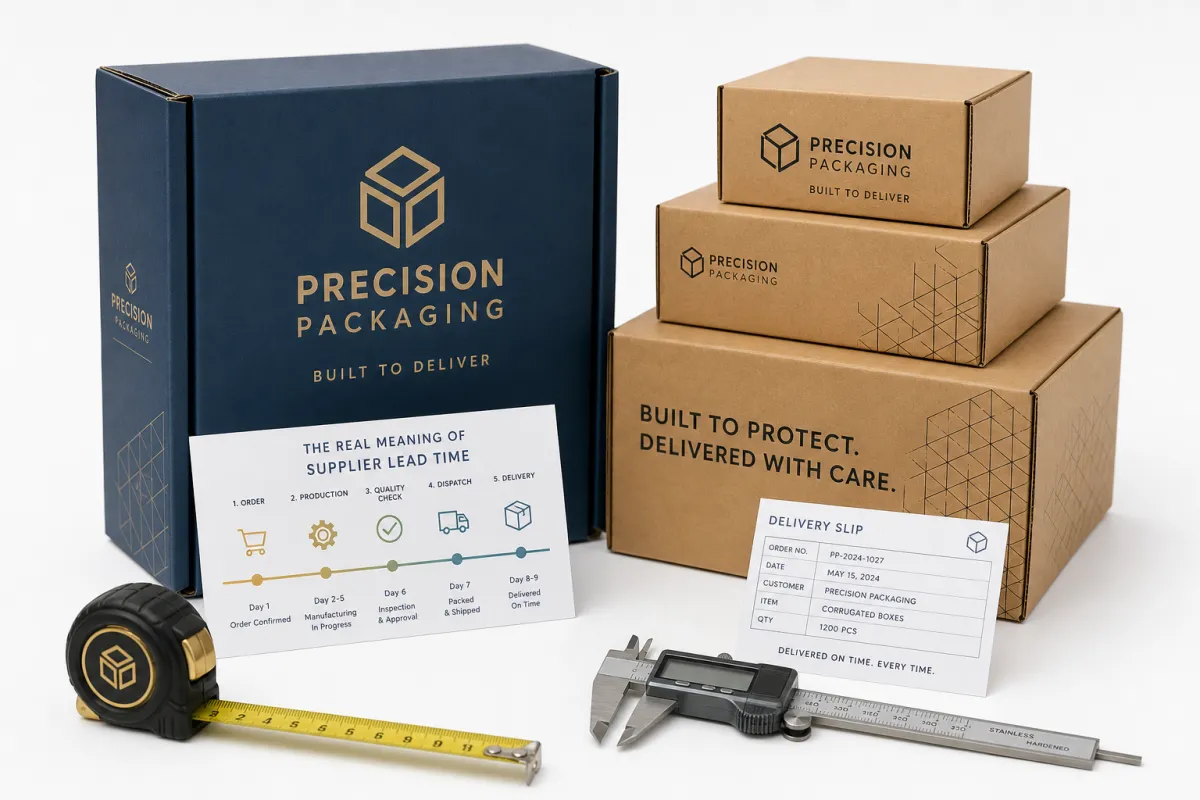
Plain version: corrugated boxes supplier lead time is the time between a confirmed, approved order and the moment the boxes arrive at your dock. Simple definition. Messy reality. In actual procurement work, the clock usually includes quote review, specification checks, artwork or dieline setup, proof approval, production slotting, and freight.
Quoted production time is only one piece of that picture. A supplier might quote 7 business days for manufacturing, yet the order still lands in your warehouse 12 or 15 days later because transit takes another week. If you are supporting a store opening, a subscription launch, or a seasonal promotion, that difference matters a lot. The total order cycle time keeps the project honest, and the corrugated boxes supplier lead time should be discussed as a full delivery window, not a single factory number.
Different box types move at different speeds. Stock cartons usually move fastest because the structure is standard and the board is often on hand. Custom printed cartons take longer because artwork needs checking, plate or digital files may need setup, and the run has to be placed into a specific machine schedule. Fully engineered packaging, such as a die-cut mailer with inserts or a reinforced multi-part shipper, adds another layer of steps. The more specialized the box, the more the corrugated boxes supplier lead time grows.
There is also a gap between the supplier's internal clock and your customer-facing clock. A carton can be done in the plant and still be useless if freight has not been booked or your receiving team cannot take pallets. The real question is not, "How fast can you run it?" The better question is, "What is the complete corrugated boxes supplier lead time from approved art to usable inventory at my location?"
A good supplier should separate three things clearly:
- Production time - the time spent converting board into finished cartons.
- Transit time - the time spent on a truck or freight network.
- Order cycle time - the total elapsed time from approval to delivery.
That split looks small. It is not. When buyers and suppliers talk past each other, the issue is usually that one person is talking machine time while the other is staring at the warehouse receiving date. Once those clocks are separated, the corrugated boxes supplier lead time becomes much easier to control.
The fastest order is usually the one that stops changing. In packaging, steady specs and clean artwork save more time than a rush fee ever will.
How corrugated boxes supplier lead time works from quote to delivery
The order flow is usually more predictable than people think, but only if the inputs are clean. A standard corrugated boxes supplier lead time often moves through a sequence like this: request for quote, specification review, dieline or box style confirmation, artwork setup, proof approval, production scheduling, converting, packing, and shipping. Each stage can be quick. The whole order still drags if one stage gets stuck in a drawer nobody checks.
- Request for quote: the supplier checks dimensions, quantity, board grade, print method, and destination.
- Specification review: the box style, flute choice, and any inserts or partitions are confirmed.
- Artwork or dieline setup: files are prepared for print or structural cutting.
- Proof approval: the buyer signs off on layout, copy, color references, and dimensions.
- Production scheduling: the order is placed into a machine window that fits the plant's load.
- Converting and packing: board is cut, scored, printed, glued, bundled, and palletized.
- Freight: cartons are shipped by parcel, LTL, or full truckload depending on volume.
Where do delays usually happen? At the handoff points. A buyer changes dimensions after the quote goes out, the artwork arrives in the wrong file format, or no one on the customer side is assigned to approve the proof. Each of those adds days to corrugated boxes supplier lead time without the machine even starting.
Machine sequencing matters too. Corrugated plants do not run every box style in any random order. Jobs get grouped by board grade, flute type, print method, and setup efficiency. If one order uses single-wall B-flute with a simple one-color flexographic print, it may fit into a different production window than a heavy double-wall shipper or a full-coverage digitally printed mailer. That is why two jobs with the same quantity can have wildly different corrugated boxes supplier lead time expectations.
Transit time deserves its own attention. A supplier might produce your boxes in 8 business days, but if the cartons ship cross-country on a standard freight lane, the total schedule can stretch another 4 to 7 days. For a launch date, that is not a footnote. It is the difference between having cartons in hand and waiting on a trailer. Buyers who manage corrugated boxes supplier lead time well always ask for production and shipping as separate line items.
Rush orders can happen, but they are not magic. A supplier can only accelerate an order if the board is in inventory, the press or converting line has room, and the spec does not need extra tooling or a complex proof cycle. If any of those pieces are missing, the promise gets shaky fast. That is why the best rush plan for corrugated boxes supplier lead time is not hope; it is preparation. I have seen more than one team assume a rush fee fixes everything. It does not. It just buys a shot at the schedule.
Key factors that affect corrugated boxes supplier lead time
Board availability is usually the first swing factor. Standard single-wall board moves faster because mills and converters keep common liners and mediums in regular rotation. Specialty liners, unusual calipers, or heavy-duty structures may need procurement first, and that adds time before the job even reaches the plant. If a buyer wants the shortest possible corrugated boxes supplier lead time, common board grades usually help.
Box complexity is the next major driver. A regular slotted carton, or RSC, is usually simpler than a die-cut mailer, a wraparound sleeve, or a box with glued-in inserts. Reinforced corners, partitions, and multi-part assemblies all add handling steps. The more components the box has, the more chances there are for the corrugated boxes supplier lead time to stretch.
Printing adds another layer. One-color flexo is often straightforward. Digital print can be fast for short runs, but it still needs file prep and print management. Full-coverage graphics, white ink, special coatings, or premium retail finishes can change the setup pattern entirely. A buyer looking at Custom Shipping Boxes should ask whether the print coverage is worth the schedule impact, because the visual result and the corrugated boxes supplier lead time are tied together.
Order quantity cuts both ways. Small runs can sometimes fit into production gaps, but they also carry the risk of being bumped if the plant is packed. Larger runs may get firmer scheduling, yet they need more machine time, more palletizing, and more freight coordination. There is no universal answer here. A 500-piece order may move in a week if the spec is simple, while a 20,000-piece order can still get stuck on proof approval or material procurement. Quantity influences corrugated boxes supplier lead time, but it does not run the whole show.
Approval speed is one of the easiest things to control and one of the most underestimated. Slow proof review, unclear branding files, missing logo dimensions, and late structural changes can add days before production even starts. In many shops, the box itself is not the problem; the bottleneck is waiting on someone to answer an email. If you want better corrugated boxes supplier lead time, assign one person to own approvals and name backup decision-makers before the project starts.
Supplier location and logistics matter more than many buyers expect. Local pickup can cut the calendar hard. A regional supplier may get cartons to you faster even if the plant is not the cheapest option on paper. Cross-country freight can work fine for planned jobs, but it is a poor fit for a tight launch schedule. The real delivery promise is manufacturing plus transportation, so corrugated boxes supplier lead time should always be discussed with geography in mind.
Here is a practical way to think about it:
- Fastest path: standard size, standard board, simple print, clean artwork, nearby freight.
- Middle ground: custom size, moderate print, common board, approved proof within a day or two.
- Longest path: engineered structure, specialty materials, multiple inserts, full-color coverage, and revised approvals.
That spread is why one supplier's promise cannot be copied to another without checking the details. Even two similar orders can move differently if one has a clean file package and the other needs prepress work. That is the everyday reality behind corrugated boxes supplier lead time.
Cost and pricing tradeoffs in corrugated boxes supplier lead time
Speed almost always has a cost attached to it, and packaging is no exception. A shorter corrugated boxes supplier lead time may require expedited material sourcing, interrupted production sequencing, or premium freight. None of those are strange. They are just the price of urgency. The trick is knowing which premium is worth paying and which one just burns margin.
The biggest cost drivers are usually board grade, print coverage, tooling or die charges, minimum order quantity, and shipping distance. A basic stock-style RSC in common board can often be the lowest-cost route. A custom printed die-cut box with inserts, on the other hand, can carry higher setup charges and longer handling time. Compare too quickly and you can miss the fact that the slower choice is expensive not only in unit price, but also in corrugated boxes supplier lead time and risk.
For a buyer with recurring demand, standardization often lowers both cost and schedule pressure. Using the supplier's existing box styles, locking dimensions early, and choosing a common flute can shave time off the order and remove useless tooling complexity. That is one of the few places where price and corrugated boxes supplier lead time improve together.
Short runs can look attractive because they reduce inventory on the shelf, but they often carry a higher unit price. Larger planned orders usually improve cost per carton, yet they demand more warehouse space and more cash tied up in inventory. The hidden cost of emergency reorders is what catches people: stockouts, stop-ship situations, and expensive freight premiums. A delayed carton line can cost far more than the difference between two quotes. That is why the cheapest option is not always the best value when corrugated boxes supplier lead time is tight.
| Box option | Typical setup | Illustrative unit price at modest volume | Usual production window | Best fit |
|---|---|---|---|---|
| Stock-style RSC | No custom tooling, minimal print | $0.18-$0.40 | 3-7 business days | Urgent replenishment, plain shipping |
| Custom printed RSC | Flexo or digital print, standard structure | $0.25-$0.65 | 7-12 business days | Branding with moderate schedule pressure |
| Die-cut mailer | Cutting die, folds, tabs, full design review | $0.40-$1.10 | 10-18 business days | Ecommerce presentation, retail-ready packout |
| Engineered shipper with inserts | Multiple components, added structural checks | $0.60-$1.50+ | 12-25 business days | Fragile goods, higher protection needs |
Those ranges are illustrative, not universal, because quantity, coverage, board selection, and freight all move the numbers. Still, they make one point clear: every layer of complexity tends to add cost and extends corrugated boxes supplier lead time. If your product can ship safely in a simpler structure, that is often the cleaner financial path.
It is also fair to ask whether the packaging needs to do more than one job. A box that protects product, carries branding, and doubles as a presentation piece may be worth the extra spend. A plain shipper that only needs to survive transit may not be. For buyers sorting through Custom Packaging Products, the most useful question is not, "What looks best on paper?" It is, "What gives me the right balance of cost, performance, and corrugated boxes supplier lead time?"
For shipping performance, many teams also check testing expectations. The International Safe Transit Association publishes useful context on package testing, while FSC certification can matter for buyers tracking fiber sourcing and paperboard stewardship. If your packaging program has sustainability requirements, that can influence board selection and, by extension, corrugated boxes supplier lead time. For broader packaging and material context, industry resources at packaging.org can help as well.
Step-by-step way to shorten corrugated boxes supplier lead time
The cleanest way to improve corrugated boxes supplier lead time is to remove uncertainty before the order reaches production. Start by locking the box spec early. Final dimensions, board grade, print method, closure style, and any inserts or partitions should be settled before quoting, not after. Every late change forces a supplier to recheck material, pricing, and machine fit.
Next, prepare print-ready artwork and dieline files in the supplier's preferred format. A lot of delay happens in prepress, especially when files arrive with missing fonts, unoutlined text, low-resolution logos, or the wrong bleed. If the layout is straightforward, do not make the supplier redraw it from scratch. A clean file package can reduce corrugated boxes supplier lead time more than almost any other single action.
Ask for a production window and a transit window separately. That sounds obvious, but it is one of the easiest ways to avoid surprise. If a supplier says the run takes 8 business days and freight takes 5 more, you can build a real calendar instead of a hopeful estimate. Add a small buffer for proof revisions and carrier delays. For planned work, that buffer is not waste; it is insurance against the most common corrugated boxes supplier lead time slip points.
Use a sample or prototype only when it actually adds value. Structural samples are useful for new packaging, fragile products, or shelf-ready retail displays. For straightforward shippers, over-sampling can slow the schedule without improving the outcome. A good rule is simple: if the box is already proven and the graphics are stable, skip extra rounds. That keeps corrugated boxes supplier lead time focused on production instead of paperwork.
Repeat orders should be placed before inventory gets tight. Seasonal programs, promotional bundles, and subscription replenishment are especially sensitive to stock timing. If you know the boxes will be needed every month, do not wait until the last pallet is gone. Reordering early gives the supplier room to fit your job into the schedule, and it protects you from the worst case of corrugated boxes supplier lead time creep.
Inside your own organization, assign one person to own approvals. That person does not need to make every decision alone, but they do need to know who is responsible for signoff on dimensions, graphics, and budget. When nobody owns the approval chain, suppliers wait while internal teams debate details that should have been settled. In my view, clear ownership is one of the simplest tools for improving corrugated boxes supplier lead time.
A practical checklist helps too:
- Confirm final dimensions.
- Choose board grade and flute.
- Approve print method and color count.
- Send final artwork in the right format.
- Separate production time from shipping time.
- Set a reorder point before inventory gets low.
If you are building a packaging program from scratch, think in systems. A stable box style, a reusable file package, and a known freight lane create far fewer surprises than one-off purchasing. Buyers who approach corrugated boxes supplier lead time that way usually end up with steadier inventory and less emergency spending.
One more practical point: if the packaging must perform in transit, ask what test protocol the supplier uses or references. For some ecommerce applications, the conversation may touch ISTA procedures or drop and vibration testing expectations. For fiber-based packaging, FSC-certified board can matter if your customers or retailers ask for it. Those standards do not automatically shorten corrugated boxes supplier lead time, but they help you avoid redesigns after the order is already underway.
Common mistakes that stretch corrugated boxes supplier lead time
The first mistake is changing dimensions after the quote has already gone out. Even a small size change can require a new estimate, a new structural check, or a fresh production slot. Buyers often think a quarter-inch adjustment is minor, but from the supplier side it may affect board usage, die layout, and pallet count. That is why late edits are one of the fastest ways to stretch corrugated boxes supplier lead time.
Another common error is treating artwork approval like a tiny task. It is not. One logo correction, one missing barcode, or one low-resolution image can send the job back through prepress. If there are multiple stakeholders, the delay multiplies quickly. I have seen more packaging schedules slip from proof confusion than from machine breakdowns, and that says plenty about corrugated boxes supplier lead time management.
Ordering too late for a seasonal promotion is another one. Holiday launches, trade shows, retail resets, and subscription spikes all have fixed dates, but buyers sometimes place the carton order as if the schedule can absorb the delay. It usually cannot. By the time a rush is needed, there may be no material left to expedite, and the supplier's existing production load may already be full. That is how corrugated boxes supplier lead time turns into a cost problem as well as a delivery problem.
Some buyers also assume every corrugated supplier has the same machine capability. That is rarely true. One plant may excel at flexo-Printed Shipping Cartons, while another is better suited for die-cut retail mailers or larger double-wall shippers. Finishing options, board inventory, and converting equipment vary widely. If you want more predictable corrugated boxes supplier lead time, you need to match the job to the supplier's actual strengths.
Freight and receiving constraints can be overlooked too. A box order may be ready, but if the dock is closed, the pallets cannot be received, or the carrier appointment gets missed, the project still slips. That is especially common with full truckload shipments and multi-drop distribution. The best packaging plan respects both plant capacity and warehouse reality, because corrugated boxes supplier lead time does not end at the factory gate.
Here are the mistakes I would put at the top of the list:
- Changing the box spec after approval.
- Sending incomplete artwork files.
- Leaving proof review to too many people.
- Ignoring freight time until the boxes are done.
- Assuming one supplier can match another supplier's timeline without checking the details.
None of those are rare. They are ordinary, which is exactly why they matter. The good news is that they are all preventable with a little discipline, and preventing them usually has a bigger effect on corrugated boxes supplier lead time than negotiating a tiny production discount.
Expert tips to manage corrugated boxes supplier lead time better
Build a packaging calendar before you place the order. Include design freeze, proof approval, production, transit, and receiving dates. That makes corrugated boxes supplier lead time visible early, which is exactly what keeps a packaging program from turning reactive. When everyone can see the date chain, there is less room for surprise.
Keep a small library of approved specs. A repeatable box structure, a known board grade, and a saved artwork template remove friction from future orders. You do not need a new structural design for every product unless the product truly demands it. Standardization is one of the best tools for reducing corrugated boxes supplier lead time without sacrificing performance.
Ask suppliers which details most often slow jobs on their side. That answer is usually more useful than a broad promise that they are "fast." Some suppliers get held up by prepress; others by material shortages; others by freight. Once you know the weak spot, you can plan around it. In practice, that is how buyers turn corrugated boxes supplier lead time into something measurable instead of vague.
Keep backup packaging options for critical products. A standard shipper may not be as polished as the primary custom box, but it can keep goods moving if the main run slips. That backstop is especially useful for ecommerce, replacement parts, and fast-moving consumer goods. The business cost of an emergency substitute is often lower than the cost of a missed shipment, and it gives you breathing room on corrugated boxes supplier lead time.
For repeat programs, reorder before inventory gets thin. Many teams wait until they are down to the last pallet before thinking about replenishment, and that is usually too late to get comfortable pricing and schedule control. A better approach is to set the reorder point based on your actual consumption rate plus the real corrugated boxes supplier lead time, not the ideal one. That simple adjustment can prevent a lot of panic buying.
It also helps to ask for a split quote: one line for production, one line for freight. That makes it easier to compare local pickup, regional delivery, and long-haul shipping without mixing the numbers together. If you are evaluating Custom Shipping Boxes, this split often shows whether the box itself is slow or whether the delivery lane is the real bottleneck. Once that is clear, corrugated boxes supplier lead time becomes easier to control.
Finally, document what worked. If one supplier handled a 3,000-piece order in 9 business days because the files were clean and the board was standard, save that information. If another job slipped because two departments argued over print color, document that too. The best packaging teams turn every order into a better estimate for the next one, and that is how corrugated boxes supplier lead time becomes a managed process instead of a recurring headache.
For teams building out a broader packaging line, a well-organized catalog of Custom Packaging Products can also shorten decision time. The less you have to reinvent for each order, the easier it is to keep corrugated boxes supplier lead time stable from one replenishment cycle to the next.
FAQ
What affects corrugated boxes supplier lead time the most?
The biggest drivers are box complexity, board availability, print requirements, and how fast approvals move. Late changes after quoting usually add more time than the actual run itself, so the cleanest way to improve corrugated boxes supplier lead time is to freeze the spec early and keep the proof cycle short.
How long is a typical corrugated boxes supplier lead time for custom boxes?
Custom orders often take longer than stock cartons because they require spec review, artwork setup, and scheduled production. The real timeline depends on whether the supplier has the board and machine capacity ready when you approve the job, so corrugated boxes supplier lead time can range from a few business days to several weeks depending on complexity and freight distance.
Can I speed up corrugated boxes supplier lead time without raising cost too much?
Yes, by simplifying the structure, using standard materials, and approving artwork quickly. Standard sizes and repeat orders usually reduce both schedule pressure and hidden rush charges, which is why a little standardization often improves corrugated boxes supplier lead time and unit economics at the same time.
Does printing always increase corrugated boxes supplier lead time?
Printed boxes usually need more setup than plain cartons, but the impact depends on the print method and design complexity. Simple one-color graphics can move faster than full-coverage or specialty finish jobs, so printing does not automatically make corrugated boxes supplier lead time long; it depends on the production path.
What should I ask a supplier before placing an order?
Ask for production time, transit time, material availability, proof turnaround, and what would cause the schedule to slip. It also helps to ask whether they can quote a rush option and what changes would affect pricing, because those answers make corrugated boxes supplier lead time much easier to plan around.
If you treat corrugated boxes supplier lead time as a planning variable instead of a surprise, you will miss fewer launches, spend less on emergency freight, and make better packaging decisions from the start. The practical move is simple: freeze the spec early, separate production from freight, assign one approval owner, and set reorder points from the real schedule instead of the optimistic one. Do that, and the calendar stops being a guessing game.


