Buyer Fit Snapshot
| Best fit | Poly Mailers Lead Time projects where brand print, material claims, artwork control, MOQ, and repeat-order consistency need to be specified before quoting. |
|---|---|
| Quote inputs | Share finished size, material target, print colors, finish, packing count, annual reorder estimate, ship-to region, and any compliance wording. |
| Proofing check | Approve dieline scale, logo placement, barcode or warning zones, color tolerance, closure strength, and carton packing before bulk production. |
| Main risk | Vague material claims, crowded artwork, missing packing details, or unclear freight terms can make a low unit price expensive after revisions. |
Fast answer: Poly Mailers Lead Time: What Actually Delays Orders should be specified like a repeatable production item. The safest quote records material, print method, finish, artwork proof, packing count, and reorder notes in one written spec.
Production checks before approval
Compare the actual filled-product size with the drawing, then confirm tolerance on folds, seals, hang holes, label areas, and retail display edges. Reserve space for logos, QR codes, warning copy, and material claims before decorative graphics fill the panel.
Quote comparison points
Review material grade, print process, finish, sampling route, tooling charges, carton quantity, and freight assumptions side by side. A quote is only useful when the supplier can repeat the same color, closure quality, and packing count on the next order.
Poly Mailers Lead Time: What Actually Delays Orders
Short answer: poly mailers lead time can be a few business days for stock mailers, or several weeks for a custom run that needs proofing, material sourcing, production scheduling, and freight transit. The biggest delays often happen before the press starts running. That is where calendars quietly slip, usually one small handoff at a time.
How Long Is Poly Mailers Lead Time?
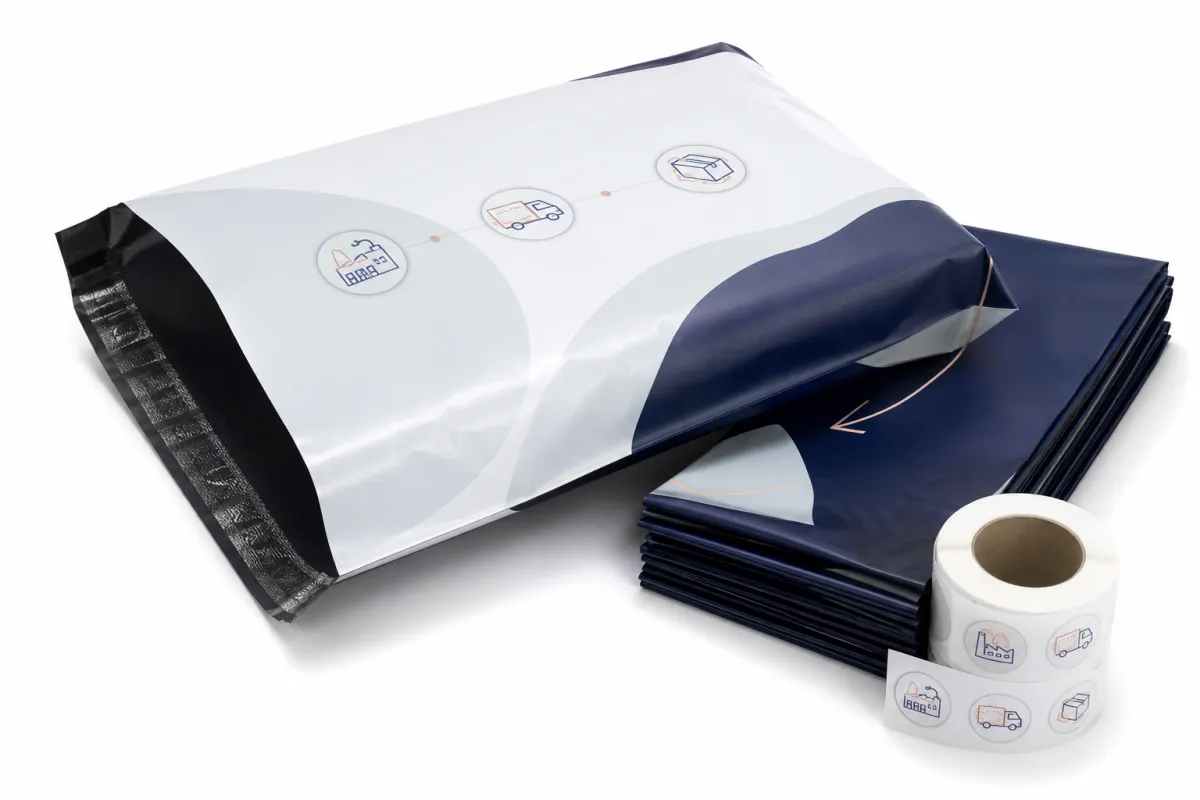
For buyers, poly mailers lead time is the full stretch between locking the specs and receiving finished mailers at the destination. In practice, a standard stock order may take 2-5 business days to produce, a lightly customized order often needs 7-12 business days, and a fully custom program can run 12-20 business days before shipping. Add transit time, and the door-to-door number can be much longer.
That range matters because two orders that look similar on paper can move at very different speeds. A stock mailer in a common size usually moves quickly because the film is already on hand and the setup is routine. A Custom Printed Mailer with a unique size, specific closure, or matched color work can need extra approval rounds, dedicated production time, and a tighter freight plan. Poly mailers lead time stretches every time a new variable enters the job.
I have seen small teams assume a mailer order is "just packaging" and then lose a week because the proof sat in three inboxes. That happens more than people think. Packaging runs on specs, approvals, and freight booking that actually fits the calendar, not on optimism. If the brief is fuzzy, the timeline will be too.
What Poly Mailers Lead Time Really Means
Most people hear poly mailers lead time and think the clock starts when the press begins running. That is too late. The real timeline starts once the supplier has enough information to quote accurately, confirm materials, and reserve a production slot without guessing at the details.
In plain terms, poly mailers lead time is the full stretch from spec confirmation to delivery. Not only printing. Not only packing. The whole chain, including artwork review, proof approval, material allocation, manufacturing, cartonizing, and shipping. A supplier can have a quick print line and still miss the date if the film is out of stock or the file needs corrections before production can begin.
Two orders may look nearly identical and still have very different poly mailers lead time. A stock mailer in a standard size often moves fast because the film is already available and the setup is routine. A fully custom mailer may require a specific film gauge, a unique size, ink matching, and a fresh production slot. Each added variable nudges the calendar outward.
There is also a difference between factory time and door-to-door time. Factory time might be five business days. Door-to-door time might be fifteen once freight, customs, or carrier pickup enters the picture. Buyers get burned when they compare one supplier's production estimate to another supplier's delivery estimate as if those numbers mean the same thing. They do not.
Fast-turn stock mailers are useful for launches, promo drops, and urgent replenishment. Custom orders fit brands that need tighter visual control, unusual dimensions, or packaging tuned to a specific product. The tradeoff is easy to see: more customization usually means more poly mailers lead time, more approvals, and more opportunities for the schedule to slip. That is not a flaw in the system. It is the system.
Think of lead time as a chain. Break one link and the whole order waits. A clean file still stalls if the film needs to be sourced. Ready materials still sit if the proof is untouched in somebody's inbox for four days. Poly mailers lead time rarely falls apart because of a single disaster; it is usually worn down by several small delays that never get tracked closely enough.
"If your proof is still moving, your production clock has not started yet."
That sounds blunt because the schedule is blunt. Poly mailers lead time should be measured from a fixed approval point, not from the first email, the first sketch, or the first rough quote. Otherwise the timeline turns into a wish.
How Poly Mailers Lead Time Works From Proof to Delivery
A clean order follows a predictable sequence. Quote. Artwork check. Digital proof. Approval. Production setup. Printing. Curing or finishing. Packing. Shipping. Every step can be quick. None of them happens automatically. That is why poly mailers lead time needs to be broken into stages instead of treated like one flat number.
The quote stage is where missing information starts creating trouble. If the supplier does not know the exact size, quantity, print coverage, film thickness, or ship-to address, the number you receive is only a rough estimate. Rough estimates are fine for early budgeting, but they are weak fuel for a fixed launch date. The cleaner the brief, the more useful the poly mailers lead time estimate becomes.
Artwork review is another place where calendars slip. Files that are low-resolution, built in the wrong color mode, or missing bleed often need corrections before a proof can even be issued. Then the proof goes out and the waiting begins. One day of review becomes three. A small copy change becomes a new proof. By then, poly mailers lead time is already drifting before production has started.
Production setup is fast for repeat work and slower for first-time jobs. A reprint may already have the film specification, plate files, and sealing settings on record. A new custom order may require new print parameters, a different film roll, or confirmation of the closure style. None of that is unusual. It just means the buyer should stop assuming every mailer order behaves the same way.
Domestic and overseas timelines need to be treated separately. A domestic run may need five to ten business days for production, then three to seven days for ground freight. An overseas run can finish printing in a similar window and still add two to five weeks for ocean transit, or a few extra days for air freight at a much higher cost. The factory can finish on time and the order can still arrive late if the shipping choice was unrealistic.
For transit risk, some packaging teams use parcel testing references from ISTA to understand how mailers hold up in the real world. That matters because weak seals, sharp corners, or puncture-prone film can cause damage claims and rework, which is another path for poly mailers lead time to blow up after production.
The slowest handoff controls the schedule. If proof approval takes four days, production cannot begin early. If freight booking gets delayed, the goods sit. If the warehouse asks for a new carton label or pallet mark at the last minute, packing pauses. Poly mailers lead time is a supply chain, not a single machine.
For planning, milestones matter more than promises. A solid schedule should show: quote issued, proof sent, proof approved, production started, production complete, freight booked, and delivery expected. If a supplier cannot give you those markers, the poly mailers lead time quote is too vague to trust.
Key Factors That Affect Poly Mailers Lead Time and Cost
Several inputs move both the calendar and the invoice. Order quantity is the obvious one. A run of 1,000 pieces is usually easier to schedule than 25,000 because it needs less material, less press time, and less packing labor. Quantity is not the whole story, though. Poly mailers lead time can jump because of size, print coverage, closure style, or a packaging requirement that looked harmless during quoting.
Material choice matters more than many buyers expect. A 2.5 mil mailer is not the same as a 3 mil mailer. Recycled content, matte film, metallic ink, and tear-resistant constructions all change sourcing and setup. If the factory already stocks the film grade you need, poly mailers lead time stays tighter. If the material has to be ordered in, the schedule stretches. Nothing mysterious there.
Print complexity changes the pace too. One-color prints are usually simpler. Two- or three-color layouts may still move well, but every extra color adds the chance of a proof correction or a registration issue. Custom sizing slows things down as well because the supplier may need a dedicated cutter or a new die file. Then there is adhesive type, which can affect seal behavior and packing speed. Small detail. Real impact.
The part buyers often miss is the price of speed. Rush slots, priority production, and premium freight all carry a cost. If a factory moves your order ahead of another job, that interruption has to show up somewhere in the quote. Poly mailers lead time and cost travel together more often than most people want to admit.
| Option | Typical Use | Production Time | Typical Unit Price at 5,000 Pieces | Main Tradeoff |
|---|---|---|---|---|
| Stock poly mailers | Fast restocks, simple shipping needs | 2-5 business days | $0.12-$0.22 | Fastest poly mailers lead time, least branding control |
| Lightly customized mailers | One- or two-color branding on standard sizes | 7-12 business days | $0.18-$0.35 | Good balance of speed and brand impact |
| Fully custom mailers | Unique sizes, special film, multi-color print | 12-20 business days | $0.28-$0.60+ | Best fit and strongest branding, longest poly mailers lead time |
Those ranges are not fantasy numbers. They are the kind of spread buyers actually see once setup, quantity, and freight are factored in. A quote that looks cheap at first glance can become expensive if it quietly assumes a slower freight window or a lower print standard. That is why the quote should separate production, packing, and shipping instead of blending everything into one blurry total.
Packaging requirements can slow the job too. If the mailers must be carton-packed in a specific quantity, palletized for warehouse receiving, or labeled by SKU for multiple distribution points, packing takes longer. In peak season, that matters. Supplier inventory matters as well. If a film roll or ink component is temporarily out of stock, poly mailers lead time grows whether the buyer likes it or not.
Overseas work adds another layer. Ocean freight is cheaper per unit, but the transit window is longer and less flexible. Air freight is faster, but it can add 15%-40% or more to landed cost depending on size and weight. That tradeoff usually makes sense only when the launch date is fixed and the margin can absorb the hit. Otherwise, the cheapest quote is just a delayed invoice with better manners.
If you are planning a pack-out that includes mailers plus other items, the broader packaging mix matters too. A cleaner spec sheet for Custom Packaging Products helps the supplier align sizes, print methods, and delivery timing across the order instead of treating every item as a separate surprise.
Step-by-Step Guide to Planning Poly Mailers Lead Time
The easiest way to manage poly mailers lead time is to work backward from the in-hand date. Not the order date. Not the date you hope to approve the proof. The date you actually need the mailers ready to ship. Start there, then add room for revisions, freight delays, and internal sign-off. That is the boring answer, which is usually the correct one.
First, gather the specs before asking for pricing. Size, quantity, film thickness, print colors, closure style, shipping address, and target delivery date belong on the same page. If any of that is missing, the quote will be less useful and the poly mailers lead time estimate will be softer than it should be. A supplier should not have to guess carton count or destination zone.
Second, treat artwork as a production input, not a creative side task. Send final files, not drafts. Use the correct dieline. Keep logo placement clear. If special Pantone matching is required, say so up front. The cleaner the file, the less time the proof cycle eats. A proof cycle can swallow three or four days with almost no visible movement on the outside.
Third, build a simple approval sequence. Quote first. Proof second. Sample if needed. Approval third. Production fourth. Shipping last. That sounds basic because it is. The problem is that too many teams let three people review the same proof in three different inboxes. Poly mailers lead time does not care about internal politics. It only cares about elapsed time.
Fourth, put a buffer on the calendar that matches the risk level of the order. For a stock mailer, two to three extra business days may be enough. For a custom printed order with overseas freight, five to ten extra business days is safer. If the order is tied to a launch, photo shoot, or retail delivery window, the margin needs to be larger because the stakes are bigger than inconvenience. Missed timing can mean missed revenue.
Here is a practical planning model for a standard custom order:
- Day 1-2: request quote and confirm specs.
- Day 3-5: review proof and send approvals fast.
- Day 6-15: production and packing.
- Day 16-20: domestic freight, or longer if shipping overseas.
That model is not magic. It is a realistic middle-of-the-road estimate. Some orders move faster. Some do not. The point is to anchor poly mailers lead time in visible milestones so nobody starts promising a miracle based on a guessed calendar.
If the order needs shipment testing or more confidence in transit performance, the design team should check the expected parcel profile before locking the spec. Film gauge, seal strength, and fold quality all matter. A package that survives the test profile is less likely to fail in the field, and fewer failures mean fewer reprints. That is one of the rare places where planning trims both cost and frustration.
For environmental and waste planning, EPA guidance on source reduction is a useful reminder to order only what you can use within a sensible window. Overbuying can cost as much as underbuying, because inventory sits, gets damaged, or becomes obsolete after a branding update. Poly mailers lead time is only one part of the equation; storage and usage matter too.
Common Mistakes That Blow Up Poly Mailers Lead Time
The biggest mistake is sending incomplete artwork and expecting the supplier to fix it. That is not a production plan. It is unpaid design work. Missing bleed, fuzzy logos, wrong dimensions, and last-minute copy changes all extend the proof stage, and every extra round pushes poly mailers lead time farther out.
Another classic error is assuming every supplier has the same stock film, the same print method, or the same carrier access. They do not. One vendor may print quickly but only on certain gauge films. Another may have lower pricing but longer booking windows. Comparing those quotes without checking the actual schedule is how buyers end up with a cheap order that arrives after the promotion ends.
Freight is the other trap. People budget for production and forget delivery. Then they discover that ground shipping to one warehouse is fine, but split delivery to three warehouses adds days and paperwork. Or they learn that ocean freight is cheap, but not cheap enough to absorb a missed launch. Poly mailers lead time should always include delivery, because a finished order sitting in transit is not finished for the business.
Chasing the lowest quote without checking the timeline is also a bad habit. Some quotes are genuinely efficient. Others are just light on details. If the supplier does not tell you whether the lead time includes proofing, setup, packing, and freight booking, the number is not useful. It is a teaser. Teaser pricing can get expensive once the corrections start.
One more issue: people change the order after approval. A color change, a size change, or a logo tweak after proof sign-off can reset the schedule because the job has to be rechecked and sometimes retooled. That is why poly mailers lead time should be frozen before the run begins. Changing the brief midstream is basically asking the factory to stop and pretend the last three emails never happened.
Timing risks get worse during peak season. Back-to-school, holiday shipping, and major promotional periods all create congestion in print queues and freight lanes. Even if your order is small, the warehouse and carrier network may not be. That is not only a supplier problem. It is a planning problem. The good news is that planning is controllable.
Expert Tips to Cut Poly Mailers Lead Time Without Wrecking Budget
Use standard sizes whenever the product allows it. A standard 10 x 13 or 12 x 15 size is usually easier to source, easier to pack, and easier to move through production than an odd custom dimension. If speed matters, standardization is one of the cleanest ways to reduce poly mailers lead time without paying a rush premium.
Keep the print setup simple. One color can still look strong if the design is disciplined. Two colors are often manageable. More than that, and you add setup time, proof risk, and extra cost. A busy design is not automatically a stronger brand. Sometimes it is just a slower one. Clean artwork also improves proof approval, which is another place where poly mailers lead time gets lost.
Ask whether the supplier already stocks the film grade, closure style, or die size you need. If they do, you may be able to cut days from the schedule. Pre-approved materials and common formats usually move faster because the factory does not need to wait for special sourcing or a new setup file. That is the kind of question that saves time without making the order feel watered down.
Bundle volumes and SKUs where possible. If you split one program into four tiny orders, you usually pay four times the setup friction. A cleaner order is easier to slot into the press schedule and easier to pack. That is especially true for brands running multiple product lines from the same warehouse. A smarter batch plan can improve poly mailers lead time and keep unit cost from creeping up.
Keep your artwork final before asking for a quote. Not almost final. Final. The difference is not semantic. It is operational. If the designer is still debating copy length or color placement, the supplier cannot issue a reliable proof and the schedule slips before the job begins. The best buyer behavior is unglamorous but effective: send a finished file, review the proof quickly, and approve without drama.
If you need help deciding whether the mailer should stand alone or fit into a broader shipping kit, browse Custom Poly Mailers alongside the rest of your packaging stack. That is often the fastest way to spot mismatched sizes, conflicting print needs, or timelines that should be aligned before the order is placed.
There is also a sustainability angle that can save money. Right-size the order. Do not overbuy because a distributor promised "better pricing" on a larger run that will sit in storage. The EPA's waste reduction guidance is useful here because dead inventory is still waste, even if it never entered a recycling bin. Poly mailers lead time may look shorter on paper when you order extra, but the real cost shows up later in storage and obsolescence.
In short, poly mailers lead time gets shorter when the buyer removes variables. Standard sizes. Clean art. Clear approvals. Known freight mode. Fewer surprises. That is not glamorous, but it is how good orders move.
Next Steps for Locking In Poly Mailers Lead Time
Start with a one-page spec sheet. Include size, quantity, thickness, print colors, closure style, ship-to address, and the date you actually need the mailers in hand. Then request two or three comparable quotes so you can see how each supplier handles poly mailers lead time, not just how they price the job.
Ask each supplier for milestone dates in writing. You want proof sent, proof approved, production start, production complete, freight booked, and estimated delivery. If one quote only gives you a single number and another gives you a schedule, the second one is much more useful. A vague quote may look tidy, but vague does not ship product.
Compare the whole offer, not just the unit price. A lower price with unclear freight, slower proofing, or a loose schedule is not a bargain. It is hidden risk. The best order is the one that balances price, schedule, and brand fit without leaving you to solve the timeline after the fact. That is the practical side of poly mailers lead time, and it is the part that saves real money.
Build in a buffer for approval delays, shipping disruptions, and internal indecision. That last one causes more missed dates than people admit. If your launch date matters, lock the specs early and move the approval process fast. Poly mailers lead time becomes manageable the moment the order stops changing.
My blunt advice: do not let a mailer quote turn into a guessing game. Nail down the details, compare real milestone dates, and keep the schedule anchored to the delivery window you actually need. Lock the specs, approve the proof quickly, and work backward from the date the boxes need to land. That is the cleanest way to keep poly mailers lead time under control without paying for avoidable surprises.
Frequently Asked Questions
How long is poly mailers lead time for custom orders?
It depends on whether the mailers are stock, lightly customized, or fully custom printed. Stock options can ship in a few business days, while fully custom jobs often need 12-20 business days before freight. The biggest swings in poly mailers lead time come from proof approval, material availability, and shipping method. Always ask for both production time and total door-to-door time so you do not confuse factory speed with actual delivery speed.
What usually makes poly mailers lead time longer?
Late artwork changes, missing specs, and slow approval are the most common delays. Custom sizes, multiple ink colors, and special materials can add setup time before production starts. Freight can stretch the schedule even when the factory finishes on time, which is why poly mailers lead time should always include the delivery leg, not just the print run.
Is rush poly mailers lead time worth the extra cost?
It can be worth it if the mailers are tied to a launch date, promotion, or hard shipping deadline. Rush pricing usually buys priority scheduling or faster freight, not magic. If your timeline is flexible, standard production is usually the better value. If your poly mailers lead time is the difference between launching on time or missing the window, paying extra may be the practical move.
Can stock poly mailers reduce lead time?
Yes, stock mailers are usually the fastest option because they skip custom setup and material sourcing. They are also easier to quote and less likely to get stuck in proof changes. The tradeoff is less branding flexibility compared with Custom Printed Mailers. For buyers who care more about speed than unique branding, stock mailers can Cut Poly Mailers lead time by a wide margin.
How do I get an accurate poly mailers lead time quote?
Give the supplier exact specs: size, quantity, material, print colors, shipping address, and target delivery date. Ask them to separate production time from freight time so you can compare offers honestly. Request a written milestone schedule so you know when proof approval, production, and delivery are supposed to happen. That is the simplest way to make poly mailers lead time less of a mystery.