Buyer Fit Snapshot
| Best fit | Printed Shipping Cartons with Logo projects where brand print, material claims, artwork control, MOQ, and repeat-order consistency need to be specified before quoting. |
|---|---|
| Quote inputs | Share finished size, material target, print colors, finish, packing count, annual reorder estimate, ship-to region, and any compliance wording. |
| Proofing check | Approve dieline scale, logo placement, barcode or warning zones, color tolerance, closure strength, and carton packing before bulk production. |
| Main risk | Vague material claims, crowded artwork, missing packing details, or unclear freight terms can make a low unit price expensive after revisions. |
Fast answer: Printed Shipping Cartons with Logo: Board, Finish, Dieline, and Unit Cost should be specified like a repeatable production item. The safest quote records material, print method, finish, artwork proof, packing count, and reorder notes in one written spec.
Production checks before approval
Compare the actual filled-product size with the drawing, then confirm tolerance on folds, seals, hang holes, label areas, and retail display edges. Reserve space for logos, QR codes, warning copy, and material claims before decorative graphics fill the panel.
Quote comparison points
Review material grade, print process, finish, sampling route, tooling charges, carton quantity, and freight assumptions side by side. A quote is only useful when the supplier can repeat the same color, closure quality, and packing count on the next order.
Printed Shipping Cartons With Logo: A Smart Brand Move
Printed shipping cartons with logo do more than move product from dock to doorstep. They shape the first physical impression a customer gets, often before the box is opened. That matters because the carton sits inside fulfillment, package protection, and brand recall all at once. A plain brown shipper says “functional.” Printed shipping cartons with logo say “someone paid attention.” That difference pulls real weight in ecommerce shipping, retail replenishment, and any program where the outer package is visible in transit.
For a packaging buyer, printed shipping cartons with logo live right between logistics and marketing. They still need to stack, survive transit abuse, and keep dimensional weight under control. They also need to look clean enough that the logo feels deliberate when the carton is tucked under a desk, scanned in a warehouse, or photographed by a customer. That is why printed shipping cartons with logo should be treated as a packaging decision first and a graphic decision second. Get the structure wrong, and the nicest artwork in the world won’t save it.
Printed Shipping Cartons With Logo: What They Are and Why They Matter
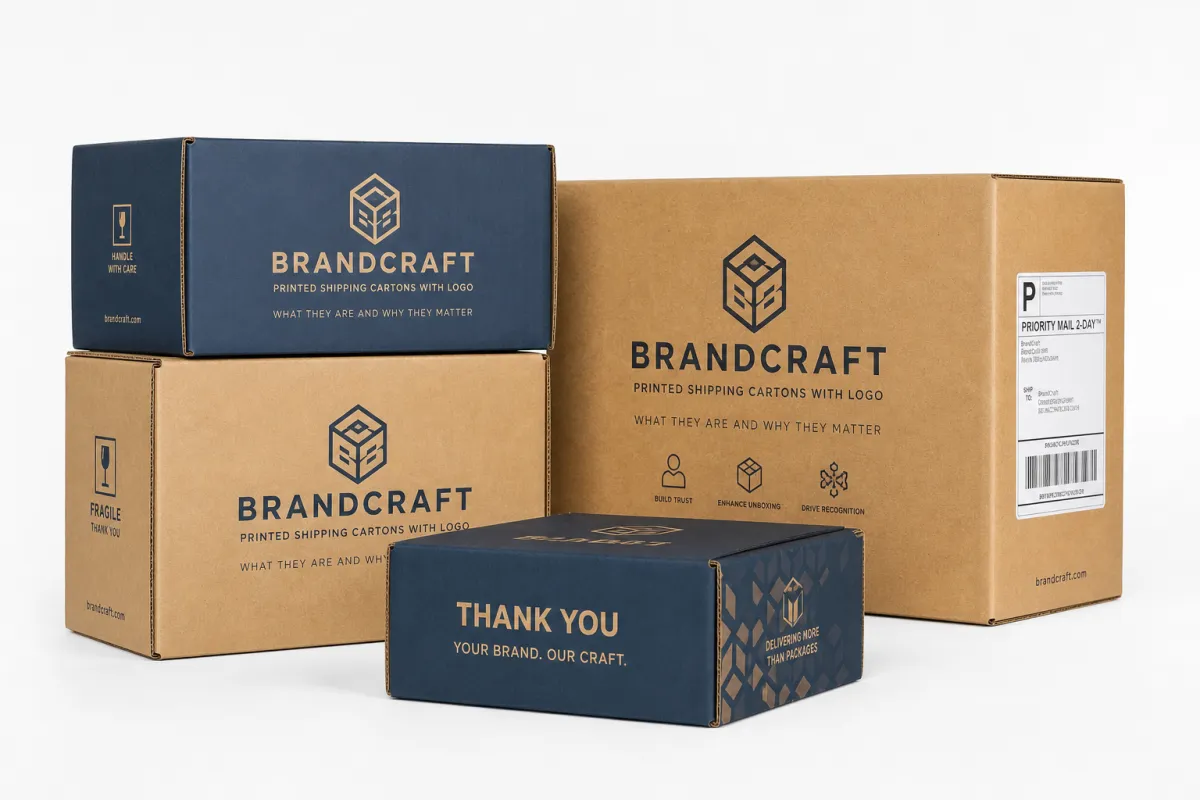
Printed shipping cartons with logo are corrugated shipping cartons that carry a brand mark, wordmark, symbol, or simple graphic directly on the outer surface. In real terms, that can mean a one-color logo on one panel, a two-color mark on the top flap, or a wraparound design that uses the whole carton as a quiet billboard. The point is not decoration for its own sake. The point is to make the shipping box work harder.
Most businesses start with the same question: do we really need printed shipping cartons with logo, or can we keep using blank cartons and labels? The honest answer depends on volume, product value, and how visible the carton is once it leaves the warehouse. If the box passes through carriers, retail receivers, fulfillment teams, and end customers, it is already communicating something. Printed shipping cartons with logo simply make that message intentional.
Buyers often underestimate how often the carton becomes the first brand touchpoint. A customer may never see the pallet, the warehouse rack, or the picker’s cart. They see the shipper. That is why printed shipping cartons with logo can feel more premium than a sticker, even when the print area is small. The carton is doing a job that ordinary shipping materials cannot: it reinforces identity at the exact moment the parcel moves from vendor property to customer property.
Packaging reality: a carton that looks clean, fits well, and stays readable through transit usually beats a flashy package that arrives scuffed or oversized.
There is a practical trust angle too. Printed shipping cartons with logo can reduce confusion in mixed-storage environments, speed receiving, and help teams distinguish one brand from another without opening the box. For businesses shipping through shared logistics centers or third-party order fulfillment, that clarity matters. It is a small operational benefit, but small benefits pile up fast when a company ships thousands of parcels a month.
The carton can also act like a shelf-facing asset in places that are not technically shelves. Think backroom storage, retail returns, trade show replenishment, and customer unboxing videos. Printed shipping cartons with logo may never sit in a merchandised aisle, but they still influence perception. That is why they are not just marketing collateral. They are transit packaging with a job to do.
For companies building out a packaging system, it helps to compare printed shipping cartons with logo against other options such as Custom Packaging Products, Custom Shipping Boxes, and Custom Poly Mailers. Each plays a different role in the shipping workflow. The carton usually wins when package protection and stacking strength matter most, which is most of the time for heavier or more fragile goods.
How Printed Shipping Cartons With Logo Are Produced
The production process starts with the board itself. Printed shipping cartons with logo are usually built from corrugated board, which pairs linerboard with a fluted medium to create stiffness and cushioning. Single-wall boards such as B flute or C flute are common for ecommerce shipping. Heavier products may need 32 ECT, 44 ECT, or even double-wall construction. The exact choice affects both print quality and shipping performance, because a board that is too thin can distort under ink pressure while a board that is too heavy may not need premium print coverage at all.
Print method matters just as much. Flexographic printing is common for high-volume printed shipping cartons with logo because it is efficient once the plates are made. Digital printing is often better for shorter runs, rapid artwork changes, or programs with multiple SKU versions. Litho-lam is the premium route: a printed liner is laminated to corrugated board, which gives sharper imagery but usually adds cost and lead time. If the business only needs a simple logo and a clean brand cue, flexo or digital is usually the smarter choice. Fancy is not always better. Sometimes it is just fancy.
Artwork prep is where a lot of mistakes happen. A logo that looks excellent on a screen can fail on a carton panel if the safe zone is too tight or the file is not built for the dieline. For printed shipping cartons with logo, the file should usually include bleed where needed, keep important text away from score lines, and simplify tiny details that might fill in during printing. One-color artwork often reproduces better than overly busy graphics, especially on shipping-grade surfaces that are not perfectly smooth.
Direct-to-carton printing is not the only route. Some companies use labels, sleeves, or stickers when they want branded presentation without committing to a fully printed box program. That can work for low-volume lines or temporary campaigns. Still, printed shipping cartons with logo usually look more integrated because the branding is part of the structure, not an afterthought applied during packing. Labels can peel, wrinkle, or shift. The carton print stays put.
Here is a simplified production flow for printed shipping Cartons with Logo:
- Review the product and shipping profile.
- Select box size and board grade.
- Place the artwork on the dieline.
- Review and approve the proof.
- Create plates or set up the digital run.
- Print, convert, and fold the cartons.
- Bundle, pack, and ship the order.
If you want a benchmark for print integrity or shipping durability, it helps to look at third-party testing guidance. The ISTA site is useful when you want to understand how cartons are evaluated for distribution hazards. That kind of framework matters because printed shipping cartons with logo only succeed when they look good and survive the route. A carton that fails in transit is just expensive cardboard.
Key Factors That Shape Quality, Cost, and Performance
Strength comes first. Printed shipping cartons with logo must protect the product before they do anything else. If the contents are heavy, fragile, or oddly shaped, the carton spec should be driven by load needs rather than print preferences. A carton that looks good but collapses under stack pressure is a bad packaging choice, not a branding win. From a package protection standpoint, board grade, flute profile, and box style matter more than ink coverage.
Size is the second variable. Oversized cartons raise freight cost, increase dimensional weight, and often make the brand feel careless. A box that is too tight can crush the contents or scuff the print during packing. Printed shipping cartons with logo work best when the dimensions are tuned to the product with enough practical clearance for inserts, void fill, or handling tolerance. Right-sizing saves board, lowers cube, and keeps the shipper looking deliberate.
Graphic complexity is the third cost lever. A simple logo placed on the top panel of printed shipping cartons with logo usually costs less than full-coverage print. It also tends to reproduce more cleanly because the carton surface is doing less visual work. Heavy color coverage, fine gradients, and tiny type can drive up setup time and spoilage risk. For many brands, restraint is not a compromise. It is the strongest move.
Sustainability also enters the picture, and buyers ask about it constantly. Recyclable corrugated board, water-based inks, and minimal coatings are common choices for printed shipping cartons with logo. If fiber sourcing matters to the brand, ask about FSC-certified board and how the carton will be recovered in normal curbside recycling streams. The FSC standards and sourcing framework are a useful reference point: FSC. That does not mean every carton needs a certificate logo printed on it, but it does mean the materials story should be clear.
Storage and transit conditions also shape print durability. Humidity can soften board edges. Cold can change how ink sits on the liner. Scuffing can happen when cartons rub against each other in a trailer or on a pallet. Printed shipping cartons with logo should be tested under real handling, not just reviewed on a proof. If the box will travel through long-haul ecommerce shipping lanes, you want to know whether the print still looks sharp after vibration, compression, and repeated touches.
Here is the practical truth most buyers learn after a few programs: printed shipping cartons with logo are not one decision. They are a bundle of smaller decisions, each with a cost attached. Box style, board grade, print method, ink count, storage space, and reorder cadence all influence the final number. That is why “cheap” cartons sometimes become expensive once waste, damage, and labor are included.
If you are comparing board choices, think in terms of the product profile:
- Lightweight apparel or accessories: often fine with single-wall board and simple one-color print.
- Heavier consumer goods: may need stronger ECT ratings and tighter internal fit.
- High-touch retail shipments: usually benefit from sharper print and cleaner unboxing.
- Mixed-SKU fulfillment: often needs a flexible carton system with fewer size variants.
That kind of thinking makes printed shipping cartons with logo less of a styling exercise and more of a packaging system choice. It also keeps the conversation grounded in what the box has to do, not just how it looks in a mockup.
Printed Shipping Cartons With Logo: Cost and Pricing Breakdown
Pricing is where the conversation gets real. Printed shipping cartons with logo can be inexpensive in one scenario and surprisingly costly in another, depending on quantity, board grade, print method, number of colors, and whether special tooling is required. Small programs often pay more per unit because setup costs are spread across fewer cartons. Larger programs gain efficiency, but only if forecasting is accurate and storage is available.
As a rough working range, a simple one-color logo on standard corrugated board may add about $0.08 to $0.25 per unit at scale, while more complex printed shipping cartons with logo can add $0.30 to $0.90 or more per unit, especially if the artwork wraps the carton or requires premium finishing. Those are not universal numbers. They are directional bands that help a buyer think clearly before asking for quotes. If a supplier offers a price far outside that range, there is usually a reason.
Blank cartons plus labels can look cheaper at first. Sometimes they are. But labels add labor, can create inconsistency, and may be less durable during transit packaging. If a warehouse worker has to apply a label to every unit, that is a real operating cost. Printed shipping cartons with logo remove a step, and in a high-volume order fulfillment environment, one removed step can matter more than a small difference in material cost.
The table below compares common options for printed shipping cartons with logo and adjacent packaging approaches:
| Option | Typical Use | Setup Cost | Approx. Unit Cost Impact | Notes |
|---|---|---|---|---|
| Blank carton + label | Low-volume or temporary branding | Low | Low to moderate | Flexible, but labels add labor and can shift in transit. |
| One-color direct print | Most common printed shipping cartons with logo program | Moderate | Low to moderate | Clean look, efficient at volume, easy to keep readable. |
| Digital full-color print | Short runs, many SKU changes, faster turn | Lower than flexo plates | Moderate to high | Good for flexibility, usually best when quantities are smaller. |
| Litho-lam presentation carton | Premium retail or high-value shipping | High | High | Sharpest appearance, but not always needed for transit packaging. |
There are hidden costs too. Art revisions can trigger extra rounds of proofing. Sample cartons can add freight and prototype charges. Rush schedules can push the price up quickly. If the internal team keeps changing dimensions after the quote, printed shipping cartons with logo become more expensive because new tooling or new print setups may be required. Forecasting is not glamorous, but it protects margin.
One thing buyers often miss is storage. A branded carton program can be smart, but only if the business has room to store the run. If the cartons take up floor space that should hold inventory, the “savings” can evaporate. This is especially true for smaller ecommerce shipping teams where packaging materials, finished goods, and shipping supplies all compete for the same square footage.
Here is the better question: what does the carton save, support, or simplify? If printed shipping cartons with logo reduce pack time by even a few seconds per unit, that can matter. If they reduce damage, that matters even more. If they make the brand feel trustworthy at the door, that may be the biggest gain of all. The unit price only tells part of the story.
Process and Timeline for Printed Shipping Cartons With Logo
The cleanest programs start with a product audit. Before ordering printed shipping cartons with logo, measure the product, consider inserts or dunnage, note the shipping method, and decide whether the carton needs to protect against drops, compression, or both. That information shapes the carton style and makes the quote far more accurate. Skip this step, and the box may arrive looking good but performing badly.
Next comes the layout discussion. Where should the logo sit? On the top panel? On the side? On both? For many brands, printed shipping cartons with logo work best with a simple top-panel mark and maybe a short side-panel message. That keeps the design legible without fighting the tape seam, score lines, or handling marks. The safest layout is usually the one with the least confusion at the press stage.
Lead time varies by print method and approval speed. Digital programs can move faster, especially when artwork is already finalized. Flexo runs usually need more setup time because plates must be made. Litho-lam programs often take the longest because they involve more stages. In practical terms, simple printed shipping cartons with logo can sometimes land in about 7 to 12 business days after approval, while more customized cartons may take 12 to 25 business days depending on volume and tooling. If there is a launch date, count backward.
Approval delays are common. Marketing wants the logo larger. Operations wants the box stronger. Procurement wants the quote lower. Then someone notices the product changed by half an inch. That is how printed shipping cartons with logo slip from a two-week project to a six-week project. A disciplined proof cycle helps. One round of artwork review is ideal. Two is workable. More than that usually means the brief was not clear enough.
Samples or prototypes are worth the time. A test carton lets you check fit, print clarity, stack behavior, and appearance under real handling. If possible, drop the packed carton, stack it, tape it, and move it through the same path your team uses every day. A proof on a screen cannot show how the carton feels at the pack station. Printed shipping cartons with logo are only useful if they still look good after a real shift.
One of the best planning habits is to tie the carton schedule to replenishment triggers. Do not wait until the last pallet is gone. Build reorder points based on average weekly use, safety stock, and expected lead time. That matters even more for printed shipping cartons with logo because a stockout forces either a rushed reorder or a fallback to plain cartons, and both outcomes weaken the program.
If the packaging team is building a broader system, it can help to compare cartons with other shipping materials in the same family. Not every product needs a box. Some light goods move better in mailers, and some secondary packaging can share graphics across formats. But where package protection and presentation both matter, printed shipping cartons with logo remain one of the most efficient choices.
Common Mistakes to Avoid Before You Place an Order
The first mistake is picking the wrong box size. A box that is too large creates wasted cube, higher dimensional weight, and a loose-looking brand impression. A box that is too small risks crushed product, bent flaps, and print damage during closing. Printed shipping cartons with logo need the right blank canvas, which in packaging terms means the right footprint and depth for the product line.
The second mistake is overcomplicating the artwork. Fine lines, tiny legal text, heavy gradients, and ultra-thin fonts can all fail on corrugated surfaces. Shipping-grade board is not a coated brochure sheet. Printed shipping cartons with logo usually look better when the design is disciplined and readable from a distance of three to six feet. That is not a limitation; it is a design rule that respects the medium.
The third mistake is skipping real-world testing. A proof may look perfect and still fail after a few touches, a humid trailer ride, or a pallet move across a warehouse. If the carton will be visible in retail environments or handled by multiple carriers, test the print under the harshest expected route. A carton that scuffs in the first mile will not impress anyone by mile ten. That is why printed shipping cartons with logo should be validated with actual transit packaging conditions, not just internal enthusiasm.
The fourth mistake is underestimating replenishment. A brand can approve a beautiful carton program and then run out of stock because forecasting was based on optimism rather than demand history. That creates an awkward choice: rush the reorder at a higher price or switch to unbranded shipping materials temporarily. Neither is ideal. Printed shipping cartons with logo should be designed around a supply plan, not just a launch date.
The fifth mistake is internal misalignment. When marketing, operations, and procurement define success differently, the carton often becomes a compromise nobody loves. Marketing wants impact. Operations wants package protection and easy packing. Procurement wants the lowest quote. A better brief defines the non-negotiables first: board strength, logo placement, and volume forecast. Then the team can compare quotes fairly.
Here is a quick sanity check before you approve printed Shipping Cartons With Logo:
- Does the carton fit the product with practical clearance?
- Will the logo still read clearly after handling?
- Does the board grade match the product weight?
- Are reorder triggers already set?
- Has the team agreed on what “good” means?
That checklist sounds simple, but it prevents expensive surprises. I have watched brands skip it, then spend the next month untangling preventable problems. Not fun. Not cheap either.
Expert Tips and Next Steps for a Better Rollout
Start with the highest-volume SKU first. That gives you the fastest feedback on whether printed shipping cartons with logo improve packing speed, reduce errors, or strengthen presentation. A pilot on the most common carton size is usually more useful than a broad rollout across ten low-volume items. If the first carton works, the rest of the program gets easier.
Create a one-page spec sheet before requesting quotes. Include box dimensions, product weight, shipping method, logo file type, print colors, board strength requirement, and target quantity. Printed shipping cartons with logo quote faster and more accurately when the supplier is not guessing. A clear brief also helps the operations team spot issues before they become production delays.
Ask for two quote paths. One should reflect direct-printed cartons. The other should show a simpler fallback, such as a blank carton with a minimal brand mark or label. That comparison helps expose the tradeoff between appearance, labor, and cost. In many cases, the printed shipping cartons with logo option wins because it removes a step from the packing line and looks more consistent at the door.
Measure the pilot with real numbers, not vibes. Track packing time per unit, damage rate, customer comments, and reorder frequency. If possible, compare the branded carton against your previous packaging format over several weeks. That kind of evidence is more useful than a one-day reaction. It also tells you whether printed shipping cartons with logo are supporting the business or just looking nice in a sample room.
For brands shipping a mix of goods, it may make sense to pair cartons with other packaging formats. That is where a broader mix of Custom Packaging Products, Custom Shipping Boxes, and Custom Poly Mailers can create a cleaner system. The goal is not to force every item into the same package. The goal is to match the package to the product and keep the brand consistent across formats.
One final operational note: printed shipping cartons with logo should be tied to both brand and logistics goals. If the carton improves recognition but slows packing, the design needs adjustment. If it speeds packing but looks sloppy, the print spec needs work. The best program does both well. That is the real advantage of printed Shipping Cartons with Logo: they can serve as shipping materials, transit packaging, and brand communication all at the same time.
When companies treat printed shipping cartons with logo as a system choice rather than a decoration choice, the payoff is usually clearer. The box becomes easier to pack, easier to identify, and more effective at the moment the customer receives it. That is a strong return for a packaging change that starts with something as simple as a logo on corrugated board.
FAQ
Are printed shipping cartons with logo worth it for small businesses?
Yes, if the same products ship repeatedly and the box does part of the branding work. Printed shipping cartons with logo are especially useful when the carton is visible in retail, warehouse, or resale settings, or when the unboxing moment matters enough to shape customer perception. For very low volumes, a simpler print layout or a label-based approach may be the better starting point.
How much do printed shipping cartons with logo usually cost?
Pricing depends on quantity, board grade, print method, box size, and how many colors are used. A simple one-color logo is usually far less expensive than full-coverage artwork or premium finishes. The best comparison is total cost, including packing labor, damage reduction, storage, and reorder frequency. Printed shipping cartons with logo can look expensive until they remove labor or reduce waste.
What is the lead time for printed shipping cartons with logo?
Lead time depends on artwork approval, production method, and whether custom tooling or proofs are required. Digital runs and simple designs are usually faster than highly customized, large-volume carton programs. Build in extra time if the carton has to align with a launch date, seasonal demand, or a promotion. In practice, printed shipping cartons with logo are best ordered before the calendar gets tight.
What logo placement works best on shipping cartons?
The top panel is usually the safest starting point because it is easy to see during packing and opening. Side-panel placement can work well when cartons are stacked, shelved, or handled by multiple teams. Keep the design simple and leave enough quiet space so the logo stays readable at a glance. Printed shipping cartons with logo do not need loud artwork to feel intentional.
Can printed shipping cartons with logo be recycled?
Yes, if the carton is made from recyclable corrugated board and the ink coverage stays within normal recycling-friendly limits. Water-based inks and minimal coatings are usually better choices for recycling compatibility. If you need a special finish, confirm how it affects local recycling rules before you approve the design. In most programs, printed shipping cartons with logo can still fit a responsible materials strategy.
If you only do one thing after reading this, make it a real pilot: pick one SKU, choose one logo placement, lock the board grade, and test the carton through your actual packing line before you order the full run. That one move tells you whether printed shipping cartons with logo are just prettier boxes or a package that genuinely pulls its weight.


