Buyer Fit Snapshot
| Best fit | Corrugated Carton Price Calculator for Accurate Quotes projects where brand print, material claims, artwork control, MOQ, and repeat-order consistency need to be specified before quoting. |
|---|---|
| Quote inputs | Share finished size, material target, print colors, finish, packing count, annual reorder estimate, ship-to region, and any compliance wording. |
| Proofing check | Approve dieline scale, logo placement, barcode or warning zones, color tolerance, closure strength, and carton packing before bulk production. |
| Main risk | Vague material claims, crowded artwork, missing packing details, or unclear freight terms can make a low unit price expensive after revisions. |
Fast answer: Corrugated Carton Price Calculator for Accurate Quotes should be specified like a repeatable production item. The safest quote records material, print method, finish, artwork proof, packing count, and reorder notes in one written spec.
Production checks before approval
Compare the actual filled-product size with the drawing, then confirm tolerance on folds, seals, hang holes, label areas, and retail display edges. Reserve space for logos, QR codes, warning copy, and material claims before decorative graphics fill the panel.
Quote comparison points
Review material grade, print process, finish, sampling route, tooling charges, carton quantity, and freight assumptions side by side. A quote is only useful when the supplier can repeat the same color, closure quality, and packing count on the next order.
Corrugated Carton Price Calculator for Accurate Quotes
If you need to price shipping cartons with any confidence at all, a corrugated carton price calculator gives you the fastest route from a rough idea to a budget that can actually be used. Box pricing has a way of moving for reasons that seem small on paper but matter a lot in production: an inside dimension that shifts by a few millimeters, a different board grade, a flute change, a heavier print load, or a carton style that needs more handling on the line. A good corrugated carton price calculator gives you a practical starting point before the back-and-forth begins, and that matters a lot when the carton has to protect product, move cleanly through packing, stack properly, and still land in a cost band the business can live with.
The real question for a packaging buyer is rarely just, “How much does a box cost?” The better question is, “What exactly am I buying for that price?” Behind the unit cost sits compression performance, shipping efficiency, packing speed, and the confidence that the carton will survive warehouse handling without forcing you to overbuild it just to feel safe. A corrugated carton price calculator helps separate the big cost drivers from the smaller ones, so the team can narrow the field before requesting samples or a formal quote.
For branded programs, replenishment orders, and shipping carton rollouts, the calculator makes it easier to compare board grades, materials, and production paths without losing sight of how the carton will really be used. It keeps the conversation grounded in what happens on the packing bench, in transit, and on the pallet. If you are reviewing Custom Shipping Boxes, the estimate needs to account for both protection and logistics, because those two factors decide whether the box saves money or quietly eats margin over time.
A good calculator is not a substitute for engineering judgment. It is the first filter, the one that sorts obvious mismatches from viable options. Use it to test structures, compare price bands, and understand where the money goes before committing time to a prototype run. That is the practical value of a corrugated carton price calculator: faster decisions, fewer blind spots, and a quote that lands much closer to the final production number.
Corrugated Carton Price Calculator: What Changes the Quote Fast
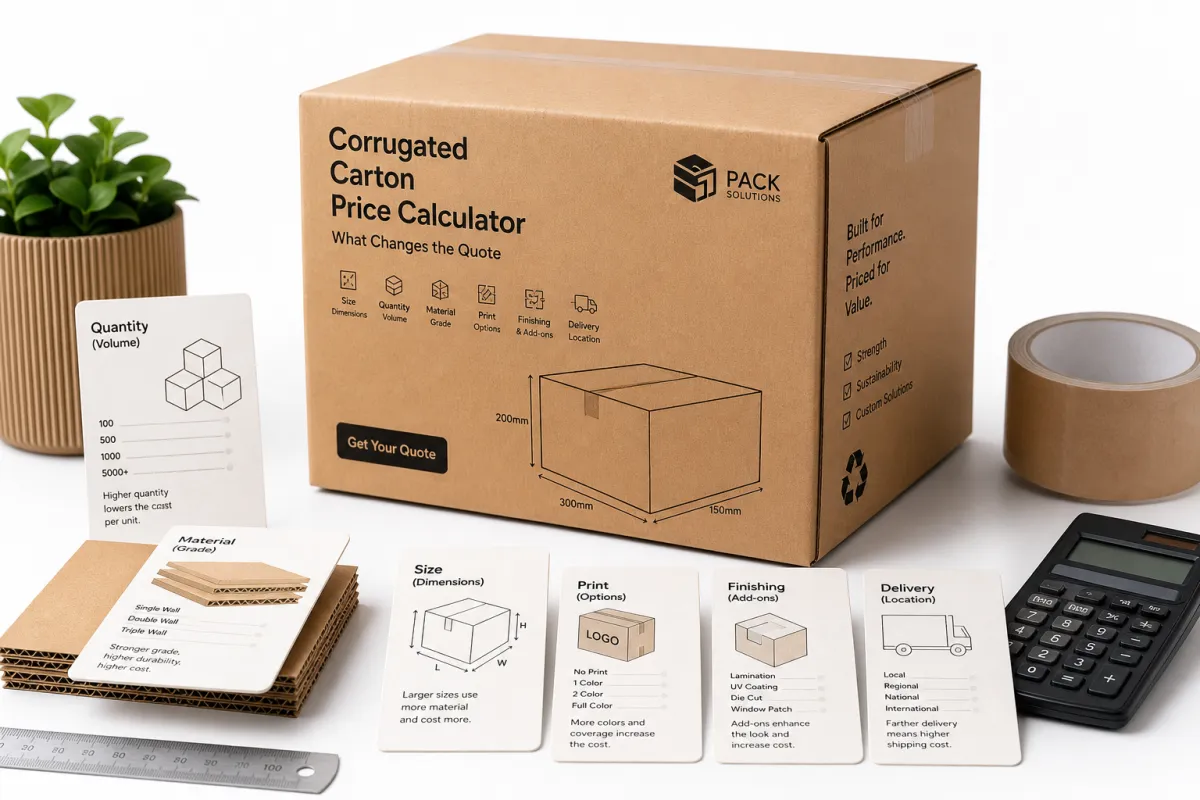
The quickest way to surprise a buyer is to change the carton dimensions by a small amount and watch the price move. A corrugated carton price calculator helps because it makes those changes visible before anyone signs off on the spec. In real production, the biggest jumps usually come from material usage, conversion method, print coverage, and shipping destination. Smaller details matter too, but they usually do not move the quote as much as the core structure and size.
Board usage is often the first thing that shifts cost. A slightly wider blank, a deeper flap, or a taller carton can increase the sheet size enough to reduce yield from the parent board, and that has a direct effect on the estimate. If your product sits close to the edge of a standard size, the corrugated carton price calculator can show whether a small redesign trims cost or accidentally pushes the job into a less efficient layout. Experienced buyers tend to treat dimensions as a financial input, not just a fit check, because the board layout is where a lot of the real cost lives.
Conversion complexity is the next major driver. A regular slotted container is usually simpler to run than a die-cut carton with locking tabs, hand-insert folds, or multiple glue points. Anything that adds assembly steps will usually add labor and quality control time, and the calculator should account for that. Print works the same way. A single-color logo on kraft board follows a very different path from full-coverage four-color graphics with coatings or spot treatments. A corrugated carton price calculator should separate those costs clearly, because print often gets underestimated.
“The cleanest quote usually starts with the cleanest input set. Final dimensions, clear strength targets, print count, and delivery postcode tell the calculator far more than a vague ‘standard shipping box’ request ever will.”
It also helps to think about the buyer’s decision in context. A shipping carton is not a standalone object; it is part of the packing line, the pallet pattern, the freight cube, and the damage rate. If a slightly stronger carton costs a few cents more but protects against crush in transit, that trade can be profitable. If a heavy double-wall build is being used for a lightweight item that ships in controlled conditions, you may be paying for strength you never need. A corrugated carton price calculator makes that trade-off visible instead of emotional.
The business case is straightforward: use the calculator to sort the viable options, then move to sampling only when the price and performance range make sense. That keeps the project moving and avoids the common mistake of requesting a formal quote before the design is really settled. In a busy packaging program, that can save days and spare a lot of unnecessary back-and-forth.
| Carton Type | Typical Use | Relative Cost Pressure | What Moves the Quote Most |
|---|---|---|---|
| Regular slotted container | General shipping, warehouse packing, standard ecommerce | Lower | Size, board grade, print coverage |
| Die-cut carton | Retail-ready packs, precise fit, special closures | Moderate to higher | Tooling, die complexity, fold pattern |
| Double wall shipper | Heavier goods, longer transit, palletized loads | Higher | Board thickness, compression target, freight cube |
| Specialty folder or shipper | Products needing tabs, inserts, or display features | Higher | Assembly labor, insert work, print and finishing |
Carton Construction Details That Move the Quote
Corrugated cartons are not all built the same way, and the corrugated carton price calculator should reflect that. A regular slotted container, a die-cut mailer, a folder, and a specialty shipper behave differently on the line and in transit. The structure you choose changes how much board is required, how much labor the box needs, and whether tooling or extra setup comes into play. Those differences matter even more when the order repeats month after month.
Single wall is usually the starting point for lighter loads and many standard shipping applications. It uses one corrugated medium between linerboards, which keeps material cost lower while still providing a practical level of protection. Double wall adds a second fluted medium and is often chosen for heavier items, taller stacks, or situations where cartons sit in storage before they move. Triple wall is less common, but it still has a place in demanding industrial packing. A good corrugated carton price calculator lets you see how each wall construction changes the estimate before you commit.
Flute profile matters just as much. C flute is common because it balances cushioning and stacking performance. B flute often gives a flatter print surface and can work well in retail or display-oriented boxes. E flute is thinner and supports sharper graphics and tighter packaging footprints, while larger profiles such as A or BC combinations can provide stronger structural support. The important point is simple: flute choice affects thickness, print quality, and compression strength, so the corrugated carton price calculator should never treat it as a minor detail.
Inside dimensions influence manufacturability as well. If the clearance around the product is too tight, packing slows down or the fold pattern gets more complicated. If the carton is too loose, board is wasted and the product can move around in transit. Both problems show up in the quote. The same is true for inserts, partitions, and internal fitments. They add material, and they add handling steps. A reliable corrugated carton price calculator should show those additions plainly instead of burying them in a generic customization line.
Print and finishing can change the production path more than many buyers expect. One-color branding on the outer liner is usually straightforward. Multi-color graphics, flood coats, varnish, or specialty labels can require extra processing and tighter registration control. Even when the finished carton looks simple, the production sequence may be anything but simple. That is why the corrugated carton price calculator works best when it breaks down print coverage and finishing by option, not as a lump sum.
A practical way to judge construction is to ask how the carton will be handled. If it will be packed once, shipped once, and unpacked once, a leaner structure may be enough. If it will be stacked, warehoused, and moved through several touchpoints, the carton needs enough compression strength and surface durability to avoid becoming the weak link. That is where the corrugated carton price calculator shifts from a quote tool into a planning tool.
Specifications That Matter for Shipping and Logistics
The best carton spec is the one that survives the whole logistics chain. A corrugated carton price calculator should help you evaluate more than print and size; it should also guide you through internal dimensions, stacking performance, moisture exposure, and freight efficiency. Once the carton leaves the plant, the real test begins in the warehouse, on the pallet, and in transit. If those conditions are missing from the spec, the quote may look fine while the carton itself underperforms.
Edge Crush Test or ECT is commonly used to estimate stacking strength. Burst strength still appears in some programs, and compression performance often matters most when cartons are palletized. For lab comparisons, ASTM methods can provide a useful frame of reference, but a practical packaging buyer should always connect those numbers back to product weight, stack height, and transit mode. A corrugated carton price calculator is most useful when it lets you compare those levels side by side instead of just presenting one default answer.
Humidity and moisture resistance are easy to overlook until the first warehouse issue appears. Corrugated board can lose performance in damp storage, cold chain environments, or long ocean moves. If the product will face those conditions, the carton may need a stronger board grade, a better outer liner, or a surface treatment that helps it hold up. That does not mean overbuilding every box. It means Choosing the Right spec for the route. The calculator should show how that choice affects unit cost, because moisture protection usually comes with a price adjustment.
Cube efficiency is another place where the numbers matter. A carton that fits the product beautifully but wastes pallet space can raise freight cost enough to erase the savings. Think about pack-out efficiency, pallet count, orientation on the pallet, and whether the cartons can stack in a stable pattern without voids. The corrugated carton price calculator helps here because it exposes the cost of a poor size choice before you lock in a production run.
For teams that test packaging formally, shipping standards can help guide the conversation. ISTA test protocols are widely used for distribution simulation, and they are a useful reference when a program needs a carton that will hold up under vibration, drop, and compression conditions. You can review the organization’s resources at ISTA. If your company is also prioritizing responsibly sourced fiber, certifications such as FSC can matter during the material review, and the relevant information is available at FSC.
The best carton is not the strongest one on paper, and it is not the cheapest one in the calculator. It is the carton that protects the product, ships efficiently, and lands at a unit cost the business can carry. A corrugated carton price calculator helps you see all three at once, which is why it deserves to sit near the front of the planning process.
Corrugated Carton Price Calculator Pricing, MOQ, and Unit Cost
Pricing usually comes from a familiar group of inputs: board usage, conversion labor, tooling, print plates, finishing, and freight. The corrugated carton price calculator is useful because it turns those variables into a visible estimate instead of a vague promise. Once you know where the price is coming from, you can decide where to save and where to spend. That is a very different conversation from asking for the “cheapest box possible.”
MOQ, or minimum order quantity, matters more than many buyers expect. Smaller runs tend to carry a higher unit cost because setup work, make-ready time, and tooling get spread across fewer cartons. Larger runs usually reduce the per-unit share of those fixed costs. The corrugated carton price calculator should make those breakpoints clear, because sometimes moving from a low-quantity order to a slightly larger run lowers unit cost enough to justify carrying a bit of inventory.
The biggest pricing drivers are usually easy to spot once you know where to look. Box size affects board usage. Board grade affects material cost and performance. Print coverage influences press time and ink use. Die-cut construction adds tooling and often adds labor. Extra inserts or internal dividers add parts and assembly steps. A properly built corrugated carton price calculator should show those variables separately, because buyers need to compare option A against option B without losing track of setup charges.
One thing that often gets missed is the difference between a quoted unit cost and the actual landed cost. A carton that looks inexpensive at the factory may become more expensive once freight, palletization, and receiving realities are included. A carton with better cube efficiency may look a little pricier on paper but save money across the shipment. The corrugated carton price calculator is most helpful when it lets you compare the finished box in context, not as an isolated line item.
| Order Scenario | Typical Price Behavior | What the Buyer Should Watch | Best Use Case |
|---|---|---|---|
| Low MOQ trial run | Higher unit cost, higher share of setup | Tooling, plates, make-ready, packaging of the finished cartons | New launches, design validation |
| Mid-volume replenishment | Moderate unit cost with better spread of fixed charges | Board grade, print coverage, freight zone | Recurring monthly demand |
| High-volume program | Lower unit cost, stronger value from stable specs | Storage space, call-off timing, forecast accuracy | Ongoing distribution, seasonal peaks |
| Spec change midstream | Can increase cost if tooling or layout changes | Revision control, artwork updates, approval timing | Rebrands, package redesigns |
Price bands make more sense when you look at realistic structures instead of abstract averages. A small single-wall mailer may sit in a lower unit range than a double-wall shipping carton, while a die-cut custom shipper with printing and inserts can move into a higher band quickly. For many custom programs, a planning range might look like $0.18-$0.35 per unit for simpler builds at moderate quantities, $0.35-$0.80 for stronger or more complex cartons, and above that when print coverage, inserts, or heavy board grades enter the job. Those are planning ranges, not promises, because the corrugated carton price calculator needs the real spec to tighten the number.
One of the most useful habits is to compare two or three workable structures instead of asking for just one quote. A small shift in flute choice, board grade, or carton style can lower total packaging cost even if the unit price moves a little. That is why the corrugated carton price calculator should be used as a comparison tool, not a yes-or-no gate.
Process, Timeline, and Lead Time for Your Order
A clean quoting process starts with clean information. The best results from a corrugated carton price calculator come from exact inside dimensions, expected product weight, board strength target, print details, quantity, delivery destination, and the date you need cartons on site. With those inputs in place, the estimate becomes useful fast. Without them, the quote has to stay broad, because the production team has no choice but to protect against uncertainty.
The usual sequence is fairly simple. First comes the RFQ, then the spec review, then any dieline confirmation or artwork check. If needed, the team moves into the sample or prototype stage, then production scheduling, manufacturing, quality checks, packing, and shipment. Complex cartons can require a few rounds of clarification. A strong corrugated carton price calculator shortens that loop because it standardizes the basic inputs before a salesperson or estimator starts chasing missing details.
Lead time stretches for a few predictable reasons. Custom tooling is one. Artwork revisions are another. Material sourcing can add time if the requested board grade or liner combination is not already on hand. Higher volumes matter too, especially when the order needs a dedicated production window or specialized finishing. Buyers often ask for speed, but speed usually comes from clarity. The more precise the information, the faster the plant can move from estimate to production. That is one of the most practical uses of a corrugated carton price calculator.
Freight planning deserves attention as well. If cartons arrive before warehouse space is ready, they become a storage issue. If they arrive after the launch window, the program feels late even when production went well. Plan around receiving hours, dock availability, pallet handling, and any special booking requirements. A carton quote is only part of the job; a full logistics plan makes the order usable. The best corrugated carton price calculator output should help you schedule the order with those realities in mind.
For recurring orders, locking the spec early usually pays off. A late change to print, a small dimensional adjustment, or a last-minute board swap is one of the most common ways a carton program slips. Those changes may sound minor, but they can trigger a new estimate or even a new production setup. The calculator helps prevent that by showing the cost effect before approval.
If your team is also comparing other package formats, it helps to review the broader line of Custom Shipping Boxes so the carton choice fits the rest of the packaging system. The right choice on paper should also work on the packing line, in the warehouse, and during delivery. That is where a corrugated carton price calculator pays for itself.
Why Choose Us for Corrugated Cartons at Scale
At scale, packaging is not only about getting a box made. It is about getting the same box made the same way every time, with the same board performance, print quality, and dimensional consistency. A disciplined corrugated program matters because the quote has to translate into cartons that match the stated spec instead of a loose approximation. A good corrugated carton price calculator is only useful when the production team behind it can hold the line on those details.
Technical guidance is a real advantage. A buyer may know the product and the launch plan, but not always the most efficient carton structure for transit, stacking, or line handling. A supplier that understands flute selection, board grades, and corrugated conversion can help avoid overspecifying the box. That protects margin without sacrificing performance. The point is not to sell the heaviest box possible; the point is to sell the right one. A corrugated carton price calculator works best when it is paired with practical advice grounded in actual packaging behavior.
Transparent communication is another sign of a good partner. Buyers Need to Know what is included in the estimate, what is a one-time charge, what could change with artwork or tooling, and what freight assumptions are built into the quote. That clarity matters even more when the carton supports a launch, a replenishment cycle, or a seasonal program with repeated ordering. If the first quote is clear, the second and third orders usually move faster. The same corrugated carton price calculator that helps during approval also helps later during reorders.
Scale brings consistency challenges too. If demand changes, the carton program needs to flex without forcing a full redesign every time. Repeat-order consistency, stable scheduling, and the ability to handle quantity changes smoothly are not side issues; they are the backbone of a dependable packaging supply chain. A reliable corrugated carton price calculator is part of that discipline because it helps teams understand how volume changes affect unit economics before the order is placed.
From my side, the best suppliers are the ones that understand corrugated performance, freight reality, and practical line handling all at once. A low list price alone does not tell you whether the carton will hold up in storage or waste cube on the pallet. A good estimate does the opposite: it tells you what you are paying for and why. That is the standard we try to meet when working through a corrugated carton price calculator request.
Next Steps: Using the Corrugated Carton Price Calculator Well
Start with the minimum inputs that matter most: inside dimensions, product weight, required strength, print coverage, quantity, destination, and target delivery date. Once those are in place, the corrugated carton price calculator can do real work instead of producing a fuzzy placeholder. If you have two possible carton styles, compare both. If you are unsure about single wall versus double wall, compare both. That small extra effort often reveals a better balance of cost and performance.
Then look beyond the box itself. Confirm whether the carton needs pallet stacking, moisture protection, inserts, or retail-ready printing. Those details are easy to leave out in the first conversation, and they are exactly the kind of details that can move the price more than expected. The corrugated carton price calculator should help you see the impact before final approval, not after the production job is already booked.
Review the output against your packing line, warehouse handling, and freight plan. A carton that looks good in isolation may create problems if it is too tall for the pallet pattern, too tight for the packers, or too heavy for the shipping lane. A carton that works operationally is worth more than a box that only looks good in a spreadsheet. That is the practical promise of a corrugated carton price calculator.
If you are comparing suppliers or building a repeat order program, ask for a quote that separates unit cost, setup, and shipping. That makes comparisons much cleaner and prevents surprise charges from hiding inside a single line. It also makes reorder planning easier, which matters if the carton is tied to a seasonal sale or a steady replenishment cycle.
Use the corrugated carton price calculator as the first step toward a precise, production-ready quote, then move directly into sampling or order confirmation once the numbers make sense. That keeps the project moving, keeps the buying team aligned, and gives the plant the information it needs to build the right carton the first time.
Corrugated carton price calculator results are most useful when they help you choose with confidence, not when they bury you in unnecessary options. Use the calculator to compare structures, check the MOQ, and judge landed cost with a clear head, and the final quote will usually come much closer to reality. That is the point: a carton spec that fits the product, behaves well in the warehouse, and avoids paying for strength or print you do not actually need.
FAQ
How accurate is a corrugated carton price calculator for custom shipping boxes?
It is usually accurate enough to compare options and set budget expectations when the key inputs are correct. Accuracy improves when the corrugated carton price calculator includes exact inside dimensions, board grade, print coverage, quantity, and destination. Final pricing can still shift a bit if artwork, tooling, or freight details change after the first estimate, so it is best treated as a planning tool rather than a fixed contract price.
What information do I need before using a corrugated carton price calculator?
Have the carton inside dimensions, product weight, desired board strength, quantity, and shipping location ready. If the box needs print, include the number of colors, ink coverage, and whether the artwork is already final. It also helps to know whether you need inserts, die-cut features, or palletized packing requirements so the corrugated carton price calculator can give a more useful result.
Why does MOQ change the corrugated carton price so much?
Setup work, die-cut preparation, and printing adjustments are spread across more cartons as the order gets larger. Smaller runs usually carry a higher unit cost because the fixed production effort does not change much. Ordering at a higher quantity can lower unit cost enough to offset the added inventory if the cartons are used regularly, which is why the corrugated carton price calculator should always be checked against demand forecasts.
Can the calculator help me choose between single wall and double wall cartons?
Yes, because it shows how material thickness and strength change the estimate in a measurable way. Single wall often fits lighter products and lower stacking loads, while double wall is better for heavier or more demanding shipping conditions. The best choice depends on product weight, transit risk, and how the cartons will be stored or palletized, which is exactly the kind of decision a corrugated carton price calculator should support.
How do I get the most useful quote from a corrugated carton price calculator?
Use final dimensions instead of rough estimates, because small sizing changes can affect board usage and freight efficiency. Provide the real quantity you expect to order, since pricing can shift at different volume bands. Ask for a quote that separates unit cost, setup, and shipping so you can compare offers clearly, and keep the corrugated carton price calculator aligned with the actual production spec.