Buyer Fit Snapshot
| Best fit | Corrugated Cartons for Subscription Boxes projects where brand print, material claims, artwork control, MOQ, and repeat-order consistency need to be specified before quoting. |
|---|---|
| Quote inputs | Share finished size, material target, print colors, finish, packing count, annual reorder estimate, ship-to region, and any compliance wording. |
| Proofing check | Approve dieline scale, logo placement, barcode or warning zones, color tolerance, closure strength, and carton packing before bulk production. |
| Main risk | Vague material claims, crowded artwork, missing packing details, or unclear freight terms can make a low unit price expensive after revisions. |
Fast answer: Corrugated Cartons for Subscription Boxes: Board, Finish, Dieline, and Unit Cost should be specified like a repeatable production item. The safest quote records material, print method, finish, artwork proof, packing count, and reorder notes in one written spec.
Production checks before approval
Compare the actual filled-product size with the drawing, then confirm tolerance on folds, seals, hang holes, label areas, and retail display edges. Reserve space for logos, QR codes, warning copy, and material claims before decorative graphics fill the panel.
Quote comparison points
Review material grade, print process, finish, sampling route, tooling charges, carton quantity, and freight assumptions side by side. A quote is only useful when the supplier can repeat the same color, closure quality, and packing count on the next order.
Corrugated Cartons for Subscription Boxes: Practical Guide
Corrugated cartons for subscription boxes look plain until they go through a real fulfillment cycle. Then the math shows up. A box that seems fine on a packing table can arrive crushed, scuffed, or packed with product drift if the board is too light, the fit is too loose, or the structure was chosen for the wrong load.
That is why corrugated cartons for subscription boxes deserve more attention than they usually get. They protect the contents, shape the unboxing moment, and affect freight, labor, and damage rates all at once. For Custom Logo Things, that balance matters because the box is not just a shell; it is part of the brand promise, and it has to survive handling from the first fold at the fulfillment bench all the way to the customer’s doorstep. Simple idea. Not always simple in practice.
What Corrugated Cartons for Subscription Boxes Actually Do
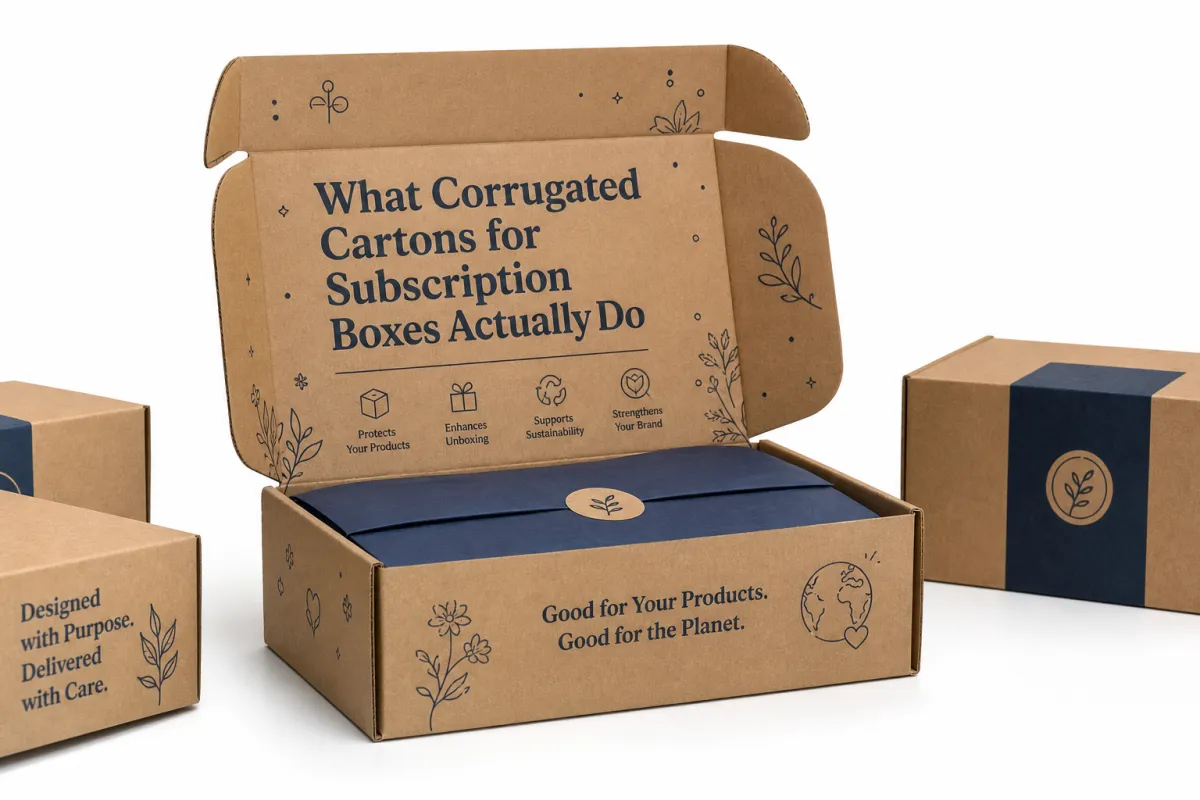
Corrugated cartons for subscription boxes are built from layered paperboard: linerboard on the outside and inside, with a fluted medium between them. That fluted center is not decorative. It adds stiffness, absorbs impact, and gives the carton the compression strength it needs when boxes are stacked in storage or squeezed in a trailer.
In practice, corrugated cartons for subscription boxes do three jobs at once. They protect the product. They make the brand look organized and intentional. They keep the shipping budget from getting chewed up by oversized cartons, heavy freight, or avoidable damage. If any one of those jobs fails, the whole package feels off.
It helps to separate the carton types people often mix together. A shipping-first carton is built for protection and speed, often with minimal graphics. A mailer-style carton is usually die-cut, folds neatly, and gives a more polished opening experience. A premium presentation carton may use a better print treatment, a nicer closure, or a more rigid build to make the box feel gift-like. Corrugated cartons for subscription boxes can sit anywhere along that range, but the choice should follow the product, not the other way around.
A subscription box can hit the right size, price, and print, then still miss the mark if the carton does not match the way the contents move, press, and settle inside it.
That is why I think corrugated cartons for subscription boxes should be treated as part of product design, not as an afterthought buried in the shipping line. The customer sees the outer carton first, then the opening sequence, then the items inside. The carton sets the tone before anything gets touched.
That opening sequence matters just as much as the graphics on the outside. If the carton opens cleanly, keeps its shape, and presents the contents without a mess of loose fill, the customer reads that as care. If the lid bows, the seams split, or the product shifts around inside, the brand feels less finished even when the artwork looks great. Customers notice that stuff. They just do.
That is the basic role of corrugated cartons for subscription boxes: keep the package intact, keep the process efficient, and make the customer experience feel deliberate. Everything else here builds on that simple fact.
How Corrugated Cartons for Subscription Boxes Work in Transit
Once corrugated cartons for subscription boxes leave the packing table, they start taking on very different kinds of stress. Some are compressed in stacks. Some vibrate for hours inside a trailer. Some get dropped at handoff points or bumped through sortation equipment. A few get punctured by a corner, an edge, or a badly packed neighboring parcel. The carton has to take all of that without losing its structure.
That is where flute profile and board grade start to matter. A lighter flute can improve print quality and give the outer surface a cleaner look, while a deeper flute can add cushioning and better crush resistance. Single-wall board works for many lightweight lifestyle kits, but heavier or more fragile packs often need stronger construction. Corrugated cartons for subscription boxes are not all built the same way, and pretending one board fits every kit is usually how damage starts.
Internal fit matters just as much. If the product nests cleanly inside the carton, the contents move less, scuff less, and transfer less shock to one another. That does not mean the carton should be packed tight enough to fight the product. It means the product, inserts, and void space should be designed together. In a lot of cases, a better-fitting carton cuts down the need for expensive dunnage or extra filler, which helps both pack speed and shipping weight.
Corrugated cartons for subscription boxes also perform differently depending on whether they are meant to be seen before opening. A plain protective shipper may never get noticed beyond the delivery label, so the main goal is protection and a close fit. A mailer-style box, by contrast, often needs to arrive looking crisp enough that the customer does not feel like they are opening a generic freight container. That is not a cosmetic preference. It is a design constraint.
The carton does not work alone. Tape selection, closure style, inner inserts, and pallet stacking all influence how corrugated cartons for subscription boxes hold up. If the carton is solid but the pack-out is sloppy, the box still fails. If the carton is properly engineered and the pack-out is consistent, damage rates usually drop because every weak point has been considered together.
The route matters too. A direct-to-consumer shipment with light handling can survive a different build than a box that sits in a cross-dock, rides on a pallet, and gets broken down by a fulfillment team every month. That is why I like to think about corrugated cartons for subscription boxes as transit systems, not just containers.
Key Factors That Shape the Right Carton
The product comes first. Weight, fragility, temperature sensitivity, and shape all change the carton spec. A lightweight apparel kit is a different animal from a beauty subscription with glass jars, droppers, and inserts. Corrugated cartons for subscription boxes need to match the heaviest item in the kit, the most fragile item in the kit, and the way the whole set behaves once packed.
Inside dimensions matter more than most buyers expect. Size to the smallest product measurement and ignore the packed kit, and you can end up with a box that looks right on paper but fails once inserts, tissue, samples, and closure tolerances are added. I have seen that enough times to say it plainly: corrugated cartons for subscription boxes should be sized to the final packed configuration, not the raw product alone.
Board selection deserves the same careful thinking. Single-wall constructions are common for lighter programs, while stronger flute combinations or higher test grades help when the load is dense or fragile. A lot of teams ask for thicker board automatically, but thicker is not always better. Sometimes a smarter flute choice gives enough stiffness without adding unnecessary weight, freight cost, or folding resistance.
Print and finish options shape the spec too. A simple one-color logo may be enough for a utility-driven program. A full-coverage print with rich graphics can create a more premium feel, but it usually raises cost and may require tighter production controls. Corrugated cartons for subscription boxes can be plain, branded, or highly finished; the right answer depends on how much of the customer experience you want the outer carton to carry.
Sustainability is part of the spec conversation almost every time. Recycled content, recyclability, right-sizing, and material reduction all matter, but only if the box still performs. A lighter carton that collapses in transit is not sustainable in any meaningful way because it creates waste, returns, and replacement shipments. I prefer practical sustainability over claims that sound nice and fail in use.
Fulfillment realities matter just as much as design choices. Will the carton be hand assembled or machine erected? Does it need to fold fast during peak season? How much shelf or pallet space does it consume in storage? Corrugated cartons for Subscription Boxes That are easy to pack and store often save more money than a slightly cheaper spec that slows down the warehouse.
If you are comparing packaging families, it helps to look beyond one format and review the broader range of Custom Packaging Products. That makes it easier to separate structural needs from visual goals and choose the carton style that actually fits the subscription model.
One useful way to narrow the choice is to ask three questions:
- How much movement can the product tolerate before damage becomes likely?
- How much visual polish does the subscriber expect at unboxing?
- How much labor can the packing line handle without slowing down?
Corrugated cartons for subscription boxes answer those questions in different ways depending on the board grade, the flute, the closure, and the size. That is why a carton spec should always be judged as a full package system, not as a single material decision.
Corrugated Cartons for Subscription Boxes: Cost and Pricing
Cost conversations usually start with unit price, but corrugated cartons for subscription boxes are better judged on landed cost. That means board, print, labor, freight, storage, damage risk, and rework all belong in the same conversation. A carton that looks inexpensive per unit can become expensive once you account for extra dunnage, assembly time, or replacement shipments caused by breakage.
The main cost drivers are simple enough. Bigger cartons use more board. Stronger board grades cost more. Heavy ink coverage and multiple print colors increase production complexity. Die-cut features, special closures, tear strips, and insert fitments add tooling and setup work. If a carton needs to carry a premium unboxing experience, those design choices tend to raise the price faster than people expect.
Volume changes the picture. Short runs usually carry a higher unit cost because setup time gets spread across fewer cartons. Larger, recurring orders generally improve pricing by making production more efficient and reducing waste. For subscription brands, that matters because reorder predictability can bring the carton cost down over time if the spec stays stable.
To make the cost range easier to read, here is a simple comparison of common carton styles used in subscription programs. These are broad planning numbers, not a quote, because print coverage, board market pricing, and quantity can move them in either direction.
| Carton Style | Typical Structure | Best Use | Approximate Unit Cost at 5,000 Units | Notes |
|---|---|---|---|---|
| Mailer-style die-cut box | E-flute or B-flute, single-wall | Light apparel, beauty kits, curated gifts | $0.55-$1.10 | Good presentation; print and structure must stay aligned |
| Regular slotted shipper | 32 ECT or similar single-wall board | General shipping, mixed contents, cost control | $0.42-$0.90 | Efficient for transport; less premium in appearance |
| Premium presentation carton | Die-cut with heavier print coverage | Giftable subscriptions, retail-style unboxing | $0.75-$1.45 | Visual impact rises, but setup and finish cost too |
| Heavy-duty shipper | 44 ECT, double-wall, or reinforced build | Glass, dense kits, fragile mixed SKUs | $1.20-$2.40 | Higher protection, more board weight, more freight impact |
Those ranges help, but the hidden costs deserve equal attention. Freight is a big one, especially if the box is oversized or too heavy. Warehousing cost can climb when cartons take up more shelf space than they need. Assembly labor rises when a carton is awkward to fold or slow to pack. Damage cost can wipe out any savings from choosing the cheapest spec up front.
That is why corrugated cartons for subscription boxes should be evaluated the same way a buyer would look at Custom Shipping Boxes: not just by the print sample or the quoted unit number, but by what the carton does once it hits the packing line and the carrier network.
Here is the practical truth: a slightly stronger carton may add pennies per unit, but if it reduces dunnage, speeds up pack-out by a few seconds, and prevents even a small percentage of returns, it often pays for itself quickly. That matters even more for recurring subscriptions, where a packaging mistake repeats every month instead of happening once.
So yes, price matters. Corrugated cartons for subscription boxes are still better priced as part of the full supply chain, not as a line item detached from use.
Step-by-Step Process and Timeline for Subscription Cartons
The best carton projects start with a clean discovery phase. Gather the packed dimensions, the heaviest unit weight, the product mix, the shipping method, the target launch date, and any retailer or carrier constraints. Corrugated cartons for subscription boxes get much easier to spec once the whole kit is laid out instead of guessed at from a single sample item.
Next comes the structural design stage. This is where dielines, closure style, panel orientation, and overall carton geometry get defined. A good structural proof lets you see folds, flaps, seam placement, and opening behavior before you commit to production. Corrugated cartons for subscription boxes benefit a lot from this stage because a box that looks fine on screen can feel awkward once real hands start packing it.
After that, sample testing should happen with real packed product, not an empty shell. Empty cartons hide problems. Packed cartons reveal them. This is the stage where you check for movement, compression, lid bulge, corner crush, and whether inserts are actually holding the contents in place. If the item shifts too much, the box spec needs another round of adjustment before full production.
For distribution testing, many brands use a protocol based on ISTA methods, and that is a smart habit because it adds discipline to the approval process. You do not need an elaborate lab setup to learn something useful. A practical test sequence with drops, vibration checks, and compression checks can reveal whether corrugated cartons for subscription boxes are ready for the route they will actually travel.
Production timing depends on carton complexity, print coverage, and the current load on the plant. A straightforward carton can often move faster than a heavy graphic package with multiple components. As a planning range, many projects need time for samples, revisions, approval, manufacturing, and freight, so building in extra time for changes is smarter than wishing them away.
Here is a simple sequence that keeps the process grounded:
- Confirm product dimensions, packed weight, and fulfillment method.
- Approve the structural dieline and print layout.
- Build prototypes with actual contents inside.
- Test fit, drop performance, and pack-out speed.
- Revise if needed, then approve production.
- Schedule inventory so launch stock arrives before demand.
That sequence sounds ordinary, and that is the point. A lot of packaging programs go sideways in these plain steps. Teams order before the carton is proven, lock artwork too early, or leave no buffer for a second sample round. Corrugated cartons for subscription boxes reward patience at the front end because they are used over and over again after launch.
If the program is recurring, build reorder logic into the timeline. A small first run can be smart, but only if there is a clear path to repeat orders once the spec is validated. That is one of the advantages of corrugated cartons for subscription boxes: once the structure is right, the repeat process gets much easier.
Common Mistakes When Specifying Corrugated Cartons
The most common mistake is sizing the carton around the smallest product dimension and ignoring the packed-out reality. Corrugated cartons for subscription boxes need room for inserts, opening clearance, closure space, and tolerance for fast fulfillment. If the spec is too tight, packing gets slower and the box may distort once it is closed.
Another frequent error is overbuilding. A thicker board does not automatically mean a better carton. It can add weight, cost, and folding resistance without improving the actual performance enough to justify it. In some cases, the better answer is a smarter flute profile or a cleaner fit, not a heavier board stack.
Skipping sample testing is expensive. Corrugated cartons for subscription boxes can look perfect in a render and still fail once real product, real inserts, and real handling are involved. That risk goes up when the subscription contains mixed SKUs, seasonal products, glass, liquid, or dense accessories that change the load from month to month.
Many brands also forget the unboxing sequence. The carton may survive shipping and still feel clumsy to open, which matters because the customer experiences the box as a process, not a static object. If the opening panel fights the user, the tape tears badly, or the contents spill out in an untidy way, the box loses value even when the structure is technically sound.
Inventory mismatch is another problem. Teams sometimes approve a carton before the product lineup is final, then change the kit after the carton has already been ordered. That creates wasted inventory or forces a compromise that weakens the fit. Corrugated cartons for subscription boxes should be approved only after the contents are stable enough to justify production.
There is also a habit of treating the box as separate from the shipping system. It is not separate. Closure method, tape quality, pallet stacking, pack-out labor, and carrier handling all influence performance. If one part of the system is weak, the carton ends up carrying more risk than it should.
A simple checklist helps avoid the most expensive mistakes:
- Confirm packed dimensions, not just product dimensions.
- Test with actual contents and inserts.
- Match board strength to the real route and weight.
- Review opening behavior as part of the design.
- Align reorder planning with launch timing.
That is the practical lesson here. Corrugated cartons for subscription boxes are not hard to get right, but they punish guesswork. The more specific the inputs, the better the result usually is.
Corrugated Cartons for Subscription Boxes: Expert Tips and Next Steps
If I had to give one piece of advice, it would be this: test the carton with the real packed kit, not just a dummy sample. Corrugated cartons for subscription boxes change behavior once weight is inside them. Flaps close differently, seams take a different load, and the contents settle into the structure in ways that empty-box testing will never show.
Standardize wherever you reasonably can. A subscription program often benefits from a small family of carton sizes instead of a long list of one-off dimensions. That makes forecasting easier, storage simpler, and reorder planning much more predictable. Corrugated cartons for subscription boxes become much easier to manage when the brand is not maintaining a warehouse full of tiny volume exceptions.
Artwork should work with the box structure, not fight it. Seams, folds, tuck flaps, and opening panels all influence where graphics land. Good packaging design respects those structural realities so the branding looks intentional instead of stretched across awkward geometry. If the carton is part of the experience, the art should treat the structure as a feature, not a problem.
It also helps to think about fiber sourcing and end-of-life expectations early. If your program has sustainability targets or retailer requirements, use materials that support those goals without weakening the carton. Certified fiber can matter to buyers, and programs that want stronger chain-of-custody documentation should look into organizations such as FSC. That matters more when corrugated cartons for subscription boxes are being sold to environmentally conscious customers or retail partners who ask about material origin.
From a packaging buyer’s point of view, the smartest next step is usually a small pilot order. Order enough to test the real pack-out, review any damage reports, watch the labor time, and gather customer feedback before you commit to a full-scale rollout. Corrugated cartons for subscription boxes are easiest to tune when the first run is treated as learning, not just as inventory.
You can also compare structure options side by side before making the final call. Looking at the wider range of Custom Packaging Products helps teams separate what is truly necessary from what is merely attractive in a sample photo. In the same way, reviewing Custom Shipping Boxes can clarify whether you need a protection-first shipper, a presentation-heavy mailer, or something in between.
My honest opinion is that corrugated cartons for subscription boxes work best when brands think in terms of recurring performance, not one-time appearance. The box has to survive the route, support the packer, and still make the customer feel like the experience was planned carefully. That is the whole job.
So if you are ready to move forward, gather product samples, target dimensions, packed weight, shipping requirements, and a realistic launch timeline, then compare a few corrugated cartons for subscription boxes against each other before you choose. The best spec is usually the one that protects the product, keeps the packing line moving, and feels boring in the best possible way once the boxes are in steady use. Boring here means reliable. That is a compliment.
If you want a clean decision, use this rule: choose the carton that survives testing, fits the packed kit without forcing it, and keeps monthly fulfillment from turning into a small warehouse drama. That is the actionable takeaway, and it holds up better than any glossy packaging promise.
Frequently Asked Questions
What flute is best for corrugated cartons for subscription boxes?
The best flute depends on product weight, fragility, and how the carton will be handled during shipping. Lightweight kits often work well with a single-wall structure, while heavier or more fragile subscriptions may need a stronger board construction. The goal is to match protection to the actual packed-out load, not just to choose the thickest board available. In a lot of cases, the smartest answer is the one that balances strength with folding efficiency.
How much do corrugated cartons for subscription boxes cost?
Pricing usually depends on board grade, carton size, print coverage, order quantity, and whether inserts or special finishing are included. Unit cost drops as volume rises, but the cheapest carton is not always the lowest-cost option once freight, damage, and labor are included. A better-fitting carton can reduce dunnage and returns, which often improves the total landed cost. That is the number that actually matters.
How long does it take to make custom subscription cartons?
Timeline depends on sampling, artwork approval, print complexity, and production load. A simple carton with limited print can move faster than a highly branded, multi-component package that needs testing and revisions. Build in time for samples and real pack-out checks before you commit to launch inventory. If you do not, the schedule will punish you later. It always does.
Are corrugated cartons for subscription boxes recyclable?
Many corrugated cartons are recyclable when they are made from fiber-based materials and kept free of heavy contamination. Recyclability improves when brands avoid unnecessary plastic add-ons and keep finishes compatible with local recycling systems. Right-sizing also helps sustainability by reducing material use and shipping waste. A recycled box that survives transit is doing its job; one that crushes and needs replacement is just creating extra noise.
How do I choose the right size for a subscription box?
Start with the packed-out kit, not the smallest product, and account for inserts, literature, and opening clearance. Check whether items will shift in transit, because even a well-sized carton can fail if the contents are not stabilized. Prototype a few size options and compare fit, pack speed, and shipping cost before locking in the final spec. If one size looks cheaper but slows the line, that “savings” is probably fake.