Buyer Fit Snapshot
| Best fit | Custom Sustainable Subscription Boxes That Cut Waste projects where brand print, material claims, artwork control, MOQ, and repeat-order consistency need to be specified before quoting. |
|---|---|
| Quote inputs | Share finished size, material target, print colors, finish, packing count, annual reorder estimate, ship-to region, and any compliance wording. |
| Proofing check | Approve dieline scale, logo placement, barcode or warning zones, color tolerance, closure strength, and carton packing before bulk production. |
| Main risk | Vague material claims, crowded artwork, missing packing details, or unclear freight terms can make a low unit price expensive after revisions. |
Fast answer: Custom Sustainable Subscription Boxes That Cut Waste should be specified like a repeatable production item. The safest quote records material, print method, finish, artwork proof, packing count, and reorder notes in one written spec.
Production checks before approval
Compare the actual filled-product size with the drawing, then confirm tolerance on folds, seals, hang holes, label areas, and retail display edges. Reserve space for logos, QR codes, warning copy, and material claims before decorative graphics fill the panel.
Quote comparison points
Review material grade, print process, finish, sampling route, tooling charges, carton quantity, and freight assumptions side by side. A quote is only useful when the supplier can repeat the same color, closure quality, and packing count on the next order.
The cheapest custom Sustainable Subscription Boxes are usually the most expensive option once breakage, replacements, and returns start piling up. That part rarely shows up in the first quote. It shows up after launch, when the box has to survive the real world instead of a render file. A package can look green on a spec sheet and still chew through corrugate, crush corners, slow pack-out, and leave customers holding a damaged product plus a recycling headache.
What Custom Sustainable Subscription Boxes Actually Mean
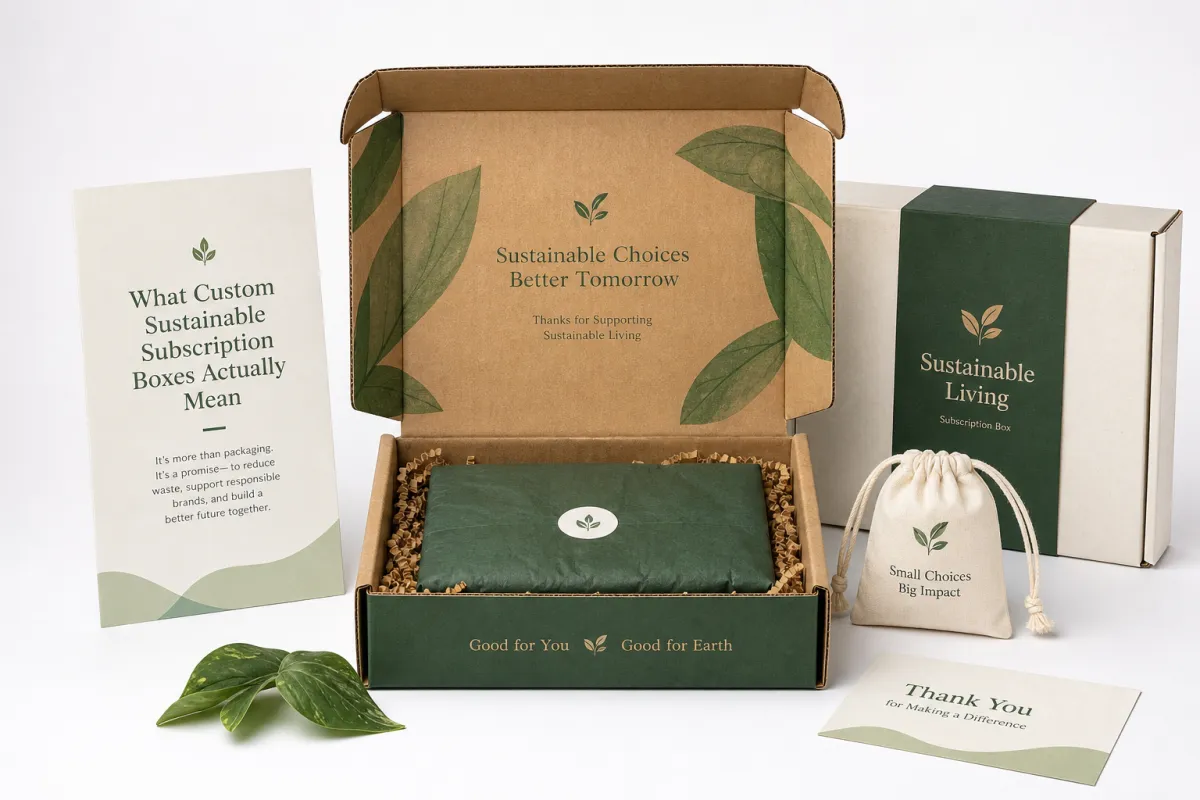
Custom sustainable subscription boxes are not just boxes with less plastic. That definition is too thin to be useful. Recurring packaging has to do several jobs at once: protect the product, hold up under repeat shipments, look like it belongs to the brand, and make disposal simple enough that customers do not need a tiny lecture to figure it out.
A package can look inexpensive on paper and still be the wrong call if it drives breakage, extra void fill, or a slower packing line. Subscription programs expose bad decisions quickly because they repeat the same shipping event over and over. A small flaw does not stay small. It becomes a monthly tax.
Sustainability is not one checkbox. It covers board choice, box size, print coverage, reuse potential, recyclability, compostability, and whether the customer can actually sort the thing correctly after opening it. A paper-based box with plastic-coated inserts and a glued-in window is not a clean solution. It is just a better story.
Subscription packaging also has a different job than one-time mailers. It has to survive repetition. That means predictable performance across hundreds or thousands of shipments, not a single polished unboxing moment that only works because the first batch was hand-tuned by someone with too much patience. Custom sustainable subscription boxes need to fit the rhythm of the operation. When the structure is awkward, the team feels it every day. When the structure is loose, damage shows up fast. When the structure is overbuilt, freight and storage eat the budget alive.
A box is not sustainable if it arrives broken and gets thrown away. That is not eco packaging. That is expensive recycling theater.
From a buyer's point of view, the target is simple: use only the material the package actually needs. That means right-sizing, clean board selection, and a layout that keeps the product stable without stuffing the cavity full of filler for moral comfort. Good product packaging is rarely flashy. It is the one that arrives intact, packs quickly, and gives the customer a clear end-of-life path.
“Custom” does not have to mean complicated. A smarter size, a better insert, cleaner print placement, or a closure That Actually Works can make a big difference. Sometimes the best custom sustainable subscription boxes are plain mailers with a better spec and better artwork. Not exciting. Just competent. That is usually enough.
How Custom Sustainable Subscription Boxes Work
The process starts with a brief: what ships, how fragile it is, how many units go out each month, and what the box needs to communicate. After that comes the structure, then the artwork built around the dieline, then a prototype, then production after approval. The steps are ordinary. The mistakes are not. Trouble starts when someone skips dimensions and says, “just make it look premium.” That is how a package gets redesigned twice.
Custom sustainable subscription boxes perform best when the product and the structure are built together. A loose box wastes space and invites movement. A tight box can reduce void fill, lower freight cost, and speed up the line. The insert matters just as much as the outer shell. If it is too complicated, the pack team spends time folding and wrestling with it. If it is too loose, the product rattles around and the customer notices.
Strong subscription programs keep the experience fresh without rebuilding the whole box every month. Seasonal graphics, sleeves, belly bands, inside printing, and modular inserts can change the look while the core structure stays steady. That is how brands keep production sane and still avoid a stale unboxing experience. It is also why many teams choose custom printed boxes with swappable components instead of a brand-new structure for every shipment.
Operationally, the sustainability choice touches more than landfill language. It affects storage space, assembly time, shipping weight, and disposal instructions. A recyclable kraft box with a clean tear strip and a paper insert is easier for most customers to understand than a mixed-material build with foam, laminated board, and a pile of little extras. If your packaging needs a manual to explain how to recycle it, the design still needs work.
For brands comparing Custom Packaging Products, the better question is not “What looks nicest?” It is “What performs best at our pack-out speed and damage target?” That shift cuts vanity spending fast. Custom sustainable subscription boxes should support the subscription model, not turn the fulfillment table into a craft station.
- Brief: define product size, weight, fragility, and monthly volume.
- Structure: choose a mailer, tuck-top, sleeve, rigid format, or hybrid kit.
- Dieline: fit artwork to the real box geometry, not the one in someone’s head.
- Prototype: test closure, insert fit, and drop behavior before ordering in bulk.
- Production: lock specs, print, finish, die-cut, and assemble.
- Fulfillment: hand off a packing method that is fast and repeatable.
Materials and Design Choices
The material choice sets the tone for the whole program. Custom sustainable subscription boxes often use recycled corrugate, kraft paperboard, FSC-certified paperboard, molded fiber, or paper-based inserts. Each one solves a different problem. Recycled corrugate handles heavier shipments and gives better crush resistance. Kraft paperboard looks clean and natural for lighter products. FSC-certified board helps when sourcing transparency matters. Molded fiber works well when the product needs shaped protection without a pile of mixed plastic. None of these options are magic. Each one has tradeoffs in cost, print quality, thickness, and recovery behavior.
If a supplier says “eco-friendly” and stops there, keep asking. What is the post-consumer recycled content? Is the board sourced under FSC chain-of-custody rules? Are the inks water-based or solvent-heavy? Does the coating block recycling in the destination market? The label should mean something. You can verify sourcing expectations through groups like FSC, which is a better signal than vague green language on a sales sheet.
Design matters just as much as material. A restrained layout with one or two print colors, a clean logo, and a simple interior panel can still feel deliberate. Some brands need more visual weight to justify the subscription price. That is where selective print coverage, a sleeve, or a premium interior message earns its keep. Spending a little more on branded packaging can make sense when the product needs help carrying perceived value.
The common mistake is assuming rich design is always wasteful and plain kraft is always sustainable. A well-designed, high-coverage box that protects fragile goods and cuts returns can beat a bare-bones package that collapses and gets replaced. The best packaging design matches the product, the channel, and the customer experience without padding the bill for no reason.
Structure changes the whole system. A mailer box is efficient for e-commerce and easy to pack. A tuck-top format can feel elegant for lighter items and retail-style presentation. A rigid box looks premium but uses more material and usually costs more. A sleeve lets one base structure carry several seasonal looks. A multi-part kit can protect delicate contents, though it may slow pack-out if the insert is fussy. Custom sustainable subscription boxes should be built around how the team actually packs, not how a mood board wishes it worked.
- Right-sizing: reduce void space first, because empty air is not a premium feature.
- Mono-material builds: keep materials easier to separate and recycle where possible.
- Water-based inks: useful when the brand wants lower-impact print chemistry.
- Clean inserts: paper-based support parts should separate cleanly from the outer box.
- Limited coatings: use them only when scuff resistance or moisture control actually matters.
A practical buying note: a clean, right-sized structure almost always beats a fancy oversized one stuffed with filler. Customers see the product first, not the packaging filler. If the product fits well, the box feels deliberate. If it swims in space, the whole thing feels sloppy. That is true for custom sustainable subscription boxes, and it is true for most retail packaging too.
For transit-heavy programs, ask whether the structure has been validated against a distribution profile such as ISTA 3A or an equivalent test plan. The point is not to collect acronyms. The point is to prove the box survives real handling. If you want a benchmark for what distribution testing covers, ISTA is a useful reference point. That kind of validation matters more than a pretty mockup that has never been dropped, stacked, or shaken.
Cost and Pricing
Cost for custom sustainable subscription boxes comes from board grade, structure, print coverage, coatings, insert complexity, finishing, order quantity, and freight. Not glamorous. Still the list that moves the number. A recycled corrugate mailer with one-color print is a very different animal from a rigid two-piece box with a custom insert and specialty coating. If you only compare the factory quote, you are missing half the bill.
Low quantities hurt. Badly. Setup, tooling, and freight get spread over too few units, so the per-box price climbs quickly. A run of 1,000 pieces might look fine on paper, but the unit cost can be nearly double what you would see at 5,000 pieces. Same package. Same materials. Same artwork. That is the math. It is also why custom sustainable subscription boxes should be planned with growth in mind, not just the first launch order.
| Option | Typical Unit Cost at 5,000 Units | Best Use | Tradeoff |
|---|---|---|---|
| Recycled corrugate mailer | $0.38-$0.78 | Heavier shipments, stronger protection, e-commerce fulfillment | Less premium feel than rigid formats |
| Kraft paperboard tuck box | $0.32-$0.65 | Light products, simple branding, lower material use | Not ideal for fragile or heavy contents |
| Molded fiber insert kit | $0.55-$1.10 | Products needing secure cavities without plastic foam | Tooling and setup can take longer |
| Rigid two-piece box | $1.20-$2.50 | Premium presentation and gift-style subscription programs | Higher material use and storage cost |
Those figures are not universal. Print coverage, board thickness, lamination, die complexity, and freight lanes can swing the number fast. A small run with heavy ink coverage and specialty finishing can land much higher than the ranges above. The table still gives a grounded starting point for a buyer who wants to compare options without getting sold a fantasy price.
The best buying decision is rarely the cheapest box. It is the lowest landed cost once storage, packing labor, damage rate, and replacement shipments are included. A slightly better insert that saves 12 seconds per pack can pay back faster than a 5 percent discount on the box itself. That is boring math. Boring math is how some programs keep margins intact.
There is also a brand cost. If the packaging looks too plain, customers may assume the product inside is cheap. If the packaging looks too elaborate, the business can get trapped in a spec that does not scale. The sweet spot is usually a package that feels considered, prints cleanly, and stays efficient to assemble. That is the real lane for custom sustainable subscription boxes: not cheapest, not loudest, just smart enough to work month after month.
If you are pricing custom packaging options, ask suppliers to quote three versions side by side: the bare minimum, the balanced option, and the premium version. That makes the tradeoffs visible instead of hiding them inside one number. It also shows whether the extra spend buys durability, presentation, or just prettier waste.
Timeline: From Dieline to Delivered Boxes
A realistic packaging schedule matters because custom sustainable subscription boxes are usually tied to launch dates, monthly shipment calendars, and inventory commitments. If the box is late, the whole subscription cycle gets noisy. A normal development path starts with discovery, then dieline selection, artwork setup, structural sampling, revisions, proof approval, production, and delivery. That sounds tidy because it should be. The delays usually come from indecision, not the calendar.
Here is a practical timing range. Discovery and dimensional review may take 1-3 business days if the product specs are ready. Dieline fitting and first artwork placement often take 2-5 business days. Structural samples or mockups can add another 5-10 business days depending on complexity. Proof revisions may move fast if the team is decisive, or they may drag for a week if three departments want one more version. Production often lands in the 2-4 week range for standard builds, and specialty finishes or unusual materials can push it further.
Some things slow the schedule down quickly. Foil stamping, embossing, soft-touch coatings, and unusual board grades often add lead time because they need extra setup or sourcing. Inserts with multiple parts do the same. So does a brand that changes dimensions halfway through proofing. Custom sustainable subscription boxes do not fail because the process is hard; they fail because someone keeps moving the goalposts.
Good timeline management is mostly about locking decisions early. Measure the product with the insert in place. Confirm the board grade. Approve the color target. Decide whether the box needs a seasonal change or one stable structure. Every uncertain detail becomes a delay later. Teams that treat packaging like an afterthought eventually learn that packaging keeps its own schedule.
- Discovery: collect dimensions, weights, fragility notes, and monthly unit volume.
- Structure selection: choose the box type and insert style that fit the product.
- Artwork setup: place graphics on the dieline and confirm bleed, folds, and glue zones.
- Sampling: test the fit with physical samples, not just screen mockups.
- Approval: sign off on color, structure, and print notes before release.
- Production: print, die-cut, finish, and pack for shipment.
- Fulfillment handoff: send the packing team assembly notes, storage instructions, and label placement.
For fulfillment, create a short handoff checklist. Include box assembly steps, insert orientation, label size, pack-out sequence, and whether the box can ship flat. That checklist matters more than people think. A box that takes 15 extra seconds to assemble across 10,000 units is not a small issue. It is a line-item problem. Custom sustainable subscription boxes should make the fulfillment team faster, not heroic.
If a supplier promises impossible speed, ask what gets skipped. Usually it is sampling, revisions, or quality control. None of those should disappear if the product has any fragility at all. A schedule that respects process beats a rushed one that creates avoidable damage.
Common Mistakes Brands Make With Sustainable Subscription Packaging
The first mistake is oversizing. Too many brands pick a box that is bigger than the product needs, then stuff the gap with paper fluff and call it sustainable. It is not. It is a bigger waste stream. Custom sustainable subscription boxes should start with the product footprint and grow only as much as transit protection demands. Empty space is cost, not convenience.
The second mistake is treating “recyclable” like a magic stamp. A package can be technically recyclable and still fail in practice if the materials are mixed, overcoated, or hard for customers to separate. Mixed-material builds confuse people, and confused people throw things in the trash. Package branding should never outrun disposal clarity. If your message says “eco” but the structure says “good luck,” the customer notices.
Recyclable on the label is not the same thing as recyclable in the real world. Local collection rules, coatings, and composite structures still matter.
The third mistake is overdesigning the launch package and then getting trapped by it. Brands fall in love with a premium concept, approve a structure that looks excellent in a render, and then discover it is too expensive to scale. The problem is not the look. The problem is locking into a spec that cannot handle growth. That gets ugly fast when the subscription takes off. Custom sustainable subscription boxes should be built for launch and scale, not just for one polished photo.
The fourth mistake is ignoring operations. A gorgeous box that folds awkwardly, has a weak closure, or needs too much hand assembly will cost more than the print upgrade ever saved. Packing labor is real money. Storage is real money. Freight is real money. If the structure eats shelf space or slows the line, the math turns nasty.
Consistency is another common miss. One month the company ships a kraft mailer, the next a glossy white box, then a black sleeve, then a novelty insert no one can recycle. That randomness weakens trust. Customers notice when the package feels improvised. Good custom sustainable subscription boxes keep the core structure stable and vary only what needs to change.
Do not assume a more expensive package is a better premium package. A cleaner layout, better proportion, and tighter fit often look better than more material. From a buyer's angle, the job is not to show off. It is to remove the junk that does not help the product or the experience.
Expert Tips and Next Steps for Better Box Programs
Start with one hero SKU or one box size family. That is the cleanest way to de-risk custom sustainable subscription boxes. If the program needs three box sizes, prove the first one before multiplying the variables. If the pack-out works, the damage rate stays low, and the storage footprint stays reasonable, then expand. If not, you just made three versions of the same headache.
Ask suppliers for a sample kit that includes board options, finish options, and insert alternatives. One sheet of specs is not enough. Real samples let you compare stiffness, closure strength, surface feel, and finish in your hands. That is where packaging design stops being a slide deck and becomes a physical decision. A buyer can judge a lot in 30 seconds with a sample, especially when comparing custom printed boxes that all look fine in a render but behave differently on a table.
Build a decision checklist before you approve production. Cover cost, durability, brand feel, shipping weight, storage space, and end-of-life instructions. If the box fails on one of those points, the program pays for it later. The strongest custom sustainable subscription boxes solve several problems at once instead of only one polished problem.
- Audit your current box: measure product fit, empty space, and the amount of filler used.
- Ask for side-by-side quotes: compare recycled corrugate, kraft board, and insert options.
- Test pack-out time: time a real person assembling 20 units, not a perfect sample.
- Check disposal clarity: make sure the customer can understand how to recycle the package.
- Validate transit behavior: use a sample or a test plan before scaling production.
If you are building or refreshing Custom Packaging Products for a subscription model, keep the focus tight. Right-size the box. Simplify the insert. Choose a material that fits the shipment, not the marketing slogan. Custom sustainable subscription boxes are not about pretending every package has zero impact. They are about wasting less, breaking less, and making recurring shipments easier to run. That is the practical version, and the only version worth paying for.
FAQ
What makes custom sustainable subscription boxes truly sustainable?
They fit the product, so you are not paying to ship empty space. They use materials and coatings that match the real disposal path, not just the marketing claim. They also balance protection, brand experience, and end-of-life recovery instead of optimizing only one of those pieces. I have seen brands spend more on “eco” packaging and end up with worse waste, which is kinda the opposite of the goal.
How much do custom sustainable subscription boxes usually cost?
Price depends on box style, material grade, print coverage, inserts, and finishing. Low-volume orders cost more per unit because setup and freight are spread over fewer boxes. Always compare landed cost and packing labor, not just the box quote, or you are missing the expensive part. A box that saves five cents but adds labor is not saving money. It is hiding it.
Which materials work best for custom sustainable subscription boxes?
Recycled corrugate works well for heavier or more protective shipment needs. Kraft board or paperboard fits lighter products where brand presentation matters. Molded fiber and paper-based inserts are useful when you want protection without mixed-material clutter. If the product is delicate, choose the material that survives the route, not the one that photographs best.
How long does it take to produce custom sustainable subscription boxes?
Plan about 2-4 weeks for development and proofing, then another 2-6 weeks for production depending on volume and finish. Structural samples, artwork revisions, and specialty coatings can extend the timeline quickly. If you need a launch date, lock dimensions and artwork early; indecision kills schedules. I’ve watched teams lose a whole week because somebody wanted a “small tweak” after proof approval. That kind of delay snowballs fast.
How do I size custom sustainable subscription boxes without wasting material?
Measure the product with inserts included, then add only the clearance needed to prevent damage in transit. Use standard board dimensions where possible so you are not forcing a custom structure when a simpler one will do. Always validate with a physical sample before final approval; paper specs lie less when they are in your hands.
Takeaway: build the box around the product, the packing line, and the actual disposal path, then test it before you scale. If custom sustainable subscription boxes do not reduce damage, labor, and waste at the same time, the design still needs work. Simple as that.

