Buyer Fit Snapshot
| Best fit | Corrugated Divider Boxes Wholesale for Safer Shipping projects where brand print, material claims, artwork control, MOQ, and repeat-order consistency need to be specified before quoting. |
|---|---|
| Quote inputs | Share finished size, material target, print colors, finish, packing count, annual reorder estimate, ship-to region, and any compliance wording. |
| Proofing check | Approve dieline scale, logo placement, barcode or warning zones, color tolerance, closure strength, and carton packing before bulk production. |
| Main risk | Vague material claims, crowded artwork, missing packing details, or unclear freight terms can make a low unit price expensive after revisions. |
Fast answer: Corrugated Divider Boxes Wholesale for Safer Shipping should be specified like a repeatable production item. The safest quote records material, print method, finish, artwork proof, packing count, and reorder notes in one written spec.
Production checks before approval
Compare the actual filled-product size with the drawing, then confirm tolerance on folds, seals, hang holes, label areas, and retail display edges. Reserve space for logos, QR codes, warning copy, and material claims before decorative graphics fill the panel.
Quote comparison points
Review material grade, print process, finish, sampling route, tooling charges, carton quantity, and freight assumptions side by side. A quote is only useful when the supplier can repeat the same color, closure quality, and packing count on the next order.
Most shipping damage does not begin with a crushed outer carton; it starts when products knock against each other inside the box. That is exactly why corrugated divider boxes wholesale can outperform a heavier carton with no internal structure. A well-built divider system creates separate cells for bottles, jars, candles, cosmetics, and small parts, so the load stays organized from pack-out to final delivery. That simple change can cut breakage, claims, and repacks in a very practical way.
Brands That Ship fragile goods at scale need a carton to do more than hold weight. It has to manage spacing, absorb handling shock, keep the pack line moving, and still arrive looking orderly enough for receiving, fulfillment, or shelf-ready unpacking. That is the real value of corrugated divider boxes wholesale: they solve a packaging problem at the source instead of asking a stronger outer box to fix an internal collision issue later.
I have seen plenty of programs where the outer box looked fine on paper, but the product inside had room to wander. Once the cells were tightened up, the damage rate dropped fast, and the packing table got calmer too. Nothing fancy, just better structure doing its job.
Practical rule from the plant floor: if the product can touch, rattle, or tip into a neighbor, the carton is not finished yet. Divider geometry matters just as much as board strength.
Why Corrugated Divider Boxes Wholesale Reduce Transit Damage
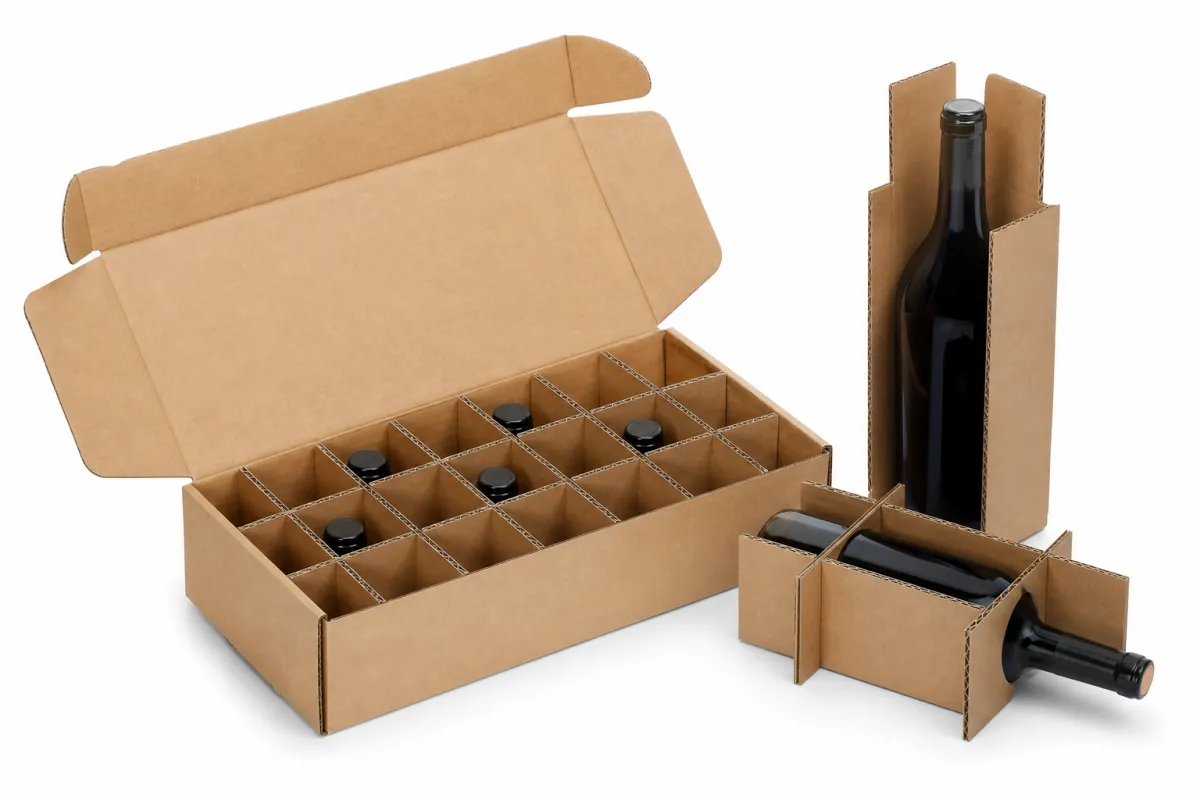
corrugated divider boxes wholesale reduce damage because they separate the load into individual cells, and that changes how force moves through the carton. Instead of one bottle or jar leaning into another and creating a chain reaction of chipped glass, dented caps, or scuffed labels, each item has its own compartment. That isolation matters during fork handling, parcel drops, vibration on linehaul trailers, and even the small shifts that happen when pallets sit in a warehouse overnight.
Most breakage comes from contact rather than dramatic failure. A carton may survive a drop, but the product inside can still fail if it has room to collide. That is why corrugated divider boxes wholesale are so common for wine bottles, sauce jars, tincture bottles, candles in glass, cosmetics in rigid containers, and industrial components with sharp edges or delicate necks. The divider grid protects the contents from one another, which is often the missing layer in a packaging spec that looks fine on paper.
The economics are straightforward. A divider insert adds board cost, but that cost is usually small compared with the expense of breakage claims, customer replacements, rework labor, and the hidden time lost when a team has to repack damaged goods. For many programs, a properly engineered divider box pays for itself by reducing waste and keeping the fulfillment line predictable. Buyers who compare only carton price often miss the much larger cost of damaged freight.
corrugated divider boxes wholesale also suit shipping programs that need consistency. Subscription kits, retail replenishment, and bulk distribution all benefit from a pack format that loads the same way every time. A predictable cell layout reduces packer error, supports better cube use on pallets, and makes it easier to train new staff. For higher-volume distribution, that repeatability can matter as much as the protective value itself.
One detail that gets overlooked is presentation. Divider boxes do not only protect fragile products; they protect the way the product looks when it arrives. A jar that lands intact but smeared against another label still creates a poor unpacking experience. A scuffed cap or loose insert can make a premium item feel downgraded. corrugated divider boxes wholesale help preserve the unboxing result, and that can matter for direct-to-consumer Brands That Ship visible product surfaces.
Another quiet benefit is line control. When the insert is right, packers do not have to fight the carton, shim gaps with extra paper, or guess whether a bottle is sitting square. That is a small operational detail, but it adds up. A better fit is gonna save time in places people rarely measure.
If you are comparing structures across a broader packaging program, it helps to review your Wholesale Programs alongside other Custom Packaging Products so the divider carton does not get designed in isolation. A good packaging spec should fit the shipping method, the product shape, and the labor flow all at once.
Corrugated Divider Box Construction and Insert Options
A standard divider box has three parts: the outer corrugated carton, the internal divider grid, and any top or bottom pads that help lock the product in place. The outer carton gives the structure its stacking strength, the divider grid creates the cell layout, and the pads manage vertical movement. In corrugated divider boxes wholesale, those elements can be tuned separately, which is useful because not every product needs the same board grade in every position.
Divider styles vary more than many buyers expect. The most common layout is a full-cell grid made from slotted sheets that interlock at right angles. That format is efficient for uniform bottles and jars because it builds a clean matrix with consistent cell sizes. Cross-partition layouts are similar, but they can be arranged to suit a specific footprint or uneven spacing requirement. Removable inserts work well for programs that need flexibility across multiple product lines, while custom die-cut partitions are useful for irregular containers, tapered shapes, or mixed-size kits.
corrugated divider boxes wholesale can also be engineered with different board combinations. A single-wall outer carton may be enough for lighter consumer products, while heavier items or longer transit lanes may call for a stronger double-wall setup. Divider sheets themselves are often made from lighter board than the outer carton, because the partitions need spacing and support more than raw compression strength. That said, the best choice depends on the product weight, the carton height, and how the load is handled in the warehouse.
For a narrow neck bottle, for example, the box may need a snug cell and a top pad to keep the shoulder from drifting. For a short jar, the priority may be compression and sidewall control. For mixed kits, the layout can shift from a simple grid to a stepped or hybrid pattern so one odd-shaped item does not throw off the whole pack. That kind of adjustment sounds minor, but it is the difference between a carton that works and one that just looks okay in a drawing.
Common construction choices buyers ask for
- Kraft outer carton with unprinted divider grid for cost control and a clean, neutral shipping presentation.
- Printed outer carton with plain internal partitions for brands that want logo visibility without adding unnecessary print coverage to the insert.
- Double-wall outer carton with reinforced pads for heavier glass, long-haul distribution, or palletized freight.
- Moisture-resistant coating or liner treatment for humid storage, cold-chain environments, or routes with long dwell times.
- Machine-glued or loose-fit inserts depending on whether the pack line needs speed or changeover flexibility.
Flute profile matters too. A, B, C, E, and combined flute structures such as BC or BE influence crush resistance, print quality, and panel stiffness. A larger flute can improve cushioning and stacking behavior, while a finer flute may help with tighter print and cleaner die-cut detail. For corrugated divider boxes wholesale, the right flute is usually chosen for the outer carton first, then the divider stock is matched to the load. There is no single flute that wins every time; the best answer depends on how fragile the product is and how much compression the finished carton must carry.
For specification reference, many packaging teams look at ISTA transport testing guidance and related industry practices to validate a structure under real shipping stress. Useful standards and testing resources can be found through ISTA and material sourcing guidance through FSC when buyers want certified fiber options. Those references do not replace a product-specific test, but they do help frame the conversation around performance, sourcing, and documentation.
Surface finish is another practical decision. Plain kraft keeps the box economical and durable-looking. Printed branding can help in retail fulfillment or premium DTC shipments. A moisture-resistant treatment may be worth the added cost if cartons are stored in damp loading areas or travel through climate swings. corrugated divider boxes wholesale are often purchased for utility first, but the outside still plays a role in how the package is received and handled.
Specifications That Matter Before You Request a Quote
The fastest way to get a useful quote is to share the actual package geometry, not a guess. Start with internal dimensions, product diameter or footprint, product height, and the exact number of units per carton. For corrugated divider boxes wholesale, a few millimeters can change the fit enough to affect pack speed and product protection, especially if the items have narrow shoulders, tall necks, or rounded bases that do not sit flat on their own.
Weight is equally important. A lightweight cosmetic bottle and a full glass sauce jar may look similar from a distance, but their load behavior is very different. A heavier item puts more stress on the bottom panel, the divider walls, and the closing flaps. If the cartons are going to be palletized, stacking height becomes part of the spec as well. A box that performs fine in a single layer may not hold up after three or four tiers on a pallet. That is why corrugated divider boxes wholesale should always be built around the real handling method.
It also helps to define the closure method early. Are you using tape only, tab-lock flaps, glue-assisted assembly, or a fold-and-lock style? Will the divider insert be shipped flat and assembled at pack-out, or will it be pre-inserted at the factory? Those choices change labor time, carton rigidity, and shipping cube. If the pack line is fast and the carton is standard, a loose grid may be enough. If the operation needs speed and consistency, a glued insert or preassembled unit can save time even if unit cost is slightly higher. corrugated divider boxes wholesale should be designed for the line, not just for the drawing.
Product shape can create surprises. Tall narrow containers want a snug cell that controls side movement. Items with sharp edges can cut or crease divider walls if the fit is too loose. Bottles with delicate necks often need top support or a tighter cell profile so the neck does not become the point of impact during vibration. If the load includes mixed heights, the spec should include a top pad or a stepped internal layout rather than forcing every item into the same empty space.
A useful spec sheet does not need to be pretty, but it does need to be complete. If the product has a label seam, a glossy finish that scuffs easily, or a closure that can leak under pressure, say that up front. Those details shape the insert design just as much as the dimensions do. A carton can be perfectly sized and still be wrong if it ignores how the actual product behaves.
Before approving a quote, send any of the following if available:
- A filled sample carton or a photo of the current pack-out.
- A product drawing with exact dimensions and tolerances.
- A pallet pattern or master case count if the cartons ship in bulk.
- Any transit condition notes, such as parcel, LTL, warehouse storage, or export movement.
- Artwork files if the outer carton will carry branding or handling instructions.
That kind of information reduces guesswork. It also helps the packaging team engineer corrugated divider boxes wholesale around the actual load instead of building a generic cell grid and hoping it behaves well in transit. From a buyer's point of view, the best quote is not just the cheapest one; it is the one that matches the real product, the real route, and the real packing workflow.
Corrugated Divider Boxes Wholesale Pricing and MOQ
Pricing for corrugated divider boxes wholesale depends on a handful of variables that stack up quickly: board grade, flute profile, box dimensions, divider complexity, print coverage, and order volume. A simple unprinted carton with a basic grid is naturally less expensive than a printed double-wall box with multiple insert pieces and a tight custom fit. The difference is not just material; converting time, die setup, and handling complexity all influence the final number.
MOQ usually reflects that setup cost. Many custom divider carton programs start somewhere around 500 to 1,000 units, though the practical sweet spot is often 1,000 to 3,000 units because that is where the converting cost begins to spread out more efficiently. Higher quantities nearly always lower the per-unit price, but only if the spec stays consistent. If the run needs several versions, mixed artwork, or multiple insert types, the economics change. Buyers planning corrugated divider boxes wholesale orders should ask how the MOQ is defined: by printed version, by carton size, or by the full combined order.
Here is a simple comparison that shows how spec choices usually affect cost and use case. These are illustrative ranges, not fixed quotes, because freight, region, and current paperboard pricing can move the numbers quite a bit.
| Option | Typical Use | Approx. Price at 1,000 Units | Approx. Price at 5,000 Units | Notes |
|---|---|---|---|---|
| Plain kraft, single-wall, basic divider grid | Light jars, cosmetics, small parts | $1.10-$1.75 | $0.58-$0.96 | Good starting point for clean, low-print shipping programs |
| Printed outer carton, standard partitions | DTC orders, retail replenishment | $1.65-$2.80 | $0.92-$1.60 | Branding adds cost, but simple print often stays efficient |
| Double-wall carton, reinforced pads, custom insert layout | Heavy glass, export lanes, palletized freight | $2.20-$3.70 | $1.35-$2.45 | Higher protection level and stronger stacking performance |
Those ranges are useful because they show the relationship between structure and cost. If a buyer only looks at carton price, corrugated divider boxes wholesale can appear more expensive than a plain shipping box. Yet the landed cost often goes the other direction once fewer breakages, less repacking, and faster line loading are included. A carton that costs a little more but saves one damaged item in every several hundred shipments can be the cheaper choice overall.
Tooling and setup charges should also be part of the comparison. Print plates may be modest for a one-color logo, while custom dies or specialty partitions can add a larger one-time cost. Some quotes bundle inserts into the box price, and others bill them separately. That is why quote comparison matters. The cleanest comparison includes unit price, sample cost, tooling, freight, and estimated lead time. Without those items, corrugated divider boxes wholesale pricing is hard to evaluate honestly.
A few other cost drivers deserve attention:
- Print coverage - full-panel graphics cost more than a small logo or handling mark.
- Divider count - more cells usually mean more board, more converting, and more assembly time.
- Board grade - stronger board costs more, but may reduce claims and protect the load better.
- Carton size - oversized cartons increase material use and freight cube.
- Insert style - loose partitions are usually cheaper than glued or die-cut configurations.
For commercial shipping programs, landed cost should include the value of labor efficiency. A divider carton that loads cleanly, folds predictably, and keeps products aligned can reduce packer fatigue and keep the operation moving. That matters in volume production, where even a small change in pack speed can affect the total cost of corrugated divider boxes wholesale more than a small change in board price.
Ordering Process and Production Timeline
A well-run order usually follows a predictable path: product review, structural recommendation, quote approval, sample or dieline confirmation, production, and shipment. That workflow is common for corrugated divider boxes wholesale because custom packaging has to be checked in several stages before paperboard is committed. If any one of those steps is vague, the project can slow down quickly.
The first review should answer three questions: what is being packed, how many units go into each carton, and how will the carton travel? Parcel shipping, LTL freight, pallet storage, and mixed warehouse handling all create different stress points. Once those are clear, the packaging team can recommend a board structure, divider count, and closure style that fit the route. A quote for corrugated divider boxes wholesale becomes much more useful once those practical details are on the table.
What speeds the process up? Exact dimensions, a photo of the product, target quantity, expected transit conditions, and print files if branding is involved. A good spec sheet removes a lot of back-and-forth. It also cuts down on the number of revisions needed before sampling. In many production runs, one clean first submission can save several days of discussion and keep the timeline moving in a straight line.
Typical timeline variables include order size, tooling requirements, whether the insert is standard or fully custom, and whether the box will carry print. For a straightforward run, a customer might see sampling or dieline confirmation in a few business days and production in roughly 12 to 18 business days after approval. More complex corrugated divider boxes wholesale orders, especially those with custom print, special board grades, or multiple insert revisions, can take longer. That is normal, not a sign of trouble.
Good approvals help the schedule more than almost anything else. Before giving final approval, it is worth checking the carton with actual product samples, not just a dimension sheet. A package can look fine in a drawing and still feel too tight, too loose, or too difficult to pack on the line. If the product has a fragile shoulder or an unusual base profile, a sample test is the safest way to confirm fit.
It also helps to think about who is packing the order. A carton that seems fine for a two-person pilot run may be annoying at scale if it takes too many hand motions or needs constant adjustment. I have seen simple layout changes shave seconds off every pack, and that kind of savings is real once you multiply it by a full shift. That is where packaging stops being theory and starts being operations.
For teams that also source shipping formats beyond divider cartons, it can help to review Custom Shipping Boxes alongside the divider design so the outer packaging family stays consistent. That kind of planning is useful when several SKU families share the same warehouse or when one brand wants a common look across different box structures. It is also the point where corrugated divider boxes wholesale become part of a larger packaging system instead of a one-off purchase.
One honest caution: not every product needs the most complicated layout. A buyer can over-specify a carton and end up paying for structure that never gets used. The better approach is to match the divider to the product risk. If the product is low-value and light, a simple cell grid may be enough. If the product is glass, premium, or shipped long distances, the stronger version may be justified. The right corrugated divider boxes wholesale order is the one that fits the route without wasting material.
Why Choose Custom Logo Things for Wholesale Divider Boxes
Custom Logo Things approaches packaging the way experienced buyers usually do: fit first, protection second, branding third. That order may sound simple, but it saves a lot of trouble. A handsome box that does not protect the product is still a bad box. A cheap box that works only until the first rough pallet move is also a bad box. The strongest point of corrugated divider boxes wholesale is that the structure can be tailored to the product load instead of forcing the product to adapt to a generic carton.
That is where practical support matters. A packaging partner should be able to look at product dimensions, shipping mode, and brand goals, then recommend a divider layout that makes sense in production. Some programs need tighter cells. Others need more room for assembly speed or a more forgiving fit. The right suggestion is not always the most expensive one, and it is not always the simplest one either. It is the one that performs well on the line and in transit.
For wholesale buyers, responsive quote support is more valuable than vague promises. Clear technical guidance, honest feedback on board selection, and a clean approval process can save time and reduce unnecessary revisions. That is especially true for corrugated divider boxes wholesale, where the carton, the insert, and the pack-out method all need to work together. If one part is off, the whole result suffers.
Custom Logo Things also fits well for buyers who want a practical mix of protection and presentation. Some brands need minimal print and a strong structure. Others need a cleaner branded look with just enough graphic treatment to support the customer experience. Either way, the goal stays the same: dependable packaging performance at scale, with no wasted material and no guesswork about how the box should function.
Another advantage is that wholesale planning can be aligned across several packaging categories. A buyer who needs divider cartons may also need mailers, shippers, inserts, or branded retail cartons. Coordinating those choices through a single packaging plan keeps artwork consistent and makes reordering easier. That is one reason many teams review Wholesale Programs and Custom Packaging Products together rather than treating each SKU as a separate event.
For brands that are still deciding between a simple shipping box and a divided format, the honest answer is usually straightforward: if products touch, divide them. corrugated divider boxes wholesale are not fancy for the sake of being fancy. They are a practical way to reduce damage, improve packing consistency, and protect the item the customer actually pays for.
Next Steps for Corrugated Divider Boxes Wholesale Orders
If you are preparing a quote request, the best starting point is to gather three things: product dimensions, target quantity, and a photo or sample of the item being shipped. With those in hand, a packaging team can begin shaping a real structural recommendation instead of guessing from a vague description. For corrugated divider boxes wholesale, that first step saves time and usually improves the final fit.
Next, define the shipping environment. Parcel handling puts different pressure on a carton than palletized freight. LTL and warehouse storage introduce stacking and abrasion concerns that may call for stronger board or a tighter insert. Mixed routes can be trickier still. If the cartons are traveling through more than one handling system, say so early. That is often the difference between a decent design and a better one.
It is also smart to ask for one or two alternate board options. A side-by-side quote can show whether a lighter board grade is enough or whether the stronger version is worth the extra cost. That comparison is especially useful for corrugated divider boxes wholesale because the difference in unit price is often smaller than the difference in protection and stacking confidence.
Ask about sample timing, plate charges, and whether divider inserts are included in the quoted unit price. Those details matter just as much as the headline number. A quote that looks lower may actually be higher once separate insert billing and freight are added. Buyers who review the full landed cost usually make better decisions and avoid surprises later in the project.
The most useful takeaway is simple: define the product, define the route, and define the labor flow before you lock the carton. If those three pieces are clear, corrugated divider boxes wholesale can be spec'd with a lot less guesswork, fewer revisions, and a much better chance of working the first time.
What products are best suited for corrugated divider boxes wholesale?
They work especially well for glass bottles, jars, candles, cosmetics, specialty foods, and small hardware items that should not touch during transit. They are also useful when a single carton carries multiple units and each unit needs its own protected cell, which is a very common need in corrugated divider boxes wholesale programs.
How do I choose the right divider count for corrugated divider boxes wholesale?
Start with the product footprint and the number of units per carton, then divide the internal space into cells that hold each item snugly without forcing the walls apart. If the items vary in height or neck shape, ask for a layout review before approving the final structure, because fit issues are easier to solve before production than after.
Can corrugated divider boxes wholesale be printed with branding?
Yes, most custom divider cartons can be printed with logos, handling marks, or simple brand messaging on the outer box. For shipping-heavy programs, many buyers keep print minimal so the carton stays efficient and cost-controlled, while the divider insert inside remains plain and functional.
What affects the price of corrugated divider boxes wholesale most?
The biggest drivers are board grade, box size, divider complexity, print coverage, and total order quantity. Freight, sampling, and any tooling or plate charges should also be included when comparing quotes, because the quote total is not always the same as the true landed cost.
How long does it take to produce corrugated divider boxes wholesale orders?
Timeline depends on whether the structure is standard or custom, how quickly specs are approved, and the size of the order. Providing exact dimensions, product samples, and print files early usually shortens the overall process, which is why clean input matters so much in corrugated divider boxes wholesale projects.


