Buyer Fit Snapshot
| Best fit | Corrugated Partition Inserts Wholesale for Safer Shipping projects where brand print, material claims, artwork control, MOQ, and repeat-order consistency need to be specified before quoting. |
|---|---|
| Quote inputs | Share finished size, material target, print colors, finish, packing count, annual reorder estimate, ship-to region, and any compliance wording. |
| Proofing check | Approve dieline scale, logo placement, barcode or warning zones, color tolerance, closure strength, and carton packing before bulk production. |
| Main risk | Vague material claims, crowded artwork, missing packing details, or unclear freight terms can make a low unit price expensive after revisions. |
Fast answer: Corrugated Partition Inserts Wholesale for Safer Shipping should be specified like a repeatable production item. The safest quote records material, print method, finish, artwork proof, packing count, and reorder notes in one written spec.
Production checks before approval
Compare the actual filled-product size with the drawing, then confirm tolerance on folds, seals, hang holes, label areas, and retail display edges. Reserve space for logos, QR codes, warning copy, and material claims before decorative graphics fill the panel.
Quote comparison points
Review material grade, print process, finish, sampling route, tooling charges, carton quantity, and freight assumptions side by side. A quote is only useful when the supplier can repeat the same color, closure quality, and packing count on the next order.
Corrugated Partition Inserts Wholesale for Safer Shipping
Corrugated Partition Inserts wholesale is one of those packaging purchases that looks straightforward until you watch a carton move through an actual shipping network. The divider does quiet work. It keeps glass from tapping glass, keeps jars from leaning into each other, and keeps a carefully packed case from turning into a jumble after a few conveyor drops, a forklift ride, and one rough stretch of road that nobody wanted to admit was rough. Tape closes the box, labels tell the story, and the outer shipper carries the weight, but the interior still needs structure if the contents can move around at all.
For bottle packs, glass jars, cosmetics, candle vessels, hardware kits, and small industrial components, corrugated partition inserts wholesale helps each item stay in its own cell so the packout stays repeatable and the damage rate stays under control. I’ve seen plenty of shipments where the box itself looked fine, yet the product inside arrived with chips, scuffs, or tipped closures because there was nothing inside to stop contact. That kind of damage is annoying on a single order, and expensive when it keeps happening on a weekly program.
Wholesale buying makes the most sense when the same divider pattern is used over and over. A stable insert speeds packing, lowers training mistakes, and takes some of the guesswork out of the bench. It also makes life easier for teams that need to keep multiple shifts aligned, because nobody has to wonder whether this carton was loaded the same way as the last one. That is the kind of ordinary efficiency that quietly saves money, which is kinda the whole point.
Why Corrugated Partition Inserts Wholesale Pays Off in Real Shipping
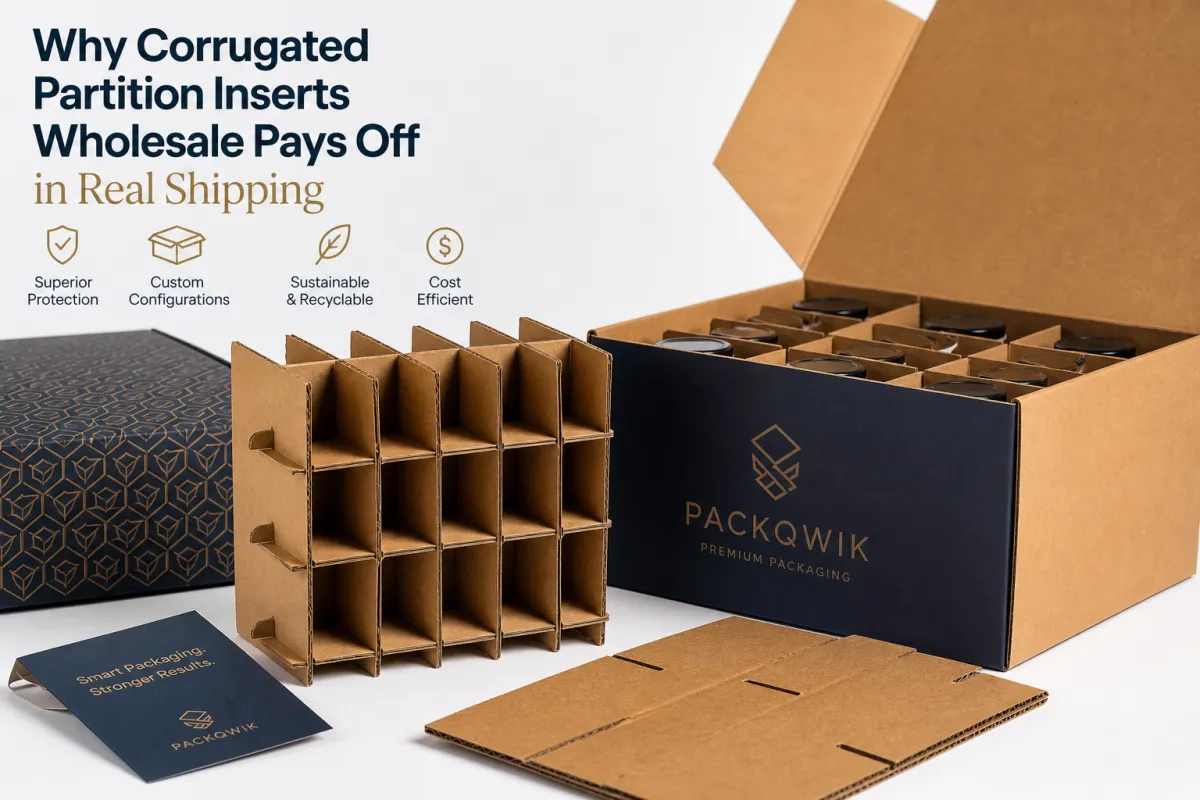
From a buyer’s perspective, corrugated partition inserts wholesale earns its keep when the package needs the same internal layout every time. A divider creates a fixed grid inside the carton, and that grid reduces the little movements that lead to breakage. You are not asking loose fill to chase every gap after the fact. You are giving the carton a shape that holds the product where it belongs before motion starts.
The carton can still be taped perfectly, stacked correctly, and stretch-wrapped tight as a drum, yet the contents can damage each other if they have room to rattle. That is one of the easiest failure points to miss during packaging design, because the outside of the shipper can look completely normal. Corrugated partition inserts wholesale addresses that weak spot by stopping direct product-to-product contact, which is why buyers tend to see fewer chipped rims, fewer broken necks, fewer scuffed labels, and fewer returns tied to internal movement.
For recurring programs, the wholesale side matters almost as much as the product itself. Once the cell layout is approved, the inserts can be produced in volume, nested efficiently, and kept ready for repeat runs. The unit price usually improves, sure, but the bigger gain is consistency. Every production cycle starts with the same internal structure, and that makes damage trends a lot easier to control over time.
If a product can move inside the carton, the carton has not finished its job. The divider gives the box real internal structure.
Loose void fill and paper dunnage still have a place. I’m not gonna pretend they don’t. They can cushion impact or help fill empty space, but they do not lock the layout the way a partition does. Corrugated partition inserts wholesale is the stronger choice when products need to stay upright, when presentation matters, or when the customer opens the box and judges the packout on sight. That is especially true for retail-ready goods, premium products, and white-label shipments where the inside needs to look as disciplined as the outside.
There is also a structural benefit on pallets. A carton with internal separation tends to distribute load more evenly, which can help the package resist the small shifts and side pressures that build up during storage and transit. No insert can rescue a weak shipper, and that honesty matters, but a properly specified divider can reduce the small knocks that often add up to a claim later. In practice, that matters a lot for brittle finishes, narrow necks, and closures that do not like being jarred around.
For teams already running branded packaging, the inside and outside need to be designed together. It is easy to overspec the outer carton and leave the interior too loose, or to overfill the box with structure that slows packing and never really improves protection. Many procurement teams pair corrugated partition inserts wholesale with the shipper program and keep both tied to one spec sheet. For larger recurring orders, that same thinking applies to Wholesale Programs, where repeat purchasing can reduce friction across the entire packout.
Corrugated partition inserts wholesale pays off because it turns a carton from a simple container into a controlled structure. That usually means fewer damaged units, faster packing, and a cleaner experience for the customer opening the box. Once a buyer sees that difference across a few runs, the value is usually pretty hard to argue with.
Corrugated Partition Inserts Wholesale Product Details and Configurations
Corrugated partition inserts wholesale is made from slotted corrugated sheets that interlock into a grid inside a shipping carton. Each cell holds one item, or one protected set of parts, so the insert behaves more like an internal frame than a cushion. That difference matters. A divider keeps the product in place. A soft filler only reacts after motion has already started.
The most common layout is the full-height cross partition, where perpendicular sheets interlock to create square or rectangular cells. This setup works especially well for bottles, jars, spices, syrups, and hardware kits because it is simple to assemble and easy to standardize across repeat runs. Half-height partitions are another option when the product does not need full vertical separation or when carton depth is limited. They can still reduce side-to-side contact while using less board, which is useful in lighter packs.
More unusual products often need a custom configuration. Corrugated partition inserts wholesale can be built with specific cell dimensions, offset slot spacing, or die-cut details around necks, handles, and shoulder profiles. That flexibility is helpful for tall cosmetic bottles, specialty beverage containers, candles in glass jars, and compact electronic components that need a mixed orientation. The goal is not simply to split the box. The goal is to match the item closely enough that it stays stable without turning assembly into a wrestling match.
Fit with the outer carton matters just as much as the divider layout. A good insert should sit snugly inside the shipper so the load does not drift in transit, but it still has to be practical for hand assembly on a busy line. If the insert is too loose, the whole stack can shift. If it is too tight, operators spend extra time forcing the parts together or crushing the board before the carton is even closed. Corrugated partition inserts wholesale works best when the carton and the divider are engineered as one system.
Corrugated also has a useful advantage over several other separator materials. Molded pulp can be the right answer for certain products, and foam still has a place where impact isolation matters more than fiber recovery, but corrugated dividers are often the better fit when the buyer wants stiff internal walls, easy nesting, and straightforward recycling after use. For wholesale buyers sending repeat shipments to retailers or fulfillment centers, that balance is hard to beat.
There is a practical inventory benefit too. Once a team settles on a few carton families, corrugated partition inserts wholesale can be simplified into standard layouts that support multiple SKUs. Instead of building a one-off insert for every item, buyers can group products by footprint, height, and fragility, then use a shared divider platform. That lowers the number of parts to stock and makes reordering much easier to manage.
Typical uses include:
- Bottles and jars that need neck-to-neck separation
- Glassware and candle vessels with brittle rims or thin walls
- Cosmetics and personal care items with premium presentation needs
- Small parts and hardware kits that must stay sorted
- Industrial components that cannot rub or chip during shipment
For buyers comparing separator structures, corrugated partition inserts wholesale usually lands in the middle on cost and very high on practicality. It gives you a rigid divider, a straightforward packing process, and a reliable way to keep product separated without making the workflow more complicated than it needs to be. That is a nice place to be if the goal is protection without unnecessary fuss.
Material Specs, Flute Choices, and Performance Limits
The first thing a buyer should ask for in corrugated partition inserts wholesale is the board spec, not just the cell count. Flute type, board thickness, and wall construction all affect crush resistance, fit, and how much abuse the insert can take before it starts to deform. A divider can look right on a drawing and still fail in a live packout if the board is too soft for the product weight or the shipping route is rougher than expected.
Single-wall corrugated is often enough for lighter products, shorter lanes, and tighter carton fit. It keeps part count and cost down while still creating a real barrier between units. C flute is common because it gives a useful blend of thickness and stiffness, while E flute works well when space is tight and a slimmer profile is needed. Double-wall, on the other hand, is a better option when the contents are heavier, the carton is taller, or the stack pressure will be higher in storage or transit. Corrugated partition inserts wholesale does not always need double-wall, but it is worth considering whenever the package has to handle compression as well as movement.
Many buyers also ask about ECT and Mullen strength, and that is the right instinct. Those numbers tell part of the story. Edge Crush Test gives a clue about stacking and compression resistance, while Mullen burst strength points to puncture and internal pressure resistance. If you are shipping glass jars or heavier components, the insert has to work with the carton rating rather than against it. A divider that is too weak can drag down the performance of an otherwise decent box.
For transit validation, many teams compare packouts against ISTA methods and use compression checks such as ASTM D642 to confirm the carton and divider can handle realistic stress. That does not mean every order needs a full lab program. It does mean the buyer should test the real product in the real carton instead of relying on a guess. A simple shake check, drop review, and closure test can save a lot of grief once the full run starts.
Moisture is another issue that gets underestimated. Corrugated is fiber-based, so humidity can change how it behaves, especially in storage or during seasonal shipping. If cartons sit in a damp area or move through several distribution points, the board can lose rigidity before the package ever reaches the customer. Corrugated partition inserts wholesale should be specified with that in mind, especially for long storage cycles, refrigerated environments, or coastal shipping routes.
Tolerances matter too. Inserts are measured to the inside dimensions of the carton, and the actual product footprint has to fit the cell with enough clearance for assembly but not so much that the item rattles. A few millimeters can make a real difference in a tight packout. For most hand-assembled cartons, controlled clearance is easier to live with than a perfect press fit because the operator still needs to get the divider in and out without tearing edges or crushing the flute.
One practical way to lower risk is to test several configurations before approving the full order:
- Measure the inside dimensions of the carton and the actual product dimensions.
- Confirm the weight per pack and the expected stacking load.
- Compare single-wall and double-wall samples.
- Check assembly speed at the packing bench.
- Run a small transit simulation or a hard handling review.
For buyers who care about fiber sourcing and chain-of-custody, the FSC site is a useful reference point for certification basics. If sustainability is part of the buying brief, ask whether the board is FSC-certified, recycled-content, or both. Corrugated partition inserts wholesale can support those goals without giving up practical protection.
The board spec should match the route, the product, and the carton. Once those three line up, corrugated partition inserts wholesale becomes much easier to trust in production.
| Option | Best For | Typical Spec | Approx. Unit Cost at 5,000 Pieces | Notes |
|---|---|---|---|---|
| Single-wall cross partition | Light to medium contents, short shipping lanes | 32 ECT, C flute or similar | $0.18 - $0.32 | Good balance of cost and speed of assembly |
| Double-wall partition | Heavier bottles, taller stacks, rough transit | 44 - 48 ECT, B/C or C/B | $0.30 - $0.55 | Better compression margin, higher material cost |
| Custom die-cut divider | Unusual shapes or premium presentation | Varies by product footprint | $0.40 - $0.85 | Higher setup cost, best when the layout repeats |
Those numbers are planning ranges, not fixed quotes. Board grade, sheet size, slot complexity, and freight can move the final cost up or down. Even so, the table makes one thing clear: corrugated partition inserts wholesale is usually cheapest when the layout is repeatable and the carton family is standardized.
Pricing, MOQ, and Cost Drivers for Wholesale Orders
Pricing for corrugated partition inserts wholesale is built around a handful of moving parts, and once those are known, quoting gets much easier. The biggest drivers are board grade, insert size, number of cells, slot complexity, and whether the layout needs custom slitting or die-cutting. Print can add cost too, although many buyers keep partitions plain because the divider’s job is protection and separation, not branding.
MOQ usually follows the conversion method. Standard layouts can often run in smaller quantities because the setup is straightforward and the sheet nesting is efficient. Highly custom divider patterns may need larger quantities before the pricing becomes practical. That is not a trick or a hidden charge; it is just how material yield and machine setup work. Corrugated partition inserts wholesale tends to reward volume once the design is stable.
Clean quoting starts with the numbers that matter. Internal carton dimensions. Product dimensions. Product weight. Expected annual volume. Units per carton. Whether the packout is going to retail, warehouse, or direct-to-customer channels. The more precise the brief, the faster the quote usually comes back, and the less likely it is that the project needs a redesign later. Corrugated partition inserts wholesale gets much easier to buy once the spec is complete from the start.
Buyers can also control cost by standardizing carton families. If three SKUs can share one divider footprint with small adjustments in fill or presentation, that often beats ordering three separate inserts. Another common savings move is to forecast repeat demand instead of buying each lot in isolation. When the supplier can see that the next order is likely to follow, the conversion plan can be set up more efficiently.
It also helps to think in total landed cost, not just the unit price on the quote. The cheapest insert on paper is not always the best deal once damage claims, packing labor, and replacement freight are added in. If a slightly better partition cuts breakage by even a small percentage, it can pay back quickly. That is especially true for brittle products or items with a high replacement value. Corrugated partition inserts wholesale should be judged by what it saves, not only by what it costs.
Common ways to keep the budget under control include:
- Using one divider layout across several carton sizes where possible
- Limiting unnecessary print or special finish work on the insert
- Choosing the lightest board that still passes fit and handling tests
- Ordering in quantities that spread setup costs across more units
- Coordinating insert and carton purchases so freight is planned together
For many teams, corrugated partition inserts wholesale is also a labor decision. A divider that is easy to fold, easy to orient, and easy to drop into the carton can shave seconds off every packout. Multiply that by a few thousand units and the labor savings become very real. A higher spec is not always better if it slows the line or creates assembly errors.
When a quote seems high, ask what the divider prevents. Breakage, scuffing, mixing, collapse, rework, or all of the above. That answer usually tells you whether the current solution is good enough or whether corrugated partition inserts wholesale is the smarter next step.
Production Process and Timeline for Corrugated Partition Inserts Wholesale
The production flow for corrugated partition inserts wholesale is simple enough on paper, yet every step matters if the final packout needs to behave the same way every time. It usually begins with the carton inside dimensions, the product footprint, and the number of cells required. From there, the supplier confirms the divider layout, board grade, and any special requirements before the design is released for sample approval or production.
First-time custom jobs take longer because fit, tolerances, and assembly behavior need to be checked carefully. Repeat orders move faster because the design already exists and the supplier can go straight to production with fewer variables. That is one reason corrugated partition inserts wholesale works so well for recurring programs: once the spec is locked, the process becomes predictable.
The approval step should stay deliberate. Before release, confirm the carton interior, cell count, product dimensions, board thickness, and any identification marks that help your team sort the correct part from the warehouse shelf. If the divider is being used with a matching outer shipper, review the insert and carton together. A small mismatch in inside dimension can make the entire packout behave badly.
Then comes conversion. The board is cut, slotted, scored, and checked for consistency so the finished inserts assemble cleanly and sit correctly in the shipper. If the slots are too tight, operators will fight the parts during assembly. If they are too loose, the cells will not hold shape under load. Corrugated partition inserts wholesale only works well when those details are controlled from the start.
Production timing depends on order size, material availability, and how much setup the layout requires. A repeat order with known specs can move quickly, while a new custom divider usually needs a little more lead time for sample review and approval. In practical terms, many buyers see lead times in the range of 10-15 business days after approval for standard runs, while more complex jobs can take longer if tooling or special board stock is involved. Freight distance matters too, since shipping the finished inserts to your facility may add a few days on top.
Here is a simple planning sequence that keeps most orders on track:
- Send carton and product dimensions, plus target quantity.
- Confirm the board spec and cell layout.
- Review a sample or layout proof against the real product.
- Approve the final version only after fit and handling are checked.
- Schedule production and receiving so the pack line never stops.
Quality control should stay visible, even if the process itself is simple. A good supplier will check slot depth, sheet alignment, and dimensional consistency so the packout behaves the same from case to case. That consistency is the real value behind corrugated partition inserts wholesale. If every insert works the same way, packers can move faster and the product arrives in better shape.
Receiving and storage deserve attention too. Keep inserts dry, flat, and protected from floor moisture. Corrugated fiber can pick up ambient humidity, and that can change how the divider folds or nests. If your warehouse is humid, plan inventory turns carefully so the board does not sit long enough to soften before use.
Why Choose Custom Logo Things for Wholesale Partition Inserts
Custom Logo Things is a practical fit for buyers who need corrugated partition inserts wholesale to work in the real world, not just on a spec sheet. The focus should stay on fit, protection, and repeatable packouts, because that is what prevents waste. A divider that looks polished but slows packing or misses the carton interior by a fraction of an inch is not a good buy, no matter how attractive it looks.
Clear technical communication makes a supplier valuable very quickly. Buyers need honest answers about board grade, slot layout, and what kind of performance the insert can realistically support. If a double-wall build is the right call, that should be said plainly. If a lighter single-wall version will do the job and save money, that should be said too. Corrugated partition inserts wholesale should never be treated like a one-size-fits-all item, because the product, route, and carton all affect the right spec.
Custom sizing support matters as well. Wholesale partition inserts work best when the divider matches the inside of the carton and the footprint of the product. That is especially true for fragile items, premium goods, or anything with a narrow neck, polished surface, or irregular shape. When the insert is built around the actual item, packers spend less time forcing pieces into place and more time moving cleanly through the line.
It also helps when the supplier understands how the insert and outer carton need to work together. A strong divider inside a weak shipper is still a weak package. A great carton with a sloppy divider can still damage the product. That is why many buyers look for a partner who can coordinate the insert design with Custom Shipping Boxes so the full packout is considered together.
For larger programs, aligning ordering cadence adds another layer of value. If the carton and the divider are both ordered through the same buying rhythm, inventory is easier to manage and there is less risk of one component arriving late. That is where corrugated partition inserts wholesale pairs naturally with our Wholesale Programs. The point is not to push a bigger order than you need. The point is to make recurring replenishment easier to plan.
What should buyers expect from a supplier they trust? A few basics, really:
- Sample approval before full production on new layouts
- Realistic lead-time guidance based on the actual spec
- Board recommendations tied to product weight and route
- Dimension checks that match the true carton interior
- Transparent MOQ discussion so planning is easier
That is the kind of support that makes corrugated partition inserts wholesale a dependable purchasing category instead of a one-off emergency fix. When the details are handled early, the shipment gets out the door with fewer surprises and less risk.
It also helps when a supplier is willing to tell buyers not to overbuy protection. Not every package needs the thickest board or the most complex layout. Sometimes the smartest choice is a well-fitted divider, a solid outer carton, and a simple packing process that operators can repeat without confusion. That kind of discipline keeps costs under control over the long run.
Corrugated partition inserts wholesale should help your operation ship cleaner, pack faster, and manage claims more effectively. If it does those three things, it is doing its job.
Next Steps to Order Corrugated Partition Inserts Wholesale
The fastest way to get corrugated partition inserts wholesale right is to start with the measurements that matter. Measure the inside dimensions of the carton, then measure the product that will sit in each cell. Do not rely on the outside box size or a rough estimate from a previous run. A few millimeters of difference can change how the packout feels, how fast it assembles, and whether the product can shift during transit.
Next, review the product’s weight, fragility, stacking pressure, and shipping route. A glass bottle heading across short regional lanes does not need the same divider as a heavier container moving through multiple distribution points. Corrugated partition inserts wholesale should be matched to the actual hazards the package will face, not only to the product description. If the contents are coated, polished, or easily chipped, that deserves extra attention because surface damage can happen even when the part does not break.
Request a sample or layout proof and test it with the real product before you commit to full volume. That matters most for tight-fitting items, glass, or packages where presentation counts as much as protection. A simple bench test can reveal a lot. Does the insert assemble cleanly? Does the carton close without pressure? Does the product stay upright after a shake or short drop review? Those answers are worth more than a guess.
Prepare a concise purchase brief so the quote comes back cleanly and accurately. Include target quantity, desired board strength, delivery window, carton details, product dimensions, and any identification marks you want on the divider. If you are planning a recurring program, say that clearly. Corrugated partition inserts wholesale becomes more economical when the supplier knows it is not a one-time emergency order.
Before you place the order, make sure the entire packout is aligned:
- Inside carton dimensions are verified
- Insert cell count matches the product count
- Board strength fits the route and stack load
- Assembly speed is acceptable on the packing line
- Storage and delivery timing fit your inventory plan
If you are comparing options, keep one question in mind: what does the insert actually prevent? Breakage, scuffing, mixing, collapse, rework, or all of the above. The answer usually tells you whether the current solution is good enough or whether corrugated partition inserts wholesale is the smarter next step.
For brands and operations that want predictable separation, lower damage rates, and a buying plan that can scale, corrugated partition inserts wholesale is the practical place to start. The right divider does not just fill a carton; it gives the carton a real internal structure, and that makes the whole shipment more dependable.
FAQ
What sizes are available for corrugated partition inserts wholesale orders?
Sizes are usually built to the inside dimensions of the carton, not a generic outside dimension. Cell count and opening size are adjusted to the product footprint, clearance needs, and carton depth, which is why corrugated partition inserts wholesale is best quoted from real measurements rather than a guess.
How do I choose between single-wall and double-wall partitions?
Single-wall is often enough for lighter contents, shorter shipping lanes, and tighter carton fit. Double-wall is a better fit when the products are heavier, the stack height is higher, or the route is rougher. The right choice depends on product weight, fragility, and how much compression the carton will see in storage and transit, so corrugated partition inserts wholesale should always be matched to the real load.
What is the usual MOQ for corrugated partition inserts wholesale?
MOQ depends on the size, board grade, and how much setup the layout requires. Standard layouts usually allow more flexibility than highly custom divider patterns. Buying in larger quantities typically lowers the unit cost because setup and conversion are spread across more pieces, which is one reason corrugated partition inserts wholesale often makes the most sense for recurring programs.
Can corrugated partition inserts wholesale be printed or marked?
Yes, but many buyers keep the partitions plain because the main job is protection and separation. If identification is needed, simple marks or printed notes can help with assembly and SKU control. Branding is often better handled on the outer carton, where it is easier to see and less likely to wear during handling.
How long does production take for a wholesale partition order?
Lead time depends on whether the design is a repeat order or a new custom layout. First-time jobs usually take longer because the sample, fit check, and approval steps must be completed before release. The fastest path is to provide carton dimensions, product dimensions, quantity, and target ship date up front so corrugated partition inserts wholesale can move through the quote and production stages without avoidable delays.


