Buyer Fit Snapshot
| Best fit | Corrugated Partition Inserts Wholesale projects where brand print, material claims, artwork control, MOQ, and repeat-order consistency need to be specified before quoting. |
|---|---|
| Quote inputs | Share finished size, material target, print colors, finish, packing count, annual reorder estimate, ship-to region, and any compliance wording. |
| Proofing check | Approve dieline scale, logo placement, barcode or warning zones, color tolerance, closure strength, and carton packing before bulk production. |
| Main risk | Vague material claims, crowded artwork, missing packing details, or unclear freight terms can make a low unit price expensive after revisions. |
Fast answer: Corrugated Partition Inserts Wholesale: Specs, Pricing should be specified like a repeatable production item. The safest quote records material, print method, finish, artwork proof, packing count, and reorder notes in one written spec.
Production checks before approval
Compare the actual filled-product size with the drawing, then confirm tolerance on folds, seals, hang holes, label areas, and retail display edges. Reserve space for logos, QR codes, warning copy, and material claims before decorative graphics fill the panel.
Quote comparison points
Review material grade, print process, finish, sampling route, tooling charges, carton quantity, and freight assumptions side by side. A quote is only useful when the supplier can repeat the same color, closure quality, and packing count on the next order.
Most shipping damage does not start with a crushed carton. It starts with a product that has room to move, and after years around packaging specs I have seen that simple mistake cost more than a few broken cases. That is why Corrugated Partition Inserts Wholesale often outperforms the easy assumption that a heavier outer box will solve everything. Bottles, jars, tools, and ceramic components can shift by just a few millimeters and still chip an edge, crack a neck, or scuff a finish, while the carrier still treats the carton as damaged cargo either way.
From a buyer's perspective, corrugated partition inserts wholesale is not a decorative add-on. It is a practical interior structure that reduces returns, cuts rework, steadies packing operations, and gives you a repeatable spec that does not turn into a fresh debate every time you reorder. The goal is plain: protect the product, preserve carton efficiency, and avoid paying for damage that could have been prevented with a better internal layout. That sounds simple, but the details are where the job either works or falls apart.
Custom Logo Things works around the realities that matter on a packing line, in a warehouse, and across a shipping network that does not wait for perfect conditions. Here, the focus is on what actually influences performance, what gets overpriced without adding value, and where buyers can trim cost without weakening the package. If you are matching the insert with an outer carton, the Custom Shipping Boxes page is a useful place to coordinate the box spec, and the Wholesale Programs page helps if you are planning repeat volume with the same pack structure.
Corrugated Partition Inserts Wholesale: Why Boxes Fail
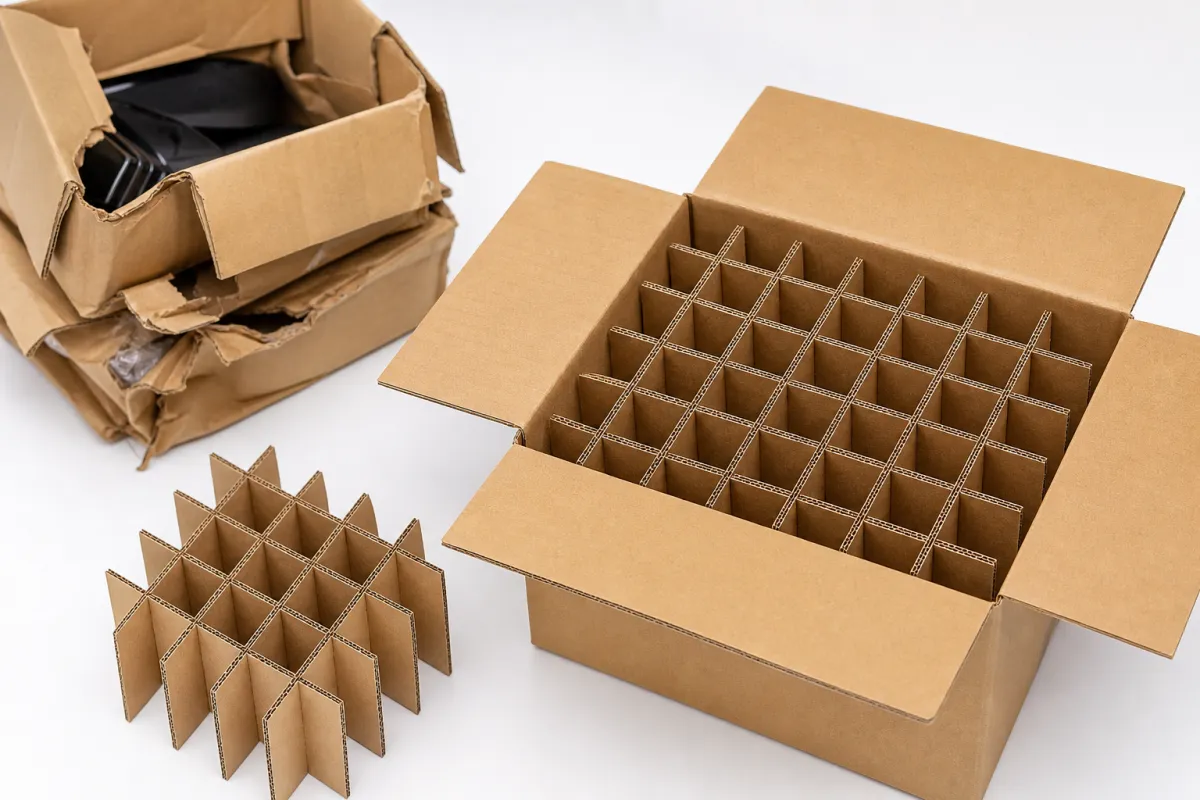
Cartons get blamed for damage all the time, yet the real problem is often what happens inside them. A box may handle compression well and still fail the shipment if the contents rattle, lean, or strike each other during handling. I have seen perfectly decent outer boxes come back with damaged goods because the interior was left to chance. That is where corrugated partition inserts wholesale proves its value. It separates one item from the next, absorbs the small shocks that come from moving freight, and lowers the chances of broken glass, scratched coatings, loose closures, or bent hardware.
Picture a typical outbound pallet. The carton gets lifted, slid, stacked, shifted, and set down more than once before it reaches the destination. If the contents are not restrained, the damage often starts early in that chain, long before the dramatic drop everyone likes to point to later. corrugated partition inserts wholesale gives each product its own cell, which turns the carton into a controlled carrier instead of a container full of loose contact points. That change is small on paper and huge in practice.
Practical packaging truth: if the product can move, the pack is not finished.
The business case is easy to understand. Fewer broken units mean fewer credits, fewer replacements, and fewer complaints. Faster packing comes from not stuffing void fill into every gap by hand. Better cube use can let you keep the same outer carton while improving the interior structure. For retail distribution and direct-to-consumer shipping, corrugated partition inserts wholesale can also reduce the volume of damaged orders that reach customer service. That is not a slogan. It is a cost line that shows up whether anyone wants to talk about it or not.
Wholesale buying matters because inserts are rarely a one-time decision. Once the layout works, buyers want the same fit next month, next quarter, and on every reorder after that. Consistency is more useful than improvisation. Before requesting a quote, have four numbers ready: internal carton dimensions, product dimensions, quantity, and the shipping method. Without those details, the quote can look attractive while fitting poorly, which creates the kind of problem nobody wants to solve after production begins.
For fragile packs, it helps to think about transit testing before the order is locked. A basic drop or vibration check against the real pack pattern costs far less than discovering a design flaw after production. For a helpful reference, ISTA publishes transport testing standards that are commonly used across packaging programs. You do not need every test in the library, but you do need a sample that proves the layout before you commit to volume. Otherwise you are guessing, and guessing is a bad habit in packaging.
Corrugated Partition Inserts Wholesale Product Details
At the most basic level, partition inserts are internal dividers. They create separate cells inside a carton so products do not touch. That sounds simple because it is simple. The real value comes from how closely the layout matches the product. corrugated partition inserts wholesale is different from loose void fill, bubble wrap, or a sleeve because it holds the items in a predictable grid instead of depending on guesswork from the packer.
Construction details matter more than many buyers expect. Lighter applications often use single-wall corrugated board, while heavier or sharper-edged products usually call for a stronger board grade and more protection around the cell walls. Slotted partitions can interlock into a grid, and die-cut layouts may suit irregular shapes. A bottle carton, a hardware kit, and a ceramic sample set all create different demands, so treating one layout as a universal answer is how money gets wasted.
Common uses for corrugated partition inserts wholesale include beverage bottles, jars, cosmetics, glass containers, auto parts, tools, labware, candles, and small e-commerce kits. If an item can chip, scratch, dent, or loosen another item, it likely belongs in a partitioned pack. The insert is doing two jobs at once: separation and support. That is why board choice matters. Too light, and the cells flex or collapse. Too heavy, and you pay for material you never needed.
Customization is where a good supplier earns the order. Buyers can specify cell count, cell width, insert height, board grade, moisture-resistant treatment, printed handling marks, and pack orientation. Manual packing lines need inserts that fold or slot quickly. Automated lines need tighter tolerances. corrugated partition inserts wholesale should fit the way the team actually packs, not the way a catalog photo happens to look.
There is a sustainability side too, and it is not just for brochure copy. Clean corrugated fiber is widely recyclable, while coatings, wet-strength treatments, or contamination can change how the material is handled after use. For broader recovery guidance, the EPA recycling guidance is a sensible reference. If your program needs FSC-certified fiber, ask for that requirement early so it is built into the spec rather than assumed after the quote.
In practice, the strongest corrugated partition inserts wholesale orders are the quiet ones: clear dimensions, clear product count, clear board choice, and no drama during sampling. That kind of order is exactly what most buyers want, even if they do not say it out loud.
Fit, Specs, and Cell Layout
Fit is where many bad orders begin. Buyers often measure the outer carton and then wonder why the insert does not behave correctly. That is the wrong starting point. You need the internal carton dimensions, the actual product dimensions, and the packed orientation. Measure the widest point, not the easiest point to grab with a ruler. Measure the tallest point, not the simplified number from a product sheet. corrugated partition inserts wholesale works only when the measurements reflect how the product sits inside the actual carton.
The main variables are straightforward: cell width, cell depth, partition thickness, overall insert height, and tolerance. If the cells are too loose, the product shifts. If they are too tight, packing slows down and the board can score or crush. If the insert is too short, the item may lift and strike the top closure or lid. If it is too tall, the carton can bulge, which creates stacking trouble of its own. That is why corrugated partition inserts wholesale should be designed from a real pack pattern rather than from a rough estimate.
Weight changes the answer. A light cosmetic bottle can tolerate a different cell geometry than a heavy glass jar or a metal part with sharp edges. Fragility changes the answer too. Thin-walled glass usually needs a tighter, more disciplined fit. Dense tools may need a stronger board grade and more support at the corners. There is no single size that protects every product, and any supplier who says otherwise is probably selling convenience, not accuracy.
Here is the practical method I prefer: start with one product, build one cell, then repeat the math across the carton. After that, check whether the insert nests flat for shipping, whether it opens cleanly on the packing line, and whether the full carton stays square when lifted. A sample is not optional on a serious corrugated partition inserts wholesale order. It is the cheapest insurance available.
Before approving the final run, test the actual product and carton together. Slide in a sample. Shake it lightly. Set it on a pallet and inspect the top closure. If you can hear movement, the spec is not finished. If the insert shifts under normal handling, the layout still needs adjustment. Buyers do not need theatrical lab language here. They need a structure that survives an ordinary warehouse move without drama. And yes, sometimes that means telling a buyer the fit is still off even if the artwork looks done.
A few order-planning details save money later:
- Pack pattern: document how many units go into each carton and how they sit.
- Cell count: confirm whether the layout needs 2, 4, 6, 8, or a custom grid.
- Flat shipping: ask whether the insert ships nested or pre-assembled.
- Tolerance: define whether the fit should be tight or slightly forgiving.
- Line speed: make sure the insert does not slow the packing team down.
That is the part many people skip, then wonder why a simple corrugated partition inserts wholesale order turns into a long series of revisions. Measure once, confirm once, and the reorder path becomes much easier to manage.
Cost, Pricing, MOQ, and Quote Breakdown
Pricing on corrugated partition inserts wholesale comes down to a handful of concrete inputs, all of them useful in the plainest way possible. Board grade, insert size, cell count, style complexity, printing, tooling, and quantity all shape the number. Bigger or more complex usually costs more. Higher quantity usually lowers the unit price. That is not a secret. It is the basic structure of the order.
What buyers should watch most closely is the quote format. A single line item does not tell you much by itself. A quote that looks a little higher may still be the better buy if the board is stronger, the insert ships flatter, or the labor to pack the carton is lower. In real terms, corrugated partition inserts wholesale should be judged on the total system cost, not just the per-piece number. A cheap insert that causes breakage is not cheap. It is deferred expense with a friendly price tag.
Minimum order quantity depends on whether you are buying a stock layout, a semi-custom layout, or a fully custom cut. Stock styles can often start lower because the tooling already exists. Custom jobs may require a higher first run because the supplier has to set up the cutting, confirm the die or slot pattern, and dial in the specification. Ask whether the MOQ is based on pieces, sheets, or total order value. Different suppliers define it differently, and that can create confusion if it is not spelled out early.
It also helps to budget for the costs people tend to overlook. Freight can be a meaningful part of the total because corrugated materials take space. Sample fees may apply. Design revisions can add time, and time affects launch schedules. If the order ships long distance, the finished unit cost can move more than the base quote suggests. That is why I usually ask buyers to request pricing at 1,000, 5,000, and 10,000 units for corrugated partition inserts wholesale. Side-by-side tiers make the break point much easier to see, and they stop the conversation from getting stuck on a single number.
| Option | Typical Use | Unit Price Range | MOQ Range | Lead Time |
|---|---|---|---|---|
| Stock slotted partition | Standard bottle or jar packs | $0.08-$0.18 | 500-1,000 pieces | 7-12 business days |
| Semi-custom partition insert | Mixed product sizes, moderate protection | $0.14-$0.28 | 1,000-3,000 pieces | 10-15 business days |
| Fully custom partition layout | Fragile, branded, or odd-shaped products | $0.22-$0.45 | 3,000-10,000 pieces | 12-20 business days |
Those figures are directional, not promises, and they move with board grade, print, quantity, freight, and any extra finishing steps. Even so, they give buyers a useful planning range for corrugated partition inserts wholesale. If a quote lands far outside those bands, ask what is driving the number. Sometimes the explanation is valid. Sometimes it is just padded margin wrapped in technical language, which happens more often than suppliers admit.
A buyer who wants control should ask for three versions: a lower-cost layout, a mid-range layout, and a heavier-duty layout. Then compare protection, labor, and shipping efficiency together. That is where the actual decision gets made.
Pricing tip: if the supplier will not provide quote tiers at 1,000, 5,000, and 10,000 units, they are asking you to make the math without enough information. That is not ideal for corrugated partition inserts wholesale, especially when the same pack will be reordered again.
Process, Timeline, and Production Steps
The workflow for corrugated partition inserts wholesale should stay simple: inquiry, spec review, quote, sample, approval, production, quality check, packing, and delivery. If a supplier skips one of those steps, that is rarely efficiency. It is risk with a better name.
Timing needs to be split into pieces. Quote turnaround can be very fast, sometimes same day for simple layouts. Samples often take a few business days when the spec is clear and the material is in stock. Production lead time depends on order size and complexity, but a practical planning range is often 10-20 business days after sample approval for custom work. Freight transit is separate. Production time and shipping time should never be mixed together, or promised dates become unreliable. corrugated partition inserts wholesale buyers need schedule language that stays precise, not hopeful.
What slows a job down? Unclear carton dimensions. Product changes after sampling. Artwork or print revisions. Waiting too long to approve the sample. Sending an inquiry with only a product name and no measurements. That last one happens more often than people admit. A supplier cannot build a dependable insert from a description like "small glass item." The carton does not understand shorthand.
What speeds a job up is equally direct: send complete information on day one. Include internal carton size, product dimensions, weight, quantity, shipping destination, and required delivery date. If the product has a special finish or a vulnerable edge, say so. If the customer needs a recycled fiber target or FSC source, mention it before the quote is locked. Good corrugated partition inserts wholesale planning removes second guesses before they turn into delays.
The approval steps matter too. Dieline confirmation ensures the layout matches the carton. Sample sign-off locks the fit. Pre-shipment inspection, where it is used, catches errors before the truck leaves. For higher-volume or fragile orders, that extra checkpoint costs far less than receiving a pallet of wrong inserts. Nobody wants to correct rework after freight has already moved. That becomes a self-inflicted tax.
Here is a clean way to manage the schedule:
- Send the full spec package.
- Review the quote tiers.
- Approve a sample that matches the actual carton.
- Confirm production quantity and ship date.
- Check the first batch before releasing repeat reorders.
That sequence keeps corrugated partition inserts wholesale from turning into a guessing game. It also protects the launch window, which usually costs more to miss than the insert itself.
Why Choose Us for Corrugated Partition Inserts Wholesale
Buyers do not need polished language for its own sake. They need inserts that fit, repeat, and arrive on time. That is the standard we aim for with corrugated partition inserts wholesale. Consistent board sourcing matters because fiber quality affects how the insert cuts and folds. Repeatable cutting matters because a one-millimeter drift can turn a good layout into a poor one. Stable supply matters because reorder consistency is the real reason wholesale buying makes sense in the first place.
A reliable packaging partner should help refine the spec instead of pushing a generic size that almost works. That means checking carton dimensions, asking about product weight, and suggesting a layout that balances protection with packing speed. It also means saying clearly when a design is overbuilt. Too much board is not a point of pride. It is unnecessary cost. For corrugated partition inserts wholesale, practical guidance is worth more than shiny promises.
Quality control and traceability matter on repeat orders. If you reorder six months later, the insert should behave like the original, not a distant relative of it. We pay attention to cut consistency, board matching, and the details that keep a packing line from losing time. Buyers should ask whether the supplier can keep the same spec file and layout reference on record. That makes reorders cleaner and lowers the odds of subtle changes slipping in.
There is also the logistics side. Bulk packing can improve freight efficiency. Mixed-SKU support helps when a brand uses several carton sizes. Export orders need tighter palletization and moisture handling than local deliveries. corrugated partition inserts wholesale is not only about making a divider. It is about making a divider that arrives in the right condition and works with the way your operation actually runs.
Most buyers are really after fewer headaches. Reasonable pricing. Fast answers. A sample that matches the quote. Stable production. That is not a big request. It is the baseline. If a supplier cannot deliver those basics, the wording on the website does not matter much.
If you are comparing outer packaging at the same time, pairing the insert with the right carton matters more than many people expect. The insert can only do so much if the box is too loose or too short. That is why corrugated partition inserts wholesale performs best as part of a proper pack system, not as a patch for a weak carton.
Next Steps Before You Order
Before you request corrugated partition inserts wholesale, gather the basics: carton internal dimensions, product dimensions, product weight, quantity, shipping destination, and whether a sample is needed first. If drawings or photos are available, send those too. A complete inquiry saves time. A vague inquiry creates a slow problem that has to be unwound later.
Then decide what kind of decision you want to make. If the spec is already settled, ask for a production-ready quote. If the layout is still uncertain, ask for a sample or a short run test first. That choice affects both schedule and cost, so make it deliberately. No supplier can guess whether you want the lower-cost layout or the stronger one. corrugated partition inserts wholesale works best when the target is clear, or the quote simply drifts.
Compare at least two material or layout options. One should test the lower-cost side of the range. One should test the safer side of the range. Then weigh protection against unit cost, labor, freight, and reorder stability. That is the real buying decision, and it is usually more useful than looking at the base price alone. A buyer who chases only the cheapest line item often ends up paying twice.
For the first inquiry, send enough detail to avoid the usual back-and-forth:
- Carton internal dimensions
- Product dimensions and weight
- Exact cell count or pack pattern
- Annual volume or reorder estimate
- Photos, sketches, or drawings
- Any special handling, coating, or compliance needs
If you want the outer box matched to the insert, say so early. If you are also sourcing cartons, the Custom Shipping Boxes page can help keep the package spec aligned instead of pushing two separate vendors to guess at one another's work. That is often where corrugated partition inserts wholesale saves the most time: one coordinated pack spec, not a pile of disconnected emails.
Use the same logic for repeat purchasing. Save the approved dimensions. Save the approved board grade. Save the approved sample. Then reordering becomes simple, which is exactly how it should be. When the numbers are ready, ask for a spec check, sample, or quote and move the order forward. corrugated partition inserts wholesale is a straightforward buy when the inputs are real.
What should I send for a corrugated partition inserts wholesale quote?
Send the carton internal dimensions, product dimensions, product weight, and the exact number of cells needed. Include quantity, shipping destination, and whether you need a sample or a production-ready quote. Photos or a simple sketch help avoid the sizing mistakes that waste time, and they make corrugated partition inserts wholesale quoting much cleaner.
How do I choose the right corrugated partition inserts wholesale cell size?
Base the cell size on the product's widest point plus a small fit allowance, not the outer carton size. Keep fragile items tighter in the cell and heavier items supported by stronger board or a denser layout. Test a sample in the actual carton before approving the final run, because corrugated partition inserts wholesale only works when the fit is proven, not assumed.
What MOQ is normal for custom corrugated partition inserts wholesale orders?
MOQ depends on style, size, and whether the insert needs custom cutting or tooling. Stock layouts can often start lower than fully custom designs, while complex jobs usually need a higher first run. Ask for pricing at multiple quantities so you can see the break where unit cost improves, then choose the corrugated partition inserts wholesale option that matches your actual volume.
How long does production take for corrugated partition inserts wholesale?
Quote turnaround is usually faster than production, but the total schedule depends on sample approval and order size. Custom samples, artwork changes, and freight arrangements can extend lead time. If you send complete specs on day one, you usually avoid the slow back-and-forth that kills deadlines, which is why corrugated partition inserts wholesale orders move faster with better input.
Are corrugated partition inserts wholesale recyclable?
Most corrugated partition inserts are recyclable when they are clean and free of heavy contamination. Moisture resistance or coatings can affect recyclability, so check the finish Before You Order. If sustainability matters, ask for board content and disposal guidance before approving the spec, especially if your corrugated partition inserts wholesale program needs a recycling claim.
The quickest path to a clean order is to send one complete spec sheet instead of a trail of half-measurements and guesswork. If you gather the carton internal dimensions, product size, weight, quantity, and pack pattern first, the quote is sharper, the sample is more useful, and the reorder is easier to repeat. That is the practical move with corrugated partition inserts wholesale: build the insert around the real product, then lock the spec before the run starts.


