Buyer Fit Snapshot
| Best fit | Corrugated Telescope Boxes Wholesale projects where brand print, material claims, artwork control, MOQ, and repeat-order consistency need to be specified before quoting. |
|---|---|
| Quote inputs | Share finished size, material target, print colors, finish, packing count, annual reorder estimate, ship-to region, and any compliance wording. |
| Proofing check | Approve dieline scale, logo placement, barcode or warning zones, color tolerance, closure strength, and carton packing before bulk production. |
| Main risk | Vague material claims, crowded artwork, missing packing details, or unclear freight terms can make a low unit price expensive after revisions. |
Fast answer: Corrugated Telescope Boxes Wholesale: Specs, Pricing, MOQ should be specified like a repeatable production item. The safest quote records material, print method, finish, artwork proof, packing count, and reorder notes in one written spec.
Production checks before approval
Compare the actual filled-product size with the drawing, then confirm tolerance on folds, seals, hang holes, label areas, and retail display edges. Reserve space for logos, QR codes, warning copy, and material claims before decorative graphics fill the panel.
Quote comparison points
Review material grade, print process, finish, sampling route, tooling charges, carton quantity, and freight assumptions side by side. A quote is only useful when the supplier can repeat the same color, closure quality, and packing count on the next order.
Corrugated Telescope Boxes Wholesale: Specs, Pricing, MOQ
A product that slides around inside its carton is already halfway to a claim. corrugated telescope boxes wholesale give buyers a tighter, more controlled fit by using a separate lid and base that overlap, so long items, dense products, and awkward sets stay put with less movement and less risk on the road.
That fit does more work than many teams expect. A carton with too much empty space looks flimsy, crushes more easily at the corners, and turns ordinary handling into damage. Wholesale buyers tend to feel that pain quickly because volume exposes weak specs fast. corrugated telescope boxes wholesale are not just a packaging format; they are a practical decision about cost, protection, and what it will take to keep the delivery clean from dock to doorstep.
"The easiest way to waste money on corrugated packaging is to buy a box that matches the dimensions on paper but misses the fit in practice."
Packaging buying usually comes down to four things: the right structure, the right board grade, the right print, and the right production plan. Get those aligned and corrugated telescope boxes wholesale pricing becomes easier to defend. Miss the mark and the cheapest quote can turn into the most expensive mistake once damage, rework, and freight are counted. I have seen more than one buyer save a few cents on the carton and then lose the whole advantage in repack labor. That part is never fun.
Corrugated Telescope Boxes Wholesale: Why They Cut Damage Claims
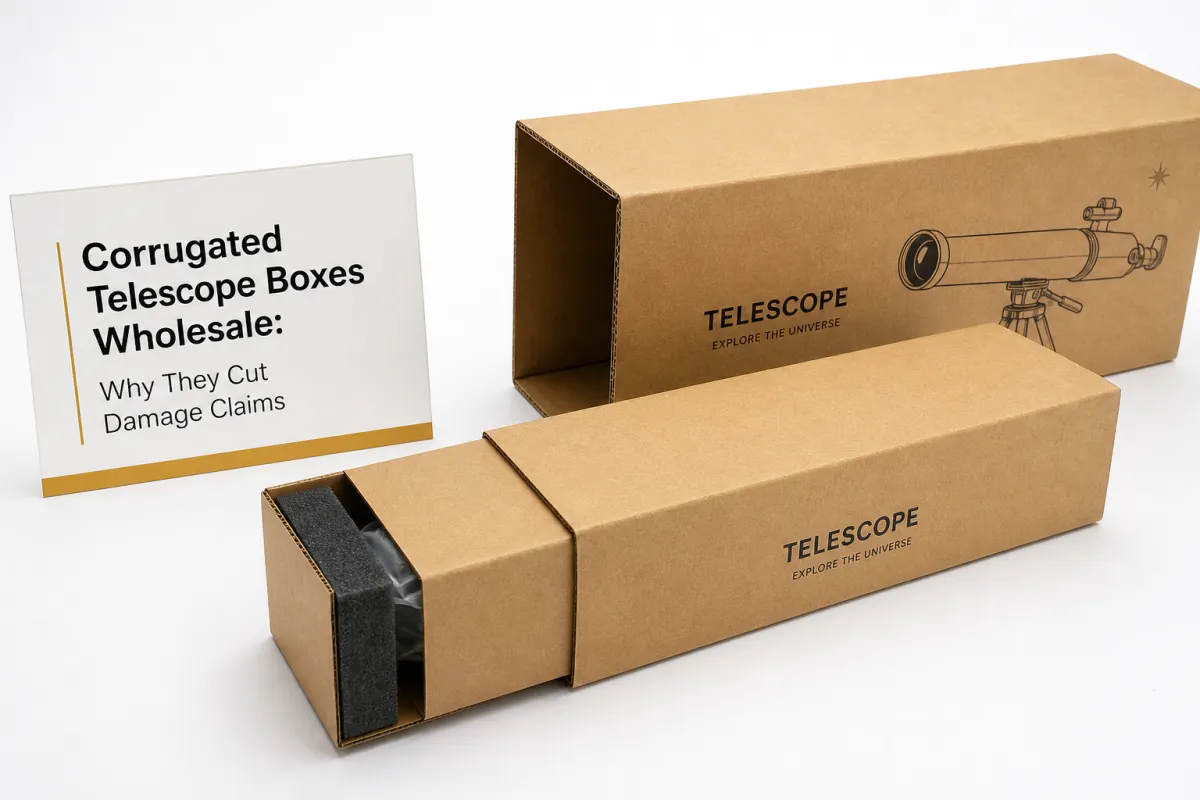
corrugated telescope boxes wholesale remain a steady choice because the two-piece build handles products better than a simple one-piece carton. The lid and base overlap, which adds wall depth, improves corner coverage, and gives the box more resistance to flex. That extra structure matters for heavy retail bundles, long components, products with odd shapes, and shipments that need to stay quiet instead of rattling through transit.
Most packaging damage starts with fit, not with bad luck. Too much clearance lets the product gather momentum inside the box, hit a wall, and transfer force to the weakest points in the structure. Corners take the first hit. Scuffs follow. Then the customer opens the package and finds a problem that should never have left the warehouse. A properly spec’d telescope box reduces that movement and gives the product a calmer ride.
Wholesale buyers care about that because scale amplifies every weak choice. A soft carton on 200 units is an irritation. A soft carton on 20,000 units becomes a margin problem. corrugated telescope boxes wholesale help buyers keep unit cost down through volume purchasing, but only if the box is strong enough to protect the product every time. A cheap carton that fails in transit is never actually cheap.
There is a real operational advantage too. Telescope styles stack neatly, store well, and can make packing easier for products that do not fit standard mailer dimensions. For retail kits, promotional sets, industrial parts, and gift packaging, the box can be part of the protection system rather than just a shell around it. That is why corrugated telescope boxes wholesale stay relevant for buyers who want fewer surprises in shipping and less guesswork at packout.
If you want to compare this structure with other packaging formats, it helps to look at the broader range in our Custom Packaging Products line and our Custom Shipping Boxes. The goal is not to chase a fancier carton. The goal is to choose the structure that protects the product at the lowest real cost.
Testing matters as soon as the product is fragile or heavy. Compression performance and drop resistance should be discussed in actual test terms, not in vague promises that sound reassuring but mean very little. References like ISTA testing standards and compression data such as ASTM D642 help set the guardrails. A box that looks sturdy but fails under load is just expensive corrugated.
Full telescope vs partial telescope
Full telescope designs use a lid and base that each wrap deeper around the product, which adds coverage and often gives the package a more finished presentation. Partial telescope styles use a shorter overlap, which can trim material use and lower cost, while leaving less room for movement control. corrugated telescope boxes wholesale buyers usually lean toward full telescope when the product is heavy, presentation matters, or the shipment will face rougher handling.
Partial telescope options make sense for lighter retail kits, display packs, and products that need a lower-profile carton. The tradeoff is direct. Less overlap means less containment. More overlap means more board and more cost. Packaging physics does not leave much room for creative interpretation, and honestly, that is kind of the point.
Corrugated Telescope Boxes Wholesale Product Details: What You Are Buying
A telescope box is a two-piece corrugated structure with a separate top and bottom that overlap to form the finished package. That overlap is the whole point of the style. It improves containment, helps resist corner crush, and gives the box more structural depth than a basic one-piece carton. For corrugated telescope boxes wholesale, the purchase is not just a box shape. It is a controlled fit system built around the product.
That control helps across a wide range of uses. Heavy retail bundles benefit because the lid captures the base. Industrial parts benefit because the package does not open as easily during handling. Gift sets benefit because telescope packaging often looks more intentional than a plain shipping carton. Oversized products benefit because a two-piece structure can be easier to pack than a single deep carton that pushes back every time the team tries to close it.
Buyers often ask for a handful of add-ons. Die-cuts can create hand holes, locking features, or better presentation. Dividers and partitions keep pieces separated. Inserts hold fragile items in place. Print can carry a logo, handling marks, or product identification. Moisture resistance matters when cartons sit in humid storage or travel through long shipping lanes. Reinforced edges help if the cartons are likely to be stacked, dragged, or handled roughly by people who do not care much for cardboard.
For corrugated telescope boxes wholesale runs, overlap depth deserves careful attention. Too shallow and the lid barely captures the base. Too deep and the carton becomes harder to open, heavier to ship, and more expensive than it needs to be. Most buyers do best with enough engagement to control movement without making the carton awkward in daily use. The exact number depends on product weight, board grade, and whether the box is meant for transit, display, or both.
Board selection shapes the result just as much as the structure. Kraft liner gives a natural look and usually handles scuffing better. White liner improves print presentation and brings a cleaner retail appearance. Coated surfaces can improve image quality or moisture resistance, though they add cost and are not always necessary. corrugated telescope boxes wholesale buyers should not pay for a finish simply because it sounds nicer in a quote. Pay for what the product actually needs.
Fit is the detail that decides whether the box works. Measure the inside dimensions first, then factor in the overlap allowance, then confirm the wall type. That sequence matters because a telescope box that is just a few millimeters off can end up either too loose or too tight. Loose means rattling. Tight means slow packing and bent corners. Neither helps the order.
Common construction choices
- Single-wall corrugated - works well for lighter products, shorter shipping lanes, and lower cost targets.
- Double-wall corrugated - the safer choice for heavier cartons, stacking, and longer transit.
- Triple-wall corrugated - used for industrial loads, harsher handling, or products that cannot afford crush damage.
- Printed kraft or white liner - useful for branding, labeling, and retail presentation.
- Die-cut inserts and partitions - worth adding when the product has multiple pieces or when movement would create expensive scrap.
When a brand needs more than one packaging format, the best next step is often to map the telescope box against the rest of the shipping line. If the same product family also needs shelf-ready cartons, retail packaging, or mail-ready packs, it can help to align the specifications through Wholesale Programs so the board grades and artwork rules stay consistent across orders.
One useful detail gets missed often: telescope boxes are not automatically expensive just because they come in two pieces. In many cases, the better fit reduces void-fill use, cuts tape consumption, and lowers damage enough to offset the structure premium. Buyers who stop at material cost miss the larger math. That is usually where the savings hide, quietly, without making a big show of it.
Corrugated Telescope Boxes Wholesale Specifications to Lock In Early
Accurate corrugated telescope boxes wholesale pricing depends on a clear spec before quotes start coming in. Measure the product's inside length, width, and height first. Define how much overlap the lid needs. Confirm the wall type, flute profile, print method, and any inserts. Get the sequence right and the quotes become cleaner. Skip a step and everyone spends time debating a carton that was never fully described.
Board grade should match the abuse level, not the buyer's mood. Single-wall fits lighter items and lower-stress routes. Double-wall is the stronger default for heavier shipments, stacked pallets, and longer transit. Triple-wall is for serious abuse, high compression needs, or industrial products that can crack, dent, or deform if the carton flexes too much. corrugated telescope boxes wholesale is not the place to save a few cents and lose far more in damage.
Flute choice matters as well. B-flute is common when print quality and crush resistance both matter. C-flute adds cushioning and stack strength. E-flute can look cleaner for retail and handle finer print detail, though it is not always the best option for heavy shipments. Some builds use double-wall combinations such as BC flute to improve compression without making the carton needlessly bulky. For wholesale orders, that is often the right balance.
Finish changes both cost and appearance. Kraft liners are practical and durable. White liners improve logo visibility and create a cleaner retail look. Uncoated board keeps the package simple and usually more economical. Coatings can help with moisture or presentation, but they should solve a real problem. corrugated telescope boxes wholesale buyers do not need a glossy finish on a carton that lives in a warehouse.
Operational details are easy to ignore and expensive to ignore. Ask how the cartons will palletize. Ask what the warehouse stacking height will be. Ask whether humidity exposure is part of the route. Ask whether the finished carton needs to hold up under top-load compression for several weeks. Those answers influence board strength, overlap depth, and the final quote.
Good suppliers should be ready to talk through carton compression, edge crush strength, and stacking load in plain language. If the only language on the quote is "quality" and "premium material," keep looking. corrugated telescope boxes wholesale is a technical purchase, not a guess-and-hope purchase.
Industry references help when the order needs a sourcing or testing anchor. A responsible packaging spec should account for the expected ship environment, and standards bodies like the Forest Stewardship Council are useful if you need verified sourcing claims for paper-based board. If certification is required, ask for proof early. Waiting until invoice time is a good way to delay the shipment.
Useful spec checklist:
- Inside dimensions of the product or kit
- Required overlap depth for lid and base
- Wall type and flute profile
- Surface finish and print coverage
- Target ship weight and stack load
- Any insert, divider, or die-cut requirement
- Packaging destination and expected lead time
Corrugated Telescope Boxes Wholesale Pricing, MOQ, and Quote Rules
The price of corrugated telescope boxes wholesale depends on a few predictable factors: size, board grade, print coverage, insert complexity, and order quantity. Larger boxes use more material. Heavier board costs more. More print colors increase setup and production time. Custom inserts add labor. Higher quantity lowers unit cost because setup gets spread across more cartons. None of that is mysterious, even if some quotes try very hard to act mysterious.
For rough planning, simple unprinted telescope boxes often land in a lower cost band, while printed double-wall or triple-wall builds move up quickly. As a practical range, buyers may see something like $0.45-$1.10 per unit for simpler custom runs around 3,000 to 5,000 pieces, $0.85-$2.20 per unit for heavier printed boxes, and $1.75-$4.50 per unit for triple-wall or insert-heavy builds. Those numbers move with size, freight, and print coverage, so they are planning ranges, not promises. corrugated telescope boxes wholesale quotes should always be checked against the exact spec.
MOQ shifts for the same reason. A plain standard size with no print can support a lower minimum. A custom printed run needs setup, plate or tooling work, and additional approval steps, which pushes MOQ higher. If the design uses multiple colors, special finishes, or custom cutouts, the supplier still has to recover those setup costs somewhere. Buyers who want a lower MOQ should keep the design simple. Fancy artwork and tiny quantities like to show up together, and they are rarely affordable.
Ask for tiered pricing every time. A quote at 1,000 units shows only part of the picture. A quote at 3,000, 5,000, and 10,000 units shows where the unit cost really settles. That matters for corrugated telescope boxes wholesale programs because the first number can look steep, the next tier can look fair, and the larger tier might justify a better buy if storage space is available.
Never compare pricing without comparing the full spec. One supplier may quote lighter board, another may include a stronger flute, and a third may leave out freight or inserts. Apples-to-oranges pricing is how people end up paying more for weaker boxes. The carton that costs less on paper can become the expensive one once product damage, repack labor, and claims are counted.
Use this quote checklist so each supplier is bidding on the same job:
- Inside dimensions and overlap allowance
- Single-wall, double-wall, or triple-wall build
- Flute type and liner color
- Print colors, coverage, and any coating
- Insert, divider, or die-cut requirements
- MOQ and tiered pricing schedule
- Tooling, plate, and sample charges
- Freight terms and destination ZIP or port
Freight can swing landed cost enough to erase a small unit-price advantage. A supplier closer to your warehouse, or one that stacks pallets more efficiently, can beat a cheaper quote by a wide margin once shipping is included. corrugated telescope boxes wholesale should be judged on landed cost, not just the invoice line.
| Build Type | Typical Use | Common MOQ Range | Typical Unit Price Range | Buyer Takeaway |
|---|---|---|---|---|
| Single-wall, unprinted | Lighter items, shorter lanes, internal shipping | 500-2,000 | $0.45-$1.10 | Lowest setup burden, but limited protection for heavy loads |
| Single-wall, printed | Retail sets, branded shipping, light to medium weight | 1,000-3,000 | $0.60-$1.40 | Good balance of cost and branding |
| Double-wall, printed | Heavier goods, stacking, longer transit | 1,500-5,000 | $0.85-$2.20 | Often the best default for serious wholesale use |
| Triple-wall or insert-heavy | Industrial parts, fragile assemblies, rough handling | 2,000-10,000 | $1.75-$4.50 | Higher cost, higher protection, lower failure tolerance |
Sample charges and tooling charges deserve attention too. A sample is worth paying for when the product is expensive or the fit is tight. Tooling can be a one-time cost, but it should be clear before approval. corrugated telescope boxes wholesale pricing should never bury fees in fine print and then act surprised when the buyer notices them.
Process, Timeline, and Production Steps for Wholesale Orders
A clean order flow saves money. The usual sequence for corrugated telescope boxes wholesale starts with the brief, then the dieline or sample, then the quote, artwork approval, production, inspection, and shipment. Skip one of those steps and the risk rises. Skip two and someone will be explaining a problem that could have been avoided.
Start with a real brief. Send the product dimensions, ship weight, desired overlap, target quantity, print details, and delivery deadline. If the product is fragile, say so. If the carton will be stacked on pallets, say so. If the boxes need to fit a specific packout line, say so. Better briefs produce better quotes. That is not flashy advice, just practical packaging work.
Timeline depends on tooling, artwork, and material availability. Repeat orders usually move faster because the supplier already has the spec and tooling. First-time custom builds take longer because the box has to be engineered, sampled, checked, and approved. For many corrugated telescope boxes wholesale projects, a rough timeline may look like 1-3 business days for quoting, 3-7 business days for sample or prototype work, and 12-18 business days for production after approval. Heavy print, special finishes, or seasonal demand can stretch that timeline. Anyone promising speed without the spec is probably guessing.
Sample approval is not a formality. It is the step that saves the most money later. A physical sample shows whether the overlap is too tight, whether the print position is off, whether the board feels too soft, and whether the carton closes the way the buyer expected. For corrugated telescope boxes wholesale, approving from a screen alone is asking for avoidable trouble.
Ask for updates at every stage. A good supplier should be able to share a proof, pre-production sample photos, milestone photos during production, and final packout confirmation before shipment. If the order is going by pallet, ask for pallet count, carton count, and gross weight. If the destination is receiving-sensitive, ask for the ETA window before the goods leave the dock.
Quality checks should match the risk of the product. A light retail pack may only need visual inspection. A heavy industrial box may need compression checks, fit checks, and clear carton labeling. Standards like ISTA and basic compression testing are not overkill on fragile or expensive goods; they are common sense. The packaging does not need encouragement. It needs to survive the route.
Practical production questions to ask:
- Is the dieline final, or will it be revised after sampling?
- What is the confirmed lead time after artwork approval?
- Will the order ship in mixed pallets or full pallets?
- Are replacement samples available if the first one fails fit?
- What inspection steps happen before freight pickup?
Why Buy Corrugated Telescope Boxes Wholesale From Us
Custom Logo Things focuses on practical packaging, not theatrical sales talk. For corrugated telescope boxes wholesale, that means stable specs, repeatable fit, clean board selection, and clear communication before production starts. Buyers do not need noise. They need cartons that arrive on spec, protect the product, and keep the line moving.
Manufacturing control matters because telescope boxes are unforgiving when dimensions drift. A lid that fits poorly on the first run will fit poorly on the rerun if nobody corrects the drawing. A board grade that looks acceptable in a sample can turn too soft when the product weight changes. Consistency across SKUs, reruns, and multiple warehouses is where disciplined production pays off. That is the unglamorous side of corrugated telescope boxes wholesale, and it is the part that protects margins.
We also leave room for design-for-manufacture guidance. If a client sends a structure that is too tight, too weak, or overbuilt, it is better to say that early than to pretend the box will magically behave later. DFM review, sample support, and QC checks are not extras. They are the normal tools of a supplier who wants the order to work.
Freight coordination matters too. Wholesale orders move in volume, and volume shipping brings its own stack of pallet counts, carton counts, and destination rules. A supplier that can confirm packaging specs, verify packout, and coordinate shipment details reduces the chance of delays. That is one reason buyers keep returning to a team that treats corrugated telescope boxes wholesale as a process rather than a one-line quote.
For buyers building a broader supply program, it helps to keep packaging formats aligned under one source. That can make artwork updates easier, reduce spec drift, and help purchasing teams track costs across lines. If the order also needs outer cartons, retail packs, or alternate shipping formats, our Custom Packaging Products catalog and Custom Shipping Boxes category give you a clearer comparison point than trying to build every box from scratch.
There is also a sourcing trust angle. If the board needs FSC-certified paper, ask for it before the order starts. If the route calls for stronger compression or specific handling requirements, say that up front. For buyers who need a verified reference point, certification and testing are boring in the best possible way. They keep the order from becoming a debate later.
What buyers usually value most:
- Clear specs and fewer revision loops
- Stable fit across repeat runs
- Support for sample approval and artwork checks
- QC checks before freight moves
- Honest pricing on the real landed cost
That is the point of buying corrugated telescope boxes wholesale from a supplier that actually understands structure, board grades, and production control. The box should do its job. The supplier should do theirs.
Next Steps Before You Order Corrugated Telescope Boxes Wholesale
Before you request a quote for corrugated telescope boxes wholesale, gather the facts that change pricing and performance. Send the inside dimensions, target ship weight, desired overlap depth, print needs, quantity, destination, and any special handling or stacking requirement. If the box is for a fragile product, include that. If the product has a fixed packout, include that too. Precision saves time. Vague briefs create revisions.
Then ask for a sample, a tiered quote, and a realistic lead-time estimate. Not just the fastest answer. The real answer. If the supplier cannot explain why one quote is cheaper than another, that usually means the spec changed or the board grade changed. corrugated telescope boxes wholesale should be compared on the same construction, the same dimensions, and the same freight assumptions.
A sensible decision path looks like this: confirm specs, compare landed cost, approve the sample, then place the production order. That order keeps surprises out of the process. It also makes it easier to explain the purchase internally because the numbers are tied to real box performance, not guesswork.
For a direct quote, send the product dimensions, ship weight, print details, expected quantity, and delivery location. If you already know the board grade you want, include it. If you do not, say what the product weighs and how rough the shipping lane is. That gives the estimator enough data to propose a fit instead of only a price. And yes, that matters. A lot.
When the spec is clear, corrugated telescope boxes wholesale becomes a straightforward buying decision: Choose the Right structure, lock the price, confirm the sample, and keep production moving. That is the clean path. Everything else is noise.
Frequently Asked Questions
What is the minimum order for corrugated telescope boxes wholesale?
MOQ depends on size, print, and whether the carton uses a standard die or a custom cut. Simple, unprinted specs usually allow lower minimums than custom printed runs. Ask for tiered pricing so you can see how unit cost changes as quantity increases. For corrugated telescope boxes wholesale, the minimum should match the setup burden, not a random number pulled from nowhere.
Which board grade is best for corrugated telescope boxes wholesale shipments?
Single-wall works for lighter products and shorter shipping lanes. Double-wall is the safer choice for heavier goods, stacking, or longer transit. Triple-wall is for industrial use, rough handling, or products that cannot afford crush damage. The right answer for corrugated telescope boxes wholesale depends on ship weight, route, and how much abuse the box must absorb.
How long does production take for corrugated telescope boxes wholesale orders?
Lead time changes based on sample approval, tooling needs, print complexity, and material availability. Standard repeat orders move faster than first-time custom builds. Peak season can add delays, so buyers should confirm the schedule before artwork approval. A realistic corrugated telescope boxes wholesale plan usually includes time for proofing and sample checks.
Can I print my logo on corrugated telescope boxes wholesale packaging?
Yes, logo printing is common on telescope boxes. One-color print is usually the most economical option, while full coverage and color matching raise cost. Print coverage can affect MOQ, so ask for pricing before you commit to the artwork layout. If branding matters, corrugated telescope boxes wholesale can be a practical place to put it.
What information do you need to quote corrugated telescope boxes wholesale?
Provide inside dimensions, box style, board grade, print details, quantity, shipping destination, and delivery deadline. If possible, include product weight and any stacking or drop-test expectations. The more exact the spec, the less time everyone wastes on revisions. That is especially true for corrugated telescope boxes wholesale, where fit and board strength drive both price and performance.
If you are ready to move, send the dimensions, quantity, print needs, and destination, and we can turn that into a clean quote for corrugated telescope boxes wholesale. Give the real spec, not the wish version, and the result gets easier for everyone.


