Buyer Fit Snapshot
| Best fit | Die Cut Insert Trays Wholesale projects where brand print, material claims, artwork control, MOQ, and repeat-order consistency need to be specified before quoting. |
|---|---|
| Quote inputs | Share finished size, material target, print colors, finish, packing count, annual reorder estimate, ship-to region, and any compliance wording. |
| Proofing check | Approve dieline scale, logo placement, barcode or warning zones, color tolerance, closure strength, and carton packing before bulk production. |
| Main risk | Vague material claims, crowded artwork, missing packing details, or unclear freight terms can make a low unit price expensive after revisions. |
Fast answer: Die Cut Insert Trays Wholesale: Specs, Pricing & Lead Times should be specified like a repeatable production item. The safest quote records material, print method, finish, artwork proof, packing count, and reorder notes in one written spec.
Production checks before approval
Compare the actual filled-product size with the drawing, then confirm tolerance on folds, seals, hang holes, label areas, and retail display edges. Reserve space for logos, QR codes, warning copy, and material claims before decorative graphics fill the panel.
Quote comparison points
Review material grade, print process, finish, sampling route, tooling charges, carton quantity, and freight assumptions side by side. A quote is only useful when the supplier can repeat the same color, closure quality, and packing count on the next order.
Die Cut Insert Trays Wholesale: Specs, Pricing & Lead Times
Die cut insert trays wholesale is not just a packaging purchase. It is a fit decision, a handling decision, and a shipping decision all rolled into one. A tray decides how the product sits, how much it shifts, how quickly the packing team can load each carton, and whether the box arrives looking orderly or beat up. Miss the fit by a small margin and the result can be scuffed edges, rattling parts, broken seals, or a customer opening the carton to find everything migrated out of place. That is not a cosmetic problem. It is a packaging failure.
The best tray usually does its job quietly. It keeps movement down, protects the product finish, and makes packout feel almost routine. It also helps labor, which buyers tend to notice after the fact. Less filler. Fewer awkward adjustments at the line. Fewer returns that trace back to transit movement. Good die cut insert trays wholesale should reduce friction everywhere the pack is touched.
If you are sourcing for Custom Logo Things, start with the real dimensions, not the idealized ones. What does the product weigh? Which features stick out? Is there a cap, handle, nozzle, cord, or accessory that changes the footprint? What outer box or mailer will the tray live inside? Those details matter more than a pretty concept drawing. Our Wholesale Programs page is a practical place to compare options once your order pattern is known.
I have seen a tray that looked perfect on the screen fail the moment the first real product hit it. The cavity was only a few millimeters too generous, and that was enough to let the item wobble inside the carton. Another tray was too tight by what looked like nothing on paper, but it slowed the packers down and nicked a painted surface. That is the part people miss: die cut insert trays wholesale is about actual handling, not just neat geometry.
Why die cut insert trays wholesale matter in shipping
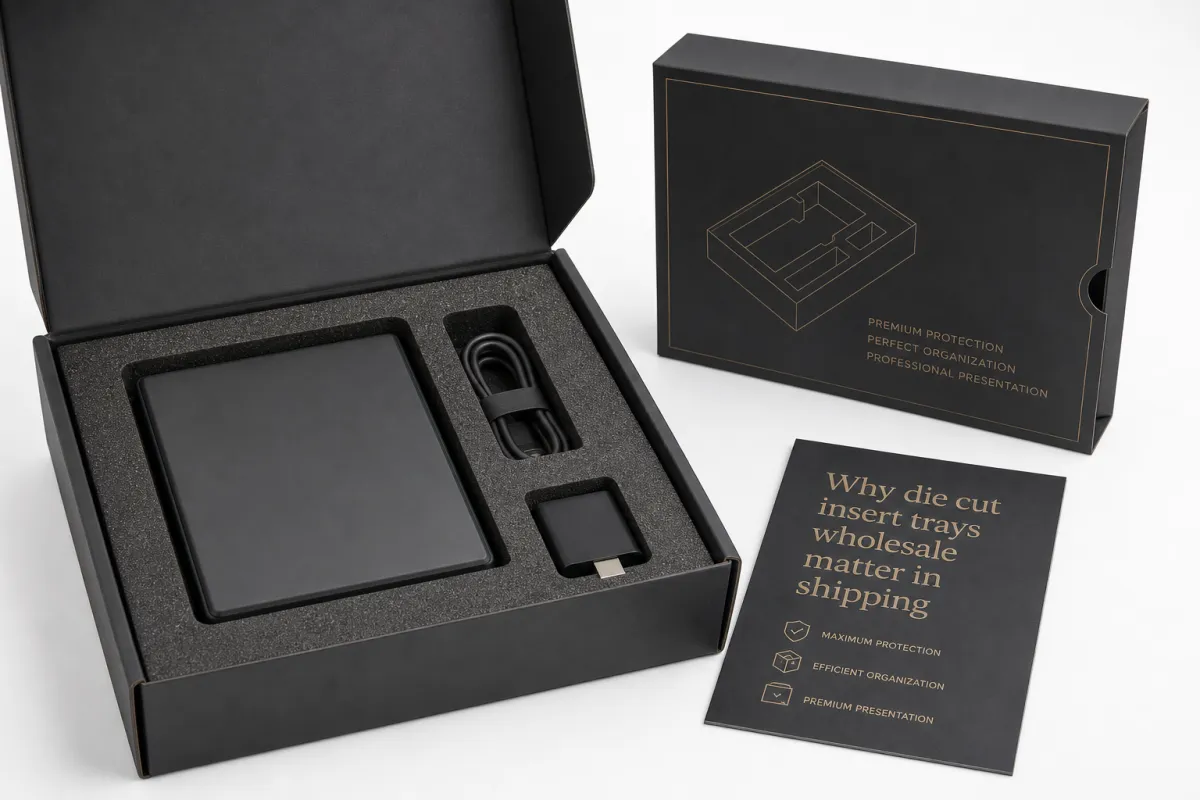
A shipping carton goes through a lot before a customer opens it. The pack leaves the line in good condition, then gets stacked, sorted, transferred, dropped into conveyors, and bounced through transit. If the insert does not hold the product in place, the outer box ends up taking all the abuse. That is a weak plan. Die cut insert trays wholesale gives the product a fixed home so the pack stays organized from warehouse to doorstep.
Fragile goods make the case quickly. Glass bottles, cosmetic jars, small electronics, accessories, and gift sets all benefit when each item has a defined cavity. Protection matters, but presentation matters too. A clean tray makes the opening experience feel intentional, which matters for premium products, subscription kits, and anything meant to feel closer to a gift than a shipment. That polish can be real without being fussy.
Most shipping damage is not caused by one dramatic drop. It usually comes from vibration, compression, and the same tiny movement happening over and over again. A tray that supports the product at the right contact points cuts that motion down and lets the carton do its job. Pair the insert with the right corrugated strength and the whole pack behaves better. Die cut insert trays wholesale should be treated as part of the shipping system, not as an accessory you pick after everything else is done.
Labor savings are part of the picture too. A consistent tray shortens training because packers do not need to guess where each item belongs. They work faster, make fewer mistakes, and use less filler. Across a shift, that adds up, especially when the same carton format repeats day after day. A tray that loads easily is usually worth more than one that merely looks impressive in a sample photo.
From a fulfillment manager’s point of view, die cut insert trays wholesale is a repeatability tool. If every tray lands the same way, every pack line behaves the same way. That is how you standardize output across shifts, reduce rework, and avoid the scramble that starts when teams begin improvising with tape, foam, or extra paper because the fit was never really locked in. Packaging should support the process, not create one more variable.
Outer box size matters as well. Bigger cartons are not automatically safer cartons. They add freight volume, and extra void space can create more movement if the insert does not control the load. A properly designed tray inside the right carton usually gives a cleaner result: a smaller package footprint, faster packout, and more predictable protection. In a lot of programs, die cut insert trays wholesale is the cleaner answer because it keeps both product damage and freight cost in check.
"A tray that fits right does three jobs at once: it protects the product, speeds packing, and makes the box look intentional instead of improvised."
Buyers who want a useful benchmark often compare testing methods such as ISTA protocols or ASTM distribution testing. Material sourcing can matter too, especially if the brand has sustainability targets. FSC-certified paper options are available for many tray structures. The references at ISTA and FSC are a good place to start if you want to judge die cut insert trays wholesale proposals with more structure than a slick rendering and a vague promise.
One more thing that trips people up: tolerance issues are normal. A tray can look correct on a proof and still fail in production if the product finish changes slightly, the cap profile shifts, or a stack of small variations pushes the fit off target. The safest orders begin with real product measurements and clear handling requirements, not just a rough concept sketched from memory. That is where die cut insert trays wholesale earns its keep.
What die cut insert trays wholesale include
At its simplest, die cut insert trays wholesale includes a custom cut component that holds one product, a group of parts, or a full set inside a shipping carton or mailer. The tray may use one cavity or several. It may include folds, tabs, or support walls. What it should not include is extra complexity that does not help the pack. Every added cut line, crease, or fold increases setup work and can slow production. A tray that works well is usually more disciplined than ornate.
These trays show up in a wide range of product categories. Bottles and jars need upright support. Electronics need separation so cords, chargers, and devices do not rub against each other. Cosmetics need tight cavity control and a clean presentation. Subscription kits need a layout that makes packout simple. Gift sets need the tray to look deliberate the moment the box opens. Die cut insert trays wholesale serves all of those cases because the core job stays the same: keep the product located and protected.
The die cut shape is the part that does the work. Precision cutouts hold the item. Folded panels add structure. Tabs keep the insert from drifting in the carton. Cavities separate components so they do not collide in transit. The tray can be designed for display, for shipping, or for a blend of both, but one of those goals usually needs to take priority. A display tray often looks sharper. A shipping tray usually tolerates transit abuse better. Die cut insert trays wholesale works best when the buyer knows which outcome matters most before the first sample gets cut.
There is a real difference between a tray that photographs well and a tray that packs quickly. A rendering can hide awkward loading behavior. A tray that looks elegant on a screen may still be slow on the line if the cavity is too tight or the support walls fight the product shape. Transit-focused trays care more about compression resistance, edge support, and vibration control. That is why die cut insert trays wholesale should be evaluated in the actual shipping carton, not only on its own.
Before asking for pricing, gather the measurements that matter. Product length, width, height, and weight. Any protruding caps, handles, nozzles, or connectors. If the tray must fit inside a fixed outer box, provide that size as well. The more complete the geometry, the faster a supplier can quote die cut insert trays wholesale without building in revisions that could have been avoided at the start.
If the packout includes accessories, map them now rather than later. A charger, refill pod, instruction card, or bottle cap can change the cavity layout more than people expect. These are the details that stretch timelines when they show up after the dieline is already underway. Die cut insert trays wholesale goes a lot smoother when the full product set is known before the sample is cut.
Stacking and nesting should also be part of the brief. Some trays need to stack flat in a warehouse. Others need to nest during production. If the trays will be handled in bulk before use, say so early. A tray that behaves well inside one box can become awkward once it has to be palletized or stored by the thousand. Packaging design only looks simple when the handling conditions are ignored.
Short version: die cut insert trays wholesale includes the tray design, cavity layout, material choice, and fit spec that determine whether the product stays where it belongs. Everything else follows from those basics.
Material and specification options for tray performance
Material choice is where the tradeoffs show up most clearly. For die cut insert trays wholesale, the common options are paperboard, corrugated board, heavier chipboard-style stock, and molded pulp-style alternatives for specific applications. Each one balances cost, stiffness, appearance, and crush resistance a little differently. Pick the wrong stock and the tray either costs too much or performs too lightly. Neither outcome helps.
Paperboard works well for lighter products, cosmetics, and display-led kits. It can stay economical and clean-looking, especially when the cavity depth is shallow and the product does not carry much weight. Corrugated board, especially E-flute and B-flute, brings better structural support for heavier items or packages that travel farther and get stacked in transit. When the shipping route is rough or the item is fragile, that extra rigidity usually pays for itself. Die cut insert trays wholesale should follow the shipping reality, not the presentation board.
Thickness is easy to overvalue. Packaging buyers see heavier board and assume stronger protection, but that is not always true. A tray can be overbuilt and still fail if the cavity fit is sloppy or if the product shifts because the shape was guessed instead of measured. The goal is the lightest material that still holds the product securely without flexing. If a 24pt board does the job, there is no benefit to moving up to a much heavier stock just because it sounds safer.
Fit tolerance and cavity design
Fit tolerance matters more than many buyers expect. A loose cavity lets the product move, especially during vibration. A tight cavity can slow packout and increase the risk of surface damage. For die cut insert trays wholesale, the right starting point is the product tolerance range, not just the nominal size. If the product varies slightly from unit to unit, the tray has to account for that variation.
Reinforced corners and support walls help when the geometry is awkward or the item rides higher than the base of the tray. If the product has a cap, handle, nozzle, lens, or other protrusion, the cavity should be built around that feature rather than forcing the packing team to press the item into place and hope the finish survives. A few millimeters can separate a secure fit from a frustrating one. That is not theory. Production lines reveal it fast.
Surface and storage conditions
Storage conditions also shape performance. Humid warehouses, long storage periods, and wide temperature swings can soften lighter stocks or affect surface coatings. If the trays will sit in inventory before use, ask whether moisture resistance or a more stable board is worth the added cost. In some cases it is. In other cases the simpler stock is enough. The decision should come from the actual storage environment, not from a default assumption.
Anti-scratch coatings and smoother surfaces can help when the tray sits close to glossy finishes, painted items, or premium components that should not rub against rough fiber edges. If the tray is purely transit-focused and stays hidden inside the carton, the finish can stay simple. There is no reason to spend on a visible-quality surface when the insert will never be seen unless that finish also improves handling or protection.
One of the most useful specification inputs is the tolerance range. If the product is 100 mm by 60 mm but may vary by 1.5 mm in either direction, say so. If the tray needs to stack without jamming, say so. If the insert needs to nest for warehouse efficiency, say so. That level of detail gives die cut insert trays wholesale suppliers a much better chance of getting the dieline right on the first pass.
Dieline accuracy matters for the same reason. A few millimeters off can create jammed packouts, weak holds, or wasted material. It is almost always cheaper to spend time on the spec sheet than to correct a tray after the sample shows the flaw. The best orders start with clean dimensions, clear product photos, and a realistic description of how the tray will be used.
For buyers comparing options, these are the most useful factors to line up: product weight, fragility, storage environment, cavity count, pack speed, and outer box size. If one of those pieces is missing, the quote is incomplete. Die cut insert trays wholesale should be priced against the actual job, not against the cardboard alone.
| Material option | Typical wholesale unit range | Best for | Tradeoff |
|---|---|---|---|
| Paperboard / chipboard | $0.16-$0.28 | Light products, cosmetics, display-led kits | Lower stiffness and less crush resistance |
| E-flute corrugated | $0.24-$0.42 | Midweight items, mailers, mixed-component sets | Slightly thicker pack profile |
| B-flute corrugated | $0.32-$0.58 | Heavier items, longer transit routes, stacked storage | Higher cost and more bulk |
| Molded pulp-style alternative | $0.30-$0.55 | Eco-focused packs, irregular shapes, cushioning needs | Less precise visual finish and longer tooling considerations |
Those numbers are starting points, not promises. Print coverage, cavity complexity, and run size can move pricing quickly. A plain tray with a simple die line behaves very differently from a multi-cavity insert with detailed folds and a premium finish. That is why die cut insert trays wholesale is so sensitive to geometry. The shape Drives the Cost more than buyers usually expect.
Die cut insert trays wholesale pricing, MOQ, and volume breaks
Pricing for die cut insert trays wholesale comes down to a few core variables: material grade, tray size, cavity count, structural complexity, print coverage, and order quantity. That is the plain version. The vague version is "it depends," which is technically correct and operationally useless. A small tray with one cavity and no print will usually cost far less than a larger multi-cavity insert with reinforced folds and a decorative finish.
Unit cost drops as volume rises because setup labor, cutting prep, and quality checks get distributed across more trays. A short run has to carry the setup almost immediately. A larger wholesale order allows that setup cost to fade into the bigger quantity. That is the point where die cut insert trays wholesale becomes more efficient, especially when repeat demand is already on the calendar.
MOQ is where many buyers get squeezed. A lower minimum order can help with fit testing, but the unit price is usually higher. A larger run gives better pricing, but only if the spec is stable. If the design is still changing, ordering too much just means paying wholesale rates for the wrong tray. That is an expensive way to find out the cavity needs one more adjustment.
Sample, prototype, or production run?
A sample or short run generally costs more per unit, and that is normal. You are paying for proofing, not just cardboard. The value is that the sample catches fit problems before they turn into an expensive production error. For die cut insert trays wholesale, a sample is usually the right move when the product is fragile, oddly shaped, or packed as part of a set that must load in a specific order.
Some buyers skip sampling to save time. Sometimes that works out. More often it just moves the delay later, after the first production lot reveals a bad fit. If the product has stable dimensions and a simple geometry, sampling can be quick. If there are any quirks in the shape, the finish, or the pack order, sample first. The small delay usually prevents a bigger one. That is a pretty boring answer, but it is usually the correct one.
Hidden cost traps
The hidden costs are usually easy to spot once you know where to look. Overspecifying thickness is one. Adding print to an insert that will never be seen is another. Designing more cavities than the product actually needs is a third. Freight deserves attention too. A tray that looks inexpensive at the unit level can become a poor buy once pallet count, carton count, and shipping distance are included. Die cut insert trays wholesale should always be compared on landed cost, not on a single line item.
Volume breaks are most useful when they match real reorder behavior. A buyer may start with a trial quantity, then move to a stable replenishment plan once the packout has been proven. The objective is not to redesign the insert every time the order size changes. The objective is to lock the spec once and scale it. That is where wholesale ordering starts to pay off in a meaningful way.
Here is a practical way to think about pricing tiers:
- Prototype tier: highest per-unit cost, lowest risk, best for fit validation.
- Trial tier: moderate cost, enough quantity for a real pack test, useful for launch.
- Wholesale tier: best unit pricing, ideal once the product and carton are final.
If the tray will be part of a repeating order flow, keep the spec stable and let the volume do the work. That is how die cut insert trays wholesale becomes a controlled supply item instead of an ongoing design problem. Stability saves money. Constant novelty usually creates more of it than anyone wants.
When you compare quotes, keep the request consistent. Ask for the same material, thickness, cavity count, print choice, MOQ, sample cost, production lead time, and freight assumption every time. Without that, price comparisons are theater. With it, you can see which die cut insert trays wholesale offer is real and which one only looks good on the surface.
Typical range example: a simple low-volume tray often lands near the upper end of the unit range, while a larger repeat order with a straightforward dieline can move down materially. That pattern is normal. Wholesale pricing follows setup, speed, and repeatability rather than guesswork.
Process and timeline from dieline to delivery
The cleanest die cut insert trays wholesale projects usually follow the same path: measurements, tray concept, dieline creation, sample review, approval, production, and shipment. When a supplier skips a step, the order may still get finished, but the risk rises. Buyers who want predictable delivery should insist on a process that makes fit visible before the full run starts.
In practice, the timeline depends on three things more than anything else: how complete your dimensions are, how quickly the sample is approved, and whether the right stock is already available. When those pieces are ready, die cut insert trays wholesale can move at a reasonable pace. When they are missing, the schedule slips. That is not a surprise. It is just how production behaves.
What usually slows a project down
Late dimension changes cause the most obvious delays. A buyer revises the product size after the dieline has already been cut, and the tray has to be adjusted. Adding a new cavity does the same thing. So does asking for a tighter fit after the first sample proved the tray was technically correct but not ideal in handling. Each change seems minor on its own. Together, they can add real time to the schedule.
Sampling matters even for simple trays because it shows how the pack behaves, not just how it looks on a screen. Does the product move when the carton is shaken? Can the packer load it in a few seconds? Does the outer box close cleanly without bulging? Those are the questions that decide whether die cut insert trays wholesale works in day-to-day use.
Lead times and logistics
For planning, many wholesale projects move from proof approval to production within a manageable window, with shipping time added on top. The exact number changes with production load and stock availability, but the important part is separating production lead time from freight time. Buyers sometimes mix those together and assume a project is late when it is really just in transit.
Freight method matters too. Palletized shipments behave differently from carton shipments. Carton count affects handling. Distance affects landed cost. If the trays are tied to a launch date, freight should be coordinated early. A tray that arrives after the product is already on the line is not useful, even if it was made well.
Here is the checklist I would use before approving die cut insert trays wholesale:
- Confirm product dimensions and weight.
- Confirm the outer box or mailer size.
- Review the cavity layout and fit tolerance.
- Check whether the tray stacks or nests properly.
- Approve the sample only after a real pack test.
- Lock the quantity and freight method before production starts.
That checklist is basic on purpose. Good packaging projects are rarely fancy. They are repeatable. When the process is clear, die cut insert trays wholesale becomes a straightforward supply task instead of a chain of avoidable surprises.
Test the tray with the actual people who will use it. A tray can look excellent in a meeting and still be awkward at the packing table. If the loader has to fight the cavity every time, the line slows down and the benefit disappears. Real-world handling should be part of signoff, not an afterthought that gets discussed after production starts.
Why choose us for wholesale insert trays
Custom Logo Things is built for buyers who need packaging that performs in shipping, not packaging that only looks polished in a render. For die cut insert trays wholesale, that means accurate sizing, repeatable quality, and practical guidance on the simplest tray that actually does the job. The goal is function first, not decorative complexity.
We also look at the pack as a system. Tray, box, product, freight, and packing speed all affect one another. That matters because an insert that saves 3 cents but slows packing is not really a saving. It is a cost with nicer branding. A good wholesale supplier should say that plainly instead of hiding it behind polished language.
Procurement teams want consistency. Operations teams want speed. Brand teams want presentation and lower damage rates. Die cut insert trays wholesale should support all three, or at least avoid creating problems for any of them. That is the standard worth holding throughout the buying process.
Overbuilding is another common problem. Insert tray specs often pick up extra layers because someone worries about damage and adds structure until the tray becomes heavier and more expensive than needed. In some cases that extra structure is justified. In many cases it is not. A better move is to choose the lightest design that still holds the product securely. That is usually the smarter way to buy wholesale packaging.
If your team needs repeat ordering, our wholesale ordering options are set up to keep the spec stable from run to run. That matters because once a tray works, you do not want to re-engineer it every time the order repeats. The whole point of die cut insert trays wholesale is to stop solving the same packaging problem twice.
Transparency matters too. If a product shape is weak, if the cavity needs more room, or if the deadline is unrealistic, that should come up early. It is better to fix a problem before production than to discover it in a warehouse full of finished trays. That is common sense, even if it does not always show up in packaging conversations.
Buyers who want to compare options can talk through stock, fit, cavity layout, and transit requirements without being pushed into unnecessary extras. If you need a simple plain insert, that is fine. If the tray needs print or a more premium surface, that can be built in as well. The spec should match the job, not the other way around.
Next steps for die cut insert trays wholesale buyers
If you are ready to move, start with the basics: product dimensions, product weight, target outer box size, expected order quantity, and whether the tray needs print or can stay plain. Those five inputs are enough to request a serious quote for die cut insert trays wholesale instead of a rough guess that leads nowhere useful.
If the product is fragile, unusually shaped, or packed with multiple parts, ask for a sample or dieline review before placing a full run. That small step catches fit problems early and protects the rest of the project. For simple repeat orders, the process can stay lean. For anything with geometry quirks, sample first. It is cheaper than learning the hard way.
Do not chase the lowest unit price without comparing materials. A slightly higher quote can be the better buy if it reduces damage claims, speeds packing, or fits the carton more cleanly. Die cut insert trays wholesale is one of those categories where the cheapest option can become the most expensive after the returns begin.
A practical decision path looks like this: confirm the spec, approve the sample, lock the quantity, schedule production, and line up freight before the trays are needed. That sequence keeps the project moving and avoids the late scramble that turns a normal packaging order into a fire drill.
If you want a quote, send the measurements, your target volume, and your timeline. We can help compare material options and narrow the spec to the version that actually works. Die cut insert trays wholesale should be fast to quote, clear to approve, and boring to repeat. That is the point.
For a more structured buying route, review our Wholesale Programs, then send over your product details and packout goals. The sooner the real dimensions are in view, the sooner we can give you a useful number instead of a vague promise.
Die cut insert trays wholesale is worth doing well the first time. Gather the product measurements, the outer carton size, the weight, and one clear photo of the item in hand, then build the tray spec around the real packout instead of the assumption. That is the fastest path to a tray that fits, protects, and repeats without wasting time or money.
FAQ
What is the minimum order for die cut insert trays wholesale?
MOQ depends on material, size, and cut complexity. Simpler trays usually allow lower minimums than multi-cavity or reinforced designs. Wholesale pricing improves once setup cost is spread across a larger run, which is why die cut insert trays wholesale becomes more efficient as order volume rises.
How do I choose the right material for die cut insert trays wholesale?
Match the material to product weight, fragility, and shipping distance. Use heavier stock or stronger corrugated options when items shift, stack, or travel farther. Choose the lightest material that still holds the product securely without flexing, because die cut insert trays wholesale should protect the product without overbuilding the pack.
How long does production usually take for die cut insert trays wholesale?
Timing depends on sample approval, tooling setup, and current production load. Projects move faster when dimensions are final and no last-minute changes are made. Freight time should be planned separately from production time, since die cut insert trays wholesale can be finished on schedule and still arrive later if shipping is not coordinated.
Can die cut insert trays wholesale be customized for multiple products in one box?
Yes, trays can be designed with multiple cavities or compartments. The tray should hold each item securely without slowing pack-out too much. Mixed-product trays often need tighter sampling to confirm fit and handling speed, especially when die cut insert trays wholesale is used for kits, gift sets, or subscription packs.
What information do I need to request a quote for die cut insert trays wholesale?
Provide product dimensions, weight, quantity, and target outer box size. Share photos or samples if the product has an unusual shape or fragile edges. Include your required timeline so the quote reflects realistic production and shipping, because die cut insert trays wholesale pricing only makes sense when the spec is complete.


