Buyer Fit Snapshot
| Best fit | Molded Pulp Inserts Supplier projects where brand print, material claims, artwork control, MOQ, and repeat-order consistency need to be specified before quoting. |
|---|---|
| Quote inputs | Share finished size, material target, print colors, finish, packing count, annual reorder estimate, ship-to region, and any compliance wording. |
| Proofing check | Approve dieline scale, logo placement, barcode or warning zones, color tolerance, closure strength, and carton packing before bulk production. |
| Main risk | Vague material claims, crowded artwork, missing packing details, or unclear freight terms can make a low unit price expensive after revisions. |
Fast answer: Molded Pulp Inserts Supplier: Material, Print, Proofing, and Reorder Risk should be specified like a repeatable production item. The safest quote records material, print method, finish, artwork proof, packing count, and reorder notes in one written spec.
Production checks before approval
Compare the actual filled-product size with the drawing, then confirm tolerance on folds, seals, hang holes, label areas, and retail display edges. Reserve space for logos, QR codes, warning copy, and material claims before decorative graphics fill the panel.
Quote comparison points
Review material grade, print process, finish, sampling route, tooling charges, carton quantity, and freight assumptions side by side. A quote is only useful when the supplier can repeat the same color, closure quality, and packing count on the next order.
Molded Pulp Inserts Supplier: How to Choose the Right One
The hard part is that a carton can look perfectly packed and still fail on the first corner drop. I have seen that happen often enough to know it usually starts with an insert that was built to occupy space rather than control impact. A good Molded Pulp Inserts supplier does far more than form a tray. The right partner turns fiber into a protective structure, weighs cost against damage risk, and helps a brand decide whether the package needs a retail-ready look, stronger shipping performance, or cleaner end-of-life recovery. That tradeoff matters more than many buyers expect, which is why choosing a molded pulp inserts supplier is a packaging engineering decision, not a procurement formality.
From a packaging buyer’s point of view, the costs are easy to measure. Damage claims chip away at margin. Oversized inserts raise freight cost. Weak sustainability claims create credibility problems that are hard to undo. A Molded Pulp Inserts supplier should be able to explain how the insert fits the product, the carton, and the shipping lane in plain language. If that conversation stays vague, the problems usually show up later as crushed corners, loose components, or a return rate that looks harmless on paper and expensive in practice.
The sections below cover what the supplier actually does, how design choices affect performance, what pricing really includes, and how to separate honest sustainability claims from polished marketing. The goal is straightforward: help you choose a molded pulp inserts supplier that matches your product, your volume, and your appetite for risk.
What a Molded Pulp Inserts Supplier Actually Does
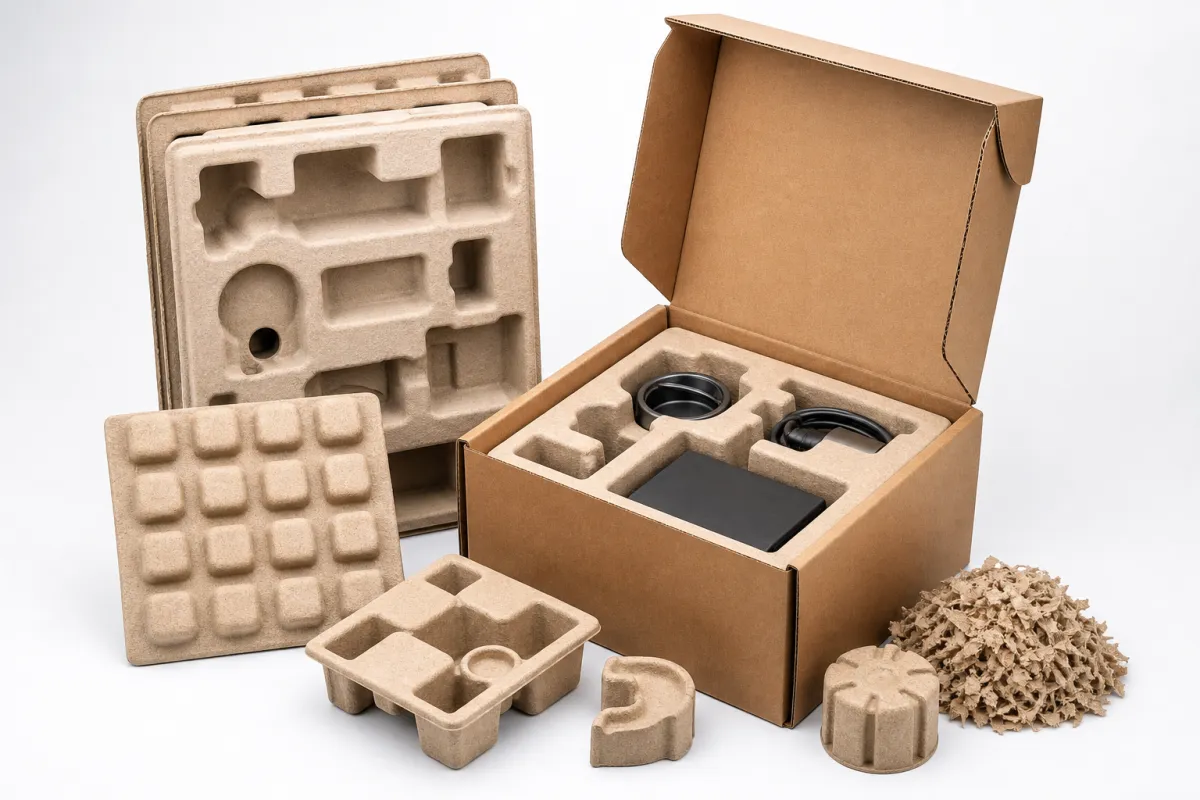
A molded pulp inserts supplier provides more than a shaped fiber part. In practical terms, that can mean custom trays, corner blocks, end caps, cushioning saddles, and support structures that hold a product steady during shipping and handling. The geometry may be simple or surprisingly exacting. A tray for a candle might only need a few load-bearing ribs. A tray for an electronics kit may need anti-rocking pockets, cable channels, and tighter control around the product cavity. A solid molded pulp inserts supplier understands that the insert is part of the protection system, not a separate accessory added at the end.
That point sounds obvious until you look at a failed pack. A clean-looking carton with the wrong insert often appears secure right up until a drop test or a courier van gets involved. The insert may keep the product centered, yet if it does not manage movement at the corners, the product still takes the hit. That is the part many teams underestimate. The real value of a molded pulp inserts supplier shows up in how they translate a packing problem into a structural solution.
Molded pulp should also be treated as a design choice, not a plastic substitute with a different surface. It can reduce dependence on petroleum-based foam, support fiber recovery goals, and fit well into paper-based pack systems. It is not automatically lighter, cheaper, or better in every case. A molded pulp inserts supplier has to balance wall thickness, fiber mix, drying profile, and surface texture against the actual product risk. If the insert is overbuilt, it may protect well but cost too much, weigh too much, or nest poorly. If it is underbuilt, it becomes an expensive reason for returns.
For buyers comparing vendors, the core question stays simple: can this molded pulp inserts supplier match the product, the route, and the sustainability target at the same time? That is the real test, not whether the sample looks attractive on a desk under good lighting.
How a Molded Pulp Inserts Supplier Builds the Right Insert
The design workflow usually starts with product data, and the best molded pulp inserts supplier will ask for more than outside dimensions. Weight matters. Fragility matters. Surface sensitivity matters. So does how the item is handled before it reaches the customer. A glossy cosmetic jar and a machined metal component may both be “small,” but they behave very differently under vibration and compression. The supplier should want CAD files, photos, break-point notes, and carton constraints before sketching a concept.
From there, the engineering discussion turns to fit and force distribution. Wall thickness affects how much load the insert can carry. Draft angles affect how smoothly the part releases from the mold. Rib geometry can stiffen the part without wasting fiber. Fiber blend influences texture, surface appearance, and how the part dries. A thoughtful molded pulp inserts supplier does not simply make the part thicker and call it safer; they decide where material matters most and where it can be reduced without losing protection.
That is why prototyping is not optional for serious projects. A workable sample often begins with a soft tool or prototype mold, then moves through fit testing and handling checks. For fragile products, I would want to see a trial pack in the actual carton, with the actual closure method, and ideally with at least one simulated distribution test. A credible molded pulp inserts supplier should be comfortable discussing the result, not hiding behind the phrase “close enough.”
There is also a difference between standard tooling and custom tooling. Standard tooling can be attractive for low-risk, repeatable formats, especially if the product family barely changes. Custom tooling becomes the better path once the product has unique geometry, higher value, or a shipping profile that punishes generic fit. A practical rule applies here: when repeated modifications start to pile up, a new mold often costs less than patching an old one. A seasoned molded pulp inserts supplier will say that directly instead of trying to nurse an awkward design through production.
Standard vs. custom tooling
For simple applications, standard tooling can shorten lead times and reduce upfront spend. The tradeoff appears later if the insert has to be forced to fit the product, because that shortcut often returns as higher damage rates or rework. A custom solution from a molded pulp inserts supplier is usually the better long-term choice if the SKU is high value, fragile, or part of a branded unboxing experience.
To make the options easier to compare, the table below sets the tradeoffs beside one another.
| Option | Best For | Typical Upfront Cost | Typical Unit Cost | Main Risk |
|---|---|---|---|---|
| Standard tooling | Low-risk items, repeatable sizes, limited customization | $0-$2,500 | $0.12-$0.28 | Fit compromises and higher damage risk |
| Semi-custom tooling | Moderate volumes, minor shape adjustments, faster launch | $2,500-$7,500 | $0.16-$0.34 | May need revisions after prototype testing |
| Fully custom tooling | Fragile, branded, or high-value products with exact fit needs | $7,500-$20,000+ | $0.18-$0.45+ | Higher upfront spend, but better protection and consistency |
These ranges are not universal, but they show the pattern many buyers miss. A lower quote from one molded pulp inserts supplier can hide a design that fails in transport. A higher quote may include better tooling, tighter fit control, and fewer damaged units. The cheapest option on paper is not always the cheapest package on the balance sheet.
Molded Pulp Inserts Supplier Pricing, MOQs, and Lead Times
Pricing usually comes down to tooling, cavity count, part size, material blend, finish, and order volume. A molded pulp inserts supplier may quote a very competitive unit price, yet the setup charges can be meaningful, especially for custom geometry. If the part needs multiple cavities or complex shaping, the mold cost rises. If the insert requires a smoother surface, tighter dimensional control, or extra drying time, the quote shifts again. Buyers who compare only unit price often miss the real economics.
For a 5,000-piece run, I would expect molded pulp unit pricing to land somewhere around $0.14-$0.35 depending on size and complexity, with tooling sometimes ranging from a few thousand dollars to well into five figures for more specialized shapes. That is not a promise. It depends on the part, the cavity layout, the finish, and whether the molded pulp inserts supplier already has partial tooling that can be adapted. Still, it gives a more grounded frame than vague phrases like “affordable” or “cost-effective.”
Lead times deserve more scrutiny than they usually get. A simple project may move from brief to sample in 10-15 business days if the supplier has the right equipment and the product geometry is straightforward. Custom projects usually take longer because you need design review, prototype approval, and at least one round of testing. Full production often follows sample sign-off by another 2-4 weeks depending on capacity. A dependable molded pulp inserts supplier should break this into milestones instead of offering one tidy delivery date that tells you almost nothing.
MOQ is another place where packaging decisions get distorted. A supplier with a lower minimum order may look attractive, but smaller runs can carry higher unit costs and less efficient freight. A larger MOQ may produce better pricing per unit, but it can create inventory pressure if the SKU is seasonal or still changing. The right molded pulp inserts supplier will help you find the economic break point instead of pushing volume for its own sake.
Freight can change the landed cost more than buyers expect. Molded pulp is nestable, which helps, yet pallet configuration, carton fill, and shipping mode still matter. If a supplier packs inserts in a way that wastes cubic space, the freight savings can disappear quickly. I have seen teams celebrate a lower unit quote and then lose the savings to higher pallet count and more expensive inbound transportation. A smart molded pulp inserts supplier knows that the best quote is the one that survives the freight math.
Rush charges are another reality. If you need samples for a launch meeting or a retailer deadline, expect premium pricing or a narrower choice of tooling paths. Capacity also changes with seasonality. The supplier’s press schedule, drying time, and labor availability all affect whether a project slips by days or weeks. Asking a molded pulp inserts supplier for a realistic lead-time range is better than asking for the fastest possible date and hoping the rest sorts itself out.
How to Vet Quality, Testing, and Sustainability Claims
If a molded pulp inserts supplier says the part is “protective,” ask what that means in numbers. Compression testing matters. Drop testing matters. Vibration testing matters. Fit verification matters. For many products, I would also want humidity exposure checks, especially if the pack ships through wet climates or sits in non-climate-controlled warehouses. Standards from bodies like the ISTA provide a sensible benchmark for distribution testing, even when your exact product does not need a formal certification path.
Quality control in production matters just as much as lab testing. A reliable molded pulp inserts supplier should control moisture content, monitor dimensions, and watch for lot-to-lot variation. Fiber parts can vary if drying conditions shift or if recycled feedstock changes. That does not make molded pulp unreliable. It means the process has to be managed. Ask how the supplier checks critical dimensions, how often they sample, and what happens when a lot drifts out of spec.
Sustainability claims are where buyers need a sharper eye. “Eco-friendly” says very little. Better questions sound like this: What is the recycled content? Where does the fiber come from? Are dyes used? Is there coating or treatment that affects recovery? What is the end-of-life path in the markets where the product actually ships? The EPA sustainability resources are a useful reference point for understanding why real-world recovery matters more than packaging slogans. A molded pulp inserts supplier should be able to answer those questions without drifting into marketing fog.
Contamination risk is one detail many teams skip. If the insert is coated, heavily dyed, or blended with materials that complicate recycling, the sustainability story weakens. The same is true if the insert performs so poorly that damage rates rise. Broken goods create waste as well. From a packaging buyer’s point of view, the most sustainable insert is often the one that protects the product properly and can enter the intended recovery stream without confusion. That is why the best molded pulp inserts supplier will discuss function and end-of-life in the same conversation.
“A good sustainability claim should survive a tough question: what happens to this insert after the customer opens the box?”
That question cuts through a lot of noise. If the answer depends entirely on an ideal recycling system that does not exist in the ship-to market, the claim is weak. If the answer is supported by actual material data, clear fiber sourcing, and honest recovery assumptions, the claim carries more weight. A disciplined molded pulp inserts supplier should welcome that level of scrutiny.
What to ask for before you trust a claim
Request test results, not just product photos. Ask for material specifications, recycled content details, and a brief explanation of the insert’s intended recovery path. If the supplier cannot explain the difference between design intent and real-world disposal, the sustainability claim is probably softer than it sounds. A serious molded pulp inserts supplier should be comfortable with that level of detail.
Also ask whether there are tradeoffs between appearance and performance. Some finishes look cleaner but dry differently. Some fibers print well but pack less efficiently. A trustworthy molded pulp inserts supplier will admit where the design has limits instead of pretending the material can do everything.
Step-by-Step Guide to Choosing a Molded Pulp Inserts Supplier
Start with a requirements sheet. List product weight, dimensions, fragile zones, stack height, carton size, ship lanes, and whether the package has to look premium at retail. If the product is delicate, define the break points. If the item is high value, define the tolerance for scuffing and movement. A molded pulp inserts supplier can only design well when the brief is clear enough to support decisions.
Next, request comparable quotes. This is where many teams go wrong. One supplier quotes a different carton size, another quotes a different product orientation, and a third assumes a different quantity. The numbers become almost meaningless. If you want a fair comparison, give every molded pulp inserts supplier the same assumptions: same product, same ship method, same carton, same volume, same performance target. Only then does pricing tell you anything useful.
After that, ask for samples or prototypes and test them in the real pack. Same carton. Same closure. Same handling conditions. If the insert is going into an automated line, test that too. Human packers can tolerate some ambiguity; machines cannot. A well-prepared molded pulp inserts supplier will help you test the pack as it will actually ship, not just as it appears in a presentation deck.
Then narrow the shortlist by evaluating support. How fast did the supplier answer questions? Did they ask smart follow-up questions? Did they explain the tooling assumptions, or did they bury them? A strong molded pulp inserts supplier should feel like a technical partner, not a quote machine. Communication speed matters because packaging projects change. SKUs shift. Artwork changes. Carton dimensions change. A supplier who can adapt without losing control is worth more than one who only looks cheap at the start.
Finally, ask about scale. If the launch succeeds, can the supplier handle a larger run without changing the part? Can they duplicate tooling if demand splits across regions? Can they maintain consistency if the order volume doubles? A good molded pulp inserts supplier should be able to talk about capacity in realistic terms, including where the bottlenecks are likely to appear.
- Build the brief. Include product weight, fragility, carton size, and expected ship lanes.
- Align the quote. Make sure every molded pulp inserts supplier is quoting the same assumptions.
- Test the sample. Use the actual carton, closures, and handling method.
- Check the evidence. Review compression, drop, vibration, and humidity data.
- Confirm scale. Ask how the supplier handles growth, revisions, and repeat orders.
Common Mistakes When Comparing Suppliers
The first mistake is comparing quotes that are not truly comparable. If one molded pulp inserts supplier priced a smaller carton or a looser fit, the quote may look better while quietly leaving the product less protected. The second mistake is skipping prototypes because the insert “looks similar” to something else. Similar-looking fiber parts can perform very differently once you account for product mass, vibration, and closure pressure.
Another common error is underestimating logistics. Molded pulp is usually nestable, but nestability only helps if the supplier packs efficiently and the pallet pattern makes sense. A quote that ignores carton fill or freight class can distort the final number by a surprising margin. I have seen packaging teams focus on a two-cent unit difference while missing a freight increase that erased the savings. A good molded pulp inserts supplier will help you look at landed cost, not just unit cost.
Sustainability claims can also distract buyers from performance. That is a costly mistake. Damaged product creates customer frustration, replacement shipments, and more material use. A slightly heavier or more carefully designed insert may reduce waste overall because it protects the product better. That is why the best molded pulp inserts supplier is not the one with the loudest environmental claim, but the one that can prove the insert works and explain why the material choice makes sense.
Revision policy is easy to overlook and expensive to ignore. A supplier that charges heavily for every tweak can become costly fast if the product changes late in development. Ask how revisions are handled, who owns the tooling, and whether the quote includes reasonable design iteration. A practical molded pulp inserts supplier should be transparent here because packaging rarely stays frozen for long.
“If two inserts look alike, test them anyway. Performance lives in the details you cannot see from a sales photo.”
Expert Tips and Next Steps for a Better Shortlist
Use a scorecard. It sounds ordinary, but it works. Rank each molded pulp inserts supplier on engineering support, test evidence, pricing clarity, lead-time realism, capacity, and communication speed. Assign a weight to what matters most. A fragile product may deserve more points for testing evidence. A fast-moving launch may deserve more points for sample speed. A seasonal SKU may care more about MOQ flexibility. The point is not to create bureaucracy; it is to make tradeoffs visible.
Ask every vendor for the assumptions behind the quote. Who owns the tooling? How many revision rounds are included? What is the expected sampling timeline? What happens if the product changes by 2 mm? Those questions reveal whether the molded pulp inserts supplier understands real production work or just knows how to issue a price. The best answers are specific, not theatrical.
A simple decision matrix helps, especially for teams balancing brand, budget, and sustainability. If damage risk is high, protection should outrank unit price. If the item is low risk and high volume, efficiency may matter more than custom geometry. If the brand has made public sustainability commitments, fiber sourcing and recovery claims need to be documented carefully. A disciplined molded pulp inserts supplier should help you weigh those factors instead of forcing you into a single metric.
For teams that want a stronger internal process, I would recommend two prototype options: one conservative and one leaner. Test both against the same product, in the same carton, under the same conditions. Compare damage rates, pack speed, and freight efficiency. That exercise often makes the choice obvious. The better molded pulp inserts supplier will not resist the comparison; they will use it to refine the design.
If you want a packaging reference point beyond supplier promises, resources from the Packaging School and packaging.org community can help frame material and design questions in a more practical way. Standards, tests, and recovery assumptions are easier to judge when they are tied to real handling conditions instead of generic claims. That is exactly where a strong molded pulp inserts supplier earns trust.
One last point: do not choose on price alone. That shortcut is tempting, especially under launch pressure, but it can backfire quickly. The right molded pulp inserts supplier should be able to explain every tradeoff in plain language, from tool cost to test data to end-of-life assumptions. If the explanation is clear, the choice usually becomes clearer too. If it is not, keep looking.
FAQ
What should I ask a molded pulp inserts supplier before requesting a quote?
Ask what product data they need: dimensions, weight, break points, shipping environment, and any surface sensitivity. Request a breakdown of tooling cost, unit cost, MOQ, and lead time so the quote can be compared fairly. Confirm whether samples, revisions, and testing are included or billed separately. A serious molded pulp inserts supplier should answer those questions without hesitation.
How long does it usually take a molded pulp inserts supplier to move from sample to production?
Simple, low-risk projects can move faster if the geometry is straightforward and tooling is already available. Custom projects usually need time for design review, prototype approval, and at least one test round before scale-up. Ask for a milestone-based timeline rather than a single delivery date. A reliable molded pulp inserts supplier should give you both the steps and the timing.
What affects molded pulp inserts supplier pricing the most?
Tooling complexity, cavity count, and part size usually drive the biggest cost swings. Order volume matters because higher runs spread setup costs across more units. Material blend, finish quality, and freight efficiency can change the landed cost more than the unit quote suggests. That is why a molded pulp inserts supplier quote should always be read with the assumptions attached.
How do I know if a molded pulp inserts supplier is truly sustainable?
Look for specifics on fiber source, recycled content, and whether the insert is designed for recycling or composting in real-world systems. Check whether the supplier can explain dyes, coatings, and contamination risks clearly. Compare claims against actual performance, because damaged goods create avoidable waste. A trustworthy molded pulp inserts supplier will talk about both material sourcing and pack performance.
Can a molded pulp inserts supplier help with fragile or high-value products?
Yes, but the design must be validated with drop, compression, and vibration testing. High-value items often need tighter tolerances and more careful fit control. Ask for a prototype review before committing to full production so the protection level matches the risk. The right molded pulp inserts supplier should be comfortable proving that the insert protects what matters most.
Choosing a molded pulp inserts supplier is less about finding the lowest quote and more about finding the clearest thinking. If the supplier can show how the insert protects the product, fits the carton, supports the shipping route, and aligns with realistic recovery claims, you are in much better shape. The practical move is to demand one clean prototype test, one honest landed-cost comparison, and one straightforward explanation of end-of-life assumptions before you commit. That single pass is often enough to separate the supplier who just sounds good from the one who can actually carry the pack.