Buyer Fit Snapshot
| Best fit | Custom Corrugated Tray Boxes Bulk projects where brand print, material claims, artwork control, MOQ, and repeat-order consistency need to be specified before quoting. |
|---|---|
| Quote inputs | Share finished size, material target, print colors, finish, packing count, annual reorder estimate, ship-to region, and any compliance wording. |
| Proofing check | Approve dieline scale, logo placement, barcode or warning zones, color tolerance, closure strength, and carton packing before bulk production. |
| Main risk | Vague material claims, crowded artwork, missing packing details, or unclear freight terms can make a low unit price expensive after revisions. |
Fast answer: Custom Corrugated Tray Boxes Bulk: Pricing and Specs should be specified like a repeatable production item. The safest quote records material, print method, finish, artwork proof, packing count, and reorder notes in one written spec.
Production checks before approval
Compare the actual filled-product size with the drawing, then confirm tolerance on folds, seals, hang holes, label areas, and retail display edges. Reserve space for logos, QR codes, warning copy, and material claims before decorative graphics fill the panel.
Quote comparison points
Review material grade, print process, finish, sampling route, tooling charges, carton quantity, and freight assumptions side by side. A quote is only useful when the supplier can repeat the same color, closure quality, and packing count on the next order.
Custom Corrugated Tray Boxes Bulk: Pricing and Specs
A tray looks basic. That is the trick. Custom Corrugated Tray Boxes bulk orders do a lot more than carry product from point A to point B. They can cut damage, speed pack-out, and reduce freight waste that quietly chews through margin. Buyers who only stare at unit price usually miss the real story.
I have watched a tray spec solve a labor problem faster than a staffing change ever could. Run tens of thousands of units through a line and the weak tray shows up fast. Labor creeps up. Pallets shift. Returns climb. A properly built custom Corrugated Tray Boxes Bulk program turns packaging into an operations decision instead of a box-buying exercise.
There is also a trust piece here. Good tray packaging should be boring in the best way. It loads the same way every time, stacks the same way every time, and keeps surprises off the receiving dock. That consistency matters more than most teams admit out loud.
Custom Corrugated Tray Boxes Bulk: Why They Save Money
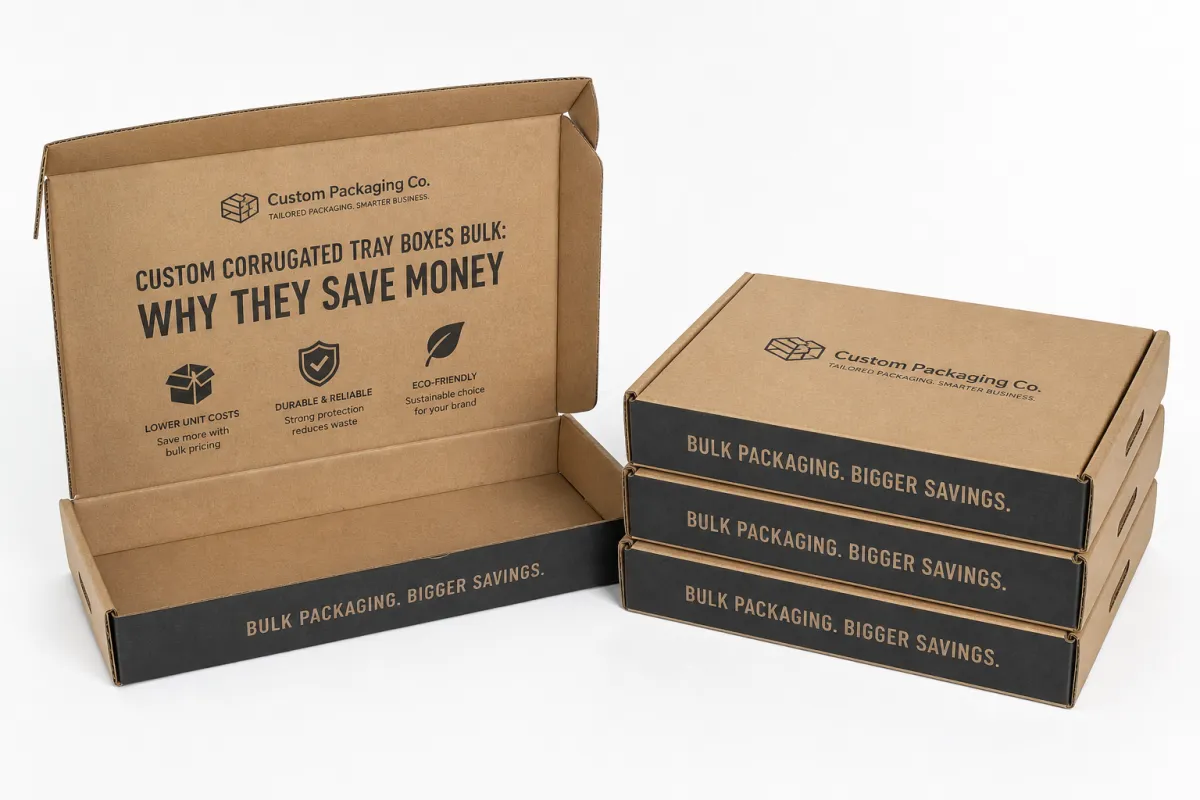
Most teams start with quotes. Fine. That is still not the whole picture. Custom corrugated tray boxes bulk programs save money because they change the pace of the packing line, the stability of the pallet, and the amount of rework that sneaks into the back end. A tray that loads faster can shave seconds off every unit. Seconds pile up. So do labor dollars. A tray that costs a little more can still win if it lowers total shipped cost.
The math gets ugly fast with cheap packaging. A flimsy carton may look like a win on paper, then add 8 to 10 seconds per unit during pack-out. Multiply that across a 30,000-unit order and the labor bill can eat the box savings alive. I have seen that happen more than once, and the spreadsheet never looks pretty after the fact. That is why custom corrugated tray boxes bulk buyers should look at throughput, not just the box line.
Trays also beat full cartons in places where product needs to be seen. Retail-ready display trays let staff move straight to shelf presentation. Open-top trays make warehouse counting easier because the load is visible. Semi-automated lines like predictable wall heights and stable corners, not packaging that wobbles around and makes the machine do extra work. If your line cares about speed, custom corrugated tray boxes bulk is often the cleaner choice.
The hidden costs are usually the ones that sting. Oversized cartons waste pallet cube. Undersized cartons crush edges and trigger complaints. Poor tray geometry forces workers to touch the product twice. Good custom corrugated tray boxes bulk programs reduce all of that by balancing protection, stack strength, and storage efficiency. That balance is where the savings hide.
The right question is not, “What is the box price?” It is, “What does this packaging do to line speed, freight cost, and damage rate?” Buyers who ask that usually make better decisions. Teams that run a pilot often find the new spec lowers total cost per shipped unit, which is the number procurement should have been chasing in the first place.
And yes, sometimes the “cheaper” tray is still the right call. If the product is light, the route is short, and the line is manual, there is no reason to overbuild it. The point is to match the structure to the job, not to inflate the spec just because it sounds more serious.
Tray Box Construction, Materials, and Use Cases
The structure behind custom corrugated tray boxes bulk orders starts with flute and board grade. B-flute gives a cleaner print surface and a slimmer profile. C-flute adds more stacking strength and cushion. BC double wall brings heavier-duty protection for rough transit or dense product. For many tray programs, 32 ECT single wall handles the job. Heavier loads or harsher handling usually push the spec to 44 ECT or a stronger test grade. Weight, stack height, pallet use, and shelf display all matter here.
Use cases are broader than people expect. Produce trays need airflow and moisture tolerance. Bakery trays need quick loading and a clean face. Beverage trays need compression resistance because weight stacks up fast. Industrial parts trays need separation, sharp internal dimensions, and edges that do not fold under pressure. Subscription kit trays often need a nicer finish because they sit inside the brand experience. Retail-ready display trays may need a low front lip so shoppers can see the product without the carton getting in the way. Custom corrugated tray boxes bulk can cover all of it, but the construction changes with the job.
Open-top trays are common, not universal. Die-cut trays fit better when the product has a fixed footprint or needs a stronger handhold. Reinforced corners help when stack pressure is high or when movement inside the tray has to stay close to zero. Moisture-resistant coatings matter for cold storage, refrigerated transit, and damp loading docks. If the tray lives in a freezer or wash-down area, standard kraft board may give up sooner than you want. That is not a flaw in corrugated itself. It is just the board doing exactly what the environment tells it to do.
A useful way to compare tray styles is to ask what the tray must do first. Some trays are built for display. Some are built for shipping. Some try to do both and end up doing neither especially well. The better custom corrugated tray boxes bulk spec usually picks a priority and builds around it. That simple choice saves a lot of arguing later.
For teams juggling multiple SKUs, I usually recommend documenting the tray's main job in one sentence before anyone starts drawing dielines. Sounds tedious. It is. Also kind of useful. “Display first,” “stack first,” or “cold-chain first” gives the supplier a real target instead of a fuzzy wish list.
| Tray Construction | Typical Board | Best For | Strength / Print Notes | Typical Price Tier |
|---|---|---|---|---|
| Open-top single-wall tray | 32 ECT, often B-flute | Light retail goods, bakery, kitting | Good print surface, lighter stacking load | Lowest |
| Heavy-duty open tray | 44 ECT, often C-flute | Produce, beverage, warehouse handling | Better compression, slightly rougher print than B-flute | Mid |
| Die-cut reinforced tray | 32 ECT or 44 ECT | Specialty shapes, semi-automated lines | Better product lock-in, higher tooling complexity | Mid to higher |
| Double-wall tray | BC flute | Heavier parts, stacked freight, long transit | Highest protection, bulkier storage footprint | Higher |
If moisture is part of the story, ask about liners, coatings, or wax alternatives instead of hoping a standard board will survive. Better resistance usually means a bit more cost and sometimes a tougher recycling path. No magic there. Buyers should weigh it honestly. FSC-certified board can also fit into sustainable sourcing plans without changing the tray shape or the way it runs through production.
“If the tray saves one repack and one damaged pallet, the box price stopped being the whole story.”
Buyers comparing custom printed boxes, tray packaging, and related Custom Shipping Boxes should match the structure to the product, not force the product to fit the structure. That simple move is usually where custom corrugated tray boxes bulk delivers the best value.
One more practical note: if a supplier cannot explain why a board grade was chosen, keep asking. Good packaging vendors should be able to talk in plain language about edge crush, flute profile, and how the tray is going to behave once it gets wrapped, stacked, and handled. If they can only talk about “nice paper,” move on.
Sizing, Printing, and Performance Specifications
Good sizing starts with the product footprint, not a guess based on the outer carton. Measure length, width, fill depth, and any clearance needed for fast loading. Add room for inserts if the product shifts, tilts, or needs separation. In custom corrugated tray boxes bulk orders, a few millimeters can change everything because the tray has to work on the line, on the pallet, and sometimes on shelf. Too tight slows workers down. Too loose raises damage risk. Packaging does love a punishment test.
Internal dimensions should be built from the product inward. Fill depth should reflect how much of the item must stay visible, how much support it needs, and whether the tray must carry a top layer under compression. Stack height matters too. High-cube pallets need tray height to line up with pallet count, case count, and wrap requirements. A tray that looks efficient on its own can waste cube if the pallet pattern is bad. That mistake shows up more often than anyone wants to admit.
Printing is usually simpler than buyers fear. One-color flexo is often the most practical choice for custom corrugated tray boxes bulk because it gives you brand marks, handling icons, and product names without turning setup into a circus. Spot graphics can help shelf presence when shoppers actually see the tray. Blank surfaces still make sense when labels, stamps, or variable data get added later. If the tray carries branding, place the logo where it still shows after the product is loaded. Otherwise you printed a nice design for the inside of a stack.
Ask for performance numbers in the quote. Burst strength or ECT values. Compression expectations. Load-bearing limits. If the tray is going through rough distribution, say so. If it needs to live in cold storage, say that too. If it will stack high, tell the supplier the stack profile. Standards from ISTA are a useful reference for transit testing, and ASTM D642 is a common compression benchmark for buyers who want something concrete instead of hand-waving.
Environment changes everything. Freezer storage affects board behavior. Humidity can weaken walls before the product leaves the dock. High-cube palletization can demand stronger corners even when the unit weight looks harmless. Custom corrugated tray boxes bulk should reflect those realities from day one, not after the first freight claim arrives.
If the tray supports retail packaging, then display performance becomes part of the spec. Front lip height, shelf fit, label windows, and top-row visibility all matter. A clean tray is not just about looks. It can affect sell-through because the display feels organized and easy to shop. Retail staff notice that stuff. So do shoppers.
I have also seen teams forget to specify score depth on a die-cut tray, then wonder why the corners crack during folding. That is the sort of detail that sounds boring until it turns into a production headache. Scores, cuts, and glue placement are not cosmetic. They determine whether the tray actually runs the way everyone expected.
The most practical workflow is simple: lock the internal size, pick the target board grade, and define the environment the tray has to survive. Once those three are set, custom corrugated tray boxes bulk pricing gets much easier to compare across suppliers.
Custom Corrugated Tray Boxes Bulk Pricing and MOQ
Pricing for custom corrugated tray boxes bulk comes down to a handful of inputs, and material is usually the biggest one. Board grade affects cost directly. Bigger dimensions eat more paper. Complex die-cuts need tooling and setup time. Multi-color print increases press time. Special coatings or moisture resistance can nudge the number again. Quantity decides how those fixed costs get spread across each unit. Two quotes for the same tray can look nothing alike, which is why procurement teams get cranky about packaging.
As a planning range, a simple open-top tray with one-color flexo may land around $0.18 to $0.32 per unit at 5,000 pieces, depending on size and board. Heavier or more decorative trays can move into the $0.30 to $0.60 range. Double-wall or highly customized die-cut trays can go higher, especially at lower quantities. Those numbers are not promises. They are a useful budget band for custom corrugated tray boxes bulk buyers who need a starting point before artwork is finalized.
Volume breaks matter more than many teams expect. Moving from 2,500 to 5,000 units can cut unit cost sharply because setup charges get spread better. Going from 5,000 to 10,000 can lower it again, though the drop is usually smaller. Sometimes the extra inventory costs less than the savings it creates. Sometimes it does not. That is why the answer is math, not guesswork. A smart buyer checks storage space, cash flow, and reorder timing before they chase the lowest piece price.
MOQ expectations depend on structure. Standard tray shapes can start lower if the tooling is straightforward. Highly custom die-cut trays usually ask for a higher minimum because the setup is less forgiving. If you are testing a new product launch, ask for a pilot quantity and a tiered replenishment price. That gives you room to validate fit before you commit to a larger run of custom corrugated tray boxes bulk.
To compare quotes cleanly, ask every vendor for the same inputs:
- Exact internal dimensions and tray height
- Board grade and flute specification
- Print coverage, ink count, and color method
- Need for coatings, laminations, or moisture resistance
- Tooling, die cost, and any setup fees
- Delivered price versus factory pickup price
- Lead time, not just unit cost
That list matters because a quote can look cheap until freight, tooling, or reprint risk shows up later. A buyer comparing custom corrugated tray boxes bulk should insist on apples-to-apples numbers. If one supplier quotes a blank tray and another includes printed branding, those are not the same offer. If one assumes a standard pallet pattern and the other builds around a tight retail stack, the pricing gap is not really a gap. It is just two different jobs wearing the same label.
Inventory planning can also change the equation. Bulk tray runs reduce purchasing frequency, which trims admin work and makes replenishment easier to forecast. Programs that feed into Wholesale Programs often benefit from that stability because repeat orders can be built around locked specs and predictable reorders. For branded packaging programs, consistency matters almost as much as the sticker price.
One practical note: for seasonal lines, ask for a quote that separates recurring unit price from one-time setup. That makes it easier to see whether the second order will be cheaper than the first. Usually, it will be. Sometimes a lot cheaper. And if a supplier buries the setup charge inside the unit cost, make them show their work.
Order Process and Production Timeline
The order process for custom corrugated tray boxes bulk usually starts with a spec review. A decent supplier will ask for dimensions, product weight, handling method, storage conditions, and print requirements before quoting. That first step avoids the most common tray problem: a structure that looks fine on paper and falls apart on the line. If the program is simple and uses a standard form, the quote moves fast. If it needs a new dieline, expect more back-and-forth. Paper never stops being paper, but people still manage to overcomplicate it.
From there, the job moves to dieline approval and artwork review. For many programs, a digital proof is enough to check print placement and copy. For tighter fits, a physical sample or first-article prototype is the smarter play. Sample work can add days, but it is usually cheaper than fixing a full run. That is especially true for custom corrugated tray boxes bulk orders that have to fit semi-automated equipment or a fixed retail shelf.
Typical lead time often lands around 12 to 15 business days from proof approval for straightforward jobs, though complex trays can take longer. Add shipping time and the calendar stretches again if the plant is far away. Material availability can also shift the schedule, especially with special board grades or coatings. If the launch date is fixed, share it early. Waiting until artwork is finished before talking about timing tends to create delays no one enjoys.
Speed usually comes down to the buyer. Final product dimensions before quote request. Editable artwork files. Confirmed print area. Sample decision made early. Prompt proof approval. Those small steps reduce review loops, and review loops are what drag down custom corrugated tray boxes bulk programs. I know that sounds dull. It is. It also saves real time.
Repeat orders move faster than first builds because the spec is already locked. That is why many teams keep tray packaging on a controlled reorder schedule instead of treating it like a one-off purchase. Once the die, board grade, and print are approved, production becomes more predictable and fit risk drops hard. For businesses building out broader Custom Packaging Products, that kind of repeatability saves time across the calendar.
One more thing: first-article approval should not be rushed just because the order is large. A tray carrying a display load, stacking load, or fragile product should be checked with the real item inside it. That extra step protects the entire custom corrugated tray boxes bulk run from expensive mistakes. I would rather lose a day on sampling than a week on rework.
Why Choose Us for Bulk Tray Box Programs
Buyers come back to a supplier for one reason: the program keeps working. For custom corrugated tray boxes bulk, that means consistent board quality, consistent scores and cuts, and consistent print placement. In a production environment, tiny variation turns into real disruption. A tray off by a few millimeters can slow loading, jam a line, or create a crooked display. The goal is not just to ship a tray. The goal is to keep the operation calm.
Fast, clear quoting matters too. If a buyer has three days to compare options, a detailed quote with separate tooling, unit cost, and freight is worth far more than a quick number with no context. That clarity matters even more for custom corrugated tray boxes bulk because the economics shift with volume. A team that answers real questions quickly usually saves the buyer time later.
Spec lock-in is another reason companies stick with a dedicated partner. Once the construction is approved, the production history starts to matter. Reorders get easier. Inventory planning gets cleaner. The pack line learns the tray. Changes happen less often. That matters for companies using tray packaging as part of a larger package branding strategy, because consistency supports both operations and shelf presence.
In-house design help is useful for the same reason. A supplier who can review corner strength, flute choice, and print layout before production starts can prevent expensive revisions. That is not marketing fluff. It is practical. Packaging mistakes often show up only after the product is packed, stacked, or shipped. Catching them before production is far cheaper than fixing them after a full custom corrugated tray boxes bulk run is already underway.
Our approach stays focused on the stuff buyers actually care about: tolerances, inspection checks, packaging consistency, and communication speed. If a tray needs to work on a retail shelf, in a warehouse, or in a mixed distribution network, we aim to keep the spec clear and the process simple. For buyers comparing custom corrugated tray boxes bulk with other tray packaging or with custom printed boxes, that kind of process control is often what separates a decent quote from a dependable program.
We also support programs tied to broader replenishment plans. That helps buyers managing multiple SKUs who do not want every pack change to become a new sourcing project. When trays connect with Custom Shipping Boxes or other secondary packaging, keeping specs aligned saves time across procurement, production, and reordering.
And if you are wondering whether a tray program is “too small” to bother with process discipline, it usually is not. Even lower-volume runs can create headaches if dimensions drift or the board spec is vague. The job gets easier, not harder, when the details are nailed down early.
Next Steps for Custom Corrugated Tray Boxes Bulk
If you are ready to quote custom corrugated tray boxes bulk, start with the basics: product dimensions, product weight, stack height, storage environment, and monthly volume. Those five inputs do more for pricing accuracy than anything else. They tell the supplier what the tray has to survive and how the line will use it. Without them, even a good estimate is a guess wearing a tie.
Next, gather the print details. Send the artwork files, note the required print area, and explain whether the tray will sit on a shelf, move through a warehouse, or travel by parcel or pallet. If you need branded packaging, ask where the logo should land after the tray is filled. If shoppers will see the tray, confirm lip height and front-panel coverage. A little clarity here saves a second round of revisions.
If the tray supports stacking, display, or fragile contents, ask for a sample or prototype. That is especially smart for custom corrugated tray boxes bulk because volume magnifies mistakes. A small sample can expose a bad flute choice, a weak corner, or a print placement issue before it turns into a costly production problem. For buyers moving from testing into recurring supply, a sample is cheap insurance.
When you request a quote, ask for unit price, setup cost, freight, lead time, and minimum order quantity on the same sheet. That makes comparison easier and keeps every supplier answering the same question. If you need a starting point, use the wider range of custom corrugated tray boxes bulk and related Custom Packaging Products options, then narrow to the construction that fits your line. The next smart move is simple: ask for a spec review and a quote for custom corrugated tray boxes bulk that matches your product, your timeline, and your budget.
My honest advice: do not approve a production run until the tray has been tested with the real product, on the real pallet pattern, in the real storage environment. That one step catches the weird stuff that drawings miss. It is not glamorous. It is just good buying.
What is the MOQ for custom corrugated tray boxes bulk orders?
MOQ depends on size, tooling, and print method, but custom corrugated tray boxes bulk programs often start lower for standard constructions and rise for highly custom die-cuts. Larger quantities usually improve unit pricing enough to offset setup costs, so buyers should ask for tiered quotes. If you need a smaller test run, ask whether a pre-production sample or pilot quantity is available before committing. A good supplier should be able to explain the breakpoints without making it weird.
How do I choose the right size for custom corrugated tray boxes bulk packaging?
Measure the product footprint, fill depth, and any stacking clearance before you request a quote. Leave enough room for loading speed, inserts, and minor product variation without making the tray oversized. If the tray will display product, confirm visibility, front lip height, and shelf fit as part of sizing. For custom corrugated tray boxes bulk, fit is a production issue, not just a design preference.
Can custom corrugated tray boxes bulk orders be printed?
Yes, most bulk tray boxes can be printed with brand marks, handling instructions, product labels, or retail graphics. Simpler one-color flexo is often the most cost-effective option at volume. If the tray sits on shelf or display, ask for print placement guidance so branding stays visible after packing. That is one reason custom corrugated tray boxes bulk is often chosen for retail packaging. It keeps the shelf-facing side doing some actual work.
What affects pricing most for custom corrugated tray boxes bulk runs?
The biggest drivers are board grade, box size, print coverage, die-cut complexity, and order quantity. Freight, tooling, and any special performance requirements can also shift the total cost. A quote should separate unit price from setup costs so you can compare suppliers clearly. For custom corrugated tray boxes bulk, the quote is only useful if those pieces are broken out.
How long does production take for custom corrugated tray boxes bulk orders?
Timing depends on proof approval, tooling needs, material availability, and the shipping method you choose. Straightforward repeat orders move faster than fully custom structures that need sampling or revisions. If your launch date is fixed, share it early so the producer can plan the schedule around it. That is the simplest way to keep custom corrugated tray boxes bulk on track.
Do I need a moisture-resistant coating?
Only if the tray is going to live in a humid dock, cold room, freezer, or another environment where standard board can soften. A coating can help, but it can also change cost and recycling behavior. If your product is dry, short-haul, and stored indoors, you may not need it. For custom corrugated tray boxes bulk, the coating decision should follow the environment, not habit.

