For brands assembling sample sets, subscription kits, event giveaways, or travel-size collections, a cosmetics drawstring plastic Bags Bulk Order solves a practical packaging problem: the bags have to pack quickly, look tidy, and hold together without creating extra labor. The right bag does more than contain product. It keeps items grouped, lets the contents show through when visibility matters, and gives the kit a finished look before it ever reaches the customer.
That is why drawstring plastic bags keep showing up in cosmetics programs. They are light, easy to close, and efficient on a packing line, but they still can look retail-ready if the film, print, and closure details are chosen with care. Those details matter more than many first-time buyers expect. A bag that feels fine in a sample can behave very differently when it is packed hundreds or thousands of times.
If you are sourcing through Custom Logo Things, the goal is straightforward: specify the bag correctly the first time so the final run fits the product, the brand, and the packing workflow.
Why cosmetics teams use drawstring bags for fast, polished packaging
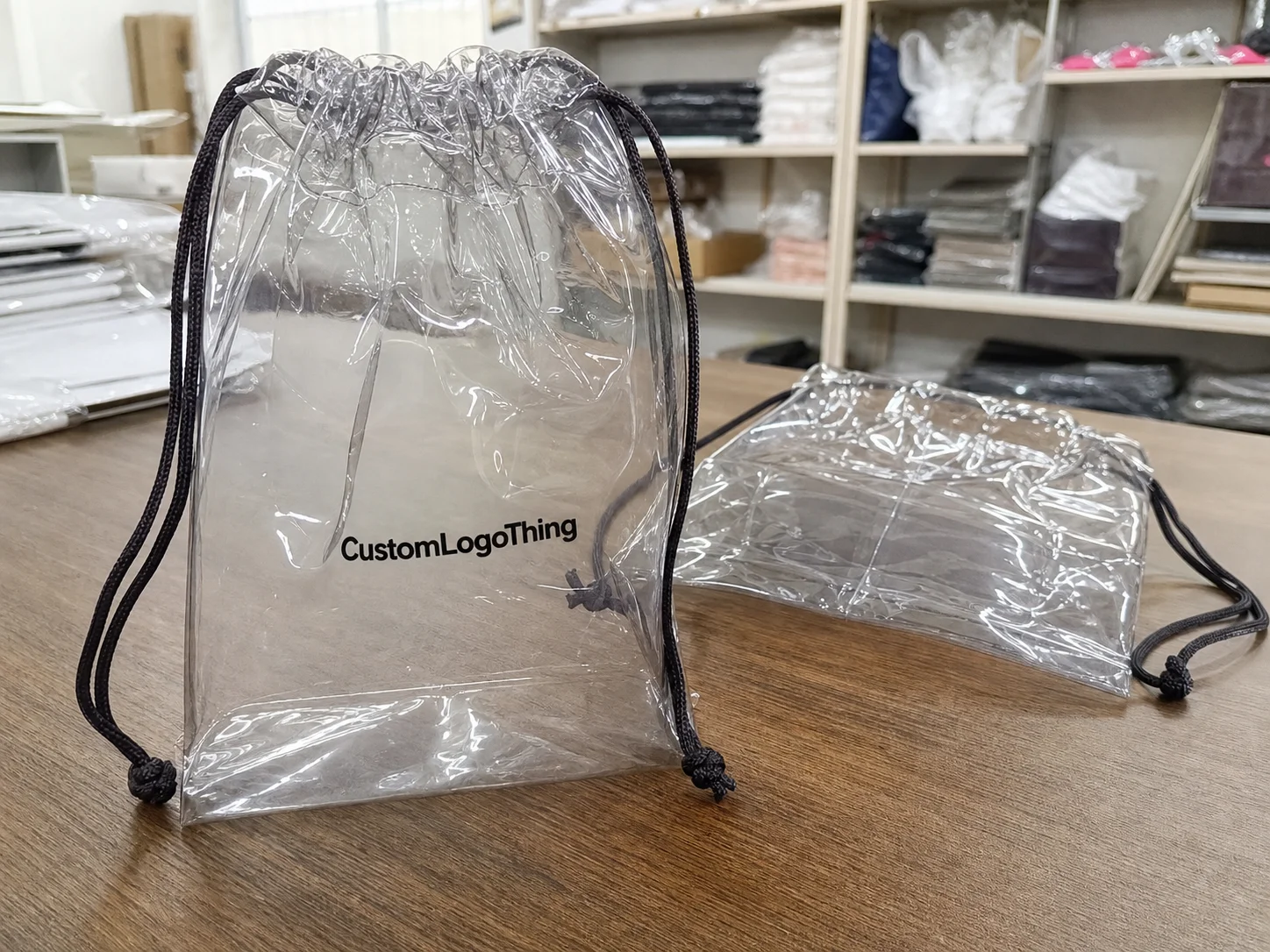
Cosmetics packaging has to do three jobs at once. It needs to protect the items, move quickly through packing, and still look good in the customer’s hand. A drawstring bag handles that middle ground well. It opens quickly, loads quickly, and closes without a zipper track, adhesive strip, or heat-sealed top, which makes it useful for repeatable assembly work.
For sample sets and mini kits, the time savings are real. A packer can place a lipstick, lotion, brush, and card insert into one bag, cinch the closure, and move on. That sounds small until you multiply it across a production run. A few seconds saved per unit can trim labor in ways that show up on a busy packing table.
Visibility is another reason buyers like the format. Clear or lightly frosted plastic shows product colors, label shapes, and set composition, which is useful for retail display and promotional kits alike. Customers can see what they are getting, while the bag still keeps the set neat instead of loose in a carton.
“The best cosmetic bag is the one that disappears into the process and still makes the product look intentional.” That is usually what buyers want: simple to pack, clean to present, and dependable enough to avoid rework.
Lightweight construction also helps with shipping efficiency. Compared with rigid boxes or molded trays, flexible bags add very little to carton weight, and they take up minimal space before filling. For a cosmetics drawstring plastic Bags Bulk Order, that can reduce freight cost, simplify storage, and keep kitting moving without extra packaging parts.
Durability still has to match the use case. A small sample bag does not need the same film gauge as a heavier multi-item retail set, and a bag that will be reopened several times should be reinforced differently than a one-time promotional piece. Weak cord channels and narrow side seals fail where stress concentrates. That is where spec discipline pays off.
There is also a less obvious reason drawstring bags work well in cosmetics: they tolerate mixed product shapes better than rigid formats. Tubes, compacts, brushes, and cards do not all stack the same way, and a flexible bag can adapt around those differences without forcing every item into a fixed cavity. That flexibility is helpful, but it can also hide mistakes. If the bag is undersized, the line operator will feel it immediately; if it is oversized, the finished set may look sloppy and move around too much in transit.
Materials, finishes, and drawstring construction options that affect performance
Most cosmetic drawstring bags are made from flexible poly films, usually LDPE or LDPE blends, because those materials offer a useful balance of softness, sealability, and clarity. LDPE is common for a reason. It bends without feeling brittle, resists cracking better than many rigid plastics under normal handling, and can be produced in multiple thicknesses for different product weights.
The finish changes the brand impression a lot. Clear bags are the simplest choice when visibility and a clean retail look matter. Frosted bags soften the contents visually, which can feel more premium or more private depending on the collection. Tinted bags support a coordinated color story. Printed bags give the most branding control and are usually the better fit for launch kits or promotional campaigns.
Drawstring construction matters just as much as film choice. Some bags use an integrated cord that runs through a reinforced top channel. Others use a ribbon-style closure that gives a softer, gift-like appearance. In either case, the closure needs enough room to move freely without cutting into the film. If the channel is too tight or the reinforcement is too thin, repeated opening will chew up the edge and shorten the bag’s life.
From a buyer’s point of view, the strongest bag is not always the thickest bag. The better question is whether the construction matches the handling pattern. A promotional kit opened once at a trade show can use a lighter spec than a retail bag that may be handled several times by store staff and shoppers before purchase.
Surface finish also affects print readability. Gloss film makes colors pop, but it can create reflections under store lighting. Matte or frosted surfaces reduce glare and can make logos feel more understated. If the artwork includes fine text, a clearer surface with strong contrast usually works better than a busy decorative finish. That is a small detail that often gets missed until proof time.
For teams comparing options, the basic selection logic below narrows the field quickly:
| Option | Best use | Typical strengths | Tradeoff |
|---|---|---|---|
| Clear LDPE bag | Retail display, sample sets | High visibility, simple look, efficient packing | Shows contents and internal labels |
| Frosted bag | Premium kits, privacy-sensitive items | Soft presentation, reduced glare | Slightly less content visibility |
| Tinted bag | Branded collections, seasonal promotions | Color coordination, stronger brand feel | May reduce product visibility |
| Printed bag | Retail and promotional branding | Logo impact, campaign messaging | Higher setup and print costs |
For material and sourcing standards, some buyers also check broader packaging references from organizations like packaging.org, especially when they want context on film performance, sustainability claims, or print consistency expectations.
Size, thickness, and print specifications to lock in before ordering
Size is where many cosmetic bag orders start to drift, because the product set looks simple until someone measures the stack height incorrectly. The right approach is to measure the largest item, then add room for loading and cinching. For mixed kits, the real question is not which item is smallest. It is how the whole set sits once everything is packed together.
Width, height, and gusset depth all matter if the bag has a shaped bottom or side expansion. If the bag has no gusset, usable space is more limited than the outside dimensions suggest. Buyers should also confirm the opening width after the drawstring is cinched, because a bag can look generous on paper and still be awkward in production if the closure eats too much usable opening.
Thickness selection should be tied to use, not habit. Lighter films can work well for sample packets, cotton pads, or a single mini bottle. Heavier gauges make more sense for multi-item kits, beauty tools, or retail sets that will be handled repeatedly. In real terms, a modest increase in film thickness may add pennies to the unit cost but improve confidence around the cord channel and side seals.
Typical specification choices buyers compare
- Light-duty samples: thinner LDPE, basic clear film, one-color logo or no print
- Retail kits: mid-gauge film, frosted or clear finish, logo print in a defined placement area
- Promotional bundles: custom size, more durable seals, stronger cord reinforcement, larger print area
- Premium presentation: matte or frosted finish, precise print registration, cleaner closure appearance
Print specifications deserve just as much attention as size. A one-color logo may be enough for a clean, brand-forward look, while a multi-color design may suit seasonal promotions or product launches. Artwork should be supplied in a print-ready vector format whenever possible, and the buyer should confirm whether the logo sits above the closure line or on the front panel below it. That placement sounds minor, but it affects visibility once the bag is cinched.
If the bag will carry inventory or be used in internal operations, include UPC placement, product codes, or warning text during the spec stage. Some brands also need basic identification for warehouse control, and that is easier to build into the layout before production than to fix afterward.
For a retail environment, the bag format should match the product category: lipstick sets, skincare minis, makeup tools, bath accessories, or promotional bundles. That is especially useful for a cosmetics drawstring plastic bags bulk order because fit affects both presentation and packing speed. A bag that is just slightly too deep can make small sets look sparse. One that is too shallow can force the closure awkwardly and stress the film at the top edge.
Thickness and finish should also be considered alongside storage conditions. If the bags will sit in a hot warehouse or be packed into crowded cartons, a slightly sturdier spec can reduce edge distortion and scuffing before use. Those issues are subtle, but they show up in the final presentation.
What affects cost, pricing, MOQ, and quote accuracy
Pricing usually comes down to a few variables: film type, dimensions, thickness, print coverage, number of colors, closure style, and total quantity. Order volume has a large effect because setup costs are spread across more units as the run gets larger. That is why unit pricing often improves sharply once the order reaches a more efficient production tier.
For a rough buying frame, simple unprinted bags usually sit at the lower end of the range, while custom-printed bags with special finishes or reinforced construction cost more. Depending on size and decoration, a bulk run might land anywhere from about $0.10 to $0.35 per unit, with custom printing, heavier film, or specialty finish pushing the number upward. Freight, duty, and one-time setup fees can change landed cost quite a bit, so it is smart to ask for the full picture.
MOQ depends on the decoration method and whether tooling or print setup is required. Unprinted bags usually allow more flexibility, while custom-printed runs typically require a higher minimum because the setup effort is fixed regardless of volume. That is normal. The important part is making sure the MOQ fits your actual campaign demand instead of just chasing the lowest-looking quote.
To improve quote accuracy, send these items up front:
- Exact bag dimensions and whether a gusset is needed
- Target quantity and any planned repeat order volume
- Material preference such as clear, frosted, or tinted film
- Print details including number of colors and placement
- Delivery location and target date for receiving the goods
Ask the supplier to separate the quote into packaging, printing, freight, and any one-time setup fees. That keeps comparisons honest. A low unit price with high freight or hidden setup can look attractive until landed cost is calculated. If you are comparing multiple suppliers, separating those line items makes the differences obvious.
Buyers should also ask whether the quoted price includes overage or scrap allowance. In packaging production, a small amount of waste is normal, especially on custom print jobs, and it is better to know upfront whether the quoted quantity is net or gross. That avoids misunderstandings when cartons arrive and the count is tighter than expected.
For buyers exploring broader purchasing structures, internal resources such as Wholesale Programs can help clarify how volume pricing and repeat ordering are usually handled.
Process and timeline from artwork approval to delivery
The normal order flow is simple on paper: quote request, spec confirmation, artwork submission, proof review, production, inspection, and shipping. In practice, each step depends on clean input from the buyer. The fastest orders are the ones where the dimensions, print area, and intended use are already locked.
Delays usually show up in three places. The artwork is not print-ready, the size has not been finalized, or the brand team has not approved color and placement. If the supplier is waiting on revisions, the schedule slips. That is why the smoothest orders are built on a complete brief before production starts.
Proofing should include a layout review at minimum, and for larger or more visible retail orders, a physical sample may be worth the extra time. A digital proof confirms composition and placement, but it will not fully show how the closure sits or how the finished bag presents under light. For a cosmetics launch, that extra check can be useful.
Lead time should always be split into two pieces: production time and shipping time. A bag run may take roughly 12 to 18 business days after proof approval, depending on quantity and print complexity, while transit can add several more days or longer depending on destination and freight method. If the bags are tied to a launch or kit assembly window, build the calendar backward from the deadline instead of trusting a single “ship by” date.
What keeps the schedule moving? Fast proof approval, print-ready files, and a locked spec before production starts. If the bags are needed for a timed retail rollout, that discipline matters more than one extra revision round. Good packaging runs are usually boring in the best possible way.
Inspection is another checkpoint that deserves attention. A finished bag should be checked for seal integrity, cord function, print placement, dimensional consistency, and visual defects such as haze, wrinkles, or off-register logos. None of those defects are dramatic on their own, but they add up when the bags sit side by side in a retail set. A short random pull test can also show whether the cord channel and top seam will hold under normal handling.
For teams that need basic purchasing help or order questions answered before they commit, the FAQ page is a useful starting point.
Why custom packaging buyers compare suppliers before placing a bulk order
Comparing suppliers is not just about price. On a large cosmetics run, consistency matters just as much. The bag should stay uniform from first carton to last carton: consistent clarity, consistent print registration, consistent seam strength, and a closure that behaves the same way across the order. If the first hundred are good but the last hundred are sloppy, the packing team ends up paying for it later.
Quality control should include material inspection, print verification, dimensional checks, and random pull testing on finished bags. That is not overkill. It is common sense for packaging that may be used in retail display or direct-to-consumer fulfillment. Buyers often ask whether the supplier checks sealing strength, measures actual film thickness, and verifies logo placement against the approved proof. Those are the right questions.
Communication matters too. Cosmetics launches often have hard dates attached to retail resets, influencer kits, seasonal promotions, or event handouts. If a supplier is slow to answer spec questions or unclear about proof timing, that can become a real scheduling risk. A good packaging partner should translate the brand requirement into a manufacturable spec without turning the order into a maze.
Supply flexibility is another reason buyers compare options. One campaign may need a smaller frosted bag for skincare minis, while another needs a clear printed bag for a fuller gift set. A supplier that can support repeat orders, size revisions, and branded variants usually becomes easier to work with over time because the learning curve drops after the first run.
It also helps to ask for a sample pack or reference images of previous construction styles before placing a high-volume run. That does not replace testing, but it gives buyers a faster read on how the film handles, how the cord sits, and whether the finish matches the brand’s expectations. Cosmetic packaging is visual work. Small differences in clarity, gloss, and edge finish can change the perceived value of the set more than a casual quote comparison suggests.
For durability expectations, buyers sometimes look for testing references such as ISTA when shipment protection or transit handling is part of the specification. That is especially relevant if the bagged kits will be packed into outer cartons and shipped through multiple handling points.
Next steps to finalize your cosmetics packaging order
If you are preparing a cosmetics drawstring plastic Bags Bulk Order, the fastest path is to gather the essentials before requesting the quote. Have the bag dimensions, quantity, material preference, print file, and target delivery date ready. Once those are fixed, the rest of the conversation gets much easier.
Start by grouping the products by use case. A single lipstick sample does not need the same structure as a five-piece skincare kit, and a fragile glass bottle may require more room and a stronger film than a lightweight makeup sponge set. Choose the bag size and thickness based on the heaviest or most delicate item in the mix, not the easiest one to fit.
Ask for one or two material options so you can compare appearance against cost. Often, the difference between clear and frosted, or between standard and slightly heavier film, is enough to change the final decision once the brand team sees the tradeoff in practical terms. If the quote includes a proof, review artwork placement, closure position, and any small text that must remain legible after cinching.
If sustainability is part of your procurement discussion, align the material choice with verified sourcing or packaging goals rather than vague claims. Some buyers also review standards from the FSC when paper components or mixed-material kits are involved, even if the bag itself is plastic. The broader packaging system still matters.
Final step: confirm the spec, approve the proof, and place the order early enough to cover both production and transit. That is the simplest way to keep a cosmetics launch on schedule and avoid paying for rush decisions that could have been prevented with a clean brief.
FAQs
What size should I choose for cosmetics drawstring plastic bags in bulk?
Match the bag to the largest item in the set, then allow enough room for loading and the cinched closure. For mixed kits, measure the stacked items together rather than relying on the smallest product. If you are uncertain, request two size options and compare fit, presentation, and freight efficiency side by side.
Can I print a logo on cosmetics drawstring plastic bags bulk order runs?
Yes, most bulk runs can support one-color or multi-color branding depending on the film and print method. Artwork should be prepared as a clean vector file with clear placement instructions, and a proof should always be reviewed before production so logo position and readability are checked against the actual bag size.
What is the usual MOQ for custom cosmetic drawstring bags?
MOQ depends on material, print complexity, and whether special setup is required. Simple unprinted bags usually allow lower minimums than fully printed or specialty-finish versions. For the most accurate number, send dimensions, material preference, and target quantity with the quote request.
How long does production usually take after artwork approval?
Production time depends on order volume, print setup, and current factory schedule. Shipping time is separate from manufacturing time, so both should be confirmed before launch planning begins. Fast approvals, print-ready files, and locked specs help keep the schedule moving without avoidable delays.
Are these bags suitable for retail display and not just storage?
Yes, clear or frosted cosmetic drawstring bags can work very well for retail if the film, print quality, and closure finish are specified correctly. Choose a cleaner-looking finish and confirm that the logo and product contents remain visible from the customer’s point of view. If the bags will be handled often, ask for reinforced seams and a closure style that holds up to repeated opening.


