Beauty packaging gets judged fast. A frosted zipper bag can make a serum, scrub, mask, or refill pouch look cleaner and more finished than a fully clear bag, while still leaving enough visibility for color, texture, or fill level to matter. That is why beauty Frosted Zipper Bags bulk order planning should begin with the product role, not the quote sheet.
Packaging decisions are often made in seconds. Visibility, zipper feel, and label contrast usually matter more than decorative complexity, especially for buyers who need one pouch style to cover several SKUs without creating warehouse clutter or a messy replenishment plan.
There is a practical upside too. One well-chosen frosted zipper bag can support trial sizes, mid-size retail packs, and refill formats across the same line. That reduces packaging variation, makes reorders easier to forecast, and lowers the chance that a launch gets delayed because one specialty bag is stuck in approval. The useful sequence is straightforward: define the use case first, then lock size, closure, and print goals before asking for pricing.
Why frosted zipper bags change how beauty products sell
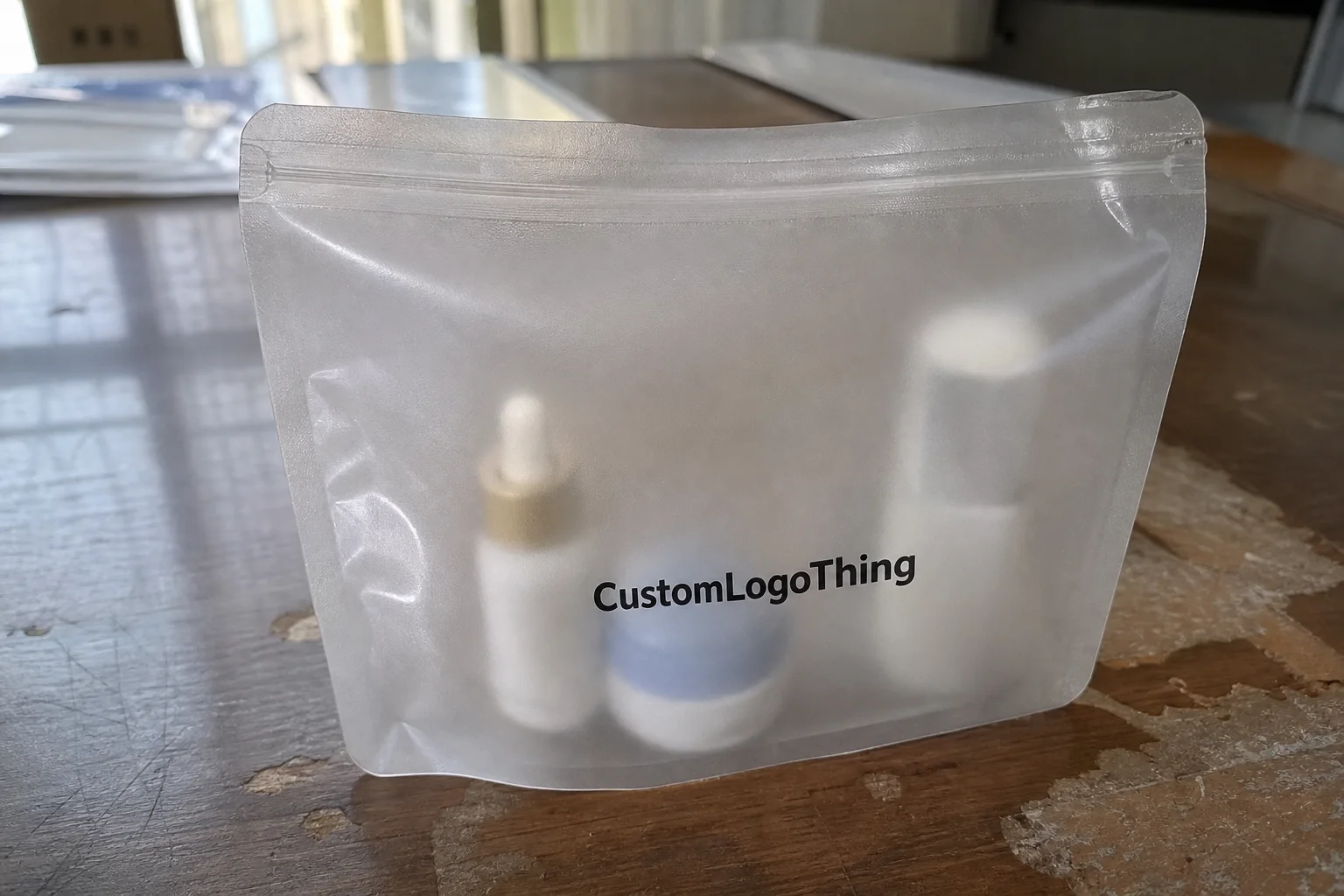
A frosted finish changes the first impression without requiring a heavy print program. The surface softens what is inside, cuts glare under store lighting, and gives logos or ingredient panels better contrast than a glossy clear bag. For beauty buyers, that matters because a pouch does not need to shout to look premium. It only has to look controlled, clean, and intentional.
That visual control has a shelf effect. If one frosted zipper pouch can serve a face mask, body scrub, and refill pack with only a size change, the brand keeps the system consistent while cutting down on SKU sprawl. Procurement gets cleaner too. Fewer pouch styles means fewer approvals, fewer backups, and fewer opportunities for a launch to stall because one custom bag missed its deadline.
The strongest use cases are the ones where visibility helps but full transparency would look untidy. Powders, colorful scrubs, pressed sachets, and small accessories all benefit from a muted window effect. Frosting reduces the clinical look of a clear pouch without hiding the product entirely. That balance is useful in beauty because the packaging has to reassure and present at the same time.
"Buyers usually want two things at once: enough product visibility to reassure the customer, and enough surface control to keep the line looking premium."
That is the commercial frame for beauty frosted Zipper Bags Bulk order planning. Start with shelf role, refill role, and fulfillment role. Then decide whether the pouch needs to stand alone, hang on a peg, or ship inside a secondary carton. The answer changes the structure, the cost, and the test plan.
There is also a brand-consistency angle that gets overlooked. Beauty lines often live or die by visual repetition: same finish, same zipper line, same label placement, same color read across different formats. Frosted film helps keep that system tidy because it reduces the visual noise of whatever is inside the pouch. A colorful scrub still reads as a premium item instead of a bright mass of product suspended in a clear bag.
Frosted film, zipper seal, and print surface details
Most Frosted Zipper Bags are built from frosted PE, or from laminated film structures such as PET/PE when the order needs more stiffness and a sharper print face. The typical bag thickness for beauty goods sits around 4 to 8 mil, although refill pouches and larger kits can justify more. Thin material lowers cost, but it also reduces stand-up feel and transit protection. If the pouch has to protect a product with a sharp edge, a heavier gauge usually pays for itself.
The frosted finish is doing real work. It lowers glare, hides clutter inside the bag, and creates a better background for black, white, or metallic printing. It also changes the color read of the product inside. That is useful for brighter formulas and less useful for products that depend on exact visual color matching. A nude-toned powder, for example, can shift visually once the frosted layer is added. That tradeoff should be understood before sampling begins.
Zipper choice matters just as much. A standard press-to-close zipper is common for retail, sample packs, and everyday recloseable use. Stronger zipper profiles make more sense for refill formats that will be opened and closed repeatedly. If the pack is meant for travel, a better top seal or a tear notch may be needed so the first opening is clean and the reseal is still reliable afterward.
Print surface needs attention too. Some buyers want a full front-panel print. Others only need a logo and one short claim line. A clear window, a matte writing panel, or a hidden measurement strip can improve function, but each extra zone changes artwork setup and sometimes the minimum order. The cleaner the spec sheet, the fewer surprises later.
- Structure: frosted PE or laminated film
- Closure: standard zipper, stronger press-to-close, or specialty closure
- Extras: tear notch, bottom gusset, hang hole, clear window
- Print: one-color, multi-color, or label-ready surface
- Fit: product volume, headspace, and shelf profile
Material choice also affects barrier behavior. Frosted PE alone is often enough for dry goods, accessories, and many beauty refills, but it will not behave like a high-barrier barrier pouch. If the formula is sensitive to moisture, oxygen, or scent loss, the buyer should ask whether the pouch needs a liner, a stronger laminate, or a secondary package. That question belongs in the first spec review, not after a sample has already been approved.
For buyers comparing suppliers, useful standards sit outside the bag itself. Packaging transit testing often follows ISTA protocols, especially for shippers that need confidence in compression and drop performance. The International Safe Transit Association publishes practical guidance at ISTA, while broader packaging design and material discussions often appear in references like Packaging School.
Beauty frosted zipper bags bulk order planning: specs to lock first
The core rule is blunt: fix the bag size before comparing quotes. Small dimension changes can alter material usage, zipper placement, and the die line, which means two samples that look similar on paper may land in very different cost bands. In beauty Frosted Zipper Bags bulk order planning, size is the first spec to settle because it influences almost everything else.
The four decisions that move the order fastest are width, height, gusset depth, and closure style. Once those are locked, the supplier can estimate material yield and recommend the most sensible film weight. After that, the team can decide whether the bag needs a matte frost level, a clear viewing area, or a dedicated label zone for batch codes and compliance text.
Decoration should be mapped before quoting too. Single-color printing usually keeps costs down and produces a cleaner premium look on frosted film. Multi-color print pushes the job into a more involved setup. If the brand wants a front panel that doubles as a writing area or needs a transparent window to show the formula, that needs to be stated early, not after artwork is already in proof.
For beauty buyers, the best size strategy is often plain, and that is a good thing. A small pouch for sheet masks or travel items, a mid-size pouch for bath salts or scrubs, and a larger refill pack can cover most needs without forcing the line into ten different SKUs. Replenishment becomes more predictable. Reordering becomes faster. Inventory mistakes drop.
Before requesting a quote, use a short worksheet that includes exact dimensions, expected fill weight, closure style, print colors, and whether the bag is for shelf display, shipping, or both. That one step usually saves more time than any negotiation over unit price. It also gives the supplier a real basis for recommending the right film, zipper, and seal strength.
It helps to include the format the warehouse will actually handle. Some buyers want pouches shipped flat in master cartons; others need them pre-packed in retail-ready bundles. That detail affects carton count, packing density, and sometimes the risk of zipper deformation during transit. A bag that looks perfect in a sample photo can still cause handling issues if the carton spec is ignored.
| Option | Typical MOQ | Indicative unit cost | Best fit |
|---|---|---|---|
| Stock-style frosted zipper bag | 3,000-5,000 units | $0.12-$0.20 | Fast launches, simple branding, refill tests |
| Custom size with one-color print | 5,000-10,000 units | $0.18-$0.32 | Core retail SKUs, cleaner shelf presentation |
| Gusseted pouch with multi-color print | 10,000+ units | $0.24-$0.45 | Refill packs, kits, premium bundles |
Pricing, MOQ, and unit cost drivers that move the quote
The biggest price drivers are easy to identify once you know where the money goes: bag size, film thickness, zipper type, print colors, and any custom tooling. The mistake is assuming a slightly larger pouch will only add a small amount. In practice, a bigger bag can change material yield enough to move both MOQ and unit cost.
Higher volume does reduce the price per bag, but not in a straight line. A new print plate, extra color, or specialty closure can flatten the savings curve. That is why a quote that looks cheap at 20,000 units may not be the best option for a brand that only plans to sell 6,000 units before the next revision. The order should match actual sales velocity, not wishful forecasting.
MOQ works differently depending on whether the bag is stock-style or fully custom. Stock-style orders often start lower because the supplier is not changing as many variables. Custom sizes, custom print, and specialty zippers usually raise the floor. Buyers should ask for tiered pricing at two or three volumes so finance can compare launch quantity against replenishment quantity without reopening the spec sheet.
Ask whether the price includes plates, cartons, proofing, freight, and sample charges. Those extras can distort the apparent savings. A quote that is lower by a few cents per unit may still cost more overall once packaging, inland transport, and proof rounds are added. A fully loaded number is more useful than a tidy line item that hides the actual spend.
One more practical point: the cheapest quote is often the most expensive order later if it creates rework. Misaligned zippers, weak seals, or print drift cost more than a modest upgrade to the right film or finish. A buyer should compare not only unit cost, but also reject risk, scrap risk, and the time cost of fixing mistakes. One bad run can consume the savings from several “cheap” POs.
For teams managing branded cartons and secondary packaging, the U.S. EPA has useful material on source reduction and recycling priorities at EPA recycling guidance. That matters because a pouch specification that looks efficient in production may still be a poor fit if it complicates the broader packaging recovery strategy. Mixed-material structures can offer better shelf performance, but they may be harder to recycle than mono-material options. Buyers should choose with eyes open.
One hidden cost is schedule compression. Rush orders rarely show up as a line item, yet they can force air freight, overtime, or partial shipment plans. If a launch window is tight, the buyer should ask whether a sample approval delay would push production into a more expensive freight option. That is often where budget overruns begin.
Order process and timeline from proof to delivery
The normal workflow is straightforward: inquiry, spec confirmation, artwork check, sampling or digital proof, production approval, manufacturing, inspection, and shipment. The fastest orders are the ones where the buyer sends a clean brief and the supplier can confirm the die line without a long clarification loop. Time is usually lost before production starts, not during the run itself.
Lead time depends on how much is changing. A fixed-size pouch with print-ready artwork may move from proof approval to production in 12 to 15 business days, sometimes a bit faster for stock structures. New sizes, complex print, or a sample round can extend that schedule. Freight adds its own clock, especially if the order is crossing borders or waiting on consolidation.
Three items cause avoidable delays: missing dielines, unclear Pantone references, and last-minute changes to zipper or film color. Those are not small details. They are the exact points where production teams stop and ask for clarification, and every clarification burns a day or more. If the launch date is fixed, the buyer should build buffer time into the calendar rather than hoping the schedule will compress itself.
For production planning, one rule works better than most. New size plus custom print plate equals extra time. New size plus sample approval equals even more time. If both are present, the buyer should assume a longer path and plan freight accordingly. That kind of conservative scheduling is usually the difference between a clean launch and a late shelf arrival.
Sampling deserves more attention than it usually gets. A digital proof can confirm layout, but it cannot tell you whether the zipper feels right, whether the frost level makes the product too muted, or whether the pouch stands the way the team expected on a shelf. A physical sample answers the questions that actually show up after opening day.
For buyers who need a structured procurement path, the pages for Wholesale Programs and FAQ are useful starting points. The first helps set commercial expectations; the second answers the questions that usually slow a purchase order right before approval.
On the quality side, ask whether the supplier follows documented inspection steps and whether the outer carton plan has been checked against transit stress. If a shipment needs to survive multiple handoffs, that should be visible in the approval trail. For more technical context, ISTA documentation is a useful reference point for packaging and shipping tests.
A practical timeline should also include a defect review window. If the buyer expects to inspect incoming goods, the supplier should know what counts as a cosmetic tolerance and what counts as a reject. Without that definition, minor disagreement can turn into delays on receiving day. Clear standards are not bureaucratic. They keep the shipment moving.
What a reliable supplier should show before production starts
A reliable supplier shows capability before they show enthusiasm. That means comparable bag samples, print examples, and a clear spec confirmation sheet. If the vendor cannot confirm dimensions, zipper style, film thickness, and print method in writing, the buyer is taking on avoidable risk. The sales pitch is not the evidence. The proof is the evidence.
Quality control in bulk orders should include seal strength checks, zipper alignment, print registration, and carton packing standards. None of those checks are glamorous, but each one protects the order from a different type of loss. A weak seal creates leakage risk. A crooked zipper creates customer complaints. Poor carton packing turns a passable bag into damaged inventory before it reaches the warehouse.
It helps to ask what gets checked before packing and what gets checked before shipment. Those are not always the same. A run can look fine at the machine and still fail later if carton compression or palletization was handled loosely. The better suppliers separate in-process checks from final inspection, because problems caught early are cheaper to fix.
Communication matters as much as machinery. One contact who can confirm changes quickly reduces the chance of a misprint or a stalled run. A supplier who answers slowly during quoting will usually answer slowly during production too. That delay can be expensive if the order needs a corrected proof or if the brand team discovers a labeling issue late in the process.
Good partners also flag risk early. They tell the buyer if a requested bag size is awkward, if the zipper style is not ideal for the fill weight, or if a design will look crowded on frosted film. That honesty saves money. It also saves reputation, which is harder to rebuild than a production schedule.
Before approving production, ask for documented tolerances, approval records, and a clear defect or reprint policy. If the order includes paper inserts or retail sleeves, request any sustainability claims to be tied to something specific, such as FSC-certified paper components, rather than vague language. Claims should be defensible, not decorative.
From a buyer’s point of view, the best supplier is the one that removes uncertainty before the first machine starts. That is especially true in beauty frosted zipper Bags Bulk Order planning, where the product has to look polished, close properly, and arrive on time without forcing a scramble in the warehouse.
Next steps to place a cleaner, faster bulk reorder
Start with the actual product, not the pouch trend. Gather target dimensions, estimate the first-run quantity, and decide whether the order is refill-focused or shelf-display focused. If the bag needs to support both, say so upfront. That single decision changes the structure, the print layout, and sometimes the MOQ.
Then send one consolidated request. Include artwork files, closure preference, bag thickness target, any gusset requirement, and the expected reorder cadence. The cleaner the brief, the faster the quote. The cleaner the quote, the easier it is for purchasing, marketing, and operations to sign off without a chain of follow-up questions.
My preferred sequence is simple: lock specs first, request pricing second, approve a sample or proof third, and schedule production last. That order protects the launch calendar and stops small unknowns from growing into missed ship dates. It also keeps beauty frosted zipper Bags Bulk Order planning grounded in the real variables that move cost and timing.
Keep the spec file tight and the reorder logic consistent. The best outcome is not the lowest quote on paper. It is the pouch that arrives as expected, performs in use, and can be reordered without restarting the whole approval cycle. That is the practical value of a disciplined bulk order plan.
If the packaging line is still being refined, it is worth separating the requirements into must-haves and optional upgrades. Must-haves include dimensions, closure behavior, and print placement. Optional items include hang holes, custom window shapes, and special matte levels. That distinction keeps early quoting realistic and stops the project from drifting into feature creep.
FAQ
What size works best for beauty frosted zipper bags in a bulk order?
Choose the size based on product volume first, not on what looks common in the market. Fill weight, headspace, and closure clearance matter more than a generic pouch format. For mixed SKUs, standardizing on two or three sizes usually reduces MOQ pressure and makes replenishment easier to forecast.
What has the biggest impact on MOQ and unit cost?
Film thickness, print complexity, and zipper style usually move MOQ and unit cost more than cosmetic changes. Larger runs lower per-bag cost, but setup charges, plates, and specialty finishes can shift the break-even point. Ask for tiered pricing at multiple volume levels so you can compare launch quantity against repeat-order economics.
How long does production usually take after artwork approval?
Lead time depends on whether the bag is stock-size or fully custom, and whether the artwork is ready at approval. A clean proof cycle is the fastest path. Revisions, missing specs, and color changes add days quickly. Build in extra time for a new size, sample approval, and freight if the bags are tied to a fixed launch date.
Can I order a sample before committing to a full run?
Yes. That is the safest way to verify zipper feel, frost level, print placement, and actual bag size. Ask whether the sample is a physical prototype or a production proof, because those two checks answer different questions. Use the sample to confirm filling behavior and shelf appearance, not just the artwork file.
What do you need to quote beauty frosted zipper bags accurately?
Provide exact dimensions, quantity, thickness target, closure style, print colors, and any special features such as a gusset or tear notch. Include artwork files and a short description of product use so the supplier can judge the right material and structure. If you want a reliable quote, mention whether the order is a first run or a repeat order with the same specs.
Are frosted zipper bags suitable for every beauty formula?
No. They work well for dry goods, many refill items, and products where controlled visibility matters. If the formula is oily, moisture-sensitive, scent-heavy, or especially fragile, the buyer should review barrier needs and seal strength before approving the bag. Frosted film changes presentation; it does not replace proper protection.
Should buyers choose mono-material or laminated film?
Mono-material PE is usually easier to explain from a recycling standpoint, while laminated PET/PE can offer more stiffness and a sharper print surface. The better choice depends on the product, the shelf requirement, and the recovery path in the target market. There is no universal winner. The right answer is the one that matches both performance and downstream handling.


