Cuffed Beanies Quote Guide for Restaurant Groups starts with a small discipline that saves a surprising amount of money: make every supplier quote the same product. The best cuffed beanies supplier quote Checklist for Restaurant groups removes the guesswork before the first price lands. If one vendor is pricing a light stock acrylic hat and another is pricing a denser knit with embroidery, individual bags, carton labels, and split freight, the lower number is not useful. It is just incomplete.
A quote should read like a production plan, not a guess. If yarn, knit, cuff depth, decoration, packaging, freight, and approval steps are not shown clearly, the buyer is carrying risk the supplier has not priced.
Restaurant groups have a different problem than a single cafe ordering a small batch. A beanie may need to work for line cooks leaving late, patio staff in cold weather, managers at outdoor events, retail shelves, or a seasonal guest giveaway. The product looks simple. The order usually is not.
Cuffed Beanies Supplier Quote Checklist for Restaurant Groups
The fastest way to compare vendors is to build one master spec and send it to everyone. Same yarn. Same cuff height. Same logo method. Same packaging. Same delivery assumptions. Once the spec is fixed, the quote becomes a buying tool instead of a loose estimate.
Start with the use case. Staff uniforms usually need a durable, midweight knit that holds shape after repeated wear and storage in lockers, cars, or back-of-house bins. Patio service may call for a warmer yarn and a snugger fit. Seasonal retail needs a better finish: clean tags, consistent folding, and packaging that looks intentional near a host stand or register.
Ask each supplier for a quote sheet that breaks out:
- Yarn, color, gauge, and knit construction
- Cuff height, finished measurements, and stretch range if available
- Logo placement, decoration method, and setup charges
- Packaging, folding, bagging, carton counts, and carton labels
- Freight, duties, split shipments, and delivery method
That structure catches mismatched assumptions quickly. One quote may include a decorated beanie packed by location. Another may include only blank goods shipped to one address. A third may bury freight in the unit price but exclude duties or rush handling. None of those quotes should be treated as equal until the missing pieces are exposed.
For restaurant groups, the practical goal is control. A clear quote separates the base hat, decoration setup, sampling, shipping, packaging, and reorder conditions. Operations teams can route approvals faster because they are not decoding vague line items. Finance can see the real landed cost. Store managers receive product that matches the rollout plan instead of a mixed carton that creates an extra sorting job at closing time.
Knit, Yarn, and Cuff Details That Change the Quote
Yarn choice is one of the largest cost drivers, and it affects the first thing wearers notice: handfeel. Acrylic remains common because it is warm, consistent, easy to source, and usually cost-effective. Wool blends can feel richer and perform well in cold conditions, but they raise the price and may require closer care instructions. Recycled fibers and blended yarns can support sustainability targets, although availability, minimums, and color matching vary more than buyers expect.
Knit gauge changes both appearance and performance. A tighter gauge gives a cleaner surface for branding and a more polished drape. A looser knit can feel softer and more casual, but it may stretch faster with repeated wear. If the logo sits on the cuff, a denser rib or finer knit usually supports sharper embroidery and a tidier patch application.
Cuff height looks like a style detail. It is also a cost detail. A short cuff can feel modern and relaxed. A taller double-layer cuff creates more branding space and gives the hat a heavier presence. That extra knit area can add material, production time, and packing bulk, especially on custom runs or programs using heavier yarn.
Buyers should ask for finished dimensions, not just a style name. Useful measurements include total height uncuffed, cuff depth, opening circumference, and approximate stretch range. Suppliers do not always publish every measurement, but they should be able to confirm enough to avoid a fit surprise.
Shade tolerance deserves more attention in multi-location orders. A dark charcoal sample can shift slightly across production lots if the supplier changes yarn lots or mills. That shift may be invisible in one store. It becomes obvious when a reorder arrives six weeks later and sits next to the first batch. The same risk applies to cream, oatmeal, forest green, and any brand color expected to match uniforms or packaging.
Two questions usually prevent avoidable trouble:
- What color variation is acceptable between production lots?
- Will the supplier keep the same yarn, gauge, and rib construction on reorders?
If the answer is vague, the quote is not finished.
Decoration, Color, and Fit Choices for Approval
Decoration should be defined before pricing. The same logo can land at very different costs depending on the application.
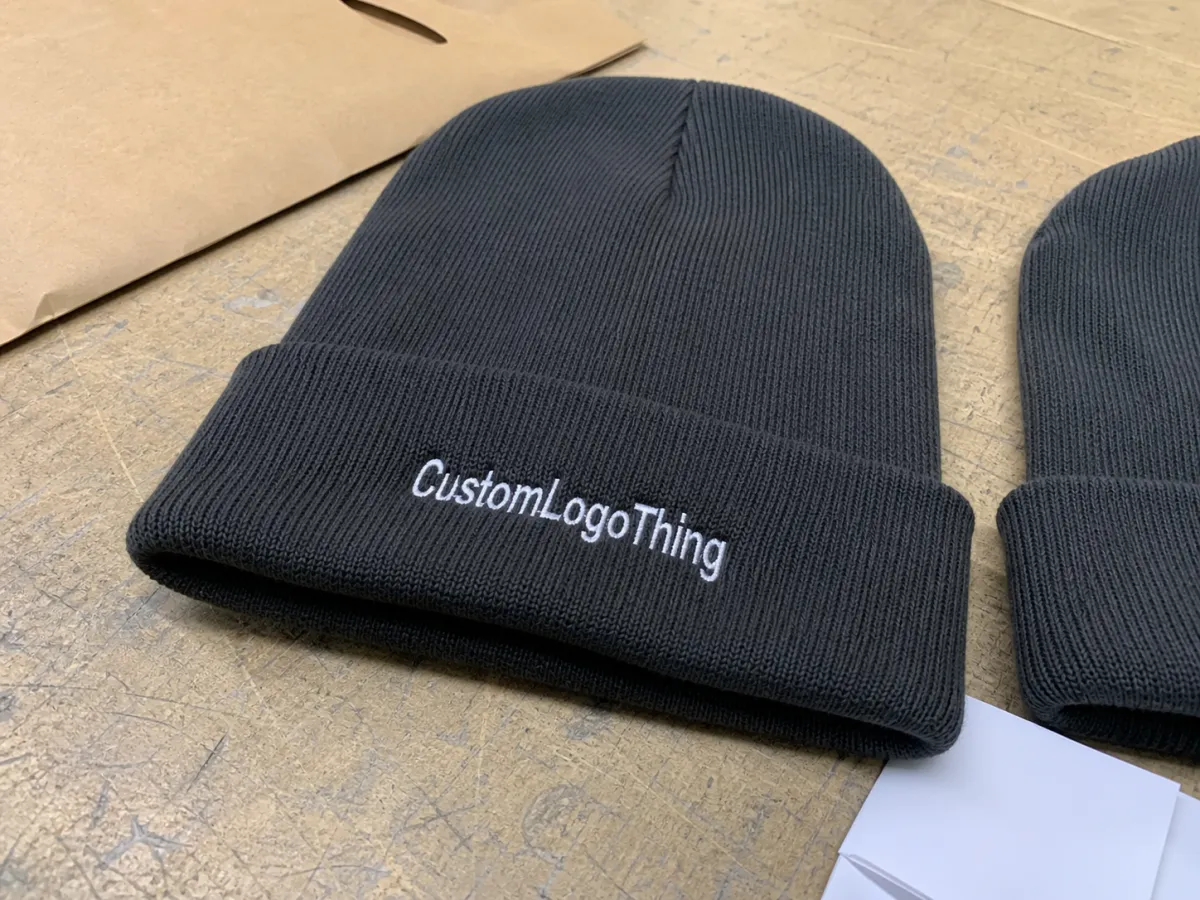
Embroidery is usually the safest option for staff wear because it is durable, familiar, and clean on a cuff. It works best when the artwork has enough line weight and does not rely on tiny type. Woven patches suit logos with small details, multiple colors, or a more retail-oriented finish. Woven labels are good for understated branding, especially on side cuff placements. Print and heat transfer can work for simple artwork or short runs, but the supplier should confirm wash resistance, adhesion, and how the transfer behaves as the knit stretches.
Placement matters as much as method. Front center is visible and expected. Side cuff can feel more refined. Back cuff can work for retail or giveaways where the brand wants restraint. “Logo on cuff” is not a production instruction. Give exact placement, orientation, logo width, and whether the beanie is approved to be worn cuffed only.
Artwork format also affects speed. Vector files are best for embroidery, patches, and labels. If the only logo available is a small PNG from a menu or social profile, expect cleanup time, redraw charges, or a longer proof cycle. For embroidery, ask whether digitizing is included, whether the supplier will provide a stitch count estimate, and whether the final sew-out will be approved before production.
Fit needs the same level of attention. One size usually has to cover a wide staff mix. A hat that feels comfortable for one wearer may feel tight across the forehead for another; a loose hat may shift enough to hide the logo. Finished circumference, stretch recovery, cuff depth, and total height help predict how the beanie will sit after real use.
Do not ignore finishing items. Interior care tags, brand labels, hangtags, size stickers, folded presentation, and individual bags can change the perceived quality. If the order will be sold, gifted, or displayed, the pack-out may matter almost as much as the knit. If the beanies are for back-of-house uniform use, simpler packaging may be smarter. Paying for retail presentation that gets opened and discarded in a manager’s office is not value.
A clean approval path should include artwork approval, placement approval, sample or sew-out approval when needed, and packaging approval. If those steps are absent from the quote, the buyer still does not have a final spec.
Cuffed Beanies Pricing, MOQ, and Unit Cost Drivers
The cuffed beanies supplier quote checklist for restaurant groups is most useful when it strips hidden assumptions out of the price. Ask for separate lines for the blank beanie, decoration setup, sampling, freight, duties, rush handling, and packaging. A single blended price can be convenient, but it makes cost control harder.
MOQ may be set by style, color, yarn, or decoration type. A supplier may accept a low quantity on a stock blank but require a higher run for custom knitting, private labeling, or woven patches. Embroidery minimums may be lower than custom patch minimums. Custom dyed yarn may require more units than a restaurant group actually needs for one season.
Restaurant groups often reduce unit cost by combining location needs into one production run, then splitting shipment after inspection. That can work well if the supplier can pack by location and label cartons accurately. If not, the savings disappear when the operations team has to re-sort inventory manually.
Unit cost typically drops as quantity rises, but only when the spec remains stable. Changing yarn, adjusting cuff height, moving the logo, adding a hangtag, or shifting from one ship-to address to 18 addresses can reset the economics. The cheapest unit price is not always the cheapest landed cost.
| Decoration method | Best use | Typical setup | Typical per-unit add-on | Notes |
|---|---|---|---|---|
| Embroidery | Staff uniforms, durable branding | $45-$125 | $0.60-$1.50 | Sturdy finish; best on cuff or front panel with artwork simplified for stitching |
| Woven patch | Premium retail, guest-facing programs | $60-$150 | $0.80-$2.25 | Good for fine detail and multi-color logos; confirm patch size and attachment method |
| Woven label | Subtle branding, understated uniforms | $40-$100 | $0.30-$0.90 | Low-profile look; common on side cuff or folded edge |
| Print or heat transfer | Simple artwork, smaller runs | $35-$85 | $0.20-$0.60 | Confirm wash life, stretch behavior, and adhesion before approval |
These ranges are directional, not universal. Freight, labor market, seasonality, rush timing, artwork complexity, and order size can move them. A supplier quoting far outside the range may still be right, but the buyer should ask why.
Request landed cost by location if the order ships to several restaurants. Split freight, residential surcharges, inside delivery, special carton handling, duties, and brokerage charges can distort the final number. A quote that saves $0.40 per beanie but adds hundreds in distribution fees is not a bargain.
Also ask how sampling is billed. Some suppliers credit sample fees toward the bulk order after approval. Others treat samples, digitizing, and freight as separate costs. Neither approach is automatically wrong. The issue is whether the cost is visible before approval.
Production Workflow, Proofs, and Lead Time Expectations
A reliable quote maps the workflow from request to delivery. At minimum, expect mockup, proof, sample or sew-out approval if needed, bulk production, inspection, packing, and shipment. If a supplier cannot describe those steps clearly, the quoted lead time is probably softer than it looks.
Lead time moves with yarn availability, decoration complexity, quantity, and packaging. Stock yarn with simple cuff embroidery can often move faster than a custom knit pattern with retail hangtags and individual bags. A clean run after proof approval may take 10-15 business days in many standard programs. More complex orders can run 15-25 business days or longer during peak cold-weather seasons.
The hidden delay is often approval, not production. Restaurant groups may need signoff from marketing, operations, procurement, ownership, and sometimes individual location leaders. A proof that sits in an inbox for four days can erase the advantage of a fast supplier.
Build a buffer if the beanies support a patio opening, holiday retail set, staff uniform change, or new restaurant launch. A hat that arrives two days late may still be perfectly made. Operationally, it has failed the event.
Ask how the supplier stores approved specs. Reorder success depends on records: yarn, color, gauge, cuff depth, logo file, digitized art, patch dimensions, placement notes, packaging, carton counts, and ship-to instructions. Without those records, each reorder becomes a reconstruction project.
If packaging or distribution is included, ask whether cartons are selected for the shipment method and handled according to sensible transit practices. For higher-value retail pack-outs, it is reasonable to ask about carton strength, moisture exposure, and whether packing assumptions align with guidance from organizations such as ISTA. If paper hangtags, wraps, or inserts are part of the brief, certified sources such as FSC stock may be relevant.
The more clearly the supplier explains the workflow, the easier the schedule is to trust.
Supplier Quality Checks for Multi-Location Orders
A Quote for Restaurant Groups should double as a quality-control map. Good suppliers explain measurement tolerance, shade review, logo placement, stitch or patch inspection, folding, carton labeling, and final count verification. They also say what happens if something misses the approved spec.
Quality is not only appearance. It is consistency across stores, boxes, and reorders. A good-looking beanie that arrives in the wrong allocation creates work for managers who already have labor, inventory, and service pressures competing for attention.
For multi-location orders, ask whether the supplier can carton-pack by location. Each carton should show location name or number, quantity, style, color, and any internal purchase order reference. If there are staggered delivery dates, those should be documented before production. Mixed cartons may save a few minutes in packing and cost hours during receiving.
Inspection standards should be practical. Buyers do not need a laboratory report for every basic uniform beanie, but they do need sensible checks: correct yarn and color, consistent cuff depth, logo centered within tolerance, clean embroidery backing, secure patch attachment, no obvious snags, and accurate count. For retail programs, add presentation checks: fold consistency, hangtag placement, barcode or sticker accuracy, and bag clarity.
Ask how corrections are handled if the sample or first run misses the spec. A strong answer includes an approval trail, remake or repair options, and a realistic timeline. A weak answer avoids responsibility or treats the approved proof as if it never existed.
Reorder discipline matters too. The best programs keep the same spec, art files, approval notes, and packaging plan attached to the account. That record prevents small shifts from creeping in: a logo moving half an inch, a cuff growing taller, a charcoal yarn turning warmer, a patch edge changing finish. Tiny changes become visible when stores compare product.
How to Compare Competing Supplier Quotes
Use the same spec sheet for every vendor. Basic, yes. Also the only fair comparison.
If one supplier prices a heavier knit, a larger logo, retail packaging, and split shipment while another prices a light blank beanie to one warehouse, the quote totals are not competing. They are describing different jobs.
Ask every supplier to list assumptions in writing: yarn type, knit gauge, cuff height, decoration method, logo size, packaging format, freight terms, payment terms, proof process, and approval deadlines. That request usually exposes which quote is production-ready and which one is just a placeholder.
A side-by-side breakdown beats a single grand total. Look for separate lines for setup fees, digitizing, sampling, unit price, packaging, freight, duties, split-shipment fees, and rush charges. Then compare the operational details. Which supplier responded with fewer gaps? Which one understood the artwork without multiple corrections? Which one gave a credible schedule? Which one can support reorders without rebuilding the spec?
Small price differences can be misleading. A supplier that costs $0.25 more per unit but packs by location, stores the approved production record, and gives clearer proofing may be the better value. The opposite can also be true; sometimes a lower bid is lower because the spec is simple and the supplier runs that product efficiently. The point is not to distrust low prices. The point is to know what they include.
The lowest bid becomes risky when assumptions are fuzzy. A quote that protects approvals, keeps decoration consistent, and lands on time usually serves a restaurant group better than a cheaper number that creates cleanup work later.
What to Send First for a Fast, Accurate Quote
Suppliers quote faster when the first request contains the real order conditions. Send total quantity, quantity by location, target in-hand date, logo file, preferred decoration, ship-to addresses, and intended use. Those details shape the production plan immediately.
Add color standards, packaging preferences, and whether the beanies are for staff uniform use, retail sale, patio giveaways, or a promotional campaign. A supplier cannot price the right pack-out without knowing whether each piece needs a hangtag, a polybag, a care label, or only bulk carton packing.
- Total quantity and quantity by location
- Logo file in vector format if available
- Preferred decoration, logo size, and exact placement
- Ship-to addresses and any staggered delivery dates
- Packaging needs, carton labels, and retail presentation details
- Target in-hand date for each location or the master shipment
If the logo has brand standards, send them. Pantone references, approved embroidery thread colors, minimum logo size, and clear-space rules all reduce proof revisions. If the restaurant group uses internal location codes or purchase order labels, include those early as well. They affect cartons and packing lists, not just paperwork.
For several restaurants, ask for one master spec and one reorder plan before approval. That keeps the program consistent when a location adds staff, opens later than planned, or needs replenishment after the first run. Reorders should not require a new debate about yarn, logo placement, or packaging.
Before approving a quote, run through the cuffed beanies supplier quote checklist for restaurant groups one final time: yarn, knit, cuff, decoration, artwork proof, sample path, packaging, freight, duties, lead time, inspection, location pack-out, and reorder terms. If every supplier answers those points clearly, the final choice becomes easier to defend.
The better quote is not always the longest. It is the one that makes the fewest assumptions. In a multi-location restaurant program, that difference shows up later in fewer proof revisions, fewer receiving problems, and fewer awkward explanations about why the second batch does not quite match the first.
What should a restaurant group include in a cuffed beanies supplier quote request?
Include total quantity, quantities by location, target delivery date, logo file, preferred decoration, logo placement, packaging expectations, and ship-to addresses. Add color requirements and any carton-labeling needs so the quote reflects landed cost, not just the base hat price.
How does MOQ affect cuffed beanies pricing for multi-unit restaurant orders?
MOQ may apply by style, yarn, color, or decoration type. Higher quantities usually lower unit cost, but only if the product spec and artwork remain consistent across the order. Combining locations into one production run can help, provided the supplier can pack and label by location.
Which decoration method is best for cuffed beanies in restaurant uniforms?
Embroidery is often the strongest choice for staff wear because it is durable and reads cleanly on the cuff. Woven patches work well for fine logo detail or a more retail finish, while woven labels suit subtle branding.
What lead time should buyers expect after approving a cuffed beanies sample?
Simple stock-yarn programs may run about 10-15 business days after proof approval, while custom yarns, patches, retail packaging, or larger multi-location orders can take 15-25 business days or longer. Confirm proofing, production, inspection, packing, transit, and delivery dates in writing.
How can restaurant groups compare cuffed beanies supplier quotes fairly?
Use one spec sheet so every supplier prices the same yarn, knit, cuff height, decoration, packaging, and shipping plan. Ask for written assumptions and separate lines for setup, sampling, unit cost, freight, duties, split shipments, and rush charges.
What hidden costs should buyers watch for in a cuffed beanies quote?
Watch for digitizing, setup fees, sample charges, freight, duties, split-shipment fees, rush fees, special packaging, carton labeling, and location-based fulfillment. Also confirm whether the quoted unit price includes decoration or only the blank beanie.