When Gloss Placement Changes the Bag Budget
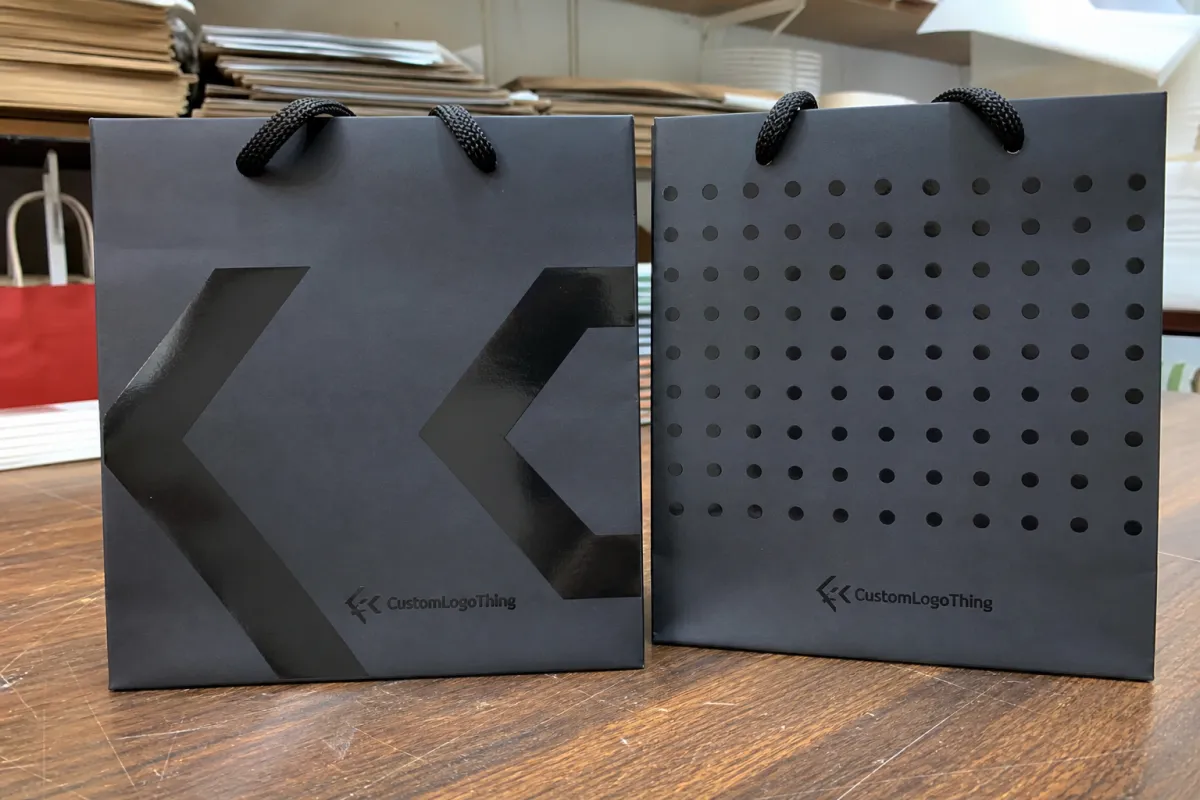
Two matte Paper Shopping Bags can look almost identical on a spec sheet. Same 210gsm white art paper. Same cotton rope handles. Same 250 x 100 x 300 mm finished size. Then one bag adds a glossy logo panel, and the quote changes.
That difference is the reason buyers search for Paper Shopping Bags spot uv price in the first place. They are not only buying a carrier bag. They are deciding how much polish, shelf presence, and reuse value they want each customer handoff to carry.
Spot UV is a clear gloss coating applied only to selected areas after printing and lamination. On a matte surface, it catches light sharply. A logo, border, monogram, product name, or repeat mark can suddenly look raised even when the surface is technically flat. The effect depends on contrast. Put gloss over a quiet matte field and it reads as intentional. Spread gloss across the whole front panel and much of the premium tension disappears.
The cost difference is not decorative fluff. Spot UV usually adds a separate finishing pass, its own artwork layer, tighter registration control, curing time, and more careful handling after print. Dark matte bags make the challenge sharper because fingerprints, dust, scuffs, and slight alignment shifts show faster than they do on pale paper.
Spot UV makes the most sense for boutique apparel, cosmetics, jewelry, premium food gifting, product launches, corporate merchandise, and event kits where the bag may be photographed or carried beyond the point of sale. A plain printed kraft bag may be smarter for market goods, low-margin pickup orders, or short-use packaging. The better choice depends on the role of the bag: transport only, or transport plus brand signal.
Practical buying point: the lowest unit price usually comes from a plain printed kraft or white paper bag. Spot UV earns its place when the bag needs to feel more deliberate in the customer’s hand.
Paper, Lamination, and Spot UV Details Buyers Should Compare
A paper shopping bag starts as a printed sheet, not as a bag. The sheet is printed, finished, cut, creased, folded, glued, reinforced, and fitted with handles. The spot UV decision must be planned while the artwork is still flat, because the glossy layer needs to land correctly before converting begins.
Material choice sets the base. White art paper gives sharper color and a cleaner retail look, which is why it appears so often in beauty, fashion, gift, and promotional packaging. Kraft paper has a warmer, more natural tone, but the brown base changes ink color. Coated paper improves smoothness and print coverage. For many retail bags, common paper weights sit around 180gsm to 250gsm, though the right grade depends on bag size, product weight, handle style, and bottom reinforcement.
Lamination matters because spot UV needs a background. Matte lamination is the standard pairing: flat light absorption behind a high-gloss highlight. Soft-touch lamination can feel more luxurious, but dark soft-touch films should be tested for scuffing before a large order. Gloss UV over gloss lamination is usually harder to justify because the contrast becomes weak under shop lighting.
Finish stacking can get expensive quickly. CMYK print, Pantone spot colors, metallic ink, foil stamping, embossing, debossing, matte lamination, soft-touch film, and spot UV can all appear on one bag design. Each extra process adds setup, tolerance, inspection, and sometimes sampling. A foil logo with a quiet UV pattern can look excellent. A tiny foil mark surrounded by hairline UV detail can become a registration problem waiting to happen.
Fine UV lines deserve suspicion. So does tiny gloss type. Thin varnish strokes may break up. Small text can fill in. Large solid gloss blocks can show dust, orange peel texture, roller marks, or uneven shine if the surface is not controlled. Strong spot UV design usually uses clean vector shapes, adequate line width, and enough distance from folds and cut edges.
Paper Shopping Bags Spot UV Price: What Drives the Quote
The main variables behind Paper Shopping Bags spot uv price are bag size, paper weight, print coverage, color count, lamination type, gloss coverage area, handle material, reinforcement, order quantity, sampling, packing method, and shipping destination. No single factor explains the quote. A small bag with ribbon handles, foil stamping, and precise logo-only UV may cost more than a larger bag with simple rope handles and one-color print.
Spot UV is not priced by shine alone. Production may require a separate screen, plate, or digital finishing setup depending on the method used. The supplier also needs the varnish layer prepared correctly, registered against the printed sheet, cured, inspected, and protected during stacking. If the UV sits over dark matte lamination, small defects become easier to see.
Quantity changes the unit price fast. A short run carries more setup cost per bag because print setup, lamination, varnish setup, and converting still take machine time. Larger orders spread those fixed costs across more units, so practical price breaks often appear around 1,000, 3,000, 5,000, or 10,000 pieces. The exact minimum depends on construction, equipment, finish mix, and production schedule.
Price ranges vary by market and freight route, but buyers should expect a finished custom paper bag with lamination and spot UV to sit above a basic printed paper bag. Small runs may show a steep per-unit jump because setup dominates the math. At higher quantities, the UV premium usually becomes easier to absorb, especially when the gloss area is controlled rather than spread across a large decorative field.
| Bag Option | Typical Use | Cost Direction | Buyer Notes |
|---|---|---|---|
| Plain printed kraft bag | Natural retail, takeaway, simple merchandise | Lowest | Good for earthy branding; tight color matching is limited by the brown paper base. |
| Matte laminated white art paper bag | Fashion, beauty, gift retail | Moderate | Cleaner print surface and better scuff protection than unlaminated paper. |
| Matte laminated bag with logo-only spot UV | Premium logo presentation | Moderate to higher | Often the most balanced upgrade because the gloss area stays controlled. |
| Full pattern spot UV bag | Luxury retail, launch kits, photo-ready packaging | Higher | More varnish coverage and inspection time; artwork must be clean and repeatable. |
| Spot UV with foil stamping or embossing | High-end gifting, jewelry, VIP events | Highest | Each finish needs its own setup, tolerance review, and proofing discipline. |
For a useful comparison, ask for several versions: plain printed paper, matte laminated paper, matte laminated Paper with Logo-only spot UV, and a larger UV pattern if that is under consideration. If the supplier can separate material, finishing, sampling, and freight costs, the decision becomes clearer. You can see whether the quote is moving because of paper weight, handle changes, gloss area, or shipping volume.
Custom Logo Things treats spot UV pricing as a construction question first. The bag still needs to carry the product, stack in cartons, resist scuffing, and look consistent across the run. A finish that customers barely notice should not make the bag harder to produce or more fragile in use.
MOQ, Size, Handle, and Load Specifications to Confirm
A useful quote starts with real specifications: width, height, gusset depth, finished orientation, paper type, paper weight, print method, lamination, spot UV location, handle style, quantity, packing preference, and delivery address. “Medium shopping bag with logo” leaves too much guesswork.
Size changes structure. A narrow boutique bag needs a different gusset and handle balance than a wide apparel bag. A tall bottle bag or candle bag may need heavier paper, stronger bottom board, and handle anchoring that resists concentrated weight. Dimensions alone are not enough. If the bag must hold a 1.2 kg jar set, boxed candles, wine bottles, or multiple cosmetics cartons, say so before pricing.
Handles affect cost and customer feel. Cotton rope feels soft and premium. PP rope is durable and widely used. Ribbon creates a gift-bag look, though it can wrinkle if packed carelessly. Twisted paper handles support a more natural positioning when the rest of the construction matches that claim. Die-cut handles can be economical, but the top fold may need reinforcement so the hand hole does not tear.
MOQ should be discussed early. Custom Printed Paper Bags with spot UV usually require a production minimum because every stage has setup work. Very small runs may be possible in limited formats, but the unit cost can look uncomfortable. Quantity breaks are more useful than a single number because they show whether a modest increase in volume creates a meaningful price drop.
Carton and logistics details also affect landed cost. Rope-handle shopping bags are bulky compared with flat mailers. Carton dimensions, carton weight, palletization, air freight volume, sea freight timing, customs, and local delivery can shift the real price. A bag that looks inexpensive per piece can lose its advantage if it ships with too much trapped air.
Standards-minded teams may also have documentation requirements. Distribution testing can reference organizations such as ISTA when packed goods will move through parcel or freight networks. Paper sourcing may involve FSC certification when chain-of-custody documentation is required. These details should appear in the quote request, not after production starts.
Artwork Setup for Clean Gloss Registration
Spot UV needs more than a standard print file. The designer should supply a separate varnish layer showing exactly where the gloss should appear, usually as a solid vector shape in a clearly named spot color. The cleanest production files label each layer plainly: print, dieline, fold lines, handle holes, foil, embossing, and UV.
Vector logo files are preferred. Fonts should be outlined. Images should be embedded or linked at suitable resolution. CMYK artwork should be prepared for print, with Pantone references supplied if brand color control matters. Bleed and safe margins need to match the dieline because the sheet will be printed flat, finished, cut, folded, glued, handled, and packed before it becomes a finished bag.
Registration is the way one production layer lands on another. The gloss layer must sit over the printed artwork within normal tolerance. A UV outline that must touch the exact edge of a tiny letter is risky. Small serif type, thin highlight marks, varnish shapes crossing fold lines, and gloss details near handle holes should be checked before proof approval.
Good spot UV design tends to be bold. Logos, initials, icons, borders, tone-on-tone patterns, selected product words, or controlled repeats usually perform better than a fully coated front panel. If everything is glossy, nothing feels selected. The strongest designs often leave more matte space than gloss.
Proofing should match the risk. A digital proof confirms layout, size, placement, handle location, and UV coverage. A physical pre-production sample is useful when the decision depends on paper feel, lamination softness, gloss contrast, color match, handle color, or premium presentation. If the finish stack includes foil stamping and spot UV together, sampling is often worth the delay.
Artwork quality can affect both price and lead time. Low-resolution images, screenshots, flattened PDFs, missing dielines, and unoutlined fonts create prepress work. A clean file helps the supplier quote the actual job instead of protecting the estimate against unknown artwork problems.
Production Steps and Lead Time from Proof to Delivery
A typical production sequence starts with specification review, artwork check, dieline confirmation, quote approval, digital proof, optional sample, bulk paper procurement, printing, lamination, spot UV application, curing, bag converting, handle attachment, quality inspection, packing, and shipment. Each stage protects the next one. If a detail is skipped early, the problem usually appears late, when it is more expensive to fix.
Several factors add time: sample approval, color matching, complex UV registration, foil or embossing combinations, custom handle sourcing, high order quantity, peak production schedules, and freight routing. A matte laminated bag with logo-only UV is usually easier to schedule than a dark soft-touch bag with foil, embossing, and a large repeat UV pattern.
Production lead time is not the same as delivered timeline. Factory completion is only one part of the schedule. Transit, customs clearance, local delivery, warehouse receiving, and internal distribution can add days or weeks depending on destination and shipping method. Air freight may help urgent launches, but bulky paper bags are often charged by dimensional weight, not only actual weight.
If the bags are tied to a store opening, trade show, product launch, or holiday promotion, work backward from the in-hands date. Leave room for proof revisions and sample review. Approving artwork at the last possible moment puts pressure on every process after it, and spot UV still needs curing, inspection, and careful packing even on a rush order.
Rush production may be possible if paper, handles, and machine capacity are available. Sometimes it is not. Forcing speed too hard increases defect risk, especially with dark lamination, heavy gloss coverage, or tight registration. The cleaner approach is to confirm milestones in writing: proof date, sample date if applicable, bulk start, estimated completion, ship date, and expected arrival.
Quality Checks That Protect the Finished Bag
Quality control for spot UV paper bags is more than checking whether the logo shines. Inspection should cover gloss coverage, registration alignment, surface cleanliness, varnish consistency, scuff resistance, lamination adhesion, paper cracking on folds, handle strength, bottom reinforcement, finished dimensions, and carton packing.
Small finish defects can look large on a premium bag. Dust under lamination may appear as a raised bump. Poor varnish control can create uneven gloss. UV applied too heavily near folds may crack. Weak handle anchoring can fail even when the print looks beautiful. From a buyer’s point of view, the bag has to survive the customer’s hand, not just the approval photo.
Incoming material checks reduce later trouble. Paper thickness, board stiffness, surface smoothness, handle color, rope diameter, ribbon width, reinforcement board, and adhesive compatibility all influence performance. A 250gsm sheet may feel strong, but if the top fold reinforcement is weak or a rope knot is poorly set, the carrying experience suffers.
In-process inspection usually includes checking first-off samples before the full run, monitoring color consistency, comparing UV placement against the approved proof, pull-testing handles, verifying dimensions, and reviewing packed cartons for crushing risk. For heavier retail goods, a simple loaded carry test can reveal failures that a visual inspection misses.
Storage conditions matter too. Matte lamination, soft-touch film, and UV coatings can react badly to rough packing, humidity, heat, or pressure if the cartons are stacked poorly. Dark bags need extra care because rub marks show quickly. If bags will sit in a warehouse before distribution, carton strength and packing orientation deserve more attention than many buyers give them.
The quote conversation should include performance, not decoration alone. Alcohol bottles, cosmetics with sharp box corners, humid-storage products, event kits, and gift sets transported multiple times all create different stress points. Share those details before production planning, because fixing a weak bag after delivery is usually more expensive than specifying it correctly at the start.
What to Confirm Before Requesting a Custom Bag Quote
Start with a short checklist. Choose the bag size or provide product dimensions. Estimate the loaded weight. Select the preferred paper color and finish. Decide whether the UV should cover only the logo or a larger pattern. Confirm target quantity and delivery location.
Artwork helps more than rough descriptions. Send a vector logo, brand colors, reference photos, existing bag samples if available, and any packaging guidelines. If sustainability requirements matter, specify whether you need FSC paper, paper handles, reduced plastic lamination, recyclable positioning, or supporting documentation. Some environmental claims depend on the full construction, not only the paper substrate.
Ask for quantity breaks at practical levels: minimum order, mid-volume option, and larger run. Purchasing teams can then compare unit price against storage space, cash flow, and reorder timing. A lower unit cost is not useful if half the inventory sits too long or the artwork changes before the next promotion.
Your request should include delivery country and postal code, desired in-hands date, physical sample requirements, product weight, handle preference, finish preference, and compliance expectations. Photos are useful when matching an existing bag. Even a quick picture can clarify handle length, gusset proportion, gloss placement, and overall finish direction.
Once those details are ready, Custom Logo Things can review the construction, flag risky finish combinations, and prepare a quote that reflects the real Paper Shopping Bags spot uv price rather than a vague decorative estimate. That is the practical path to a bag that prices correctly, produces cleanly, and feels right after the customer leaves the counter.
FAQ
What affects paper shopping bags with spot UV pricing the most?
The biggest factors are bag size, paper weight, order quantity, print coverage, lamination, spot UV area, handle type, sampling needs, and shipping destination. Spot UV adds cost because it requires a separate artwork layer, setup, registration control, varnish application, curing, and extra inspection. Larger quantities usually reduce unit cost because setup expenses are spread across more bags.
Is spot UV cheaper than foil stamping on paper shopping bags?
Spot UV is often more economical than foil stamping when the design needs a clear glossy effect rather than a metallic finish, but the comparison depends on coverage area, artwork complexity, and quantity. Foil stamping has die and setup requirements. Spot UV depends heavily on varnish area, registration, and lamination compatibility. Some premium designs use both finishes, but that should be priced as a deliberate upgrade.
What MOQ should I expect for custom spot UV paper bags?
MOQ depends on bag size, material, print method, finish combination, and production schedule. Because spot UV bags require printing, lamination, varnish setup, and converting, very small runs are usually less cost-efficient. Ask for quantity breaks so you can compare the minimum order against a larger run with a lower unit cost.
How should I prepare artwork for a spot UV shopping bag quote?
Send vector artwork when possible, with fonts outlined, colors identified, and a separate spot UV layer showing exactly where the gloss should be applied. Include the dieline, bleed, safe margins, handle placement, and any foil, embossing, or print layers if those finishes are also requested. Avoid screenshots or flattened low-resolution files because cleanup can add time and affect quote accuracy.
How long does production take for paper shopping bags with spot UV?
Timing depends on proof approval, sampling, material availability, order quantity, finish complexity, and shipping method. The process usually includes artwork review, proofing, optional sample approval, printing, lamination, spot UV application, converting, handle attachment, inspection, packing, and delivery. If the bags are tied to a launch date, provide the required arrival date early so production and freight can be planned with a realistic buffer.

