Buyer Fit Snapshot
| Best fit | Design Custom Boxes projects where brand print, material claims, artwork control, MOQ, and repeat-order consistency need to be specified before quoting. |
|---|---|
| Quote inputs | Share finished size, material target, print colors, finish, packing count, annual reorder estimate, ship-to region, and any compliance wording. |
| Proofing check | Approve dieline scale, logo placement, barcode or warning zones, color tolerance, closure strength, and carton packing before bulk production. |
| Main risk | Vague material claims, crowded artwork, missing packing details, or unclear freight terms can make a low unit price expensive after revisions. |
Fast answer: Design Custom Boxes: Structure, Print Proof, Packing, and Reorder Risk should be specified like a repeatable production item. The safest quote records material, print method, finish, artwork proof, packing count, and reorder notes in one written spec.
Production checks before approval
Compare the actual filled-product size with the drawing, then confirm tolerance on folds, seals, hang holes, label areas, and retail display edges. Reserve space for logos, QR codes, warning copy, and material claims before decorative graphics fill the panel.
Quote comparison points
Review material grade, print process, finish, sampling route, tooling charges, carton quantity, and freight assumptions side by side. A quote is only useful when the supplier can repeat the same color, closure quality, and packing count on the next order.
How to Design Custom Boxes: Practical Packaging Tips
Learning how to design custom boxes is never just about picking a color palette and sending a file to print. I wish it were that tidy. The box has to survive a warehouse floor, a courier network, and a customer opening it with one hand while checking a phone with the other. I still think about a folding carton job in Chicago where the mockup looked polished on screen, yet the box split at the glue station because the board caliper was 0.45 mm thicker than the spec sheet allowed and the tuck flap was 1.5 mm too short. A pretty concept became a pallet of rejects in less than an hour, which is the sort of lesson nobody puts in the sales brochure. That kind of failure can cost a brand $1,200 in scrap on a 10,000-unit run before freight is even counted.
If you are starting from zero, our Custom Packaging Products page is a helpful place to compare mailers, folding cartons, and rigid setups before you settle on a structure. How to design custom boxes becomes much clearer once you treat the carton as a system rather than a canvas. Structure, size, material, print, finishing, and handling all need to agree. That is the core of strong packaging design, whether the goal is Custom Printed Boxes for ecommerce or premium retail packaging for a shelf display. In practice, that means thinking like a buyer in Austin, a packer in Toronto, and a freight clerk in Newark at the same time, which is exactly why a box that looks elegant in a mood board can still fail at 6:30 a.m. on a loading dock.
How to Design Custom Boxes: What It Really Means
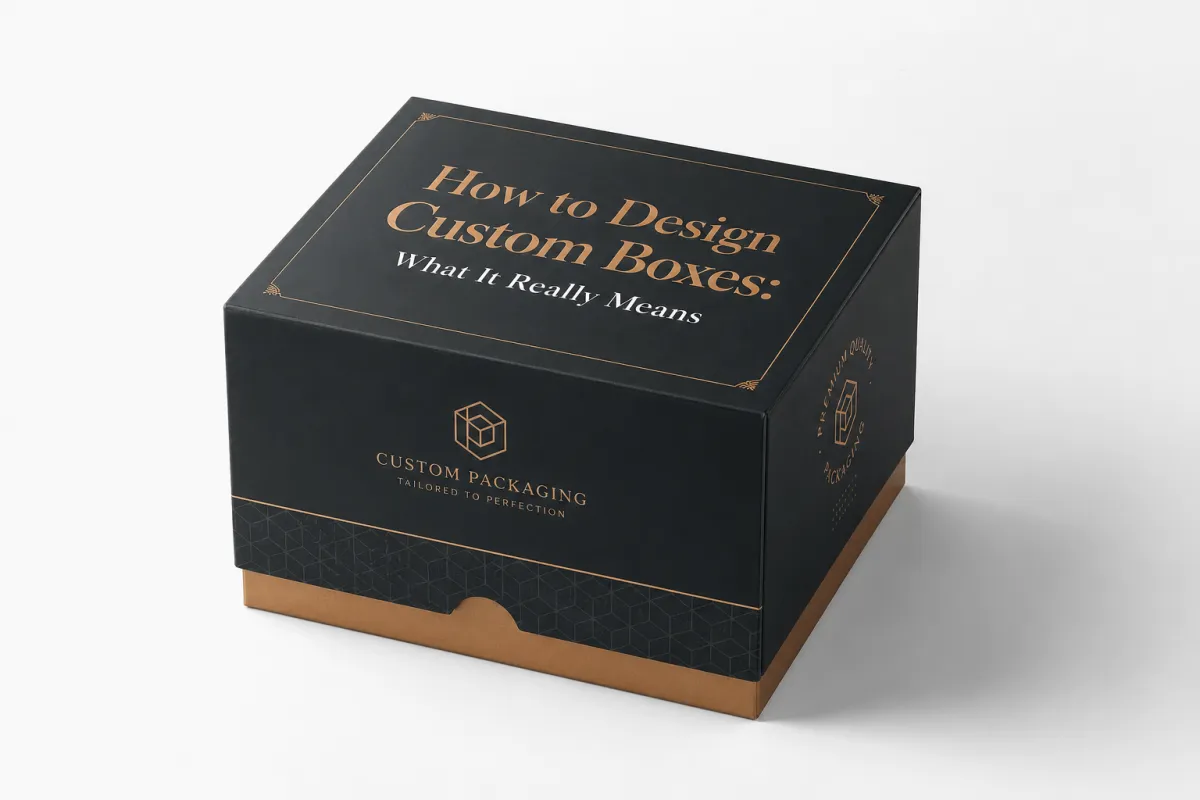
People usually ask me how to design custom boxes because they want the packaging to look good. Fair enough. A box that lands on a shelf or at a front door should look intentional, not like it escaped from a warehouse in a panic. Still, appearance is only one layer. A real box design begins with the product: its weight, its fragility, its center of gravity, the way it nests, the way it slides, and the way it behaves when five or six cartons are stacked on top of it in a truck. I have seen a 280 g candle set crush in transit because the insert was sized for the sample product, not the production product, which had grown by 2 mm after a mold change on the wax line in Shenzhen. Two millimeters. That is smaller than a fingernail, and yet it can ruin an entire run of 12,000 units.
That is why Custom Box Design is a balancing act between protection, presentation, and production reality. A box for a 90 g skincare jar may work beautifully in a 350gsm C1S artboard folding carton with a 2 mm crash-lock base. A 2 kg subscription kit may need a corrugated mailer with an E-flute or B-flute profile and a board strength closer to 32 ECT or higher, depending on the ship method and the amount of stacking expected. How to design custom boxes well means accepting that the shape on the dieline, the ink on the sheet, and the finished carton on the packing table all need to match. If they do not, the box will tell on you fast - usually with a ripped corner or a very awkward silence from the fulfillment team in Columbus or Mississauga.
The warehouse matters more than most founders expect. I once saw a luxury tea client in Portland present a matte black rigid box with gold foil on the lid. It looked expensive on a conference table. The problem showed up in fulfillment: the lid fit so tightly that operators needed two hands and a thumb crease to open it fast enough for kitting. The line slowed by 18 percent because the design ignored the person who had to touch it 3,000 times a day. Beauty can be expensive when it fights the work, and I say that with affection for the designers who think every box deserves a dramatic reveal. Sometimes the drama belongs in the product, not in the packing station where labor runs $19 to $24 an hour.
"If the box fights the product, the customer notices in ten seconds, and the warehouse notices in ten minutes."
A plant manager near Columbus, Ohio, said that to me years ago, and it still lands. How to design custom boxes is not a style exercise first. It is a packaging engineering decision with branding attached. Good branded packaging makes the product feel deliberate. Poor packaging makes the product feel costly to ship and awkward to trust. I know which one I would rather explain to a client after the first damaged-box complaint lands in the inbox, especially when the retailer is asking for a 2 percent breakage rate and the actual number is heading toward 7 percent.
What Do You Need Before You Design Custom Boxes?
Before you learn how to design custom boxes in a practical way, gather the basics: product dimensions, unit weight, fragility level, shipping method, target quantity, and the kind of opening experience you want the customer to feel. That short list sounds obvious, but it is the difference between a clean dieline and a week of revisions. You also need to know whether you are building custom printed boxes for ecommerce, a folding carton for retail, or a rigid set for a premium launch. The more clearly you define the use case, the easier it becomes to Choose the Right board, closure, insert, and finish.
It helps to collect one physical sample, a budget range, and any legal or barcode copy before the design starts. That way the structure can be built around the product instead of adjusted after the fact. I have seen teams skip this step and then discover, two rounds later, that the bottle neck, the cap, or the carry insert needs more clearance than the original plan allowed. How to design custom boxes gets much simpler when the inputs are real, not aspirational, and when the box style is chosen before the artwork starts to bloom. Otherwise you are kinda designing in the dark and hoping the cardboard will forgive you.
How Custom Box Design Works from Dieline to Delivery
The production path is more predictable than first-time buyers usually expect. How to design custom boxes starts with a brief, then measurement, then a dieline, then artwork layout, proofing, sampling, printing, converting, finishing, and final assembly. Each step looks simple on paper. Each step can also create a costly error. If the brief misses the barcode placement by 8 mm, the art team may need to reflow an entire panel. If the dieline ignores a 3 mm glue tab, the carton may look perfect in PDF form and still fail on the folder-gluer. I have watched this happen on a folding carton line in Dongguan, and it is always more annoying in person than it sounds in theory.
The dieline is the backbone. In a corrugated plant, it marks cuts, scores, folds, glue tabs, and panel orientation so the converting line can run cleanly. In a folding carton line, board grain, score depth, and print registration need to line up so the carton folds without cracking. How to design custom boxes gets simpler once you understand that the dieline is not decoration. It is the manufacturing map. Bleed, safe zones, score lines, and glue areas are not optional details. They decide whether a box runs at 1,500 units per hour or jams every third stack. I have seen operators stop a line for a glue flap that was technically "fine" on the screen. On the floor in Mexico City or Monterrey, "fine" is a very small word with very large consequences.
Timeline matters as much as structure. A simple tuck-end carton with a single-color CMYK print and no special finish can move from approved artwork to production in about 8 to 12 business days after proof approval, depending on the plant schedule. A rigid presentation box with a magnetic closure, inside print, and a custom insert can take 18 to 25 business days, especially if the insert needs a second tooling pass. If you are learning how to design custom boxes for a launch date, sample rounds and revisions deserve calendar space. That is usually where the delay lives, and it is rarely because someone is "almost done." It is because one tiny dimension still behaves like a stubborn door hinge.
Delays usually come from the same four problems: incomplete copy, missing barcode data, late logo files, and waiting on physical samples. I watched a beverage client in Atlanta lose a full week because the UPC arrived as a JPEG rather than a vector file, which forced a redraw. Another project in a Chicago retail meeting stalled because the buyer wanted the shelf-facing panel widened by 6 mm after seeing the planogram. That sounds tiny until it changes the whole carton body. How to design custom boxes is partly about making those edits before anyone is standing on the production floor with a stopwatch. Production people have a way of staring at an issue in total silence that somehow makes the mistake feel larger.
For teams that want a reference point, a standard proof flow often looks like this:
- Collect the product sample, dimensions, and target quantity.
- Create the dieline and place the artwork.
- Approve a digital proof or flat proof.
- Review a physical sample if the box is structural or premium.
- Release to print, convert, finish, and pack out.
Key Factors That Shape the Box
Product dimensions sit at the center of how to design custom boxes. Measure height, width, and depth with a caliper or a ruler that reads in millimeters, then add clearance for inserts, tissue, bubble wrap, or simple packing tolerance. A difference of 2 or 3 mm may sound small, but on a tighter carton it can decide whether the product drops in neatly or catches at the shoulder. If you are working with glass, ceramics, or anything with a cap and neck, the fit has to protect the item without letting it rattle. I have a mild grudge against rattling boxes, honestly; they make even a good product feel like it is being tossed around by strangers on a bus in London at 8 a.m.
Material choice changes the outcome. Corrugated board is the workhorse for shipping and ecommerce because it handles impact and compression better than thin paperboard. Folding carton stock, such as 300gsm or 350gsm SBS or C1S, works well for lighter retail goods and cosmetics. Rigid board is a different animal: heavier, stiffer, and often wrapped with printed paper for a premium presentation. Specialty substrates, including kraft board, recycled board, and FSC-certified stock, can support a cleaner environmental story when the brand wants that signal on the shelf. If you are deciding how to design custom boxes for both cost and performance, the substrate is often where the smartest tradeoff lives. It is also where people accidentally overspend because "premium" sounds better than "appropriate" when the carton is really only carrying a 120 g serum bottle.
Printing and finishing come next. CMYK gives flexibility for full-color imagery, while PMS spot colors help protect brand consistency across a run of custom printed boxes. Inside printing can create a strong reveal for gift sets, and it only adds a small amount to setup if the artwork is organized correctly. Coatings matter too: aqueous coating, soft-touch lamination, gloss film, matte film, embossing, debossing, foil, and window patches all affect the look, the handling, and the cost. I once negotiated with a supplier in Xiamen who quoted a foil-stamped lid at $0.18 per unit for 5,000 pieces and then moved it to $0.21 per unit when we added soft-touch wrap and a heavier liner. That kind of change can sink a low-margin launch if nobody catches it early. The frustrating part is that the design still looks "small" on a spreadsheet while the budget screams in the background.
Structure matters just as much as graphics. A mailer box opens differently than a tuck-end carton, and a sleeve box tells a different story than a retail tray. Mailers are useful for ecommerce because they ship flat, assemble quickly, and support strong product packaging for direct-to-consumer orders. Tuck-end cartons are common for cosmetics, supplements, and small electronics. Sleeves add a premium feel without a huge material increase. Trays work well for display and bundling, especially in club and grocery settings where the product needs to be visible from more than one angle. How to design custom boxes is the art of matching structure to use case before the artwork gets too far along. Once the art is baked in, changing structure can feel like trying to replace a staircase after the walls are painted.
The simplest way to think about it is to ask four questions:
- Will the box travel by parcel, pallet, or hand carry?
- Does the product need cushioning, inserts, or a locking closure?
- Will the box sit on a shelf, hang on a peg, or land in a shipping carton?
- Does the brand want a practical shipping box or a presentation piece?
That last question matters a lot. Some brands want the box to disappear. Others want the packaging to do half the selling. Neither answer is wrong. The point is to decide early, because how to design custom boxes for a subscription brand is not the same as designing for a luxury gift set or a palletized retail tray. Customer experience, freight cost, and the unpacking ritual all change the final structure. I have seen a brand save $0.14 per unit by making the unboxing simpler, and I have seen another lose money because it insisted on a velvet-lined inner tray for a product that shipped through rough parcel lanes out of Los Angeles and Dallas. Guess which one had to replace damaged units.
How to Design Custom Boxes Step by Step
The first step in how to design custom boxes is to write a product brief that says what the box must protect, where it will be sold, how it will ship, and what feeling the customer should have when they open it. The brief does not need to be long. One page can be enough if it includes exact dimensions, unit weight, quantity, target cost, and the closure type you want. I prefer a short brief over a 40-slide deck because the small details are easier to verify when everyone is looking at the same numbers. And, frankly, no one ever fixed a crooked fold by adding more slides or a more polished title page.
Step two is measurement. Use the actual production sample if you can, not the CAD drawing from six months ago. Measure with calipers if the fit is tight, and add clearance for inserts, tissue, or hand assembly. If you are packaging a jar, measure the widest point, not just the label diameter. If you are shipping a device, include cable bulges, buttons, and any top-heavy weight shifts. How to design custom boxes without a precise measurement step usually ends with a box that looks fine in a mockup and awkward in the real world. I have done enough sample reviews to know that "close enough" is one of packaging's most expensive phrases, right after "we can fix that later."
Step three is structure selection. Choose the box style before you polish the artwork. That order matters. A lid-and-base rigid set creates a different opening moment than a mailer with a dust flap, and a sleeve changes the reveal again. If you are comparing options, our Custom Packaging Products catalog can help you sort out the common formats before you commit to one. I have seen more than one marketing team change the whole package after they held a sample of a tuck-end carton next to a two-piece rigid box and noticed the difference in hand feel immediately. That reaction is real. Packaging is one of the few areas where a five-second touch test can overturn a six-week presentation, especially when the sample arrives from a plant in Jiaxing or Ho Chi Minh City and the real object suddenly feels more concrete than the pitch deck ever did.
Step four is the dieline and artwork layout. Place the logo, product name, legal copy, and barcode with the fold lines in mind. Leave safe zones near scores and cut edges, and keep important text away from the glue flap. Do not assume a designer who works on posters will automatically understand carton behavior. Box artwork needs a packaging mindset. In how to design custom boxes, the panels are not just panels; they are a sequence of visible and hidden surfaces that the customer encounters in a specific order. A box is basically a tiny stage production with stricter measurements and less room for improvisation, and the spotlight is a shipping label or a retail shelf tag.
Step five is proofing. A digital proof catches spelling, color separation, and panel placement, but it will not tell you how the box feels in hand. A physical sample catches the things screens hide: board stiffness, corner crush, coating glare, and the way a closure snaps shut. I visited a co-packer near Atlanta where a perfume carton looked perfect in the PDF, yet the sample showed a faint white line on the fold because the art ran too close to the score. One 2 mm design shift fixed the problem instantly. That sort of fix always feels almost too easy after everyone has spent days discussing it, which is packaging's version of an eye roll and a very expensive sigh.
Step six is production release. Once the sample is approved, keep the files organized, name the artwork version clearly, and send a clean sign-off. Confusion at this point costs time and board. If the supplier is running custom printed boxes with inside print or a special finish, confirm the exact board grade, coating, and trim size before the first sheet goes on press. That final check is a huge part of how to design custom boxes without expensive rework. I have seen a missing version number create more chaos than a bad dieline, which is saying something when the run is 8,000 cartons and the finishing line is booked for Thursday morning.
A simple checklist helps the process stay repeatable:
- Product sample measured in millimeters.
- Box style chosen for shipping or retail.
- Dieline checked for bleed, scores, and glue areas.
- Artwork proofed with barcode and legal copy.
- Physical sample approved before print.
- Final file version locked and shared with production.
That is the rhythm I have used with supplement tubs, candle kits, and electronics sleeves. It is not flashy. It works. How to design custom boxes gets easier every time you reuse a clean process. Repetition is underrated in packaging; people love innovation until a carton fails at the warehouse dock in the rain or a carton pops open on a conveyor at 2:15 p.m. on a Tuesday.
How Much Does It Cost to Design Custom Boxes?
Cost is where a lot of first-time buyers get surprised, because how to design custom boxes can look inexpensive on paper and expensive in production if the spec is not matched to the job. The main drivers are board type, box style, print complexity, finishing, quantity, and whether you need inserts or custom closures. A simple corrugated mailer with one-color print might come in at $0.32 to $0.48 per unit at 10,000 pieces, while a rigid presentation box with foil, embossing, and a wrapped insert can climb past $2.00 per unit depending on size and labor. That spread is not subtle. It is the difference between a practical launch budget and a very awkward finance meeting in Seattle or New York.
Volume changes the math in a major way. Setup fees, tooling, proofing, and make-ready cost the same whether you order 500 or 5,000, so the unit price falls as quantity rises. That is why a small run of 250 boxes often feels expensive: the press setup and finishing time are spread across fewer boxes. I have quoted jobs where the print cost per carton dropped by nearly 40 percent when the order moved from 1,000 to 5,000 units, even though the design stayed the same. If your goal is to learn how to design custom boxes for a launch, ask for pricing at two or three volume points. The difference can be sharp, and the spreadsheet usually looks more dramatic than the marketing pitch. On one cosmetic line, for example, the quote moved from $0.62 at 1,000 pieces to $0.39 at 5,000 pieces after the same dieline was reused without changes.
Here is a practical comparison that I often use with clients balancing branded packaging, durability, and budget:
| Box Type | Typical Use | Approx. Unit Cost at 5,000 | Strength | Brand Impact |
|---|---|---|---|---|
| Corrugated Mailer | Ecommerce, subscription kits, shipping | $0.28-$0.55 | High | Good, especially with clean print |
| Folding Carton | Cosmetics, supplements, small goods | $0.12-$0.35 | Medium | Strong shelf presence |
| Rigid Box | Gift sets, luxury retail, premium launches | $1.20-$3.50 | Very high | Excellent premium feel |
| Mailer with Insert | Fragile products, curated kits | $0.45-$0.95 | High | Balanced protection and presentation |
Where should you spend? I would put money into structure, board quality, and clean branding first. If the box collapses, the foil does not save it. If the print is crooked, embossing only makes the issue louder. A dependable structure with sharp artwork usually beats a flashy box that is hard to pack. That is one reason how to design custom boxes often starts with engineering before finish choices. You can add spot varnish later. You cannot easily rescue a weak carton, especially if the board spec was too light at 250gsm when the product really needed 350gsm C1S or a corrugated insert.
Where can you save? Start with standard shapes, reduce the number of special inks, and avoid unnecessary inserts. If the product is already secure, you may not need a custom foam tray. If the inside face will never be seen, you may not need inside print. The cost savings can be substantial. On one personal care job, moving from a fully printed interior to a plain kraft interior trimmed the quote by 11 percent without hurting the unboxing experience. That kind of decision matters for package branding because it keeps the design focused on the moments the customer actually sees, not the parts that spend most of their life inside a mailer in suburban Ohio.
If sustainability is part of the brief, ask for FSC-certified board or recycled content and confirm the plant can document it properly. The FSC system is one of the clearer ways to support responsible sourcing, and it helps when retail buyers ask questions about materials. For shipping performance, it also helps to understand lab and transit testing references from ISTA, especially if the box will go through parcel networks with repeated drops and vibration. I have seen beautiful boxes fail because nobody tested them against the real handling conditions in Houston, Phoenix, and Newark. That is the kind of avoidable headache that makes me want to hand people a calibration tape and a cup of coffee.
Common Mistakes When You Design Custom Boxes
The biggest mistake in how to design custom boxes is designing for the mockup instead of the shipment. A carton can look elegant in a rendered image and still fail because the product shifts in transit, the tuck flap opens too easily, or the insert catches on the side panel. I once worked with a tea company whose branded packaging looked flawless on the desk, but the loose pouch inside scraped the inner print and left abrasion marks before the box even reached the customer. The fix was simple: a 4 mm tighter insert and a slightly different fold sequence. Simple fixes are never glamorous, which is probably why they get ignored until someone is staring at a damaged pallet in Miami or a returns bay in Philadelphia.
Artwork mistakes are another common trap. Text that crosses a fold line becomes hard to read. A logo too close to the edge may get trimmed. Dark artwork near the glue flap can pick up scuffs during converting. Barcode placement deserves more attention than it usually gets; if the scanner cannot read it in one pass, the warehouse team will not thank you. How to design custom boxes well means treating the dieline as a functional surface, not a flat poster. It also means respecting the people on the line, who can spot a bad panel alignment faster than a designer can say "but it looked fine on my screen." On a 20,000-unit job, one misread barcode can turn a one-hour receiving issue into a half-day delay.
Over-specifying finishes can also hurt you. Foil, spot UV, soft-touch lamination, custom windows, and thick board all sound luxurious. Every added layer raises cost, slows production, and can make assembly more finicky. A client in a retail meeting once asked for five finishes on a midsize carton, and the final quote came back 29 percent above their target. We cut the plan to two finishes, improved the logo placement, and the box still looked premium. That is a cleaner path for how to design custom boxes that stay commercially sensible. My honest opinion: elegance usually survives reduction better than it survives decoration, especially when the production run is 3,000 pieces and the margin is only $0.80 per box.
Another mistake is skipping real-world testing. You want to know how the box behaves in a cold warehouse, on a 3-foot conveyor drop, or under a stacked pallet. The best teams test before they buy 20,000 units. A quick sample run, a day on a packing table, and a simple parcel drop test can tell you more than a week of email feedback. I have watched teams save thousands by catching a paperboard crack at the score line long before production. That is the practical side of how to design custom boxes that people often miss. The box does not care how excited the launch deck looks; it only cares whether it survives the drop.
- Do not place key copy across folds.
- Do not ignore glue flaps and score lines.
- Do not choose a finish before you know the budget.
- Do not approve a sample without packing the real product.
Final Checks Before You Order
Before you place the order, run one last review of the numbers, the structure, and the customer experience. How to design custom boxes becomes far less stressful when you treat the final check like a shop-floor walk-through: product dimensions confirmed, board grade confirmed, print method confirmed, and timeline confirmed. I like to ask whether the box has to survive parcel shipping, retail handling, or both, because a box that only has to sit on a shelf can make different material choices than one that will cross three carrier hubs and two distribution centers. That distinction sounds obvious until it saves you from a return pile of 600 units from a single bad week.
My own habit is to keep a simple packaging spec sheet that includes dimensions, target cost, MOQ, finish, closure type, and turnaround. If I am comparing suppliers, I also ask for a physical sample and a separate freight estimate. That sounds basic, but the details matter. One supplier may quote a cheaper box and then make up the difference in shipping or finishing. Another may offer a slightly higher carton price but save money through faster assembly and less waste on the line. That is why how to design custom boxes should always be evaluated as a total package, not just a per-unit print quote. I have seen a "cheap" box turn into an expensive headache after labor and freight got involved. The invoice, as usual, was the rude one, especially when the freight charge was $340 from Los Angeles and the carton quote itself was only $1,100.
If you want the cleanest path forward, gather your measurements, define the unboxing moment, choose two or three structural options, and request a dieline before artwork gets locked. Then review the sample, make the last corrections, and release production with confidence. That process has held up for me on kraft mailers, glossy folding cartons, and premium rigid sets alike, and it remains the most practical answer I can give to anyone learning how to design custom boxes for a real product launch. It is methodical, a little unglamorous, and extremely good at preventing regret. In manufacturing terms, it is also cheaper than fixing a mistake after 15,000 printed sheets have already left the press.
So the final takeaway is simple: measure the product, choose the structure for the shipping reality, proof the dieline against a physical sample, and do not release artwork until the box passes that real-world test. If the carton is right, everything downstream gets easier. If it is wrong, the finish never quite saves it.
How do I start when learning how to design custom boxes?
Start with the product dimensions, weight, and fragility instead of the artwork. Choose the box style that fits the shipping or retail use case, then build the dieline around it. Collect branding, barcode, and copy requirements before you request a proof so revisions stay simple. I always recommend starting with the object itself, because the box has to obey physics before it obeys aesthetics, whether the order is going to a Toronto storefront or a warehouse in Dallas.
What information do I need before I design custom boxes?
Have the exact product size, target quantity, shipping method, and preferred material ready. Know whether you need inserts, windows, handles, or premium finishes. Share a rough budget and timeline so the design can be matched to what is realistically producible. If you can, send a sample in hand; that one step saves more time than most people expect. A 95 mm jar, a 112 g unit weight, and a 5,000-piece MOQ are far more useful than a vague description like "mid-size cosmetic pack."
How long does the custom box design process usually take?
A simple box can move from dieline to approved proof quickly, while complex structures with finishes or inserts take longer. Sampling and revision rounds are usually what extend the timeline the most. Having final artwork and accurate measurements ready at the start helps keep the schedule tight. I have seen a one-week project stretch into three just because nobody could agree on the insert dimensions, and the plant in Guangzhou was already holding paperboard and waiting for a sign-off.
How much does it cost to design custom boxes for a small run?
Small runs usually cost more per box because setup, proofing, and production prep are spread across fewer units. Simple structures and standard printing keep costs lower than rigid boxes or specialty finishes. The best savings often come from reducing complexity before reducing quality. In plain English: remove the fancy extras before you cut the thing that actually protects the product. On a 500-piece run, a small change like dropping foil can save $150 to $300, which is real money when the launch budget is under $5,000.
What is the biggest mistake people make when they design custom boxes?
They design for the mockup instead of the real-world product and shipping environment. They also underestimate how folds, glue tabs, and coatings affect the final printed result. Testing one physical sample can prevent expensive production problems later. If the sample feels annoying to pack, the full run will probably feel worse. A box that looks perfect in a PDF but takes 22 seconds to assemble is already telling you what the warehouse will think of it.

