Custom Bakery Paper Bags MOQ Guide for Bulk Orders
The MOQ question matters because the lowest printed bag price usually depends on a larger run, not the smallest order available. For bakery buyers, the real cost is also shaped by freight, carton counts, setup work, and how quickly the bags will be used. A quote that looks cheap can become expensive if it forces a second reorder too soon or leaves too much stock in the storeroom.
Bag buying affects margin, storage, and replenishment. A small cafe may value flexibility more than the lowest unit price. A multi-location bakery with steady demand can usually justify a larger run to lower landed cost. The right decision depends on usage, shelf life of the design, and how much inventory the team can comfortably hold.
Before artwork is discussed, lock in four basics: bag size, paper grade, print count, and expected usage window. Those four items drive most MOQ outcomes. If your bakery already buys Custom Packaging Products for cakes, cookies, or gift sets, aligning the bag spec with other packaging runs can simplify replenishment and reduce dead stock.
Practical rule: compare MOQ and landed unit cost every time. If a lower quote requires a second production run within the same season, it may cost more overall.
Custom bakery paper bags MOQ guide: start with the order math
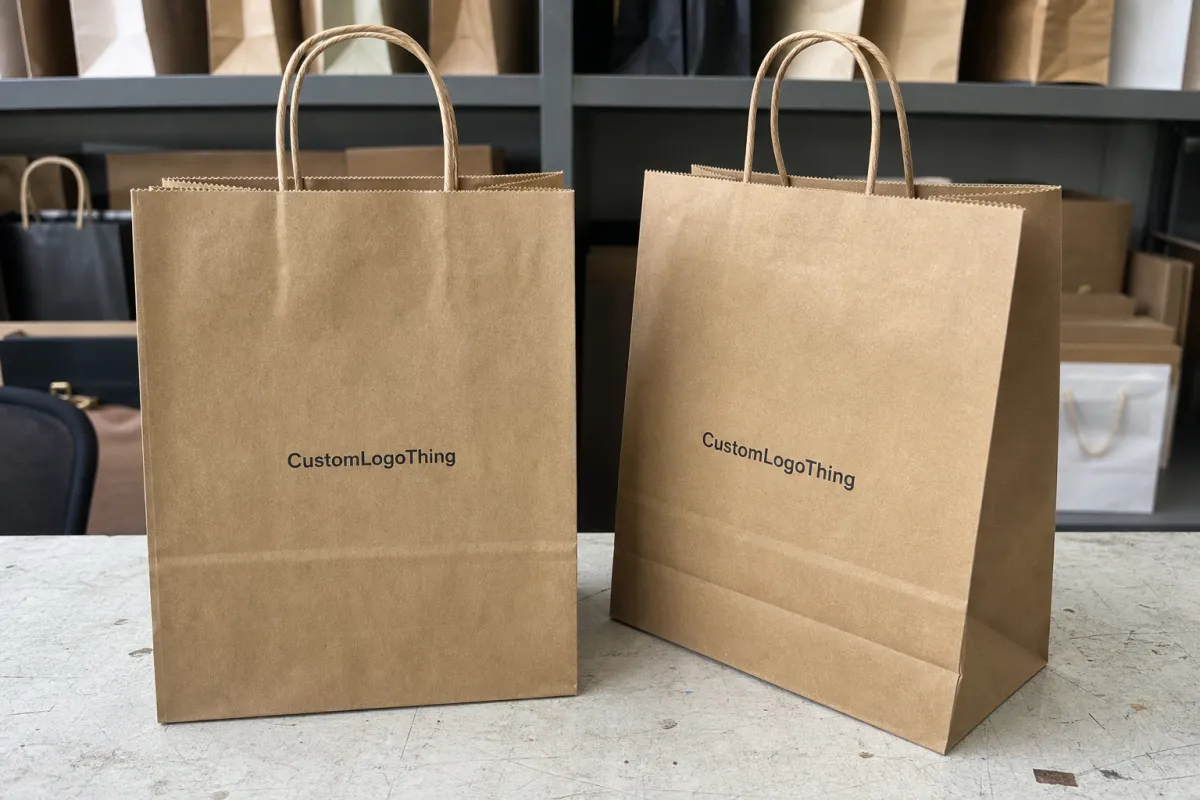
Most buyers start with one question: "What is the MOQ?" That only helps if it matches the exact spec you plan to use. A 1,000-piece flat kraft bag and a 1,000-piece handled retail bag are not comparable. The better question is which MOQ gives the best cost per bag without tying up cash or storage.
MOQ changes because the supplier has fixed setup costs before the first finished bag ships. Dieline checks, prepress, plate or screen setup, proofing, press calibration, and carton planning all happen up front. Once those costs are spread over more units, the unit price drops. That is why larger runs often make sense for steady bakery volume, while smaller shops may accept a higher unit cost to avoid excess inventory.
Bags also need to work in real use. If the bag is too flimsy, too small, or poorly proportioned, it can crease a pastry box, leak grease, or make the handoff look rushed. A correct bag size protects the product and reduces the chance of needing a second bag at the counter.
Two questions usually separate a useful quote from a weak one:
- What is the minimum quantity for my exact spec? Simple kraft or flat bags often sit lower than handled or specialty bags.
- What is the landed unit cost after freight and carton packing? Paper bags can ship in bulky cartons, so freight may matter more than expected.
A smaller MOQ can still be the more expensive choice if you reorder twice in one season. One extra setup cycle often wipes out the savings.
Independent bakeries usually want enough stock for 6 to 10 weeks. Chain accounts often order further ahead because demand is easier to forecast. Either way, the quantity should follow sell-through, not optimism.
Paper styles and bag formats that shape your order
Bag format affects MOQ almost as much as print. Flat bags are the simplest. Gusseted bags add room for bulkier items. SOS bags stand up on their own and work well at the counter. Handled paper bags add retail value, but they also add assembly steps and usually a higher minimum run.
Kraft paper remains the default because it is economical and durable enough for most bakery uses. For cookies, rolls, and light takeaway, uncoated kraft in the 60 to 80 gsm range is often enough. Once the bag must hold heavier loaves, boxed pastries, or multiple items, stronger paper or a reinforced bottom becomes more important. White paper and coated stock can lift presentation, but they also raise cost and often MOQ.
| Bag format | Best use | Typical MOQ pressure | Indicative unit cost range |
|---|---|---|---|
| Flat kraft bag | Cookies, small pastries, light takeaway | Lower | $0.07-$0.14 |
| Gusseted bag | Bread, rolls, multi-item bakery orders | Moderate | $0.10-$0.20 |
| SOS bag | Counter service, boxed pastry sets | Moderate to higher | $0.12-$0.24 |
| Handled paper bag | Premium retail packaging, gift orders | Higher | $0.22-$0.48 |
| Window or specialty bag | Display-driven bakery items | Higher | $0.25-$0.60 |
Window panels, reinforced bottoms, and custom handles all increase production complexity. That does not make them poor choices; it means each feature should solve a real handling or branding problem. A window can show off product. A reinforced bottom can support a heavier fill. A twisted paper handle can raise the perceived value of a gift order. If a feature exists only because it looks premium on a spec sheet, it is probably adding cost without solving a problem.
For bread, a wide gusset and stronger paper matter more than gloss. For croissants and delicate pastries, the correct size and a clean print layout often do more for the brand than decorative extras. For cookies sold with coffee, a small handled bag can feel giftable, but only if the case pack and fill weight still work in daily use. The format should fit the product first; branding comes second.
Print, paper, and finishing specs to lock in
Accurate specs are the fastest route to a quote that means something. Send exact dimensions, bag style, paper weight, print colors, bleed, and dieline information before asking for pricing. If the supplier has to guess at even one variable, the quote can drift enough to become useless.
Color count affects both price and MOQ. One-color kraft print usually gives the easiest path to a lower minimum because setup is simpler and waste is easier to control. Two-color work is still manageable for many bakery programs. Full-color artwork, especially with gradients or heavy ink coverage, usually adds proofing time and can nudge the minimum upward.
Finishing should support the packaging, not decorate the invoice. Matte keeps a warm, natural feel. Gloss makes graphics stand out. Spot varnish can lift a logo or border. Foil can work for premium pastry lines, but only if the product price supports it.
Good artwork files save time and money. Clean vectors, outlined fonts, and correct dimensions reduce proof cycles. That matters because last-minute changes are one of the easiest ways to miss a ship date. If the logo moves after proof approval, the job may need to be rechecked or restarted.
Proofing should be handled early and in writing. Agree on color tolerance, placement tolerance, and whether the first sample is a visual reference or a production standard. For many bakery orders, a physical sample confirms size and handle feel, while the print proof confirms layout and color intent. If cartons will move through a warehouse, ask how they will be labeled by style and count.
For buyers who want a neutral reference point on paper and packaging terminology, industry association resources at packaging.org are useful. The goal is to separate real material differences from sales language.
Pricing, MOQ, and unit cost trade-offs
Price is built from paper grade, print setup, number of colors, bag structure, finishing, carton packing, and freight. Buyers often ask for "the price" as if there is only one number. There are usually three: factory price, packed price, and landed price. Only landed price helps with planning.
Here is the practical comparison that usually clarifies the decision:
- Lower MOQ, higher unit cost: useful for a short season, a menu test, or a bakery with limited storage.
- Higher MOQ, lower unit cost: useful when the design is stable, sell-through is predictable, and the bags will not sit for months.
- Two smaller orders: can look safe, but setup costs repeat and shipping may be paid twice.
For example, 3,000 bags at $0.24 each cost more per unit than 8,000 bags at $0.16 each, but the larger order ties up more cash. If the bags move quickly, the larger order is often better. If storage is tight or the design is seasonal, the smaller order may still be the right call. The point is to weigh turnover against landed cost, not fear inventory.
Independent bakery rule: if a design will be used for one season or one promotion, choose the MOQ that avoids dead stock. Multi-location chain rule: if usage is predictable and the artwork will hold for months, push for tiered pricing and the lowest landed cost per bag.
Carton packing matters too. A lower unit price can disappear if cartons are inefficient or freight volume grows because the boxes are oversized. Paper bags are light, but air still ships. Ask for unit price and case pack count together.
If two quotes differ by only a few cents, the stronger one is usually the quote with clearer spec control, better carton counts, and fewer surprises in transit.
For transit-heavy orders, shipping performance matters. Test methods from ISTA are a useful reference when cartons move through rough distribution. A bakery buyer does not need a lab report for every order, but the principle still stands: packaging has to survive the trip, not just the pressroom.
Production steps and lead time from proof to ship
A clean order moves through inquiry, specification review, artwork proof, sample approval, production, quality check, packing, and shipment. Speed depends less on luck than on clarity. Missing dimensions, unclear print files, and slow approval loops cause most delays.
For simple kraft bag orders with one- or two-color print, a common production window is often 12 to 15 business days after proof approval. More complex runs with windows, specialty handles, foil, or heavier finishing can take 18 to 25 business days or more. Freight time sits outside that number, so sample timing and bulk timing should both be included in the plan.
The fastest orders usually have one decision-maker. If three people are checking brand color, artwork placement, and carton count, the timeline stretches. One person collecting input and making the call keeps the order moving.
Common delay points include:
- Artwork changes after the proof has already been approved.
- Bag dimensions written vaguely instead of in exact millimeters or inches.
- Unclear requests for grease resistance, food-contact performance, or handle strength.
- Late questions about shipping address, delivery appointments, or carton labels.
Sample timing and production timing should be treated separately. A sample may confirm fold, print placement, and overall look, but it does not always mirror the bulk schedule. Ask for both windows up front.
If you need to shorten first-round back-and-forth, the FAQ can help clarify common spec questions before the order is quoted. That matters most when the program includes multiple bakery SKUs or a seasonal launch date that will not move.
What a dependable bakery bag supplier should prove
Supplier quality is measurable. A dependable partner should show repeat-order accuracy, fast spec checks, consistent print, and clear communication. A low quote is not a win if the supplier cannot confirm details cleanly or changes the spec after the order is placed.
Good vendors answer prepress questions directly. They check dielines, confirm paper weight, and say plainly whether a file needs revision before the job starts. They should also give direct answers on food-contact compliance and material traceability. If the bakery wants FSC-backed paper sourcing, ask for chain-of-custody documentation from FSC. If the bags will ship in outer cartons with other retail packaging, ask how carton labeling and QC are handled.
Look for these trust signals:
- Clear QC standards with tolerance ranges for size, print placement, and carton count.
- Material traceability for paper source, weight, and finish.
- Repeatability so the second order matches the first.
- Response speed that keeps artwork and approvals moving.
A good supplier should also support routine reorders and urgent restocks without drifting on spec. Holiday spikes, promotions, and weather can all change demand quickly. The best supplier keeps the bag consistent while the bakery absorbs the volume spike.
If a supplier cannot explain the difference between production MOQ, carton count, and shipping MOQ, the quote deserves caution. Those numbers are not the same. A low factory price can become the least attractive option once freight, rush fees, or rework appear.
Order checklist and next steps for a faster quote
If the goal is a fast, accurate quote, send a complete spec from the first message. The more precise the brief, the fewer follow-up emails and the easier it is to compare one quote against another.
- Exact bag dimensions, style, and handle type.
- Paper weight or stock preference.
- Print colors, logo placement, and bleed requirements.
- Quantity target, plus a lower-MOQ option and a higher-volume option if possible.
- Delivery address or ZIP code for landed pricing.
- Artwork files, target in-hand date, and any food-contact or grease-resistance needs.
Ask for two quote paths if possible. One should show the smallest workable order. The other should show the next pricing tier, where unit cost may drop enough to justify the extra volume. Side-by-side pricing is more useful than a single number that hides the trade-off.
When mockups arrive, review three things immediately: size, print placement, and carton count. Size errors affect fit. Print placement errors affect brand perception. Carton count errors affect storage and shipping. A five-minute review can prevent a five-day delay.
For bakeries that manage branded packaging across several items, the cleanest approach is usually to keep the bag structure consistent and change only the artwork. That reduces approval friction, shortens reorder cycles, and keeps the takeaway experience aligned across products.
What MOQ should I expect for custom bakery paper bags?
MOQ usually rises with more colors, special finishes, or custom handles because setup work increases. Simple kraft or flat bag orders often allow lower minimums than premium printed or specialty formats. Ask for the MOQ tied to your exact size and print spec, not a generic catalog number.
Can I mix sizes in one custom bakery paper bag order?
Sometimes yes, but mixed sizes can require separate tooling, separate carton packing, or separate pricing tiers. The easiest way to reduce cost is often to keep one paper spec and vary only the artwork where possible. Request a Quote that shows whether mixed sizes lower or raise the true landed cost.
How do bakery bag specs affect unit cost and MOQ?
Heavier paper, more print colors, and premium finishes usually raise both unit cost and production minimums. Standard dimensions and simple print layouts are usually the fastest path to a lower MOQ. Artwork complexity matters as much as bag size, so confirm both before comparing quotes.
How long does production usually take after approval?
Lead time depends on proof approval, print complexity, and whether the order is a first run or a repeat run. Simple orders can move faster than orders with custom finishes, windows, or multiple print colors. Ask for separate timing on sampling, production, and shipping so the schedule is realistic.
What should I send to get an accurate custom bakery paper bags quote?
Send the exact bag dimensions, preferred material, print colors, quantity, and delivery ZIP or address. Include artwork files, required in-hand date, and any food-contact or grease-resistance needs. If possible, ask for both MOQ pricing and a higher-volume pricing tier to compare options.

