A rack of nearly identical bats can become a dugout nuisance fast. Same black handle tape. Same team bag. Same barrel graphics from five feet away. Then someone is digging for the right length or drop weight while the on-deck hitter is already annoyed.
Custom bat knob stickers are small identification decals applied to the bottom knob of a baseball or softball bat. Teams use them for player names, numbers, bat specs, roster control, branding, retail kits, sponsor graphics, and end-of-season keepsakes. They look simple. They are not complicated. But if you treat them like random paper stickers, they will perform exactly like random paper stickers. Badly.
What Custom Bat Knob Stickers Are and Why They Matter
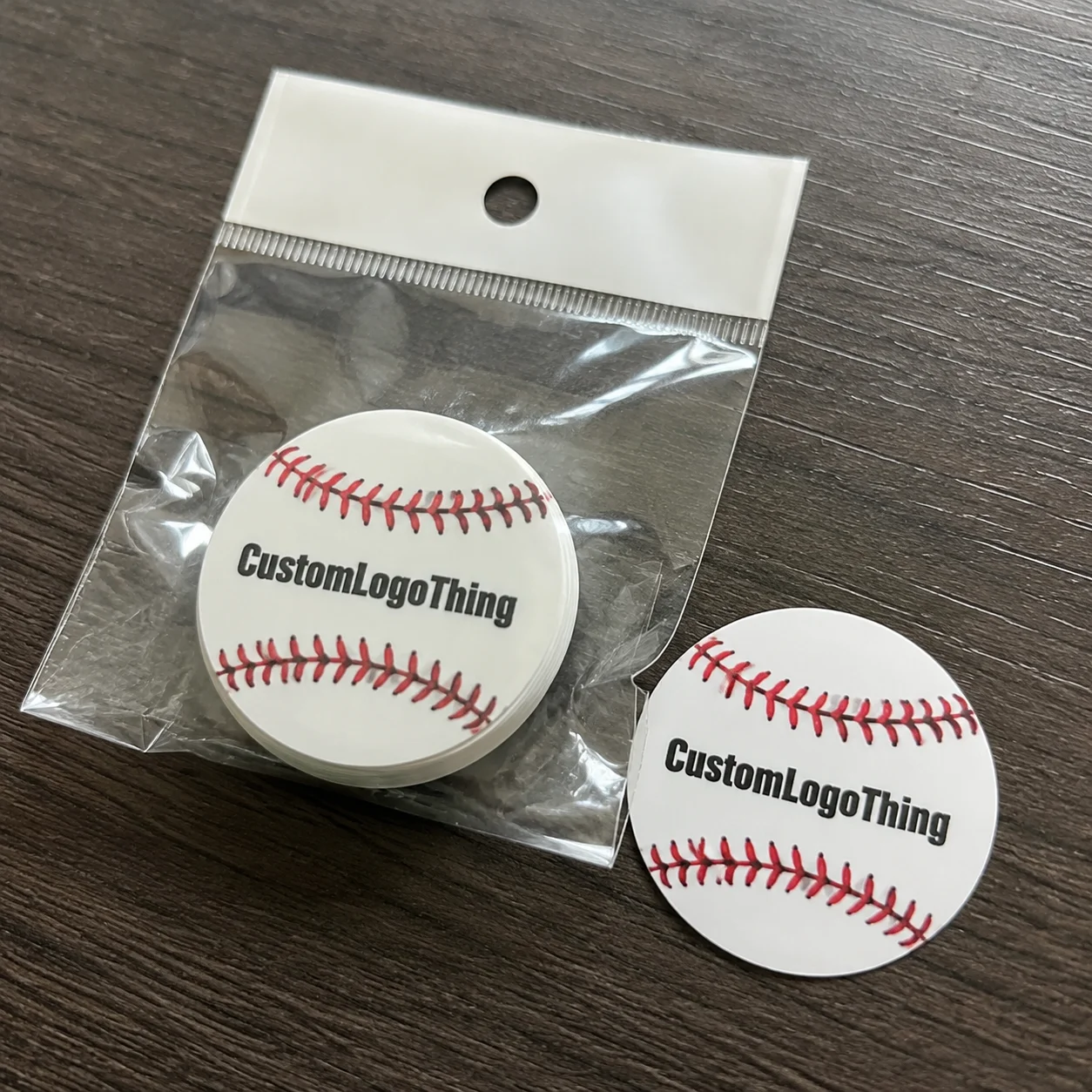
Bat knob stickers are usually round decals sized to fit the flat face at the bottom of a bat knob. Some are slightly contoured, especially when the artwork uses a shield, number, monogram, or simplified mascot shape. Most production-grade versions are printed on vinyl, polyester, or another durable pressure-sensitive label stock, then protected with a laminate or coating.
The use cases are practical. Coaches label issued gear. Players mark bats by name, jersey number, length, drop weight, or model. Retailers add branded decals to equipment bundles. Tournament organizers use commemorative artwork. Equipment brands sometimes use knob labels as a small but visible piece of package branding, especially when the same mark appears on hang tags, bat sleeves, Custom Labels & Tags, and related product packaging.
The knob is a rough spot for a decal. It gets pressed by the heel of a hand, rubbed by batting gloves, dragged across bag interiors, bumped against cleats, and exposed to dust, humidity, sweat, and heat. A bat left in a hot car after a weekend tournament is not a gentle storage condition. Neither is a damp dugout.
Surface type matters too. Wood bats can be sealed, painted, stained, unfinished, waxed, or treated. Alloy and composite bats may have molded textures, coatings, or concave knob shapes. A sticker that bonds nicely to one surface may struggle on another if the size, adhesive, or application method is wrong.
Practical callout: A good proof only shows the design. It does not prove the sticker will survive real equipment use. Adhesive choice, laminate, ink durability, cut accuracy, surface prep, and sizing all decide whether the label stays readable after repeated handling.
For buyers, the smart move is boring but effective: confirm the knob size, Choose the Right material, simplify the artwork, and understand the production timeline before ordering. That prevents the classic mistake of printing good art on the wrong construction.
How Bat Knob Decals Are Made to Stay Put
The production process is not mysterious. Artwork is created or cleaned up digitally. The design is printed on pressure-sensitive label material. The printed face is protected with a clear laminate or coating. Then the decals are die cut or digitally cut, checked, packed, and shipped as sheets, rolls, or individual pieces.
Pressure-sensitive adhesive bonds through contact and pressure. No heat, water, or solvent activation is needed. That sounds easy, and mostly it is, but adhesive cannot bond well through dust, oils, pine tar residue, wax, grip spray, or fresh bat treatments. If the knob is dirty, the sticker is sticking to residue instead of the bat. There is no premium adhesive that enjoys that job.
Face stock controls much of the finished look and feel. White vinyl gives strong color and solid opacity, which is useful for logos, numbers, and high-contrast team graphics. Clear film creates a subtler look because the knob color becomes part of the design, though white ink may be needed under certain artwork so colors do not disappear. Polyester film is often more dimensionally stable than softer vinyl, so it can be a better fit for crisp edges, tight registration, and heavier-duty labels.
Specialty films can work, but they are not automatic upgrades. Metallic, holographic, or textured stocks may look premium in a kit or retail setting. They can also raise cost, reduce readability, or need extra testing on curved and textured knob surfaces. If the decal is supposed to help a coach identify bats quickly, chrome-on-black artwork is a cute way to create a problem.
Lamination is the major difference between a short-life decorative sticker and a practical bat knob label. Gloss laminate makes colors pop and gives the face an easy wipe-down surface. Matte laminate reduces glare and gives a more equipment-like finish. Textured laminate can hide light scratches and add a grippier feel, though it may mute fine detail. The main job is protection: scuff resistance, moisture resistance, and a barrier between the ink and constant handling.
Digital printing is usually the best fit for custom bat knob stickers because orders often include full-color logos, short runs, multiple player names, variable numbers, or mixed artwork versions. Larger standardized runs may justify other production setups, but digital handles roster-based work without forcing every sticker to be identical.
One production reality is easy to underestimate: the print area is tiny. A 1.25-inch circle does not forgive crowded layouts. Tiny type, thin outlines, hairline cut shapes, and overly detailed mascots may look fine at 600% zoom on a screen. On a knob, after a few weeks in a bat bag, they become visual confetti.
Key Specs: Size, Shape, Adhesive, Finish, and Artwork
Start with size. Measure the flat face of the knob, not the widest outside diameter. A sticker that runs over the curved edge is more likely to lift because the adhesive is holding tension across a surface transition. If the flat face measures 1.35 inches, a finished decal around 1.20 to 1.25 inches is often more practical than a full 1.35-inch circle.
That small exposed border is not a design failure. It is cheap insurance. Leaving even 1/16 inch of knob around the decal helps the edge sit fully on the flattest area. For teams using mixed bat models, measure several knobs before choosing one universal size. The best universal size fits the smallest flat area in the group.
Circles are the safest shape because they match most knob faces and apply cleanly. Rounded squares, shields, initials, number shapes, and logo-based cuts can also work. The risky details are narrow points and thin extensions. A mascot tail, lightning bolt, or script flourish may catch on a bag liner and start peeling. A slightly simplified cut line usually lasts longer.
Adhesive selection matters, but it is not magic. High-tack permanent adhesives can improve bonding on certain plastics, coated wood, and lightly textured surfaces. They still need clean contact, enough pressure, and a decal that fits the flat area. Oversized stickers fail early no matter how impressive the adhesive spec sheet sounds.
| Spec Choice | Typical Use | Buyer Notes |
|---|---|---|
| White laminated vinyl | Team logos, bright numbers, full-color graphics | Strong everyday option for baseball and softball equipment labels |
| Clear film with laminate | Subtle branding or designs using the bat color | Needs strong contrast; white ink may be required for opacity |
| Polyester film | Stable decals with crisp edges | Useful for tight tolerances or higher durability requirements |
| Gloss laminate | Vibrant team colors and easy wipe-down | Can show glare under bright sun or stadium lights |
| Matte or textured laminate | Lower glare, softer finish, equipment-style look | May slightly reduce color brightness compared with gloss |
Artwork should be built for small-format printing. Vector files such as AI, EPS, or print-ready PDF are preferred because logos and type stay sharp at small sizes. High-resolution raster files can work if they are clean and supplied at the correct scale. Low-resolution screenshots are where good ideas go to get blurry.
Keep the hierarchy simple. A large jersey number with a small team mark reads better than a full name, sponsor line, motto, QR code, and detailed mascot crammed into one circle. If a QR code is required, test the printed size and contrast before relying on it. Some tiny codes scan on a proof and then fail once laminate, curvature, and real lighting get involved.
Color needs a quick reality check. If team colors must coordinate with uniforms, helmets, retail displays, or custom printed boxes, provide Pantone values, CMYK builds, or clear brand references. Screen previews are not color standards. Material, ink system, laminate, and lighting all affect the final look. Ask about tolerance if color is critical.
Variable data is one of the best uses for knob decals. Names, jersey numbers, bat lengths, drop weights, QR codes, and inventory IDs can be produced in the same order if the data is prepared correctly. Use one row per sticker version. Keep capitalization consistent. Remove duplicate records. Freeze the roster before proofing if possible, because last-minute number swaps are how mistakes sneak into production.
Pricing, MOQ, and Unit Cost Factors to Understand
Pricing is driven by quantity, material, finish, number of versions, variable data, artwork prep, cut complexity, and packing format. Size matters, but only to a point. Most bat knob labels are small, so a tiny diameter change may not shift the price much unless it affects material yield or cutting layout. Setup time is often the bigger cost.
Very small runs are possible with many suppliers, but the unit cost will be higher. Proofing, printing, laminating, cutting, inspection, and packing still take labor whether the order is 25 pieces or 1,000. A batch of 25 may be priced mostly around setup. A batch of 500 or 1,000 spreads that setup across more decals, so the unit cost drops.
For simple laminated vinyl circles at moderate quantities, broad pricing may fall around $0.20 to $0.60 per piece. Very Small Custom runs can land well above that. Specialty films, metallic effects, individual trimming, heavy variable-data setup, special adhesives, extra proof rounds, and rush timing all push costs higher. Those ranges are not quotes. They are planning guardrails so nobody is shocked that 18 highly customized stickers cost more per piece than 800 identical ones.
A single team logo in one size is easy to price. A full roster with names, numbers, bat specs, three knob diameters, and individual packaging needs more review. Sheeted decals are efficient for team handouts. Rolls may work better for assembly lines, retail packing, or equipment programs. Individually cut pieces look polished in kits, but handling and packing time increase.
Durability upgrades can be cheaper than replacements. A stronger laminate or better adhesive may add cost upfront, but replacing labels that scuff, lift, or become unreadable halfway through a season wastes money and time. The same logic applies across branded packaging and product packaging: low unit cost only helps if the item performs in real use.
For a clean quote, provide quantity, finished size, shape, preferred material, finish, artwork status, number of versions, variable data needs, packing format, and required delivery date. If the stickers are part of team kits, sponsor boxes, or retail bundles, it can help to review related Custom Packaging Products at the same time so colors and presentation stay consistent.
Buyers who care about sourcing can also ask material questions, especially if decals ship with paper-based kit components. Certifications from organizations such as the Forest Stewardship Council may matter for boxes, inserts, or tags. Film decals are usually specified around durability first, but the larger package can still be planned responsibly.
Process, Timeline, and Lead Time from Quote to Delivery
A normal order flow looks like this: inquiry, quote, artwork review, digital proof, approval, production scheduling, printing, lamination, cutting, quality check, packing, and shipping. Not fancy. Very easy to delay if the early details are vague.
Lead time usually starts after artwork and proof approval, not after the first email. Production cannot move safely until the size, material, color, design versions, and cut lines are locked. For straightforward custom label jobs, a realistic production window is often 5 to 10 business days after approval, with shipping time added separately. Complex orders, specialty materials, higher quantities, or seasonal peaks before opening day can extend that window.
The proofing stage deserves real attention. Review layout, spelling, jersey numbers, logo placement, cut line, and final size. If variable data is involved, compare the proof against the roster spreadsheet. Production follows the approved file. If the approved file says “Micheal” instead of “Michael,” the press will not suddenly develop editorial instincts.
- Confirm the size: Use the flat knob face measurement, not the total knob diameter.
- Review artwork: Check logo quality, contrast, type size, and color references.
- Approve the proof: Look at every variable name, number, spec line, and cut line.
- Allow production time: Printing, curing, lamination, cutting, and packing all need controlled steps.
- Plan shipping: Tournament weekends and team handout dates leave little room for delays.
Some production steps should not be rushed. Ink may need curing time. Laminate needs clean bonding. Cutting accuracy has to be checked, especially on small circles where a slight shift is obvious. Packing matters as well. Crushed sheets, curled edges, or loose pieces sliding around in transit make application harder than it needs to be.
Order earlier than feels necessary. That is especially true if the decals are part of a larger handout with uniforms, helmets, sponsor materials, retail packaging, or registration kits. Ask for both a target ship date and an approval deadline. The approval deadline is the date that actually protects your schedule.
Quality systems vary by supplier, but the basics should be consistent: approved specifications, controlled production steps, and final inspection. For larger equipment bundles and shipped kits, organizations such as ISTA publish transport packaging standards that can help teams think beyond the decal itself and plan for distribution without crushed or damaged components.
Common Mistakes That Make Knob Stickers Peel or Look Off
The most common mistake is ordering a sticker that is too large for the flat knob area. Once the edge bridges onto the curve, it becomes a lifting point. Bat bags, hands, dirt, and friction find that edge quickly. They always do.
Dirty surfaces cause plenty of failures. Dust, oil, pine tar residue, grip spray, wax, and fresh bat treatments all interfere with the bond. The adhesive needs direct contact with the knob. Clean the surface, let it dry completely, and apply with firm pressure from the center outward.
Cold application is another quiet problem. Pressure-sensitive adhesives usually build initial tack best at moderate temperatures. Applying decals in a cold garage, on a chilled bat, or in damp conditions can reduce early bond strength. Apply indoors at room temperature when possible, then give the adhesive time to settle before heavy use.
Artwork can fail even when the material is right. Small circles do not handle long names, detailed mascots, two sponsor logos, a QR code, a motto, and tiny legal text all at once. Low contrast is just as bad. Dark ink on a dark background may look refined on a monitor, but a coach trying to read numbers in the dugout needs clarity, not a design puzzle.
Unlaminated paper stickers are a poor choice for regular field use. They can absorb moisture, scuff quickly, wrinkle at the edges, and lose readability after repeated handling. Paper may be fine for a one-day event, novelty giveaway, or indoor display. For working equipment labels, use a durable film with protection over the print.
Assuming all bat knobs are identical creates avoidable trouble. Wood, composite, and alloy bats can vary in shape, coating, texture, and flat surface area. Some knobs are slightly concave. Some have raised branding. Some are slick enough that surface prep becomes more important. If you are ordering for mixed equipment, say that upfront so the supplier can recommend a practical size and construction.
Skipping proof review is the final self-inflicted wound. Roster-based custom bat knob stickers are only as accurate as the approved file. Check spelling, numbers, bat specs, logo orientation, and cut line placement before approval, especially if parents, coaches, or multiple team managers helped collect the data.
Next Steps: Measure, Prep Artwork, and Order with Confidence
A little preparation makes the ordering process smoother. Measure the flat knob face, choose a finished size with a small margin, count the number of bats or players, and decide whether each sticker needs unique names, numbers, bat specs, or inventory information. If sizing is uncertain, send a straight-on photo of the knob with a ruler nearby. A simple reference image can prevent a bad diameter choice.
- Measure: Record the flat face diameter on each bat model, especially if the team uses mixed brands.
- Choose a size: Keep the decal slightly smaller than the flat area to avoid edge lift.
- Gather artwork: Send vector files such as AI, EPS, or PDF whenever possible.
- Prepare data: Use a clean spreadsheet for player names, numbers, bat length, drop weight, or IDs.
- Pick a finish: Use gloss laminated vinyl for bright graphics, matte for reduced glare, or tougher film for heavy equipment use.
- Ask quote questions: Confirm material, adhesive type, laminate, sheet or roll format, proofing steps, lead time, and shipping method.
Application is simple, but it should not be sloppy. Clean the knob surface thoroughly and let it dry. Center the sticker on the flat area. Press firmly from the middle outward to push air away from the center. Avoid touching the adhesive with your fingers. After application, allow time for the bond to build before tossing the bat into a gear bag or using it in wet conditions.
Most buyers get better results when they treat these small decals like part of the equipment system, not an afterthought. The decisions are the same ones used across packaging design: substrate, adhesive, print method, finish, proofing, and real-use handling all have to line up. Custom bat knob stickers work best when the design, material, adhesive, and ordering details are handled together from the start.
FAQ
What size should custom bat knob labels be?
Measure the flat face of the bat knob, not the widest outside edge. Choose a sticker slightly smaller than that flat area so the edge does not wrap onto the curve. If you have multiple bat models, measure each type before ordering one universal size.
What material is best for personalized bat knob stickers?
Laminated vinyl or durable film is usually the best choice for team and equipment use. A protective laminate helps resist scuffing, fingerprints, moisture, and bat bag abrasion. Paper labels are better for short-term novelty use than for regular field equipment.
Can custom baseball bat knob stickers include player names and numbers?
Yes. Names, jersey numbers, bat specs, QR codes, and inventory IDs can be printed as variable data. Provide a clean spreadsheet, keep text short and high-contrast, and review the proof carefully before approval because the printable area is small.
How much do custom softball bat knob decals cost?
Cost depends on quantity, material, laminate, number of designs, packing format, and whether variable data is included. Higher quantities usually reduce unit cost because setup and production time are spread across more stickers. Special finishes, rush timing, and complex cut shapes can increase the quote.
How do I apply bat knob stickers so they do not peel?
Clean the knob surface thoroughly and let it dry before application. Apply the sticker only to the flat area, press firmly from the center outward, and avoid cold or damp application conditions. Give the adhesive time to build bond before heavy use.