Custom Beanies with Woven label lead time is usually longer than buyers expect, and the woven label is often the real bottleneck, not the knit hat body. I have seen clean, simple beanie programs move slowly for one reason only: the label approval dragged on. The hat itself was ready. The supply chain was not. That mismatch catches people off guard because a beanie feels small and straightforward, yet the process behind it has several moving parts, each with its own queue.
There is a useful way to think about it. The beanie body is the shell; the woven label is the identity layer. One can be in stock, the other may still need artwork cleanup, weaving, folding, and application. Treat those as separate production steps and the timeline starts to make sense. Treat them as one simple item and the schedule can slip by days, sometimes by weeks. A buyer who understands the difference is already halfway to a better quote.
“The beanie itself is rarely the problem. The proof, the label run, and the handoff are where schedules drift.”
What Custom Beanies With Woven Label Lead Time Really Means
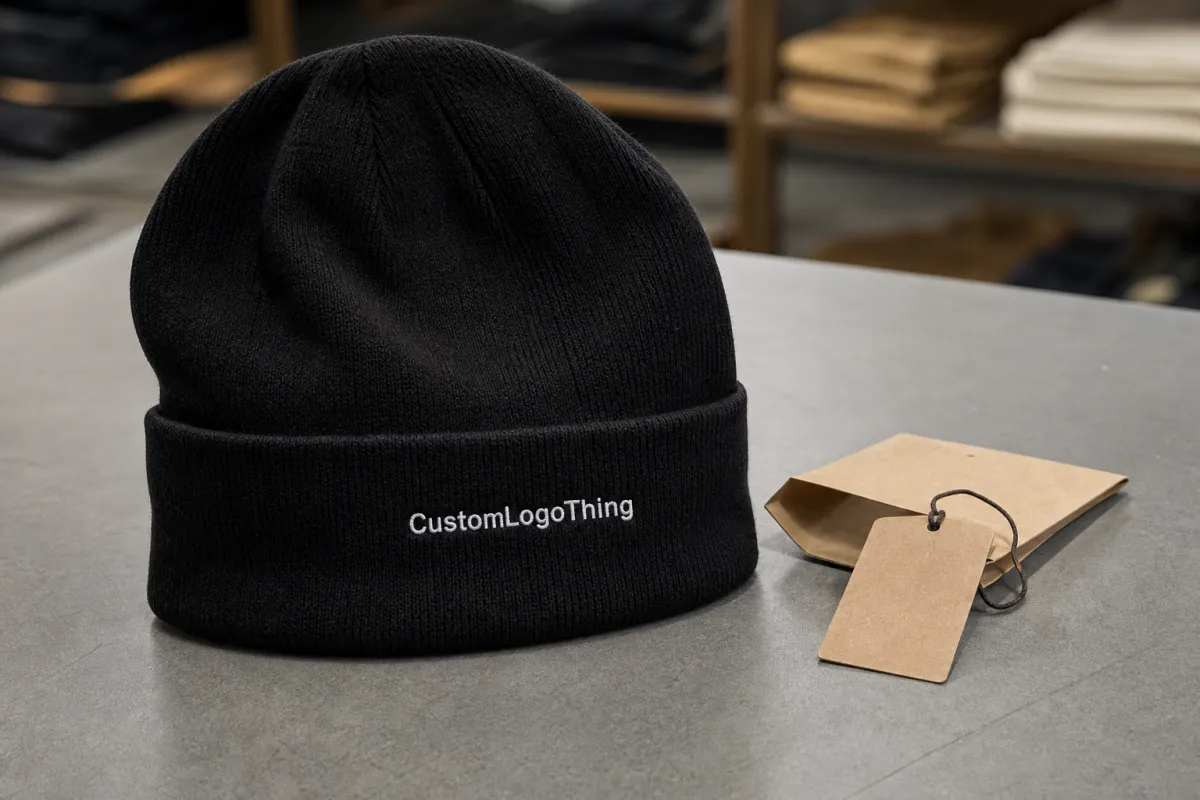
Custom beanies with woven label lead time covers the full span from artwork approval to finished goods shipping, not just the sewing window inside the factory. That distinction changes everything. A supplier may have blank beanies sitting in stock, but the woven label still has to be designed, woven, checked, and applied before the order can move. Buyers often hear one short number and assume the whole project is covered. It usually is not.
A woven label sounds small, but it behaves like a miniature manufacturing job. It needs correct artwork, thread color mapping, fold style, dimensions, and placement approval. On a run I reviewed last year, the buyer approved the front logo in minutes but spent four days debating whether the label should sit on the cuff seam or half an inch higher. Four days for placement alone. That is not unusual. It just feels strange because the object is tiny.
For bulk orders, the timeline usually comes down to three questions: Is the beanie already available, is the woven label already approved, and is the factory open on the dates you need? If all three answers are yes, custom beanies with woven label lead time may land in the 12-20 business day range from proof approval for a straightforward order. If the label is newly woven, the artwork needs revisions, or freight moves slowly, three to six weeks is more realistic. During peak seasons, especially before holiday merchandising or year-end event drops, that range can stretch further. It is not a warning sign; it is production math.
Vendors also define lead time differently. Some quotes start the clock when the order is placed. Others start at proof approval. A few count only production days and leave out packing, freight, and customs. Compare those quotes without checking the start and end points and you are not comparing the same thing. You are comparing labels on different clocks.
The better question is not, “How fast can you make it?” The better question is, “What exactly is included in the custom beanies with woven label lead time, and what is not?” Once that gets answered, the conversation turns useful. You can plan the launch, compare vendors cleanly, and keep the order from turning into a moving target.
Custom Beanies With Woven Label Lead Time: How the Process Works
Custom beanies with woven label lead time follows a predictable path, even if the details vary by factory. The process usually moves through seven stages: quote request, art proof, label weaving, beanie production or sourcing, label application, quality control, packing, and freight. Once the steps are in order, the schedule starts to make sense. Most delays happen at the handoffs, not inside one isolated production step.
- Quote request: The buyer submits quantity, size, color, artwork, fold style, and packaging needs.
- Art proof: The factory converts the logo into a woven-label file and shows layout, colors, and dimensions.
- Label weaving: The label is produced on a loom, then cut and folded.
- Beanie sourcing or knitting: The blank beanie body is made or pulled from stock.
- Label application: The woven label is sewn in the agreed position.
- Quality control: The factory checks stitching, color match, label placement, and quantity.
- Packing and freight: Goods are packed for retail packaging, bulk cartons, or branded packaging, then shipped.
The clock does not always start at the same point. Some suppliers start counting custom beanies with woven label lead time when they receive payment. Others start when artwork is approved. A few add shipping days into the same number, while others quote transit separately. A “14-day lead time” might really mean 14 production days plus 5-10 days of transit. A buyer who does not clarify that can miss a launch by a wide margin.
Sample approval can stretch the timeline too. If the first proof is clean, the project may move quickly. If the thread colors are off, the label size feels cramped, or the fold type does not suit the beanie body, the project pauses while revisions are made. One revision round is common. Two or three rounds are where schedules start to bleed. I have even seen a fast-turn order stall because the buyer liked the label but wanted a slightly warmer red, and the factory had to remap thread codes before the loom could run again. Small changes can be oddly expensive.
Picture a simple example. A buyer approves artwork on Monday. The woven label is scheduled for midweek production. The beanies are in stock, and the factory can apply labels right after weaving. On paper, that sounds fast. In reality, a queue at the factory, a delayed sign-off, or a freight booking issue can turn that into a two- or three-week calendar. Custom beanies with woven label lead time should be read as a production sequence, not a single promise.
Custom Beanies With Woven Label Lead Time: Cost and Pricing
Price and lead time move together more often than buyers expect. A Quote for Custom beanies with woven label lead time should show the blank beanie cost, woven label setup, application labor, packing, freight, and any sampling or revision fees. If those line items are missing, the quote may look cheaper than it really is. That is a classic trap in product packaging and retail packaging programs: the front number looks friendly, then the real cost appears in the margins.
For bulk orders, the unit cost usually drops as quantity rises because setup gets spread across more pieces. A 300-piece order carries the label setup far more heavily than a 3,000-piece order. A realistic range for a basic blank beanie might be $2.20-$5.50 per unit at bulk levels, depending on yarn, gauge, and knit density. A woven label can add roughly $0.25-$0.80 per unit for application, plus a one-time setup that may sit around $40-$120 depending on complexity. Those are planning numbers, not fixed quotes, because material choice and factory capacity change the picture.
Label design is another cost lever. More colors, larger dimensions, special folds, and multi-location branding all affect the bill. A simple center-fold label on the cuff is usually easier than a larger label with a detailed logo and a secondary line of text. If the brand wants a custom printed box, a hangtag, or a coordinated insert, that adds both approval time and material cost. Package branding looks small on a mood board; on a production schedule, it is another lane that has to stay in sync.
| Option | Typical Cost Effect | Typical Lead Time Effect | Best For |
|---|---|---|---|
| Blank beanie with standard woven label | Lowest setup cost; moderate per-unit add-on | Usually 12-20 business days from proof approval | Promo drops, team merch, broad bulk orders |
| Woven label plus retail packaging | Adds packing materials and labor | Often 2-5 extra business days | Retail-ready presentation and shelf display |
| Woven label plus custom printed boxes | Higher print and packaging cost | Can add 1-2 extra proof cycles | Premium gifting, launch kits, branded packaging |
| Rush production with split shipment | Highest landed cost because of expediting | May save days, not weeks | Event deadlines and time-sensitive launches |
MOQ matters too. Minimum order quantity can apply to the beanie body, the woven label design, or both. A factory may quote a tempting unit price, but if the MOQ is above your target, the real entry cost climbs fast. I would rather see a slightly higher honest quote than a low quote that only works after hidden assumptions are added. That kind of pricing almost always comes back to bite the schedule too.
Freight can shift the total as much as decoration does. Air shipping is faster, but it can turn a comfortable price into an uncomfortable one. Ocean freight is less expensive, but it adds calendar time and a little more uncertainty. For buyers who also handle Custom Labels & Tags or plan a broader merchandising rollout with Custom Packaging Products, the smartest move is to compare the landed cost, not just the unit price.
There is another subtle cost driver that people miss: seasonality. A quote in March can look very different from a quote in October because factories, freight forwarders, and even packaging suppliers face different demand peaks. If you are trying to land custom beanies with woven label lead time before a winter campaign, assume the calendar will be less forgiving than the sample spreadsheet suggests. That assumption has saved me from a few nasty surprises.
Step-by-Step: Shortening Process and Timeline Without Cutting Corners
Shortening custom beanies with woven label lead time is mostly about removing indecision. The production line can move quickly if the project is ready to move. It slows down when the buyer is still deciding on thread colors, logo placement, or packaging format. The goal is not to rush the factory blindly. The goal is to remove avoidable stops.
Start by planning backward from the real deadline, not the hopeful one. If the beanies are tied to a trade show, retail launch, employee gift date, or seasonal campaign, build the schedule from that date and then subtract proof time, production time, and transit time. Add buffer days. Always. If the order has to pass through an internal approvals chain, build that in too. A project is only as fast as the slowest person signing off on it.
Lock the artwork early. Choose one label size, one thread palette, and one placement before production starts. If you know the beanie body will use a cuff label, do not keep a second placement option alive “just in case.” That kind of indecision is expensive. It creates extra proofing and can push the woven label back into the queue.
To keep the schedule clean, ask for these milestones in writing:
- proof approval date
- label weaving start date
- label application completion date
- quality control date
- ship date and transit method
That list sounds basic, but it is where custom beanies with woven label lead time becomes manageable. When the milestones are written down, everybody sees the same calendar. There is less guessing, and fewer surprises.
This is also the stage to think about shipping integrity. If the order is heading into distribution, some buyers ask for carton specs that can pass internal receiving rules or test methods such as those used by ISTA. That does not mean every beanie order needs formal testing. It means the packing choice should match the channel. A retail-ready package, a bulk carton, and a gift box all need different handling. If paper components are involved, such as hangtags or inserts, FSC-certified paper can be a simple way to support sustainable sourcing without complicating the order.
One more practical move: confirm what happens if a step slips. Ask the vendor whether the schedule can be resequenced if the woven label proof is delayed or if a beanie color is temporarily unavailable. That answer tells you a lot about the supplier's working style. A strong partner does not just quote custom beanies with woven label lead time; it shows how the order will be managed if one part of the chain stumbles. That difference matters more than polished sales language ever will.
Common Mistakes That Stretch Lead Time and Add Cost
The biggest planning error is sending vague artwork or a loose brand brief. If the factory has to ask three follow-up questions about logo placement, label width, or thread count, the schedule stops while the buyer gathers answers internally. That delay is easy to avoid, yet it shows up constantly. I would call it the most common reason custom beanies with woven label lead time grows without warning.
Another mistake is comparing quotes only by unit price. A lower number may hide slower production, a weaker fabric, or extra charges that appear later. Sometimes the “cheap” quote does not include application labor or freight. Sometimes it includes them, but only at a standard shipping speed that misses your deadline. A quote should be judged like a full package, not a snapshot.
MOQ traps deserve their own warning. Ordering below the minimum can trigger a premium that wipes out the savings you thought you were getting. Ordering just above the minimum can be more efficient because setup costs are spread properly. That is why I like to compare total spend, not just unit cost. Small differences in quantity can have a strange effect on margin.
Freight buffers are another blind spot. Buyers often leave no room for customs clearance, local receiving, or internal distribution. That matters more when the beanies are linked to a seasonal campaign or a retail packaging rollout. Even if the factory finishes on time, the project can still miss the launch if nobody reserved time for inbound handling. Custom printed boxes, branded packaging, and product packaging all tend to add a layer of handling that should be reflected in the calendar.
Changing the label after production starts is the costliest mistake of all. Once the woven label stage is underway, a revised logo or updated slogan can force a restart. That means extra weaving, extra labor, and extra calendar time. The same thing happens if the buyer keeps changing the package branding after approval. The factory cannot read minds. It can only work from the approved file in front of it.
There is also a quiet timing mistake that shows up often: no one accounts for internal turnover. Marketing may approve the proof on Tuesday, but the operations contact who understands the shipping window may be out until Friday. That gap is tiny on paper and enormous in practice. I have watched a one-week delay grow out of nothing more exotic than a holiday weekend and a missing sign-off.
- Bad brief: ambiguous artwork and missing placement details
- Cheap-only comparison: unit price without freight or setup included
- MOQ mismatch: ordering under the true factory minimum
- No buffer: forgetting customs, receiving, or rework time
- Late revisions: changing the woven label after approval
Expert Tips and Next Steps for Buyers
Appoint one decision-maker. That sounds simple, but it prevents the same proof from bouncing between marketing, sales, and operations for three days while everyone “checks one thing.” The fastest projects usually have one person collecting feedback and one person giving final approval. That alone can tighten custom beanies with woven label lead time more than a rushed freight option ever will.
Ask for a written breakdown of the schedule. You want to see what is included, what is excluded, and where the longest delay is likely to happen. If the supplier can show a stage-by-stage timeline, you can compare vendors like-for-like. If the supplier only gives a single number, ask for more detail. Good quoting is specific. Vague quoting is expensive later.
Request a sample or at least a photo proof before the full run. For a premium retail presentation, that step is worth the pause. A woven label that looks sharp on screen can still feel too large, too shiny, or too loose on the actual beanie. A physical sample catches that. So does a clear proof with exact dimensions and placement notes. That is especially useful if the order is part of a bigger branded packaging or package branding rollout.
It also helps to build a comparison sheet. Track price, MOQ, proof turnaround, shipping method, and estimated delivery window in one place. Then you can judge the quotes honestly. A slightly higher price with a faster proof cycle may beat a low quote that leaves you waiting. If you are sourcing a wider merch kit, the same sheet can help align the beanies with the rest of the order, including Custom Labels & Tags and Custom Packaging Products.
For teams that want broader packaging context, the Packaging Institute is useful background reading on materials and supply-chain language. Packaging design is not just visual design; it is timing, handling, and cost control. That idea applies directly to beanie programs, especially when the order includes retail packaging, custom printed boxes, or other presentation layers.
The takeaway is straightforward: plan backward from the ship date, lock the woven label proof early, and ask for the production calendar in writing before you compare any price. If you do those three things, custom beanies with woven label lead time becomes a manageable schedule instead of a guessing game. If you skip them, the order can still work, but you are basically hoping the factory, freight, and approvals all behave on cue. That is a risky bet.
How long is custom beanies with woven label lead time for a bulk order?
The timeline depends on artwork approval, label weaving, application, and shipping, so ask for each stage separately instead of relying on one flat estimate. Bulk orders usually move more predictably than tiny runs, but only if the design is finalized early and the factory has capacity.
What speeds up custom beanies with woven label lead time the most?
Fast approvals matter most: lock the label size, colors, and placement before production starts. Using one proof round and standard shipping can save more time than trying to rush every manufacturing step.
Does a woven label increase the price of custom beanies?
Yes, because it adds setup, weaving, and application labor on top of the base beanie cost. The per-unit price often drops as quantity rises, but smaller orders usually feel the label cost more sharply.
What MOQ should I expect for custom beanies with woven labels?
MOQ varies by factory, but it may apply to the beanie style, the label design, or both. Always ask whether the minimum is per colorway, per size, or per production run before you compare quotes.
Can rush orders reduce custom beanies with woven label lead time?
Sometimes, but only if the factory has open capacity and your artwork is already approved. Rush service usually helps the schedule more than the design phase, so it is not a substitute for clean specs.

