Buyer Fit Snapshot
| Best fit | Custom Beverage Packaging Boxes projects where brand print, material claims, artwork control, MOQ, and repeat-order consistency need to be specified before quoting. |
|---|---|
| Quote inputs | Share finished size, material target, print colors, finish, packing count, annual reorder estimate, ship-to region, and any compliance wording. |
| Proofing check | Approve dieline scale, logo placement, barcode or warning zones, color tolerance, closure strength, and carton packing before bulk production. |
| Main risk | Vague material claims, crowded artwork, missing packing details, or unclear freight terms can make a low unit price expensive after revisions. |
Fast answer: Custom Beverage Packaging Boxes: Design, Cost, and Fit should be specified like a repeatable production item. The safest quote records material, print method, finish, artwork proof, packing count, and reorder notes in one written spec.
Production checks before approval
Compare the actual filled-product size with the drawing, then confirm tolerance on folds, seals, hang holes, label areas, and retail display edges. Reserve space for logos, QR codes, warning copy, and material claims before decorative graphics fill the panel.
Quote comparison points
Review material grade, print process, finish, sampling route, tooling charges, carton quantity, and freight assumptions side by side. A quote is only useful when the supplier can repeat the same color, closure quality, and packing count on the next order.
Custom Beverage Packaging Boxes: Design, Cost, and Fit
Custom beverage packaging boxes do more than hold a bottle or a six-pack in place. They shape the first impression, absorb shipping abuse, and quietly signal whether a brand understands the difference between attractive packaging and packaging that actually survives the route. A box can look polished in a render and still fail the moment it meets a pallet jack, a courier van, or a retail stockroom. That gap is where good packaging earns its keep.
That is also why custom beverage packaging boxes sit at the intersection of protection, display, and logistics. Glass, aluminum, PET, cartons, mixed packs, single bottles, and subscription shipments all ask for different structural answers. One drink format does not behave like another, and the package has to respect that. Ignore that fact and the box will remind you pretty quickly.
For buyers, the useful question is not whether the packaging looks attractive in a mockup. The real question is whether the structure, print, board, and price fit the beverage and the channel. A quote that looks cheap can become expensive the minute breakage, reprints, or freight changes enter the picture. At 5,000 units, even a $0.10 miss turns into $500. Packaging math is not kinda forgiving.
What Custom Beverage Packaging Boxes Actually Are
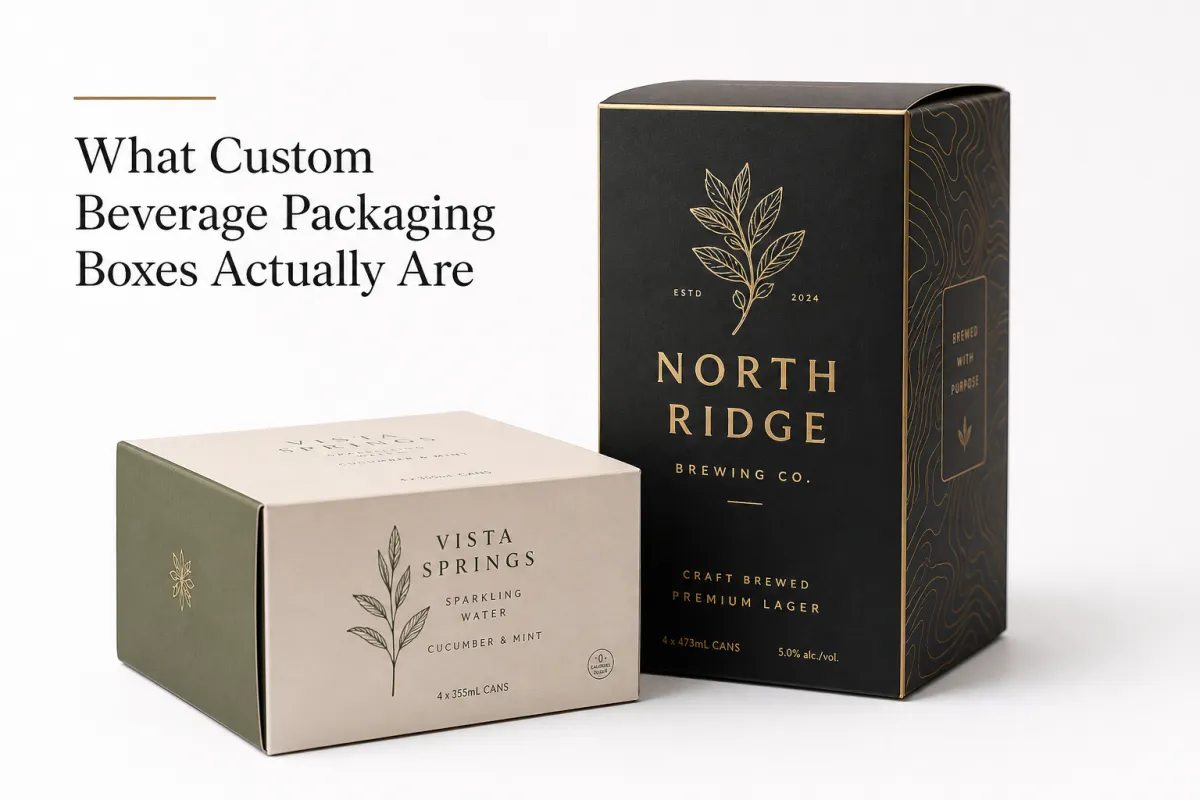
At the simplest level, custom beverage packaging boxes are packaging structures built for drinks that need a specific fit, a specific handling method, or a specific brand presentation. The category includes single-bottle cartons, six-pack carriers, mailer-style shippers, display trays, and corrugated sleeves for mixed sets. It is broader than the word "box" suggests. These are systems, not containers by accident.
People often judge the package before they taste the drink. That sounds shallow until you watch how shelves, warehouses, and delivery routes behave. A flimsy-looking carton makes the product feel less valuable. A package with the right weight, closure, and print treatment makes the same drink feel more credible. Custom beverage packaging boxes help create that credibility before the cap comes off.
Standard packaging forces the product to fit the box. Custom packaging flips that relationship and builds the structure around the product, the shipping path, and the sales setting. The difference shows up in the dimensions, in the board thickness, in insert design, and in the way the closure behaves after the third handling cycle. With custom beverage packaging boxes, the goal is not only containment. It is control over the route from pallet to shelf to doorstep.
A few formats show up again and again:
- Cartons for single bottles, cans, or promotional multipacks.
- Mailer-style boxes for e-commerce orders that need extra crush resistance.
- Display boxes that open cleanly and present the product on shelf or counter.
- Carrier packs for cans or bottles with cutouts, handles, or reinforced grips.
- Retail-ready beverage packaging designed to move from shipping case to shelf with minimal repacking.
Structure, print, and logistics all meet inside custom beverage packaging boxes. That is why the category gets underestimated. Designers tend to think in color and layout first. Packaging buyers think in fit, load, and handling first, then move to graphics. That order usually saves money and a few headaches.
If you are comparing formats, the options on Custom Packaging Products make the structural differences easier to see. A carton built for shelf appeal will not behave like a shipper built for transit, and the wrong choice shows up quickly once product starts moving.
How Custom Beverage Packaging Boxes Work in Production
Production begins with the dieline, not the artwork. Teams often rush past that step, then spend the next week fixing avoidable mistakes. A dieline defines the folds, cuts, glue points, and closure tabs for custom beverage packaging boxes. Once the structure is locked, the design wraps around it. Wrong dimensions cannot be rescued by a better logo. I have watched that lesson play out more times than I'd like to admit.
The usual workflow starts with product measurements, then structural template development, then board selection, then artwork placement, then proof review, and finally sample approval before the full run starts. The calendar may look longer on paper, but that sequence protects the budget. A sample catches a too-tight insert, a seam that breaks the copy, or a flap that refuses to close before thousands of units are already made. One missed millimeter can snowball into a very expensive headache.
Print method matters too. Offset printing works well for detailed graphics, strong color control, and larger runs. Digital printing fits shorter runs, faster turnarounds, and designs that may change from batch to batch. Flexographic printing is common for corrugated packaging where speed and cost control matter more than ultra-fine detail. The right method for custom beverage packaging boxes depends on volume, finish target, and the board itself.
Board grade and insert design need to work together. A heavy outer carton without an insert still lets glass knock around. A fine insert inside a weak box still fails when the stack gets high or the route gets rough. Good suppliers test fit tolerance, closure performance, vibration resistance, and corner impact. For shipping-heavy programs, many teams use ISTA test methods to pressure-check the package before the run goes wide.
Beverage packaging gives very little room for error. Liquid adds weight fast. Glass breaks. Even cans dent when movement builds up after repeated impacts. That is why suppliers look closely at load, fit, and consistency before release. Custom beverage packaging boxes are engineered, checked, and then produced. The drawing is only the beginning.
Timing depends on complexity, but a realistic schedule often looks like this: 1 to 3 business days for dieline and quote alignment, 2 to 5 business days for artwork setup and proofing, a few more days if a physical sample is required, then production after final approval. Simpler jobs move faster. Complex structures do not. Proofing slows the project, and proofing also prevents expensive mistakes.
How Do Custom Beverage Packaging Boxes Protect Products in Transit?
Protection starts with structure, not decoration. Custom beverage packaging boxes protect products in transit by controlling movement, absorbing impact, and keeping weight distributed in a way the container can survive. A corrugated shipping carton handles stacking pressure better than a thin retail carton. A die-cut insert keeps bottles from colliding. A well-sized closure stops the package from flexing open after a few rough handoffs.
That matters because beverage packaging gets punished in ways most dry goods never do. Courier vans shake. Pallets shift. Boxes slide against each other. A package that survives a clean desk test may still fail once the order moves through warehouse handling and last-mile delivery. The best custom beverage packaging boxes account for that chain of abuse before the first print run starts.
For glass bottles, the goal is to reduce point contact and stop the product from banging against the outer walls. For cans, the goal is usually compression control and stack stability. For mixed packs, the challenge rises again, because each container type needs its own tolerance. That is where corrugated shipping cartons, folding cartons, and custom inserts begin to work like a system instead of isolated parts.
Testing makes the difference visible. Vibration tests show whether items drift inside the box. Drop tests expose weak corners and loose closures. Compression tests reveal whether the structure can hold up under stacked loads. That is why many packaging teams think in terms of burst strength, edge crush, and fit before they think about color. For custom beverage packaging boxes, the graphics can be excellent and the structure can still be wrong. The reverse is harder to notice, but far more useful.
One packaging audit I reviewed for a sparkling water brand found the carton was visually clean but slightly oversized. Only 3 mm of extra movement was enough to scuff labels during transit. The fix was not glamorous: a tighter insert and a board upgrade. But breakage complaints dropped almost immediately. That is the kind of thing packaging people live for, even if no one on the marketing side ever notices.
Key Factors That Shape Custom Beverage Packaging Boxes
The product comes first. A tall glass bottle behaves differently from a short aluminum can. A chilled pouch does not behave like a rigid bottle. Mixed beverage sets complicate things further because the package now has to control several shapes at once. With custom beverage packaging boxes, the starting point is always the container.
Sizing sounds easy until the measurements are off by a few millimeters. Internal dimensions decide whether the product slides, jams, or crushes the corners. Headspace matters too. Too much room invites movement. Too little makes packing difficult and closing even harder. Good custom beverage packaging boxes leave enough tolerance for the product, the insert, and the realities of production without giving the contents room to rattle.
Material selection changes both performance and price. Corrugated board is the workhorse for shipping strength, especially for heavier loads or glass. Paperboard works well for lighter retail packaging where appearance matters and the box will not take as much abuse. Coated stock gives cleaner print and sharper color. Recyclable and FSC-certified materials can support sustainability goals, but the tradeoff is not always simple. A material that looks greener on paper but fails in transit is a poor bargain. If that is part of the sourcing brief, the FSC certification standards are worth reviewing before final approval.
Branding choices shape the box faster than almost anything else. Heavy ink coverage, soft-touch lamination, spot gloss, foil, embossing, and windows all change the feel of the package. They also change the cost. For custom beverage packaging boxes, the question is not which treatment looks fancy. The question is which treatment helps sell the drink, fits the channel, and survives handling without becoming waste.
Here is the practical tradeoff buyers usually face:
| Option | Best For | Typical Unit Range at 5,000 Units | Main Benefit | Main Tradeoff |
|---|---|---|---|---|
| Corrugated shipper | Heavy bottles, mixed packs, e-commerce | $0.55-$1.20 | Strong protection and better stacking | Less premium shelf presentation |
| Paperboard retail carton | Single bottles, lighter cans, display packaging | $0.18-$0.45 | Cleaner branding and lower material weight | Less impact resistance |
| Custom insert system | Glass, premium sets, multi-bottle packs | $0.10-$0.35 | Limits movement and reduces breakage | Extra setup and assembly time |
| Rigid presentation box | Premium gifting and retail launches | $1.25-$3.50+ | High perceived value | Higher cost and more freight weight |
Retail handling changes the calculation again. A box stacked in a warehouse needs compression strength. A box displayed on shelf needs a front panel that reads quickly, not eventually. A box shipped one at a time needs to survive drop and vibration conditions that resemble courier abuse, not a polite demo on a desk. Custom beverage packaging boxes should be judged against the actual channel, not the idealized version.
Workflow matters too. A box that looks elegant but slows packing by ten seconds per unit adds labor costs that only show up later. Multiply that delay by a few thousand units and the expense becomes real. The best custom beverage packaging boxes help the line move efficiently. That is not glamorous. It is useful.
Custom Beverage Packaging Boxes: Cost and Pricing Realities
Pricing for custom beverage packaging boxes comes from several parts: material, print coverage, structure complexity, inserts, finish work, and setup. The unit price is only one piece of the total. Buyers who stop there often miss freight, sampling, and the cost of correcting a problem after proof approval. The number that matters is landed cost.
Quantity has a major effect on unit price. Small runs cost more per box because setup is spread across fewer pieces. A 500-unit premium carton order can feel expensive. A 10,000-unit order usually drops sharply if the structure stays stable. That is not a pricing trick. It is manufacturing reality for custom beverage packaging boxes.
The lowest quote is often the one with the most omissions. Maybe it leaves out inserts. Maybe it assumes a simpler finish than the buyer wanted. Maybe it excludes a physical sample. I have seen quote comparisons that were not truly comparable at all. One included assembly and shipping cartons. Another did not. That is not a fair comparison. That is a surprise waiting to happen.
Use this checklist before comparing suppliers:
- Confirm exact internal dimensions and pack count.
- Ask whether the quote includes inserts, coatings, and proofing.
- Check the board grade or material thickness, not just the box style.
- Ask for the defect tolerance and sample approval process.
- Compare total landed cost, including freight and setup charges.
Savings usually come from a few places: choosing a standard size where possible, reducing print coverage, limiting finish changes, avoiding unnecessary inserts, and keeping artwork revisions under control. If a premium effect does not help sell the drink, protect the product, or justify the margin, it may not deserve a place on the box. A foil stamp on packaging that sits inside a shipper is a nice idea with poor return on investment.
Suppliers also price in risk. Tight tolerances, complex die-cuts, fragile inserts, and high-gloss finishes raise the chance of waste. More revisions after proof approval can add charges too, especially if plates, dies, or print files need to be remade. One reason custom beverage packaging boxes reward good briefs is simple: vague instructions cost money.
Typical cost drivers include:
- Board type: corrugated, SBS, kraft, recycled content, or rigid board.
- Print method: digital, offset, or flexographic.
- Finish: matte, gloss, soft-touch, foil, embossing, UV coating.
- Structure: tuck-end, auto-lock bottom, mailer, display, carrier, or insert-based.
- Production size: short runs usually cost more per unit.
If several quotes are on the table, resist the reflex to choose the cheapest unit price. Check whether the quoted box matches the shipping environment, the product weight, and the branding target. The point of custom beverage packaging boxes is not to win a spreadsheet contest. It is to move product without damage and still look like the brand meant it.
Step-by-Step Process for Ordering Custom Beverage Packaging Boxes
The cleanest orders start with clear product data. Before a dieline is drawn for custom beverage packaging boxes, gather the product dimensions, weight, pack count, closure style, and shipping method. If the beverage is glass, include bottle shape and neck height. If it is canned, include can diameter and the grouping format. If it is a mixed set, list every variant. One missing measurement can shift the whole structure.
The next step is the template. Ask for a dieline or structural drawing before design work begins. That simple move prevents a lot of chaos. It lets the designer build artwork around real folds and panels instead of guessing. It also shows the glue zones, flaps, windows, and cutouts. For custom beverage packaging boxes, the dieline is the map. Without it, people are decorating a rectangle and hoping for the best.
Proofing usually happens in stages. First comes the structural sample to check fit. Next comes the print proof to confirm color, placement, and copy. Then the pre-production sample confirms how the finished box behaves with the actual board and actual ink. Each step can feel like delay, but each step catches a different kind of mistake. Fixing a seam issue before mass production costs far less than fixing it after the whole order is printed.
A practical order sequence usually looks like this:
- Collect product measurements, weights, and packing requirements.
- Choose the box style and material based on the channel.
- Request a dieline or structural template.
- Prepare artwork on the approved template.
- Review the digital proof and request corrections if needed.
- Approve a sample or prototype.
- Move to production after final sign-off.
That sequence moves quickly when the brief is clean. It slows down when dimensions are incomplete or artwork keeps changing. Buyers who know the final size, finish target, and quantity range get quotes faster and with fewer revisions. Anyone pricing custom beverage packaging boxes should be ready with specs before asking for numbers.
Use this checklist to keep the order moving:
- Product data: size, weight, container type, and pack count.
- Use case: retail shelf, e-commerce, subscription, gift set, or wholesale shipper.
- Material preference: corrugated, paperboard, or rigid packaging.
- Print needs: colors, finishes, coatings, and special effects.
- Quantity range: low, mid, or high volume.
- Timeline: launch date, seasonal window, or replenishment schedule.
If the format is still undecided, the Custom Packaging Products page is a practical place to compare structure options before locking artwork. Structure first. Design second. Regret last.
Common Mistakes With Custom Beverage Packaging Boxes
The classic mistake is designing for shelf appeal before fit. The box looks polished in a mockup, then the product rattles inside or refuses to close cleanly. Custom beverage packaging boxes should be built around the container first. Fancy graphics cannot rescue a bad fit. They just make the failure look more expensive.
Another common problem is underestimating shipping stress. Beverage products are heavy. Glass bottles add break risk. Even sturdy cans dent if movement keeps building through repeated impacts. If the box will be stacked, loaded, unloaded, and moved again, the structure needs enough strength to handle it. Otherwise, the cost shows up as damage claims, replacements, and awkward customer emails. A box that fails in transit was never really good enough.
A cheap box that arrives damaged is not cheap. It is a refund with cardboard around it.
Vague specs create delays too. If the supplier does not know the exact weight, container shape, insert requirements, or shipping environment, they are forced to guess. Guessing is a poor packaging strategy. It leads to revisions, sample rounds, and misquotes. Clear briefs are one of the easiest ways to get better custom beverage packaging boxes without paying for avoidable back-and-forth.
Artwork files cause trouble when they are not set up for print. A file can look perfect on a monitor and print badly if the bleeds are wrong, the resolution is too low, or the colors are not built for the chosen method. Coatings and foil areas raise the stakes further. Packaging design and production files need to work together. Nice-looking files are helpful. Print-ready files are what the press actually needs.
Overspending on finishes is another trap. Soft-touch laminate feels good, but if the box lives inside a shipping case, the customer never experiences that feel. A foil accent can help, but only if the brand story truly needs it. With custom beverage packaging boxes, finish work should serve the channel and the margin, not the ego of the approval chain.
Watch for these supplier-side red flags:
- They will not provide a sample or proof before production.
- They give a price without confirming board grade or dimensions.
- They ignore pallet, warehouse, or retail handling conditions.
- They avoid talking about testing or quality checks.
- They keep changing the quote after each small question.
The better suppliers ask practical questions early. They want product weight, pack format, handoff point, and the shelf or shipping goal. That is a good sign. It means they are thinking like packaging people, not just print vendors with a box-shaped side service. Good custom beverage packaging boxes come from that kind of attention.
Expert Tips and Next Steps for Custom Beverage Packaging Boxes
Choose the structure before finalizing the artwork. That sounds obvious, yet people skip it constantly. The strongest custom beverage packaging boxes are designed from the inside out. Once the structure is set, the branding can support it instead of fighting it. The result is usually cleaner and cheaper to produce.
Ask for two quote paths if the direction is still undecided. One should be the cost-focused version, with fewer finishes and a simpler structure. The other should be the premium version, with the upgrades under consideration. Put them side by side. The gap makes tradeoffs much clearer. Sometimes the premium option earns its place. Sometimes it is only a nicer way to drain margin. That comparison helps buyers make sane decisions on custom beverage packaging boxes.
Test the package in real conditions, not just on a desk. Stack it. Shake it. Put it into cold storage if the beverage will be chilled. Run it through transit conditions if it is shipping direct to customers. Open and close it several times if the customer will handle it repeatedly. Packaging that survives a clean mockup and fails in the back room still needs work.
Good packaging decisions usually follow a simple order:
- Confirm the product and channel.
- Set the structure and board grade.
- Review the dieline and sample.
- Finalize the artwork.
- Approve production only after the test run makes sense.
That order keeps the project grounded. It also helps a brand avoid the two familiar traps: overdesigning a box that does not need premium treatment, or underbuilding a box that clearly needs more strength. There is no prize for the prettiest failure.
If you are still sorting through options, browse the formats at Custom Packaging Products and compare them against the real shipping and retail conditions your beverage faces. Then ask for a sample, compare the structure and print, and make the final call from evidence rather than hope.
Here is the short version: custom beverage packaging boxes need to protect the drink, support the brand, and fit the channel without wasting money. Before you approve a run, lock the structure, verify the sample, and compare landed cost. If any of those three are fuzzy, keep iterating until they are not.
What materials are best for custom beverage packaging boxes?
Corrugated board is usually the strongest choice for shipping, heavier bottles, and mixed packs that need more protection. Paperboard fits lighter retail packaging where presentation matters more than impact resistance. The right material for custom beverage packaging boxes depends on product weight, handling conditions, and whether the package needs to perform on a shelf or in transit.
How much do custom beverage packaging boxes usually cost?
Pricing depends on quantity, box size, board grade, print complexity, and any added finishes or inserts. Small runs usually cost more per unit because setup gets spread across fewer boxes. The better comparison is landed cost, not just the quoted box price, because freight and sampling can change the real total quickly. If a supplier gives a number that seems oddly low, ask what is missing before you celebrate.
How long does it take to make custom beverage packaging boxes?
Simple jobs can move quickly if the dieline and artwork are ready. New structures, sample revisions, and premium printing usually add time. The schedule for custom beverage packaging boxes depends most on proof approval, material availability, and the production queue. If the project needs structural testing, build that into the timeline from the start.
Can custom beverage packaging boxes protect glass bottles in shipping?
Yes, if the structure includes the right board strength and an insert or divider system that limits movement. The box should be tested for shifting, corner pressure, and stacking load before full production. Glass packs usually need more structure than standard retail cartons, so fit and testing matter a lot.
What information do I need for an accurate quote on custom beverage packaging boxes?
Provide product dimensions, weight, pack count, material preference, and whether the box is for retail or shipping. Share artwork needs, finish preferences, and your estimated quantity range. The more specific the brief, the fewer quote revisions and surprises later. Exact specs are not busywork; they are the fastest path to a quote that can be trusted.

