Buyer Fit Snapshot
| Best fit | Custom Bottle Neck Hang Tags projects where brand print, material claims, artwork control, MOQ, and repeat-order consistency need to be specified before quoting. |
|---|---|
| Quote inputs | Share finished size, material target, print colors, finish, packing count, annual reorder estimate, ship-to region, and any compliance wording. |
| Proofing check | Approve dieline scale, logo placement, barcode or warning zones, color tolerance, closure strength, and carton packing before bulk production. |
| Main risk | Vague material claims, crowded artwork, missing packing details, or unclear freight terms can make a low unit price expensive after revisions. |
Fast answer: Custom Bottle Neck Hang Tags: Design, Cost, and Fit should be specified like a repeatable production item. The safest quote records material, print method, finish, artwork proof, packing count, and reorder notes in one written spec.
Production checks before approval
Compare the actual filled-product size with the drawing, then confirm tolerance on folds, seals, hang holes, label areas, and retail display edges. Reserve space for logos, QR codes, warning copy, and material claims before decorative graphics fill the panel.
Quote comparison points
Review material grade, print process, finish, sampling route, tooling charges, carton quantity, and freight assumptions side by side. A quote is only useful when the supplier can repeat the same color, closure quality, and packing count on the next order.
Custom Bottle Neck Hang Tags: Design, Cost, and Fit
Custom bottle neck hang tags can do more shelf work than a longer label if the design is tight and the message is clear. That sounds unfair, but retail is unfair. A bottle tag sits right where the shopper's eye already goes, and that small strip of paper can carry a promo, a tasting note, a gift message, or a premium cue without touching the bottle itself. The strongest versions feel like part of the package, not an afterthought tied on at the last minute.
Custom Bottle Neck Hang Tags: What They Are and Why They Work
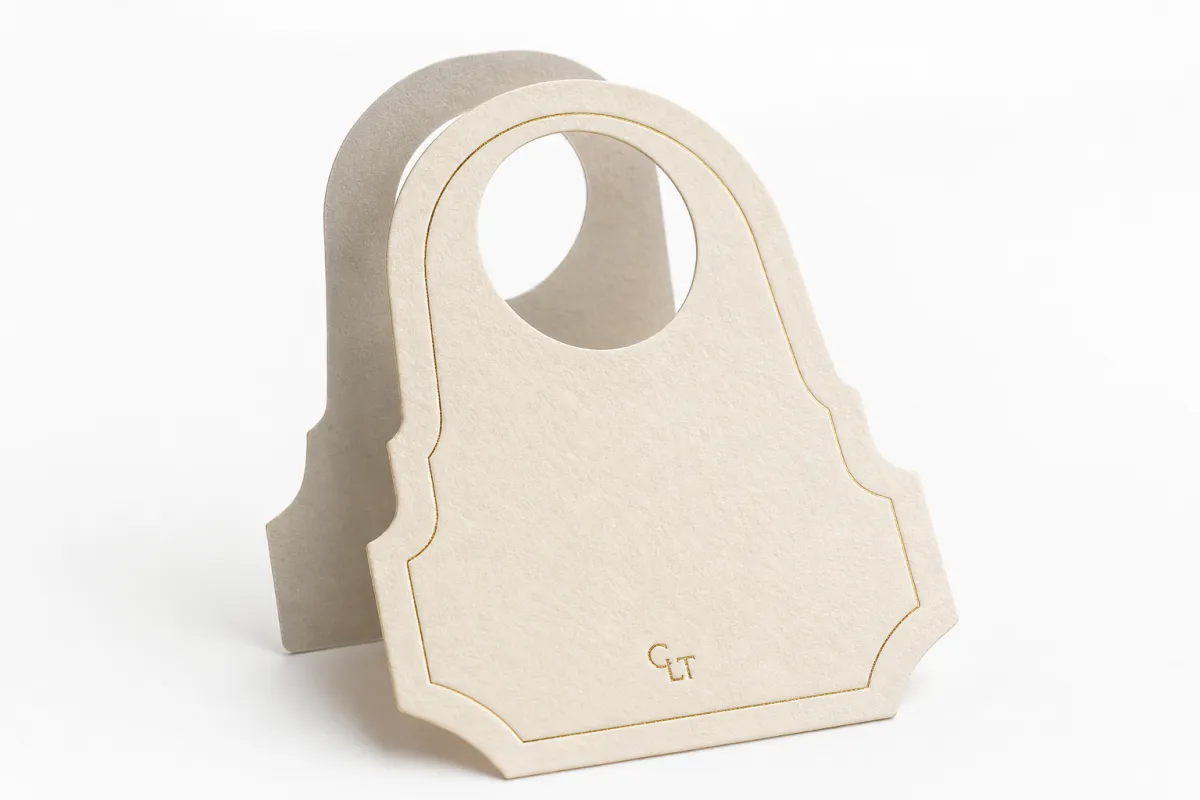
Custom bottle neck hang tags are printed tags that hang from the neck of a bottle with a string, elastic loop, ribbon, twine, or punched hole. No drama. No mystery. Just a compact piece of product packaging that adds message, structure, and shelf presence without forcing you to redesign the bottle or the label.
That is why they show up everywhere from beverage and spirits packaging to gourmet food, cosmetics, and gift sets. A bottle can already carry the core label, but custom bottle neck hang tags handle the jobs that a front label usually cannot do well: seasonal messaging, limited editions, tasting notes, ingredient callouts, QR codes, care instructions, pricing, or a short brand story that makes the item feel more deliberate. In branded packaging, those details change how the whole product is read at a glance.
There is also a practical reason buyers like them. You can test a tag concept without changing the bottle mold, the label format, or the closure. That makes custom bottle neck hang tags useful for smaller runs, promotional launches, gift bundles, event bottles, and private label items that need a fast visual lift. If the rest of the package uses Custom Labels & Tags or broader Custom Packaging Products, the bottle tag becomes one more piece of the same package branding story.
Custom bottle neck hang tags are also popular because they are easy to customize. A simple 14pt cardstock tag can be printed in one or two colors for a clean, low-cost look. A premium version might use 16pt cover, soft-touch lamination, foil, or spot UV. A more natural brand might choose uncoated stock with a kraft look and cotton string. The format flexes well, which is half the appeal, and that flexibility makes it a strong tool for both retail and gifting.
I have seen a plain hang tag pull a bottle into a higher price tier just by cleaning up the message and matching the stock to the rest of the pack. That kind of lift is small in physical size, but it is not small in perception.
A tag that looks good on screen but slides around on the bottle is not clever. It is just expensive decoration.
From a packaging buyer's point of view, the real decision is not whether custom bottle neck hang tags are useful. They are. The real decision is how to spec them so they fit the bottle, survive handling, match the brand, and land at a price that does not make procurement roll their eyes. That means paying attention to size, stock, finish, attachment method, cost, and production timing before anyone gets attached to a pretty mockup.
How Custom Bottle Neck Hang Tags Work on the Shelf
Custom bottle neck hang tags work because they sit in a high-visibility zone. A shopper scanning a shelf usually looks at the label first, then the neck, then the closure, then the overall silhouette. A tag hanging from the neck interrupts that path in a useful way. It gives the eye one more stop. In a crowded retail display, that extra stop can be the difference between "interesting" and "passed over."
The attachment method matters as much as the artwork. A pre-tied string saves labor, but it adds unit cost. An elastic loop is fast to apply and works on many bottle shapes, though it may feel less premium if the cord is too thin or too shiny. Ribbon can look elegant for gifting. Twine works for rustic or artisanal brands, especially if the rest of the package uses natural materials. A punched hole with customer assembly is the cheapest route, but it only makes sense if someone on your side is actually willing to do that work without complaining every fifteen minutes.
Custom bottle neck hang tags also need to match the bottle geometry. A straight-sided wine bottle gives you more predictable clearance than a tapered spirits bottle with a narrow shoulder and a narrow neck. Short, wide tags can swing more. Tall, narrow tags sit cleaner. Folded tags give you more message space, which is useful for tasting notes, ingredient details, or a short brand story. Single-sheet tags are simpler and usually cheaper. Multi-panel tags can hold more information, but they also introduce more layout discipline, because clutter spreads fast when the panels are not planned carefully.
The neck area is small, so the content hierarchy has to be ruthless. One message should lead. One should support it. Maybe two at most. Anything beyond that starts to behave like a flyer, and nobody wants a flyer tied to a bottle unless they are trapped at a trade show. Good custom bottle neck hang tags are readable at arm's length, have a clear front face, and avoid forcing the shopper to rotate the bottle three times just to understand what they are buying.
If you want the tag to earn its keep in retail packaging, the copy needs to be direct. Think "small-batch citrus gin," "pairs with dark chocolate," "gift-ready blend," or "limited release." The design should support that message with typography that stays legible at 6 to 8 point minimum for body text and 10 to 14 point for the primary callout, depending on stock and viewing distance. Tiny decorative type is a classic mistake. It looks refined in the proof and annoying on the shelf.
In practice, the best custom bottle neck hang tags are easy to hang, easy to read, and hard to ignore. That sounds simple because it is simple. The difficult part is removing everything that does not help the tag do its job.
Custom Bottle Neck Hang Tags Cost, MOQ, and Quote Factors
Pricing for custom bottle neck hang tags depends on more moving parts than most buyers expect. Quantity is the biggest lever. After that come size, stock, print method, number of colors, finishing, shape complexity, and whether assembly is included. If you want a neat answer without the sales fog, here it is: short runs cost more per tag, and simple builds cost less. That is not a slogan. It is just how setup works.
For a practical reference point, simple custom bottle neck hang tags in a standard rectangular shape often land around $0.10-$0.22 per unit at 5,000 pieces, depending on stock and coverage. Folded or multi-panel versions usually move into the $0.18-$0.35 range. Add foil, soft-touch lamination, custom die cuts, or hand assembly, and you can see $0.30-$0.60 or more per unit at the same quantity. Smaller runs of 250 to 1,000 pieces can cost much more per tag because you are spreading setup across fewer units. That is not a rip-off. That is math.
Minimum order quantity is another point people underestimate. Some vendors will quote short runs for events or prototypes, especially if the design is simple. But once you ask for custom shapes, specialty paper, foil stamping, or stringing, minimums often rise. The reason is straightforward: more setup, more handling, more waste risk. If you are comparing suppliers, ask whether the MOQ changes by size, finishing method, or assembly. A quote that looks cheap on paper can become less attractive once the tag needs to be stuffed, tied, or packed in a specific way.
Here is a clearer way to compare common options for custom bottle neck hang tags:
| Format | Best Use | Typical Unit Cost at 5,000 | Lead Time | Tradeoff |
|---|---|---|---|---|
| Simple single-sheet tag | Promos, price callouts, basic branding | $0.10-$0.22 | 10-15 business days after proof approval | Lowest cost, least message space |
| Folded tag | Tasting notes, gift messages, ingredients | $0.18-$0.35 | 12-18 business days | More space, more assembly or folding steps |
| Die-cut premium tag | Luxury spirits, beauty, special editions | $0.28-$0.60 | 15-20 business days | Stronger shelf appeal, higher setup cost |
| Tag with stringing or loop assembly | Ready-to-hang retail packs | Base cost + $0.03-$0.10 | Adds 2-5 business days | Saves labor later, raises production cost now |
When you request a quote, do not just ask for the price per piece. Ask for the whole stack: setup fees, die costs, proof charges, assembly, packaging, shipping, and whether the tags are packed loose or pre-strung. That matters especially if your launch uses a timed retail rollout or if the tags must be inserted into Custom Printed Boxes as part of a gift set. A low unit price is nice. A low total landed cost is better.
Material choice can swing price more than people expect. Standard coated cardstock is usually the most economical if you need bright color and clean images. Uncoated or textured stock tends to cost a bit more, especially if you want a premium tactile feel. FSC-certified paper can also affect cost slightly, although not always dramatically. If sustainability is part of the brief, ask your supplier about FSC stock options and how they affect availability.
Finishes are another budget fork. Foil stamping, embossing, soft-touch lamination, and spot UV all improve shelf presence, but not for free. If the bottle already has strong package branding, you may not need three special effects fighting for attention. Sometimes a clean ink build on a well-chosen stock does more work than a shiny tag that looks like it got into a disagreement with the rest of the package.
Bottom line: the cheapest custom bottle neck hang tags are usually simple, standard, and straightforward. The best value is the version that fits the bottle, supports the brand, and does not require three rounds of explanation to finance.
Production Process and Timeline for Custom Bottle Neck Hang Tags
The production workflow for custom bottle neck hang tags is not complicated, but it does punish sloppy planning. It usually starts with the brief, then moves into spec gathering, dieline setup, artwork prep, proofing, printing, finishing, cutting, assembly, and final packing. If any one of those steps gets rushed, the schedule starts drifting. Funny how that works.
Most delays happen before the press runs. Artwork revisions are the usual culprit. Someone notices a typo. Someone else decides the QR code should be bigger. Marketing changes the headline after seeing the proof. Then everyone acts surprised when the timeline slips. Clean files save time, and in tag production, they save real time. If the file is built on the correct dieline with proper bleed, safe zones, and vector text, approval goes much faster.
For standard custom bottle neck hang tags, a reasonable lead time is often 10-15 business days after proof approval for simple builds, and 12-20 business days for folded, die-cut, or finished versions. Add extra time if you want foil, lamination, embossing, or manual stringing. Add more time if the paper stock needs to be special ordered. Shipping can take another few days, depending on where the run is headed and whether the cartons are going into a warehouse, fulfillment center, or event site.
Here is the typical sequence I would expect on a well-run job:
- Spec gathering - confirm bottle neck size, tag dimensions, stock, print method, quantity, and attachment style.
- Artwork setup - place the design on the correct dieline and check safe zones, bleed, and hole placement.
- Digital proof - review copy, colors, and structure before anything gets printed.
- Sample or mockup approval - especially useful for new custom bottle neck hang tags or irregular bottle shapes.
- Production - printing, finishing, die cutting, and assembly.
- Packing and shipping - loose packed, bulk packed, or pre-strung depending on your workflow.
For higher-risk launches, a physical sample is worth the time. A mockup can show the artwork, but it will not tell you whether the tag swings too much, sits too low, or clashes with the closure. A sample does. That is especially true for unusual bottle shapes or premium beverage packaging where the neck area is tight. If the tag is going on a bottle that will be shipped or warehoused before retail use, ask whether the packaging should be tested for abrasion, bending, or transit stress. ISTA protocols are a sensible reference point for distribution testing, even if you are not doing full certification.
One more practical note: if your launch depends on a specific event date, give yourself buffer. A project that looks fine on paper can lose days to one revision round, a stock delay, or a packing mistake. For seasonal beverage drops, gift bundles, and promotional kits, I would leave room for one full correction cycle. Otherwise, you are betting the launch on the idea that nobody makes mistakes. That is bold. Also foolish.
If the custom bottle neck hang tags are part of a broader rollout that includes Custom Labels & Tags, matching cartons, or inserts, line up all the print pieces at once. Coordinated production usually saves both time and color mismatch headaches.
Step-by-Step Guide to Designing Custom Bottle Neck Hang Tags
Good design for custom bottle neck hang tags starts with purpose, not decoration. What is the tag supposed to do? Sell the product? Identify the flavor? Explain a seasonal promotion? Add gifting value? Tell a short brand story? If that purpose is unclear, the layout becomes a junk drawer. Pretty junk, maybe. Still junk.
Step 1: Measure the bottle first. Not the artwork. The bottle. Check neck diameter, shoulder slope, cap height, and the amount of open space available below the closure. A tag that looks proportional on a flat mockup may sit awkwardly on a narrow neck or disappear against a tall bottle. For many standard beverage bottles, a tag around 2 x 3.5 inches or 2.25 x 4 inches works well, but the right size depends on the actual vessel. Custom bottle neck hang tags should be sized to the bottle, not to someone's guess.
Step 2: Decide the content hierarchy. The strongest tag usually uses one primary headline, one supporting line, and one small detail. That is enough. Example: brand name, product type, and a tasting note or gift cue. If the bottle is for beauty or gourmet food, the supporting line might be a usage benefit, ingredient highlight, or production note. In packaging design, clarity beats cleverness more often than people want to admit.
Step 3: Match the material to the use case. Coated paper works well for vivid color, crisp photography, and modern retail packaging. Uncoated stock gives a softer, more tactile feel and often suits craft or artisanal brands. Heavier card stock feels more substantial and travels better if the tag will ship attached to the bottle. If the bottle is part of a premium gift set, a 16pt cover or similar heavy stock usually feels more appropriate than thin paper that flops around like a bad decision.
Step 4: Choose the finish with restraint. Foil, embossing, spot UV, and soft-touch lamination can all elevate custom bottle neck hang tags, but each one should earn its place. A metallic finish can work beautifully on spirits packaging. The same effect can look out of place on a rustic olive oil bottle or a natural beauty product. Good finish choices support the story. Bad ones shout over it.
Step 5: Build the file properly. Use the correct dieline, keep live text inside the safe zone, extend artwork into the bleed, and convert linked images to print-ready resolution. Check the hole placement against the neck size. If the tag is folded, make sure the fold line does not crush important type or a QR code. For barcodes and QR codes, test readability at final size. A pretty tag that scans badly has failed one of its main jobs.
Step 6: Compare the tag to the rest of the package. The tag should feel like part of the same system as the label, carton, insert, or wrap. If the rest of the package uses custom printed boxes with warm neutrals and a restrained serif typeface, do not slap a neon tag on it because someone in a meeting wanted "more pop." Package branding works best when the tag feels intentional, not like it was borrowed from another product line.
Here are a few design checks that save real pain later:
- Keep the main message visible from about 2 to 3 feet away.
- Use high contrast between text and background.
- Leave room around the hole so the paper does not tear.
- Test the string or loop against the actual neck finish.
- Ask for a folded physical sample if the design relies on panels.
There is a reason experienced buyers keep coming back to sample-led design. Custom bottle neck hang tags are small, and small formats magnify bad decisions. A little extra planning up front usually beats a stack of reprints later.
Common Mistakes With Custom Bottle Neck Hang Tags
The most common mistake with custom bottle neck hang tags is simple: making them too big. Oversized tags swallow the bottle, swing awkwardly, and often scrape against each other in transit. Too small has its own problem. It can make the brand feel cheap or unfinished. There is a middle ground, and it depends on the bottle. Shocking, I know.
Another frequent problem is overcrowding the design. Buyers try to squeeze in the brand story, ingredients, tasting notes, a promo code, social handles, a sustainability claim, and a QR code all on one face. The result is a tag that looks busy even before it is printed. Good custom bottle neck hang tags are not a storage unit for every piece of information. They are a filter.
Attachment issues also create trouble. If the punched hole sits too close to the edge, the tag can tear. If the string is too thin, it cuts into the paper. If the elastic is too loose, the tag slides around. If the bottle neck is tapered, a rigid loop can sit crooked or slip off during handling. These failures are not dramatic, which is why they are so annoying. They show up one case at a time and quietly embarrass everyone.
Finish choices can miss the mark too. A high-gloss coating on a brand that wants a natural, handmade look can feel wrong. Heavy metallic foil can overpower a minimalist label. Over-embellished custom bottle neck hang tags sometimes look expensive in a way that does not help the actual product. That mismatch is common in premium beverage packaging, where teams confuse "more finish" with "more value." Those two things are not the same.
There is also the budget mistake: approving a quote without checking setup, assembly, packing, or shipping. That is how a project that seemed manageable turns into a finance conversation nobody wanted. I would rather see a buyer ask one annoying question up front than discover three hidden charges after approval. The first move saves money. The second one saves everyone from pretending to be surprised.
Here is the short version of what goes wrong most often:
- Tag size is chosen before the bottle is measured.
- Copy is too small to read at shelf distance.
- Hole placement weakens the card.
- String choice does not fit the brand or bottle.
- The quote leaves out assembly, packing, or freight.
If you avoid those mistakes, custom bottle neck hang tags become one of the easiest ways to improve retail packaging without changing the bottle itself. That is a pretty good return for a small piece of card.
Expert Tips and Next Steps for Custom Bottle Neck Hang Tags
If you are new to custom bottle neck hang tags, start with one sample build instead of betting the entire run on a first draft. Pick one size, one stock, and one attachment method. Test it on the real bottle. Not a rendering. Not a photo. The actual bottle. That one sample tells you more than a stack of digital proofs ever will.
That sample-first approach is especially useful for launches that sit alongside other branded packaging pieces. If the bottle is going into a gift box, carton, or bundle, the tag should be evaluated with the rest of the package in hand. A bottle tag that looks perfect by itself can feel too small next to a large carton, or too formal next to a casual wrap. The best package branding reads as one system, not a pile of separate decisions.
Keep the message short. Really short. For most custom bottle neck hang tags, one strong message beats three average ones. If the tag is retail-facing, the buyer should grasp it in a second or two. If it is for gifting, the message should feel warm and specific, not generic enough to be printed on anything from wine to hand soap.
If you need to reduce cost, work in this order: simplify the shape, simplify the finish, simplify the print coverage, and then check whether assembly can happen on your side. That sequence usually protects the most visible parts of the design first. It also keeps the tag from looking stripped-down in a cheap way.
One production trick I use a lot is this: lay the tag next to the bottle photo, then next to the actual bottle, then next to the closure. If it still feels right in all three contexts, you are probably in good shape. If it only looks good in one, keep adjusting. That is the kind of boring test that saves a lot of expensive rework later.
Here is a practical checklist before you place an order:
- Confirm bottle neck measurements and shoulder shape.
- Decide whether the tag needs to be single-sheet or folded.
- Write the final copy before layout begins.
- Request a quote that includes setup, assembly, and shipping.
- Review the dieline and proof carefully.
- Approve a physical sample if the bottle shape is unusual.
For brands that want a coordinated launch, I would also compare the tag with any labels, cartons, or inserts already in the system. If the bottle uses Custom Labels & Tags and the outer pack uses a distinct look, the bottle tag should bridge the two, not clash with either one. That kind of consistency makes the whole product feel thought through.
One last production tip: plan for the real world, not the brochure. Boxes get stacked. Bottles get handled. Tags swing. Strings loosen. Paper dents. ISTA-style thinking helps because it forces you to consider transit, packing, and handling instead of assuming the tag will stay pristine because the mockup looked clean on a laptop. It rarely does. Reality is rude like that.
Used well, custom bottle neck hang tags give you an efficient way to add value, improve shelf presence, and sharpen retail packaging without rebuilding the entire product. Keep them fitted, readable, and tied to the launch plan, and they will pull their weight. Treat custom bottle neck hang tags as an afterthought, and they will look like one. Simple as that.
FAQ
How do I choose the right size for custom bottle neck hang tags?
Start with the actual bottle, not a generic template. Measure neck diameter, shoulder shape, and the hanging space below the closure, then choose a size that stays proportional to the bottle body. For tapered or unusual bottles, a physical mockup is the safest way to confirm that the tag sits correctly.
What materials work best for custom bottle neck hang tags?
Coated stock works well for bright color, photography, and sharp graphics. Uncoated or textured stock makes more sense for natural, premium, or artisanal branding. If the tag has to feel substantial or survive shipping, heavier card stock is usually the better move.
Can custom bottle neck hang tags fit different bottle shapes?
Yes, but the attachment method matters a lot. Elastic loops and pre-tied strings usually handle more variation than rigid setups. Tapered necks and unusual shoulders should always be tested with a sample before you commit to the full run.
What affects the price of custom bottle neck hang tags the most?
Quantity has the biggest impact because setup costs are spread across the whole run. After that, size, stock, print coverage, finishing, die-cut complexity, and assembly all move the price. Simple shapes and standard materials are usually the easiest way to keep costs in check.
What is a realistic turnaround for custom bottle neck hang tags?
Simple jobs often move in about 10-15 business days after proof approval. Folded, die-cut, foil-stamped, or assembled tags usually take longer, often 12-20 business days or more. Shipping, revisions, and material availability can all add time, so build a buffer into the schedule.
Do custom bottle neck hang tags need to match the bottle label exactly?
They do not need to match perfectly, but they should feel like they belong to the same system. A tag can contrast with the label if the brand story supports it, yet the type, color, and finish should still feel intentional. If the tag looks borrowed from another product line, the package starts to feel disconnected.

