A customer notices the bag before they notice the earrings. That is the whole trick. Custom Boutique Paper Bags for jewelry do a lot of quiet work before the customer even gets home. They make a simple purchase feel deliberate, giftable, and worth the price tag.
For jewelry retailers, the bag is not just a carrier. It is packaging, brand cue, and a small piece of theater all at once. The right one frames the sale, protects delicate items on the way out, and keeps the brand story consistent with the box, tissue, and care card. The wrong one does the opposite. It whispers budget at the exact moment the customer should be thinking special.
That is why jewelry bags deserve more than a generic spec sheet. Small format packaging is unforgiving. A millimeter off in size, a weak handle, or a finish that scuffs too easily shows up fast. Buyers usually notice the problem in the store, not after delivery, which is why the details matter before production starts.
What Makes Jewelry Boutique Bags Feel Premium
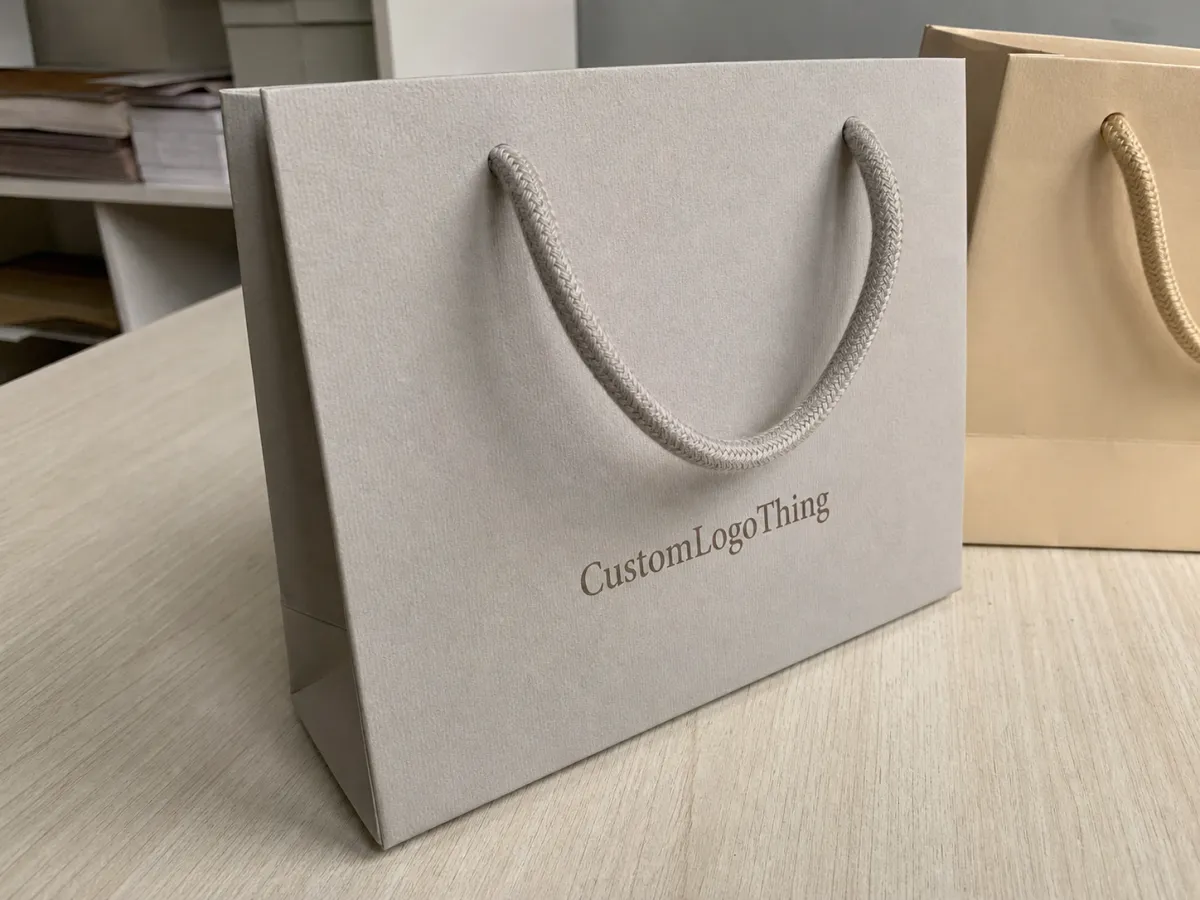
Premium is mostly about signals, not price. A compact bag with clean proportions, a sturdy board feel, and a logo printed with restraint usually looks more expensive than a larger bag covered in shiny effects and five fonts fighting for attention. People try to decorate value onto a bag. That is backward. Value should be built into the structure first.
Custom boutique paper bags for jewelry work especially well because jewelry is already small, delicate, and high-margin. A ring box, a velvet pouch, or a necklace set does not need a giant carrier. It needs a bag that makes the handoff feel intentional. In real retail use, these bags show up at checkout counters, bridal appointments, holiday gifting, VIP client packages, and quick add-on sales. The same pair of studs feels different when it leaves in a flimsy generic bag versus a branded one that looks like it belongs in the store.
The bag also changes how the purchase looks outside the store. Someone carrying it into the street, the car, or a photo gives your brand free visibility. That works only if the design is clean. If the artwork is crowded or the structure looks weak, the bag becomes a moving ad for indecision.
A bag that looks generic tells the customer the brand stopped caring one step too early.
Good jewelry bags are usually easy to identify from a few feet away. The logo reads clearly, the color palette stays disciplined, and the proportions feel deliberate. That does not require heavy decoration. A single strong color field or a centered mark can do more for perceived value than a design that tries to prove itself from every angle.
Consistency matters too. If the bag does not match the jewelry box or tissue paper, the whole package feels assembled instead of designed. The best setups are not loud. They just feel like they belong together.
How Jewelry Bag Design Works in a Real Retail Order
A good jewelry bag has two jobs. First, it gets the purchase from the counter to home without drama. Second, it reminds the customer where it came from. That second job matters more than people think, because the bag often outlives the transaction. Customers reuse it, store keepsakes in it, or hand it to someone else. That extends brand exposure in a way a receipt never will.
Structure matters here. A flimsy bag collapses when a small box goes in, which makes the whole purchase feel like an afterthought. A stiffer build holds its shape, keeps the box upright, and gives staff something that packs quickly during a rush. None of that sounds glamorous. It is simply what good retail packaging is supposed to do.
The bag also has to work with the rest of the stack: jewelry boxes, tissue paper, inserts, gift receipts, and care cards. If the box is elegant but the bag is flimsy, presentation drops the second the customer leaves the counter. If you sell bridal sets or layered gift items, the bag should have enough room for the box plus tissue and a little hand clearance so it does not look jammed shut.
There is a practical side to packaging design that gets ignored until it becomes a headache: storage and handling. Flat-packed bags should stack neatly, store easily behind the counter, and assemble without slowing staff down. If the team hates using it, the bag is failing even if it looks nice in a render.
Artwork needs to survive real conditions. Thin logos, weak contrast, and crowded graphics can disappear once the bag is folded, carried, or photographed under store lighting. A good proof should be checked at actual size, not just on a screen. Jewelry packaging is small. It needs clarity, not noise.
Materials, Finishes, and Size Choices That Change the Feel
Material choice changes everything. Coated paper gives a smoother, more polished look. Kraft paper feels earthy, handmade, and more casual. Textured paper adds a tactile cue that can make a small bag feel more expensive. Rigid-laminated builds are the most upscale, but they are also heavier and cost more, so they make sense for gift-focused or high-ticket jewelry lines rather than everyday checkout use.
A useful way to think about custom boutique paper bags for jewelry is in three common build types:
- Coated paper for clean branding and sharp print.
- Kraft paper for natural, eco-forward, or artisanal positioning.
- Rigid-laminated paper for upscale presentation and stronger structure.
For paper thickness, small boutique bags often land around 157-210 gsm for printed paper faces, with reinforcement added where needed. Rigid builds may use 1.5-2.0 mm board. Handle anchors should be reinforced, because a beautiful bag with weak handle attachment fails at the worst possible moment. A customer does not remember the paper grade. They remember the bag giving out.
Finishes move perception fast, but they should be chosen with discipline. Matte lamination feels calm and modern. Soft-touch coating adds a velvety surface and works well on minimalist artwork. Foil stamping gives a metallic flash, which can look excellent on black, navy, forest green, or deep burgundy bags. Embossing and debossing add subtle texture. Spot UV can work too, though too much gloss on a jewelry bag can feel loud. Small packaging does not need to audition for a nightclub.
Size deserves more attention than it gets. A bag that is too wide makes a tiny ring box float awkwardly. A bag that is too tight looks cheap and stresses the handles. Measure the jewelry box first, then add room for tissue, ribbon, and hand clearance. Most boutique jewelry bags sit in compact formats, but larger gift sets or bridal packaging need more width and a slightly taller profile. If there is a chance the customer will add a second item at checkout, build for that.
Handle choice changes the experience too. Ribbon handles feel gift-forward. Cotton rope handles feel sturdy and comfortable. Paper twist handles are practical and cost-conscious. Die-cut handles can work for flat lightweight builds, but they are not the best answer if the goal is a premium feel. Handle comfort sounds minor until a customer carries the bag for twenty minutes and notices the difference.
Print method matters more than most buyers expect. Offset printing is better for crisp detail and larger runs. Hot foil stamping is better for a metallic accent that looks intentional. A plain kraft bag can still look refined if the ink coverage stays simple and the artwork respects the texture of the stock. The mistake is trying to fight the material instead of using it.
For sourcing and performance, it helps to think in standards rather than vibes. FSC-certified paper can support traceability goals, and transit-related guidance from sites like FSC and ISTA is useful if your packaging will be bundled or shipped in bulk. For broader packaging education, Packaging.org is a solid reference point.
| Bag Build | Best Use | Typical MOQ | Approx. Unit Cost | Tradeoff |
|---|---|---|---|---|
| Kraft with 1-color print | Everyday boutique sales, eco-forward branding | 200-500 pcs | $0.55-$1.20 | Less polished; artwork must stay restrained |
| Coated paper + matte lamination | Most jewelry boutiques, gift-ready retail packaging | 300-1,000 pcs | $0.85-$1.80 | Better look, moderate cost jump |
| Rigid-laminated bag + foil | VIP orders, bridal sets, luxury gifting | 500-2,000 pcs | $1.40-$3.50 | Best presentation, heavier freight, higher setup cost |
Those numbers are broad, and they should be. Final pricing shifts with size, paper grade, handle type, print coverage, assembly method, carton packing, and freight. They also usually exclude duties and local delivery charges. A quote that does not separate those pieces is not very useful.
Custom Boutique Paper Bags for Jewelry: Cost, MOQ, and Unit Pricing
Pricing is a mix of boring details, which is exactly why it matters. Paper stock, size, print coverage, handle type, finishing, insert work, and freight all affect the final number. The logo itself is rarely the expensive part. Setup, material choice, and the amount of handwork are where the bill grows teeth.
MOQ is simple: smaller runs cost more per bag because setup is spread across fewer units. That is not a trap. That is manufacturing math. For custom boutique paper bags for jewelry, lower-volume orders make sense when you are testing a new brand look, launching a seasonal line, or buying for a limited event. Larger runs work better when the bag design is stable and annual usage is predictable.
Here is the cleanest way to compare quotes:
- Base bag cost - paper, structure, handles, size.
- Decoration cost - print, foil, embossing, spot UV.
- Assembly cost - pre-built bags, inserts, or special folding work.
- Freight - weight, carton count, destination, delivery speed.
For a realistic buying range, simple bags at 100-250 units may land around $1.50-$3.50 each, depending on size and finish. At 500 units, many buyers see the range drop closer to $0.85-$1.80. Past 1,000 units, a cleaner spec can get into the $0.55-$1.25 range. Those are broad bands, not promises, because a foil-stamped rigid build and a plain kraft bag are not competing in the same league.
If you are reviewing suppliers, ask for two or three quantity breaks. That is where the truth shows up. A quote that looks cheap at 100 units can become expensive at 500. A quote that looks high at 250 units may make sense once setup is spread out. Compare line by line, not by the final number alone. That is the fastest way to see whether the price is actually real.
There is another pricing mistake worth calling out. Buyers sometimes add every possible upgrade because each one sounds premium in isolation. That usually creates a bag that costs too much and still does not look focused. One strong upgrade, like soft-touch lamination or foil stamping in one place, often does more than stacking five finishing effects.
Buyers also underestimate rejection risk. If a supplier cannot tell you paper thickness, laminate type, handle attachment method, and print process, they are asking you to trust a vague spec. That is not a serious quote. Ask for the actual build details before you compare cost.
Production Steps, Lead Time, and Turnaround From Proof to Delivery
The order process should be boring. Boring is good. It usually means fewer surprises. A clean production flow for custom boutique paper bags for jewelry looks like this: brief, dieline, artwork setup, proofing, sample approval, production, quality check, packing, and shipping. If someone skips one of those steps, that is where mistakes hide.
What speeds things up? Complete dimensions, print-ready logo files, Pantone targets, finish requests, handle preferences, and a confirmed delivery address. If you can answer those six items without three email threads, you will save time. If not, production waits while everybody tries to decode the project from screenshots and half-finished notes. That is how schedules start wobbling.
Lead time and freight time are not the same thing. Lead time is production. Freight time is transit. Buyers mix them up constantly and then act surprised when the bags are late even though production finished on schedule. Simple paper bags with standard printing and standard handles often move faster, usually around 12-15 business days after proof approval in a smooth run. Premium builds with foil, embossing, rigid board, or custom inserts need more breathing room, often closer to 18-25 business days.
Delays usually come from the same places: incomplete artwork, late proof changes, special finishes, and peak-season queues. Jewelry packaging often spikes before holiday periods, bridal season, and event-heavy months, so leaving a cushion is smart. Nobody enjoys paying rush fees because the project started two days late and ended five days late.
Quality control matters before the bags leave the floor. Good checks include print registration, glue line alignment, handle attachment strength, edge scuffing, and carton compression. A bag can look beautiful on press and still arrive tired if it was packed badly. Ask how cartons are arranged, how corners are protected, and whether random samples are pulled before shipment. That is where practical suppliers separate themselves from the people just selling pictures.
File prep is another place where projects either glide or drag. Vector logos are best. If the art uses tiny text, thin lines, or complex gradients, ask for a print review before approval. Some details vanish on textured paper or soften under foil. A screen mockup will not tell you that. A physical sample usually will.
Common Mistakes That Make Jewelry Bags Look Cheap
The first mistake is sizing. Buyers measure the jewelry box, ignore tissue, ribbon, inserts, and hand space, then wonder why the bag looks overstuffed. That is not a design problem. That is a math problem. The bag should hold the whole presentation without bulging at the top or swallowing the box at the bottom.
The second mistake is overdesign. Too many fonts, too many finishes, too many colors, and too much shine can make a good bag feel cheap fast. Premium usually looks calm. Luxury retail packaging rarely needs to shout. It needs to be clear. If the bag is trying harder than the jewelry, something has gone off the rails.
The third mistake is weak construction. Handles that feel flimsy, folds that crack, and paper that buckles under a small box all damage trust. A customer may not say it out loud, but they notice. They feel it in the hand. They remember the sag. If the bag flexes too much at the base, the brand picks up a discount-store feeling no logo can fix.
The fourth mistake is chasing the lowest unit price without checking what gets lost. Cheap paper, weak lamination, poor alignment, and bad handle attachment can cost more in the long run if the bags get tossed, replaced, or quietly make the brand look smaller than it is. That is a very expensive bargain.
The fifth mistake is ignoring operations. Flat-pack efficiency matters. Storage space matters. So does how fast staff can assemble the bag during peak hours. If the team has to fight the packaging every time they serve a customer, the premium bag becomes a daily annoyance. Retail teams have enough to do already.
The sixth mistake is ignoring how materials behave over time. Dark matte finishes can show scuffs. Kraft can absorb ink in a way that softens fine details. Foil can look great in a sample and then reveal tiny registration issues when the run scales up. These are not deal breakers. They are reasons to ask better questions before the order is locked.
The best jewelry bag is the one staff can use quickly, and customers are happy to keep.
Expert Tips and Next Steps for a Cleaner Order
Start with the use case, not the wishlist. A bag for gifting, counter pickup, bridal sales, loyalty rewards, or shipping support will not always need the same structure. That sounds obvious, but people still order one generic spec and hope it solves five different jobs. It usually does not.
If you want the bag to feel elevated, pick one hero upgrade and let it do the work. Maybe that is soft-touch coating. Maybe it is foil stamping in one place. Maybe it is a thicker board with a cotton handle. The point is focus. One clear premium decision often looks better than a pile of decoration.
Before placing an order, I would check six things every time:
- Measure the box and add clearance.
- Choose the quantity band before asking for pricing.
- Gather logo files and color targets in vector format.
- Decide on one finish that supports the brand, not three.
- Ask for proof, sample, or dieline review before approval.
- Compare at least two quotes line by line, not just by total.
When you compare suppliers, make them separate stock, print, handle, finish, and freight. That is the cleanest way to avoid vague pricing. If you also need matching boxes or inserts, keep the design system consistent so the bag does not drift away from the rest of the packaging. Package branding gets stronger when every piece looks like it belongs in the same collection.
Honestly, the best custom boutique paper bags for jewelry do not try to be the star of the show. They make the jewelry feel more considered, more gift-ready, and more valuable without begging for attention. That is the job. Do it well, and the bag becomes the final layer of the experience instead of an afterthought.
What size should custom boutique paper bags for jewelry be?
Measure the jewelry box first, then add room for tissue, ribbon, and a little hand clearance so the bag does not look stuffed. Small ring and earring boxes usually need a compact bag, while layered gift sets need extra width and height to stay upright. If the size is uncertain, ask for a dieline Before You Order.
Which paper stock looks best for jewelry boutique bags?
Coated or laminated paper usually gives the cleanest premium look for boutiques that want a polished finish. Kraft works better for earthy, handmade, or eco-forward positioning, but it needs disciplined artwork to avoid looking plain. Rigid-laminated builds are best when the bag must feel sturdy, giftable, and visibly upscale.
How much do custom boutique paper bags for jewelry cost at low MOQ?
Low-MOQ pricing is usually higher per bag because setup and production prep are spread across fewer units. The biggest cost levers are size, print coverage, finish level, and handle type, not just the logo itself. Get quotes at multiple quantities, like 100, 250, and 500 units, to see where the unit price drops enough to matter.
How long is the turnaround for jewelry paper bags?
Simple bags with basic print and standard handles usually move faster than premium builds with foil, embossing, or custom inserts. Proof approval time matters, so tight artwork and quick feedback can shave days off the schedule. Add freight time separately, because production may be done before the boxes actually arrive at your door.
What makes custom boutique paper bags for jewelry feel expensive?
Clean proportions, sturdy handles, and a restrained color palette do more for perceived value than a loud design ever will. One strong finish, like foil or soft-touch lamination, often beats piling on several small effects. Good packaging feels easy for staff to use and easy for customers to keep, which is the kind of detail people remember.

