Buyer Fit Snapshot
| Best fit | Custom Box Dividers Bulk projects where brand print, material claims, artwork control, MOQ, and repeat-order consistency need to be specified before quoting. |
|---|---|
| Quote inputs | Share finished size, material target, print colors, finish, packing count, annual reorder estimate, ship-to region, and any compliance wording. |
| Proofing check | Approve dieline scale, logo placement, barcode or warning zones, color tolerance, closure strength, and carton packing before bulk production. |
| Main risk | Vague material claims, crowded artwork, missing packing details, or unclear freight terms can make a low unit price expensive after revisions. |
Fast answer: Custom Box Dividers Bulk: Specs, Pricing, and Lead Times should be specified like a repeatable production item. The safest quote records material, print method, finish, artwork proof, packing count, and reorder notes in one written spec.
Production checks before approval
Compare the actual filled-product size with the drawing, then confirm tolerance on folds, seals, hang holes, label areas, and retail display edges. Reserve space for logos, QR codes, warning copy, and material claims before decorative graphics fill the panel.
Quote comparison points
Review material grade, print process, finish, sampling route, tooling charges, carton quantity, and freight assumptions side by side. A quote is only useful when the supplier can repeat the same color, closure quality, and packing count on the next order.
Custom Box Dividers Bulk: Specs, Pricing, and Lead Times
A product that shifts a quarter inch inside a carton can pick up a scuffed label, a chipped edge, or a broken seal long before it reaches the customer. That tiny amount of movement is exactly why custom box dividers bulk orders deserve real attention: they keep products in place during transit, maintain a clean packout, and reduce the expensive habit of fixing a packaging problem later with extra filler, heavier tape, or a larger box than the job actually needed.
From a packaging buyer’s standpoint, the math is pretty direct. A properly fitted divider set can reduce damage claims, speed up the packing line, and improve shelf-ready presentation without changing the product itself. That matters in product packaging, retail packaging, and branded packaging alike. It matters even more once cartons pass through multiple hands, because a divider that stays aligned in a warehouse usually performs better than a loose fix that only looked good on a sample table. For teams comparing Custom Printed Boxes, insert systems, and package branding upgrades, custom box dividers bulk often becomes the most practical way to turn a packout into a controlled system instead of a guess.
There is another benefit that usually shows up later in the budget. One well-fitted divider set can cost less than the combined effect of extra outer packaging, freight penalties tied to dimensional weight, and replacement inventory after breakage. I’ve seen teams chase the cheapest divider quote, only to spend more on returns and repacks than they would have spent on the right spec in the first place. That is why many operations treat custom box dividers bulk as a risk-control purchase, not a decorative one. It is packaging design with a practical job: keep the product where it belongs and keep margin from leaking away in transit.
“A divider seems inexpensive until a pallet of returns tells a different story. The right fit protects margin in a way most buyers only see after the first damage report.”
Custom Box Dividers Bulk: Why Small Gaps Cost More
Small movement rarely stays small. A candle jar that leans into another jar can chip the finish. A cosmetic bottle with a secure cap can still rub through a printed label. A glass item may survive a short drop and still fail later because repeated vibration weakens the same corner over and over. That is the practical reason custom box dividers bulk tends to be about more than separation; it is about stopping motion across the full shipping cycle.
Bulk divider orders help because they keep the carton architecture consistent. Once the same divider layout is used across every pallet, the packout stays stable in storage, on the line, and in the field. That consistency matters for multi-SKU programs, seasonal runs, and retail packaging sets that need to look organized even after long transit. In a warehouse, a divider that works for 1,000 units becomes even more valuable at 10,000 units, because small fit issues begin to compound. That is where custom box dividers bulk starts paying back through fewer damaged units, less void fill, and less time spent rebuilding cartons that should have been right from the start.
Presentation plays a part too. Clean internal partitioning changes the way a box feels the moment it opens, which matters for subscription kits, gift sets, and ecommerce orders that double as unboxing moments. Buyers often compare the cost of custom box dividers bulk with the cost of adding more external protection later. In many cases, the divider wins because it addresses the problem at the source. Extra corrugate outside the box can add freight, create storage headaches, and still fail to stop movement inside the carton.
Here is the comparison that usually matters most:
- Divider-first approach: controls motion at the product level, often with lower damage risk and better pack speed.
- Outer-box-only approach: can mask the issue for a while, but it often adds weight, size, and cost.
- Void-fill-only approach: works for some items, though it can shift during transit and create a less consistent unboxing experience.
In practice, custom box dividers bulk works best when the product has repeatable dimensions, moderate fragility, and a carton footprint that will not change every few weeks. That describes glassware, candles, health and beauty kits, food gifting, accessories, and small electronics. It also fits wholesale programs where a buyer needs the same internal layout across multiple destinations. For teams that need both packaging discipline and ordering flexibility, Custom Packaging Products can be the right starting point.
Custom Box Dividers Bulk Product Details
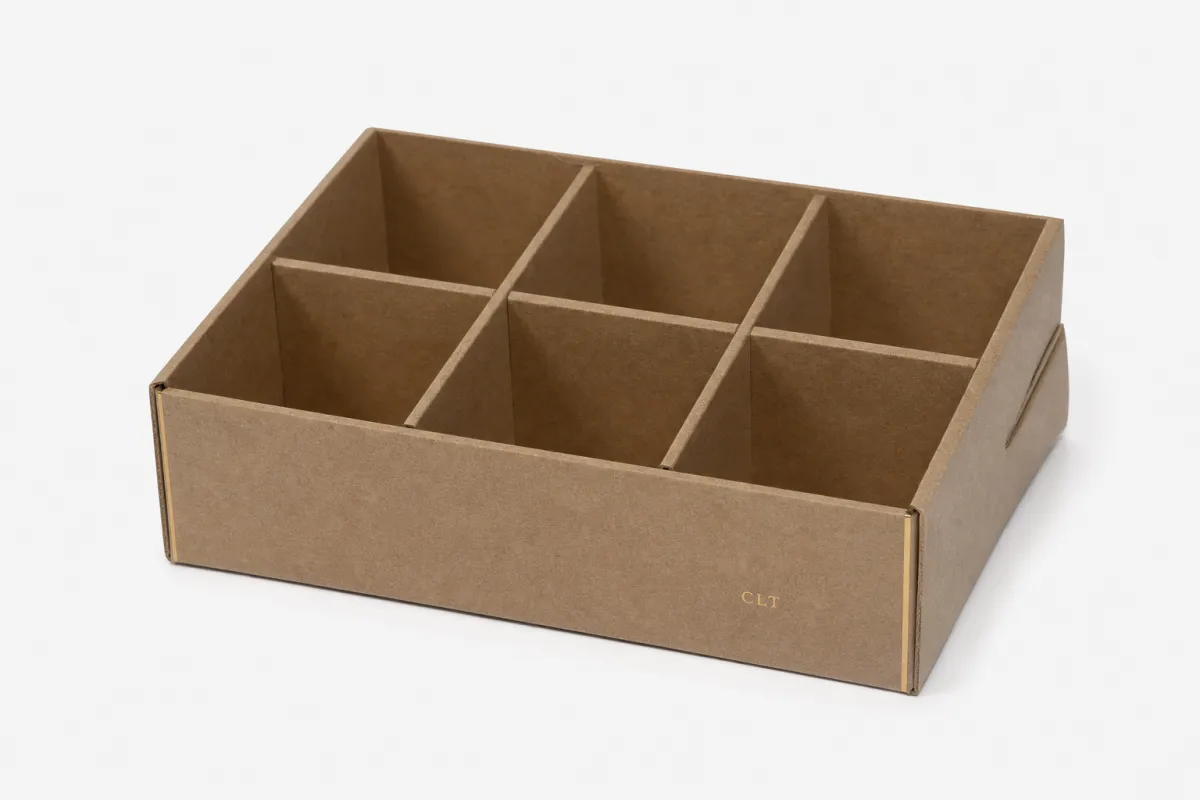
At its simplest, a divider is a structural insert that splits one carton into separate cells. Decoration is not the point. Control is. Custom box dividers bulk configurations differ from stock inserts because they are cut or partitioned to match the exact carton footprint, the product dimensions, and the way the packout will be loaded. Stock dividers are convenient; custom layouts are usually more exact and more predictable.
Buyers usually choose among a few formats. Corrugated grids are common for heavier or more fragile items. Chipboard partitions are often used for lighter products or tighter retail packaging programs. Slotted inserts and die-cut layouts can create more precise cell counts for odd product mixes. All of these can be produced as custom box dividers bulk orders once the run size is large enough to justify a repeatable specification.
The right fit depends on the application. Glassware needs a firmer wall between items. Cosmetics often need a cleaner presentation and less abrasion. Candles can benefit from a partition that supports the jar body and keeps lids from touching. Food kits may need compartments that prevent rattling while still allowing fast loading. Electronics usually need enough spacing to keep corners from striking the carton wall. In every case, the divider should work with the item, not against it.
Customization reaches beyond cell count. Buyers can specify:
- Divider height: full-height, partial-height, or flush with the carton top.
- Panel thickness: matched to the load, the drop risk, and the required stiffness.
- Cell width: sized to the product with practical loading clearance.
- Wrap style: standard slotted, cross-divider, folded, or die-cut forms.
- Print: simple identification marks, product names, or brand messaging where useful.
- Insertion method: manual packout, semi-automated loading, or line-ready partitioning.
That is where custom box dividers bulk starts to connect packaging engineering with package branding. A divider may not be the hero of the shelf, but it can still reinforce the message that the brand pays attention to order, protection, and detail. For that reason, many teams treat divider work as part of broader packaging design rather than a separate afterthought. It sits beside custom printed boxes, protective inserts, and the outer carton as one coordinated system.
Materials, Dimensions, and Performance Specifications
Material choice changes the result more than many buyers expect. A divider that feels perfect for a light cosmetic set may collapse under the stack pressure of a heavier glass item. A divider that looks sturdy on one line may be too bulky for a carton that needs higher pack density. That is why custom box dividers bulk should begin with the product, the carton, and the distribution environment rather than with the cheapest board on the quote sheet.
Corrugated board is the most common option for protective divider work. It provides better cushioning and stronger compression resistance, especially with B-flute or E-flute constructions. E-flute is thinner and works well where print quality and tighter packing matter. B-flute is thicker and better when the divider must hold shape under heavier loads. For more demanding shipping lanes, some buyers move to higher basis weights or stronger board grades. A typical choice might be 32 ECT for lighter programs and 44 ECT or double-wall structures when the stack load is higher or the route is rougher. That is not universal, but it is a useful rule of thumb.
Chipboard is often used for lighter items, especially where a neat internal appearance matters and the weight of the products does not demand corrugated protection. It can be a smart choice for cosmetics, accessories, and layered kits. The tradeoff is stiffness: chipboard is less forgiving under pressure and moisture than many corrugated structures. For custom box dividers bulk projects that travel long distances or face humid storage, that tradeoff needs careful review.
Dimensions are where many projects lose time. Knowing the outside carton size is not enough. The critical measure is the internal carton dimension, because that determines the true cavity available for the divider set. From there, buyers should calculate product clearance, handling clearance, and tolerance range. A practical starting point is to allow about 1/16 inch to 1/8 inch of clearance on each side for items that are wrapped, sleeved, or manually loaded. Fragile items may need more or less depending on their geometry and whether the divider is supporting the item body or only separating items from each other.
Performance specs should stay concrete. Ask for or confirm:
- Compression strength: enough to survive stacking, pallet wrap tension, and warehouse storage.
- Cut accuracy: clean die lines and consistent cell size across the run.
- Moisture resistance: especially important in warehousing, coastal shipping, or seasonal humidity swings.
- Stack behavior: whether the divider walls retain position when cartons are loaded above them.
- Edge integrity: whether the score lines and folds hold without cracking.
For testing and transport validation, many teams reference ISTA test methods and, where compression matters, ASTM procedures such as D642 or transport simulation programs like D4169. If the divider material is part of a sustainability brief, FSC certification can help confirm responsible fiber sourcing. Those standards do not choose the design for you, but they do give procurement teams a common language for comparing suppliers and protecting the spec.
Before approving custom box dividers bulk, I always recommend a short spec checklist:
- Carton internal length, width, and height.
- Product dimensions, weight, and the heaviest SKU in the set.
- Number of cells required and whether the cells are uniform or mixed.
- Board grade, flute type, and any moisture or strength requirement.
- Target ship date, destination, and whether the order will be palletized or master-cartoned.
This is the part that saves time later. The more exact the spec, the easier it is to quote custom box dividers bulk without back-and-forth revisions that chew up production time.
Custom Box Dividers Bulk Pricing, MOQ, and Unit Cost
Pricing rarely comes down to one variable. With custom box dividers bulk, the main drivers are board grade, finished size, cell count, print coverage, tooling, and order volume. A simple two-cell insert in chipboard is priced very differently from a heavy corrugated grid with tight tolerances and branded print. A quote that looks high at first glance may still produce the better landed cost once freight, waste, and damage reduction are included.
As a directional reference, smaller bulk runs may sit around $0.35-$0.85 per divider set for corrugated work and $0.18-$0.40 per set for simpler chipboard layouts, depending on quantity and dimensions. Larger repeat orders can come down meaningfully once tooling is spread across the run. Printed surfaces, custom cutouts, and special inserts can push the cost upward. If the design requires specialized tooling, there may also be a one-time setup charge that should be spread across the full project. Those numbers are not universal, but they are close enough to frame the conversation in a useful way.
MOQ depends on complexity. Simple divider formats may start at a few hundred sets if the size is standard and the cut pattern is straightforward. Fully custom layouts with multiple cells, print, or unusual board combinations often start closer to 1,000 sets or more. For custom box dividers bulk, MOQ is less about gatekeeping and more about production efficiency. A short run with heavy setup can be expensive for both sides; a longer run can spread that setup cost and lower the unit price in a way that actually helps the buyer.
There are also hidden costs that change the real landed price:
- Freight: divider sets are often lightweight but bulky, so carton cube and pallet count matter.
- Samples: prototype charges may apply, especially if dielines must be developed from scratch.
- Setup and tooling: custom cutting rules or partitions may require a one-time charge.
- Rush production: compressed schedules can increase labor and scheduling cost.
- Revisions: if carton dimensions change after approval, the cost can rise quickly.
The most useful comparison is not unit price alone. It is the total delivered cost per finished divider set. That means the quote should include materials, manufacturing, packaging, freight assumptions, and whether the order is shipped flat or assembled. Buyers placing custom box dividers bulk orders for multiple locations should also ask whether a standardized design can be used across several SKUs. Standardization often lowers cost because the same layout can be ordered repeatedly instead of starting from zero every time.
| Divider Type | Best Fit | Typical MOQ | Indicative Unit Cost | Notes |
|---|---|---|---|---|
| Chipboard partitions | Light products, cosmetics, gift kits | 300-1,000 sets | $0.18-$0.40 | Good print surface, lighter protection |
| E-flute corrugated | Retail packaging, moderate protection | 500-1,500 sets | $0.28-$0.55 | Balances strength and compact size |
| B-flute corrugated | Fragile items, glass, candles | 500-2,000 sets | $0.35-$0.85 | More cushioning and stack support |
| Heavy custom grid inserts | Heavier multi-item sets | 1,000+ sets | $0.55-$1.20 | Better for demanding shipping lanes |
For buyers comparing custom box dividers bulk quotes, the fairest apples-to-apples method is to normalize everything: same board grade, same cell count, same freight assumption, same sample scope. If one supplier includes tooling and another does not, the cheap quote can become the expensive one very quickly. That is why many procurement teams pair divider sourcing with broader Wholesale Programs when the order cadence is regular and the carton footprint is stable.
Custom Box Dividers Bulk Process, Timeline, and Lead Time
The order flow is usually simple enough on paper, yet delays show up fast when the specs are thin. For custom box dividers bulk, the process normally begins with an inquiry, then a spec review, then a sample or prototype, then approval, then production, then quality checking, and finally shipment. Each step looks manageable on its own. The bottleneck is almost always information quality.
The fastest projects are the ones where the buyer sends the carton internal dimensions, product weights, target quantity, shipping destination, and required delivery date upfront. If the box size is still changing, the divider project pauses. If the product dimensions are uncertain, the sample needs revision. If the packaging team is waiting on internal approval, the lead time extends even when production is ready. A sharp spec packet can save several days on custom box dividers bulk orders.
Typical lead times vary by complexity. A simple divider run with existing materials and no print may move in 10-15 business days after proof approval. More complex jobs with custom tooling, printed components, or special board grades often sit closer to 15-25 business days. Very large repeat runs or programs with multiple SKUs can take longer. If the cartons themselves are still in development, the divider schedule should not be locked too early, since a carton change can force a complete redesign of the insert.
Three places create the most friction:
- Incomplete carton data: outside dimensions are not enough; internal dimensions matter.
- Sample revision loops: a small change in cell width can affect fit and loading speed.
- Approval delays: the divider may be ready, but the buyer is still waiting on signoff.
For seasonal launches, set a buffer. If the product has to hit shelves before a promotional window or holiday shipment cutoff, plan as though the order will take longer than the fastest possible quote. That is not pessimism; it is ordinary packaging planning. A one-week buffer is often enough for simple runs, but complex custom box dividers bulk programs should have more breathing room, especially if freight is tied to a fixed appointment or a distributor receiving window.
There is a second efficiency gain that people sometimes miss. Once the divider design is stabilized, future orders become much easier to reorder. The dieline stays on file, the cell sizes stay fixed, and the production team does not need to rebuild the spec every time. For a buyer handling multiple quarterly runs, that can make custom box dividers bulk feel less like a project and more like a repeatable supply item.
One practical tip: send a simple approval pack. Include carton artwork if relevant, the divider layout sketch, the number of products per carton, and the pallet plan. That lets the supplier confirm whether the divider should ship flat, pre-assembled, or nested for efficiency. When the schedule is tight, those details matter more than polished language.
Why Buyers Choose Us for Bulk Divider Orders
Buyers usually stay with a divider supplier for one reason: consistency. If a supplier can quote accurately, cut cleanly, and keep cell sizes stable from one run to the next, the relationship becomes easier to manage. That matters a lot in custom box dividers bulk programs, because the value is not in a flashy sample. It is in repeatability, clear communication, and practical packaging support.
Our approach is built around measurable details rather than vague claims. We focus on cut quality, dependable quoting, and fast translation from product specs to usable divider recommendations. If a carton needs a slightly different partition structure to handle a heavier bottle, that should be obvious in the recommendation. If the product needs broader clearance for manual loading, that should be called out before production starts. Good packaging support reduces rework, and rework is where margin disappears.
Quality control also matters more than buyers sometimes realize. A divider with weak scores may collapse in use. A cell that is a few millimeters too tight can slow the pack line. A mis-sized insert can look acceptable in one sample and then fail across a full pallet run. With custom box dividers bulk, those small errors can multiply quickly. That is why we check dimensional accuracy, score integrity, and basic fit before release.
Another reason buyers value a stable supplier is communication speed. Packaging timelines move quickly, especially for ecommerce launches and retail packaging resets. If a project manager waits two days for a simple answer about board grade or lead time, the schedule can slip. Clear updates, plain language, and a direct path from inquiry to production are not luxuries. They are what keep the job moving.
What buyers typically want from a divider supplier:
- Repeat-order readiness without redoing the spec from scratch.
- Sampling support that proves fit before bulk production.
- Responsiveness when carton dimensions or target volumes change.
- Practical recommendations that fit the actual product, not just the drawing.
For brands that treat product packaging as part of the customer experience, divider quality is inseparable from the rest of the system. It affects shipping performance, presentation, and the perception of care. That is true whether the project is a straightforward shipper or a more polished branded packaging program that also uses custom printed boxes. In that sense, custom box dividers bulk is not a niche purchase; it is one of the simplest ways to improve the entire carton experience.
Next Steps for Ordering Custom Box Dividers Bulk
The best next step is to gather the right information before requesting a quote. For custom box dividers bulk, that means carton internal dimensions, product dimensions, product weight, target quantity, shipping destination, and the date the order needs to land. If you already know whether the product is fragile, stackable, or temperature-sensitive, include that too. Those details can change the divider material recommendation.
It also helps to decide whether you need a prototype. A sample is not just a formality; it is the best way to verify fit, loading speed, and perceived quality before committing to a full run. For fragile or premium items, a sample often prevents expensive surprises. A divider that looks right on screen can still be too tight for assembly or too loose for shipping. In custom box dividers bulk, that difference matters.
Before approval, confirm these points in writing:
- Material: chipboard, corrugated, or another agreed structure.
- Divider layout: cell count, orientation, and panel sequence.
- MOQ: by SKU if you are ordering more than one style.
- Freight assumptions: how the shipment will move and who pays for it.
- Lead time: from proof approval, not from the first inquiry.
Then follow a simple order sequence:
- Measure the carton internally and confirm product dimensions.
- Choose the protection level based on weight and fragility.
- Request a sample or prototype.
- Approve the dieline and material spec.
- Confirm timing, freight, and final quantity.
- Move to production and inspect the first shipment carefully.
That is the cleanest way to avoid costly packaging errors. A good divider order is not complicated once the measurements are honest, the requirements are specific, and the supplier has enough information to build the right structure the first time. That’s the part that tends to get people over the finish line without drama.
How do I choose the right custom box dividers bulk size?
Use the exact internal carton dimensions, not the outside box size. Leave enough clearance for wrapping, loading, and minor dimensional variance, and match the cell size to the most fragile item in the set rather than the easiest one to fit. With custom box dividers bulk, the carton footprint is the starting point, but the product geometry decides the final layout.
What is the typical MOQ for bulk custom box dividers?
MOQ depends on the material, the divider complexity, and whether tooling is required. Simple standard-size runs often start lower than fully custom layouts with multiple cells or print. If you plan to order several divider styles, ask for MOQ by SKU so you can compare options cleanly. That is especially useful in custom box dividers bulk programs where multiple products share one packaging family.
How much do custom box dividers bulk orders usually cost?
Pricing is driven by board grade, finished size, number of cells, and total quantity. Freight, setup, and sample costs can change the landed unit cost, sometimes more than the divider itself. The best comparison is total delivered cost per finished divider set, because that is the number that affects margin. For custom box dividers bulk, unit price alone rarely tells the full story.
What is the lead time for bulk custom box dividers?
Lead time varies with sample approval, material availability, and order volume. Straightforward runs move faster than complex multi-cell or printed divider designs. Build in extra time if your launch date is fixed or if the cartons are still changing, because a carton revision can force a divider revision. That is one of the most common timing risks in custom box dividers bulk.
Can custom box dividers bulk orders be used for multiple products?
Yes, if your product range shares the same carton footprint or similar dimensions. A single divider platform can often be adjusted for different packouts with minor changes, which simplifies inventory, quoting, and reordering. Standardizing layouts is one of the smartest ways to improve efficiency with custom box dividers bulk, especially for brands managing several SKUs or seasonal runs.
If you are planning a new program, the strongest place to start is still the measurement step. Accurate carton data, realistic tolerances, and a clear shipping requirement make custom box dividers bulk easier to quote, faster to produce, and far less likely to fail after the first few shipments.

