Buyer Fit Snapshot
| Best fit | Custom Box Liners Wholesale projects where brand print, material claims, artwork control, MOQ, and repeat-order consistency need to be specified before quoting. |
|---|---|
| Quote inputs | Share finished size, material target, print colors, finish, packing count, annual reorder estimate, ship-to region, and any compliance wording. |
| Proofing check | Approve dieline scale, logo placement, barcode or warning zones, color tolerance, closure strength, and carton packing before bulk production. |
| Main risk | Vague material claims, crowded artwork, missing packing details, or unclear freight terms can make a low unit price expensive after revisions. |
Fast answer: Custom Box Liners Wholesale: Pricing, Specs, Lead Times should be specified like a repeatable production item. The safest quote records material, print method, finish, artwork proof, packing count, and reorder notes in one written spec.
Production checks before approval
Compare the actual filled-product size with the drawing, then confirm tolerance on folds, seals, hang holes, label areas, and retail display edges. Reserve space for logos, QR codes, warning copy, and material claims before decorative graphics fill the panel.
Quote comparison points
Review material grade, print process, finish, sampling route, tooling charges, carton quantity, and freight assumptions side by side. A quote is only useful when the supplier can repeat the same color, closure quality, and packing count on the next order.
Custom box liners wholesale is where damage control stops being guesswork and starts becoming a numbers problem. Clean cartons still fail. A box can pass a drop test and still show up with rubbed corners, dented labels, or a product that wandered just far enough inside the shipper to take the hit. The invoice looks fine. The claim does not.
Custom Box Liners Wholesale: Why Damage Claims Start Here
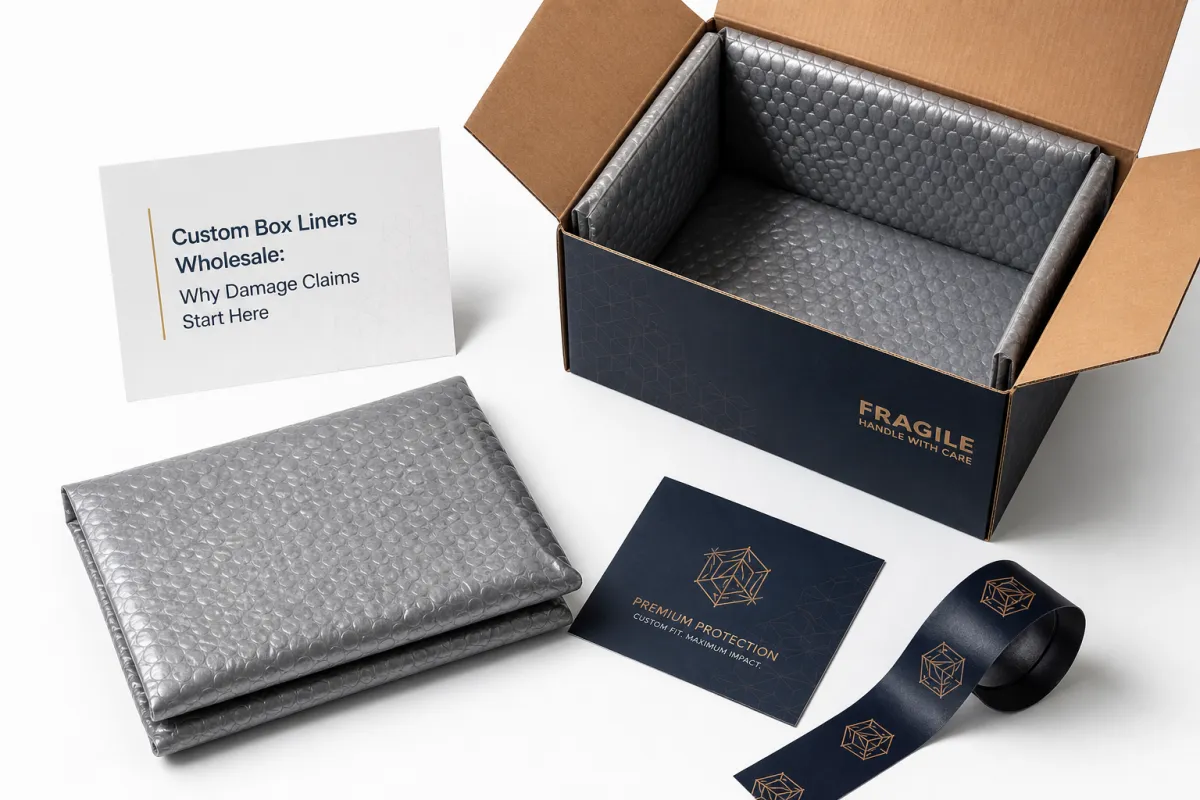
Custom box liners wholesale is often the cheapest fix for the most expensive packaging headache. Returns cost more than board. Replacement stock costs more than board. Labor at the service desk costs more than board. That math tends to become obvious only after a few thousand units are already out the door and the damage rate starts climbing.
The failure pattern is familiar, and a little annoying because it is so preventable. The product survives vibration in testing. It even survives a decent drop. Then the carton reaches a customer, the item shifts half an inch, and one corner takes the impact that should have been absorbed somewhere else. The outer box did its part. The liner did not hold the product still enough. That is not a carton failure. It is a fit failure.
For a packaging buyer, custom box liners wholesale is not a decorative line item. The goal is fewer claims per shipment, less wasted product, and fewer apologies for damage that could have been prevented with a better insert profile. A neat unboxing matters. A lower return rate matters more.
Generic void fill looks inexpensive at first glance, which is why it keeps getting chosen. Loose paper shifts. Air pillows collapse in odd ways. Crumpled kraft can work in one lane and fall apart in another because the packing result depends on the operator, the shipment, and how much time someone had to stuff the carton. Stock inserts can be fine if the product and carton happen to match a standard size. “Happen to match” is a weak strategy for repeat shipments. custom box liners wholesale gives you control over clearance, support points, and movement inside the shipper.
That is where the savings show up. Less movement means fewer chipped edges. Better spacing means less abrasion on printed surfaces. Cleaner containment means fewer crushed accessories and fewer customer complaints. I have watched buyers argue over a two-cent liner change while paying far more later in freight, service labor, and replacement inventory. Strange habit, but common.
Practical rule: if the product can slide, rattle, tilt, or rub, the carton is only doing part of the job. Custom box liners wholesale is about finishing the job inside the box.
Packaging teams often separate appearance from performance, then discover they are tied together. custom box liners wholesale can support branded packaging and retail presentation, but protection comes first. Once the fit is right, presentation usually improves on its own. If you want a broader look at packaging formats, our Custom Packaging Products page compares structures, and our Wholesale Programs page outlines order flow for larger runs.
The biggest savings usually come from replacing generic filler with a liner that actually controls the product. That is why custom box liners wholesale matters: not because it looks impressive on a quote, but because it cuts waste where the money leaks out.
Product Details: What Custom Box Liners Wholesale Includes
Custom box liners wholesale covers more than one format, and that matters because products fail in different ways. Some need side support. Some need a tight cavity. Some need a fold that keeps a lid panel from rubbing a finished surface. One liner style for every shipment usually produces mediocre results. Packaging rarely rewards shortcuts.
The most common options include corrugated liners, paperboard liners, die-cut inserts, folded wraps, and edge protection pieces. Corrugated liners do the heavy lifting. They add structure, absorb impact, and can be built with single-wall or double-wall board depending on product weight. Paperboard liners are thinner and cleaner for lighter retail presentation. Die-cut inserts create exact cutouts for bottles, jars, tools, electronics, or any item that needs a fixed nest. Folded wraps and edge protection pieces fill gaps, stabilize corners, and reduce abrasion where hard edges would otherwise grind together.
Material choice changes the outcome more than most people expect. A 32 ECT liner is fine for many light to medium applications, but a fragile glass set or a heavier multi-pack may need stronger board, a different flute, or a thicker caliper. Recycled content can be a smart decision if the product and shipping lane allow it. Moisture resistance matters if cartons sit in a humid warehouse, move through cold-chain environments, or travel long distances in mixed freight. custom box liners wholesale should be built for the actual route, not an idealized one.
Production choices also affect speed and cost. Plain liners are usually simpler and cheaper. Printed liners add brand cues, handling marks, or assembly instructions. Scored and slotted designs reduce labor at packing stations. Die-cut formats cost more to set up, but they remove guesswork during assembly and create a tighter fit. In a wholesale program, that balance matters. You are not buying art. You are buying consistency.
custom box liners wholesale works across several packing environments:
- E-commerce fulfillment: the liner keeps products from shifting during parcel shipping and improves the first impression when the box opens.
- Retail packaging: the liner supports cleaner product presentation and helps the item sit centered, upright, and undamaged.
- Industrial packing: the liner separates components, prevents surface contact, and helps workers pack at a steady speed.
If the job needs printed logos, product IDs, or handling cues, custom box liners wholesale can support that too. Keep the print coverage practical. More ink means more cost. More colors mean more setup. More setup means more chances for the order to slow down. Simple tends to win.
One detail buyers miss: the liner does not need to solve every problem alone. Sometimes the smartest answer is a liner plus a simple wrap, or a liner plus a corner support piece. custom box liners wholesale is flexible enough to combine those parts, which is often cheaper than forcing one overbuilt insert to carry the entire load.
Specifications That Matter for Custom Box Liners Wholesale
Good quoting starts with good measurements. custom box liners wholesale is not a guessing contest unless you want guesswork in your carton, and guesswork is expensive. Before asking for pricing, gather the inside dimensions of the carton, the exact product dimensions, the product weight, the number of units per shipper, and the amount of movement you need to stop. If the product can rock inside the box, the liner spec is too loose. If packing staff need to force the product into place, the liner spec is too tight.
Fit tolerance is where many projects go wrong. A liner that is only a few millimeters loose may not look dangerous on paper, but it can create enough play for corners to strike the sidewall during transit. A liner that is too tight can crush labels, deform closures, or slow packing so much that labor becomes part of the problem. In custom box liners wholesale, small dimensional errors turn into very real money very quickly.
Strength metrics matter too. Caliper tells you thickness. ECT, or Edge Crush Test, helps indicate stacking performance. Burst strength can help when comparing board options. Flute choice changes cushioning and stiffness. A-B flute or double-wall construction may be the right answer for heavy or fragile items, while a lighter flute profile may be enough for retail-ready displays or light e-commerce kits. No board spec solves every shipment, despite how often suppliers talk as if one does.
Here is a practical way to think about the main specs:
- Inside dimensions: determine actual fit and friction points.
- Product weight: helps decide whether you need basic support or impact resistance.
- Stack height: matters if multiple units are nested, layered, or loaded in rows.
- Movement prevention: tells the supplier whether you need a snug nest, a divider, or edge reinforcement.
- Environmental exposure: drives moisture resistance and board grade selection.
Design details change performance in ways that are easy to underestimate. Fold style affects how quickly a packer can build the insert. Locking tabs can reduce assembly errors. Corner protection can save fragile products from pressure damage. Coatings may improve scuff resistance or moisture performance. Print coverage can support branding, but only if the added ink does not interfere with folding or adhesion. custom box liners wholesale should be designed around the assembly line as much as the shipment.
For buyers documenting requirements, standards help keep the discussion concrete. The ISTA testing framework is widely used for transit performance, and the EPA Sustainable Materials Management resources are useful when the team is balancing protection and recyclability. If you need FSC-aligned paperboard, the FSC system is the obvious reference point. Standards do not make a bad spec good, but they do keep the conversation grounded.
Samples are not optional if the product is fragile or expensive. custom box liners wholesale should include a carton trial, even if it is only a short run of a few pieces. Measure the fit with the actual product, not a CAD assumption. Check how quickly staff can pack it. Shake the carton gently. Drop a filled sample if the product is at risk. The point is to expose the failure before the wholesale run, not after the first shipment lands on a customer’s porch.
Honestly, a lot of packaging waste starts with a quote that never included the right dimensions. If the supplier has to “work from experience” instead of actual data, you are not buying custom protection. You are buying optimism.
Custom Box Liners Wholesale Pricing and MOQ Breakdown
custom box liners wholesale pricing is shaped by a handful of factors that are easy to identify and easy to ignore until they show up on the quote. Material grade. Size. Print complexity. Cutting method. Order quantity. Pack configuration. Freight. The quote may look simple, but the bill is built from several moving parts.
Material grade is usually the first driver. Heavier corrugated board costs more than lighter paperboard. Moisture-resistant stock costs more than standard stock. FSC-certified material may add a small premium depending on supply and lead time. Larger liners also cost more because they use more board per unit and take up more warehouse and freight space. custom box liners wholesale rarely gets cheaper by accident. It gets cheaper when the design is efficient.
MOQ realities are straightforward. Simple corrugated liners can often start at lower quantities than a fully die-cut, printed, or specialty-finished piece. As the run gets larger, unit cost tends to fall because setup is spread across more pieces. That said, a higher MOQ is not a bargain if the spec is overbuilt. I would rather see a buyer order 10,000 well-designed units than 25,000 liners that do too much and cost too much. custom box liners wholesale should save money over the life of the program, not just win a fake comparison on the first PO.
Here is a plain comparison of common liner paths:
| Option | Typical Use | Setup Complexity | Common Unit Range | Notes |
|---|---|---|---|---|
| Stock filler | Basic void fill and light padding | Low | $0.03-$0.10 | Cheap, but inconsistent for product control |
| Stock insert | Standard carton sizes and repeat builds | Low to medium | $0.06-$0.18 | Works when dimensions already match |
| Custom corrugated liner | Shipping protection, separation, support | Medium | $0.12-$0.32 | Good balance of protection and price |
| Die-cut custom insert | Fragile products, premium presentation, tight nests | Higher | $0.18-$0.55 | Better precision, more setup, tighter fit |
| Printed branded liner | Retail packaging, instructions, package branding | Higher | $0.20-$0.60 | Print adds setup and press time |
Those numbers are directional, not a quote. Final pricing depends on sheet size, waste, number of cuts, finishing requirements, and how efficiently the design nests on the board. A simple liner that fits well can beat a fancy insert that wastes material. Buyers need that reality more than they need a polished quote page.
Watch the hidden costs too. Tooling. Plates. Sample runs. Freight. Rush fees. Extra packaging configuration. custom box liners wholesale often looks inexpensive until the buyer asks for a revision after proof approval or wants a last-minute change in board grade. That is not punishment. That is how production works when the spec keeps moving.
A useful buying framework is simple: choose the lowest-cost spec that still protects the product, then compare price per protected shipment rather than price per piece. If a liner saves one out of every fifty shipments from damage, the real ROI is usually obvious. If it does not change the claim rate, it is just board with a confidence problem.
For buyers working through a larger packaging stack, the liner should be viewed alongside the outer carton, labels, and shipping method. custom box liners wholesale is one part of product packaging, not the whole system. If the shipper is under-graded or the product is overpacked, no amount of liner tweaking will fix the basic mistake.
How Do Custom Box Liners Wholesale Orders Move From Quote to Delivery?
The normal process for custom box liners wholesale is easy to follow if the supplier is organized. First comes the quote request. Then the packaging team reviews dimensions, product weight, carton style, and any damage history. After that, the supplier recommends a structure, sends a proof or drawing, produces a sample if needed, and moves into production after approval. Nothing exotic. Just a chain of decisions that should not be rushed.
The fastest projects come from buyers who send the right information at the start. Product photos help. Carton dimensions help. Weight helps. Shipping method helps. If there is a known damage issue, say what is failing: crushed corners, scuffed surfaces, broken closures, shifting accessories, or crushed labels. The more specific the problem, the faster the right custom box liners wholesale spec gets identified.
Timelines vary with complexity. A simple corrugated liner with no print and no special finish can move fairly quickly once the spec is locked. A printed die-cut insert takes longer because it needs more setup and more review. Samples can add days. Artwork revisions can add more. Approval delays are the biggest schedule killer because the factory cannot build what nobody has signed off on. That part is boring, but it is true.
Here is the usual time breakdown in plain terms:
- Quote and recommendation: often 1-3 business days if the buyer provides full specs.
- Proof or structural drawing: often 2-5 business days depending on revisions.
- Sample or trial build: usually a few days to a week, depending on complexity.
- Production: simple orders may run around 10-15 business days after approval; complex jobs can take longer.
- Transit: separate from production and depends on shipping mode and destination.
That is why custom box liners wholesale planning should start earlier than many teams expect. Production time is only one part of the schedule. Shipping time is another. Receiving and inspection is another. If the inventory hits a distribution center on Friday afternoon, it is not magically ready for Monday morning use. Packaging buyers know that, but procurement teams sometimes need a reminder.
Approval discipline matters. If the drawing shows a 2 mm clearance and the product team wants 6 mm after the proof is issued, the schedule shifts. If the board grade changes because someone wants to “make it stronger,” the schedule shifts. If the print needs a new plate, the schedule shifts. custom box liners wholesale rewards decisive specs. Endless tinkering punishes everyone.
A short, clean approval chain is one of the easiest ways to improve delivery performance. One person should own the dimensions. One person should own the final artwork. One person should own the sign-off. When too many people feel entitled to redesign the insert, the order becomes a committee project, and committee projects are usually late.
That is also why sample approval before the full run matters. It lets the buyer confirm fit, packing speed, and protection before committing to the wholesale quantity. In custom box liners wholesale, a half-hour sample review can prevent a very expensive quarter.
Why Choose Us for Custom Box Liners Wholesale
custom box liners wholesale should come from a supplier that knows how to recommend the right liner, not just the most expensive one. Buyers do not need a trophy spec. They need predictable results, steady pricing, and clear communication when the design needs to change. That is the difference between a vendor and a partner, and most procurement teams can tell the difference quickly.
Manufacturing capability comes first. Can the supplier handle the board grade you need? Can they cut the insert cleanly? Can they keep dimensions consistent across repeat runs? Those are basic questions, but basic questions expose a lot of bad setups. A solid custom box liners wholesale program also includes spec checking before production starts. If the liner is too large for the carton or too shallow for the product stack, the right answer is to fix it before it ships.
Practical support matters as much as machinery. Fast quote turnaround helps. Clear drawings help. Honest feedback on overbuilt specs helps. If a buyer asks for a double-wall insert where a single-wall liner will do the job, the supplier should say so. If the product needs more edge protection than the current design provides, that should be explained without drama. Nobody needs packaging theater.
Quality control should be visible, not implied. Sample approval. In-line checks. Repeat-order consistency. Correct pack counts. Clean die lines. Stable print registration when print is involved. Those details are not flashy, but they are the reason a wholesale order shows up usable instead of merely present. custom box liners wholesale depends on boring reliability. That is a compliment.
There is also value in matching the liner to the broader packaging system. If you are using Custom Printed Boxes, branded packaging, or a retail-ready presentation, the insert should support that look without getting in the way of protection. If the product is headed into e-commerce, the insert should speed packing and reduce return risk. If the program is industrial, the liner should simplify handling and separation. Good custom box liners wholesale work fits the channel, not just the product.
We also see a lot of buyers who want one answer for every SKU. That usually creates a poor fit somewhere. A better approach is to compare two or three structural options, then choose the one that balances protection, assembly speed, and cost. That is the kind of decision custom box liners wholesale should make easier, not harder.
Bottom line: a good liner supplier saves money by preventing mistakes, not by pretending every product needs the same build.
If your team already uses Wholesale Programs, the process should feel familiar: share the specs, review the recommendation, approve the sample, and move. If you are still mapping the broader product packaging mix, our Custom Packaging Products page shows related structures that can work alongside the liner.
Next Steps for Custom Box Liners Wholesale Buyers
If you are ready to evaluate custom box liners wholesale, start with the basics. Measure the product and the carton. Write down the damage issue in plain language. Decide whether the priority is protection, presentation, or both. Estimate monthly volume. That is enough to get a useful quote instead of a vague guess.
Photos help more than most people expect. Send a photo of the current packaging setup, a photo of the damaged product if that is the issue, and a photo of how the item sits inside the carton today. custom box liners wholesale gets better when the supplier can see the real packing condition instead of imagining it from a few dimensions and a hopeful email.
Ask for three things at the same time: one sample, one production-ready quote, and one alternate spec. The alternate spec should be either a lower-cost version or a stronger version, depending on what you are trying to solve. That makes the tradeoff obvious. If the cheaper option still protects the product, great. If the stronger option is worth the added cost, you will know why.
Before the order moves, a procurement team should clear six points:
- Fit: the liner should hold the product without forcing it.
- Strength: board grade should match weight and transit stress.
- Print: only add printing if it supports the packaging design or handling process.
- MOQ: the minimum should match forecast, not wishful thinking.
- Lead time: production and transit both need to fit the launch schedule.
- Freight: large liners can change landed cost more than the unit price suggests.
One more useful habit: compare price per protected shipment, not just price per liner. A slightly better custom box liners wholesale spec may cost a little more but save much more by reducing breakage, returns, and repack labor. That is the kind of tradeoff smart buyers make all the time. Cheap on paper is not always cheap in the warehouse.
When the spec, price, and timeline line up, custom box liners wholesale stops being a sourcing headache and starts being a dependable part of your product packaging system. That is the real win. Not drama. Not hype. Just a carton that protects the product, ships cleanly, and does the job it was supposed to do.
What is the usual MOQ for custom box liners wholesale orders?
MOQ depends on board type, cutting method, and whether the liner is a simple corrugated design or a more complex die-cut insert. Simple corrugated runs can often start lower, while printed or tightly engineered styles usually need higher volume to make the unit price sensible. A higher MOQ only helps if the spec is not overbuilt.
How do I choose the right material for custom box liners wholesale?
Match the liner to product weight, fragility, and moisture exposure. Heavier or fragile items usually need stronger corrugated grades, while lighter retail presentation pieces can often use thinner board. If the product travels through humid storage or mixed freight, ask about moisture resistance and whether recycled content changes performance.
How do I measure a box liner for the best fit?
Measure the inside dimensions of the carton and the product dimensions separately. Include any clearance needed for packing speed, protective wrap, labels, or accessories. If possible, send a sample carton or photos so the supplier can confirm the fit before full production. That saves time and prevents the classic too-loose or too-tight mistake.
Can custom box liners wholesale orders include printing?
Yes. Printing can include logos, handling marks, product IDs, or simple instructions. It works well for branded packaging and retail packaging, but keep the print coverage practical because more color and more coverage usually increase cost. The best print is the one that helps the packer or supports the brand without slowing the line.
What affects lead time on custom box liners wholesale jobs?
Lead time changes with design complexity, sample approval speed, and production volume. Artwork revisions and structural changes add time fast, so lock the spec early. Also plan for shipping time separately from production time, because those are not the same thing and inventory never magically arrives early.
How do I know if a liner spec is too weak?
If the product shifts, tilts, scuffs, or arrives with corner wear, the liner is not doing enough. Test the packed carton with the actual product and watch for movement after a gentle shake. If the item can move more than a little, the design needs another pass.
custom box liners wholesale works best when the spec is realistic, the price reflects the actual material and setup, and the timeline matches the shipment plan. Do that, and the liner does its job quietly, which is exactly what good packaging should do.

