Buyer Fit Snapshot
| Best fit | Custom Boxes for Ecommerce projects where brand print, material claims, artwork control, MOQ, and repeat-order consistency need to be specified before quoting. |
|---|---|
| Quote inputs | Share finished size, material target, print colors, finish, packing count, annual reorder estimate, ship-to region, and any compliance wording. |
| Proofing check | Approve dieline scale, logo placement, barcode or warning zones, color tolerance, closure strength, and carton packing before bulk production. |
| Main risk | Vague material claims, crowded artwork, missing packing details, or unclear freight terms can make a low unit price expensive after revisions. |
Fast answer: Custom Boxes for Ecommerce: Material, Print, Proofing, and Reorder Risk should be specified like a repeatable production item. The safest quote records material, print method, finish, artwork proof, packing count, and reorder notes in one written spec.
Production checks before approval
Compare the actual filled-product size with the drawing, then confirm tolerance on folds, seals, hang holes, label areas, and retail display edges. Reserve space for logos, QR codes, warning copy, and material claims before decorative graphics fill the panel.
Quote comparison points
Review material grade, print process, finish, sampling route, tooling charges, carton quantity, and freight assumptions side by side. A quote is only useful when the supplier can repeat the same color, closure quality, and packing count on the next order.
Custom Boxes for Ecommerce: A Practical Packaging Guide
Custom boxes for ecommerce do more than hold a product. They set the tone before the customer even lifts the lid. That first tactile moment can either reinforce trust or quietly chip away at it. A glossy ad can bring someone to checkout, but custom boxes for ecommerce are often the first physical proof that the brand is serious, careful, and worth remembering.
That matters because ecommerce removes nearly every in-person cue buyers normally use. No shelf display. No sales associate. No store lighting making a carton look richer than it really is. In that gap, custom boxes for ecommerce become product protection, brand signal, and shipping discipline all at once. Done well, they reduce damage claims, improve unboxing, and keep fulfillment costs under control. Done poorly, they create returns, negative reviews, and a brand impression that feels smaller than the product inside.
Custom Boxes for Ecommerce: Why the First Shipment Matters
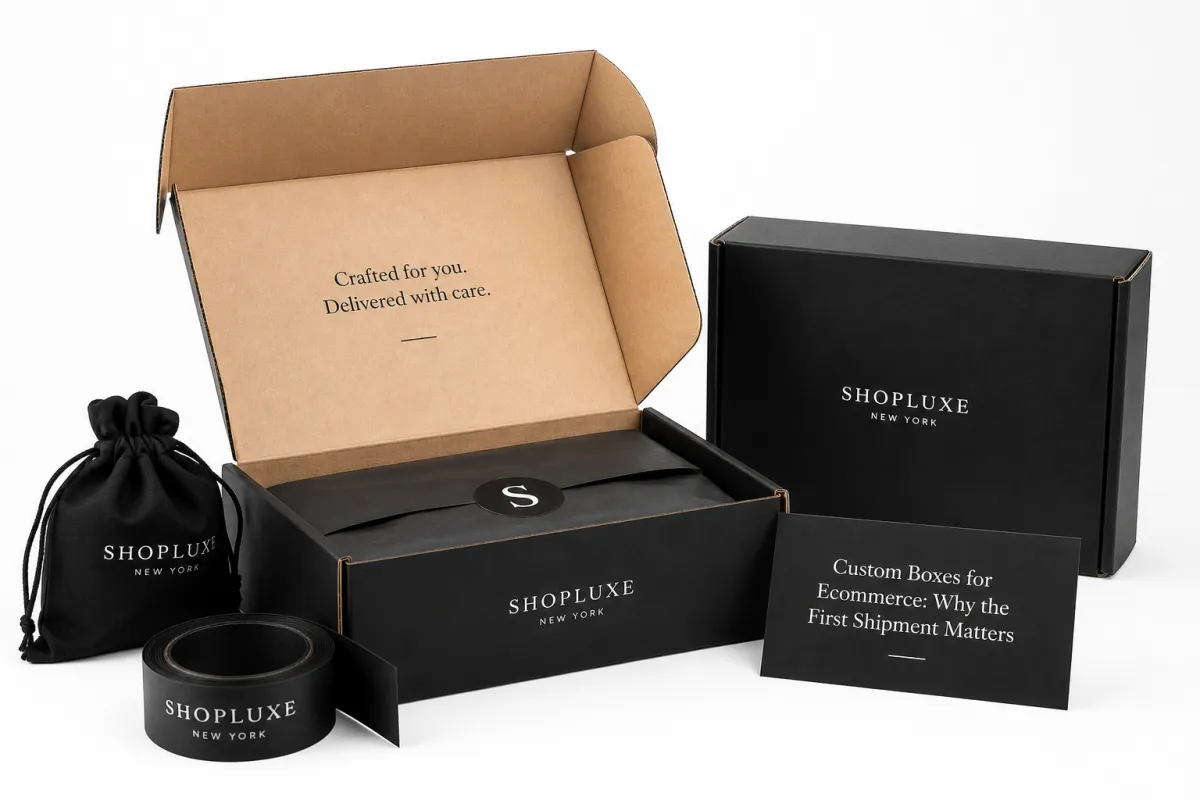
Picture the sequence. A shopper sees a polished ad, reads a few convincing product claims, pays, waits, and then opens a delivery that arrived in a crushed generic carton. That gap between promise and presentation is where custom boxes for ecommerce either protect the sale or quietly undo it. The product may still be fine. The brand feel is not.
From a packaging buyer's point of view, custom boxes for ecommerce are built to do three jobs at the same time: fit the item, survive transit, and communicate value. That sounds simple until you start looking at actual damage rates, parcel handling, and dimensional weight charges. A box that is two inches too large can cost more to ship, require more filler, and give the product room to move. A box that is too tight can scuff the finish or collapse under pressure. Either way, the carton becomes the problem instead of the solution.
Packaging is often the first physical proof of quality. In retail packaging, the customer can compare a package to the store environment, the other products on the shelf, and the attention around it. Ecommerce strips away that context. The box has to carry more of the story. That is why branded packaging is not just a visual layer; it is a practical part of the product experience, especially for new brands trying to look established in a crowded doorstep market.
custom boxes for ecommerce also affect the bottom line in ways that are easy to miss at first. A weak box can increase claims, replacements, and reverse logistics. A generic box can leave money on the table if the unboxing experience fails to create repeat purchase momentum. And because shipping carriers sort by weight and size, the wrong carton can create a double penalty: more damage risk and higher freight cost. In other words, the box is not packaging theater. It is a margin decision.
A box looks cheap only until it starts generating returns, re-shipments, and bad reviews. Then it becomes one of the most expensive line items in the operation.
That is why custom boxes for ecommerce need to be treated as a balance of protection, presentation, and shipping efficiency. If one of those three is off, the others usually suffer too. I have seen brands spend real money on beautiful print, then lose it all because the carton flexed on the bottom seam. Pretty is nice. Functional pays the bills.
How Custom Boxes for Ecommerce Move From Brief to Warehouse
The best custom boxes for ecommerce do not begin with artwork. They begin with measurements. Measure the product at its widest, tallest, and deepest points, then add space only for the insert, protective material, or finger clearance the packout actually needs. If a bottle ships with a molded pulp insert, the insert changes the box size. If a soft good ships folded, compression matters more than empty space. Good packaging design starts with the object, not the decoration.
After measurement comes structure. Corrugated mailers are the workhorse for most ecommerce brands because they are light, printable, and familiar to fulfillment teams. Folding cartons fit lighter products, cosmetics, accessories, and display-oriented product packaging. Rigid boxes bring a premium feel, but they also add cost, storage bulk, and slower packout. If a brand sells subscription kits, gift sets, or high-margin items, rigid or specialty structures may make sense. If the goal is safe, efficient shipping, corrugated usually wins on practicality.
custom boxes for ecommerce also depend on print method and board grade. A one-color flexographic print on kraft corrugated behaves very differently from a full-color litho-laminated carton with soft-touch coating. The visual difference is obvious. The structural difference can be just as important. E-flute and B-flute boards are common because they balance crush resistance and printability, while heavier products may need stronger corrugate or different wall construction. The board should match the abuse the parcel system will deliver, not the mood board.
Prototyping is where most packaging teams learn fast. A sample can look perfect on screen and still fail in the hand. Does the box close without bowing? Does the insert slow packout by 20 seconds per unit? Does the tape line interfere with graphics? Does the box hold up after a drop test, vibration exposure, or corner compression check? For parcel-shipped goods, ask for tests that reflect actual distribution, such as ISTA-style protocols. If you want a reference point, the test methodology resources at ISTA are a useful starting place.
If you need a shorter path from concept to shipment, review supplier capabilities early and compare formats against the full range of Custom Packaging Products. That makes it easier to decide whether a mailer, shipper, or presentation box actually fits the job.
Here is a practical timeline for custom boxes for ecommerce in the real world:
- Day 1-3: product measurements, shipping requirements, quantity target, and board choice.
- Day 4-7: dieline review, artwork prep, and structural adjustments.
- Day 8-12: proof approval, color signoff, and sample review if needed.
- Day 13-25: production, depending on print coverage, tooling, and order size.
- Transit: another 2-7 business days inside the U.S., often longer for freight or overseas sourcing.
Simple custom boxes for ecommerce can move quickly. Complex cartons with inserts, specialty coatings, or multi-part construction take longer. A buyer who understands the sequence usually gets fewer surprises and better pricing conversations. And yes, sometimes the box takes longer than the product itself. That is kind of the deal.
What Drives Custom Boxes for Ecommerce Pricing
Pricing for custom boxes for ecommerce is usually driven by five things: dimensions, board grade, print coverage, structural complexity, and quantity. The first two are easy to understand. A larger box uses more board, and a stronger board costs more. The last three can move the price sharply because they change setup time, press efficiency, and finishing labor.
As a rule, larger boxes cost more twice over. First, the material area rises. Second, shipping cost often rises because carriers charge by dimensional weight. If the carton is oversized, you pay to ship air. That is one of the quietest profit leaks in ecommerce. A box that seems inexpensive at the unit level can become costly once freight and parcel pricing are added.
custom boxes for ecommerce with simple graphics are usually cheaper than high-coverage branded packaging with full bleed color on every panel. One-color kraft prints, small logo marks, and limited coverage are typically easier to produce. A carton with heavy ink coverage, spot varnish, foil, or soft-touch lamination takes more work and often more quality control. That premium may be justified for hero products, but it should be intentional.
Order volume matters more than many new brands expect. Setup charges are real, and they get spread across the run. That means 500 boxes may have a very different unit cost than 5,000 or 10,000 boxes. It is common to see pricing improve sharply once a run clears the setup-heavy zone. Still, a larger order only helps if the sell-through rate is strong enough to avoid stale inventory.
Below is a practical comparison of common options for custom boxes for ecommerce:
| Box Type | Best Use | Typical Unit Range | Strength | Tradeoff |
|---|---|---|---|---|
| Corrugated mailer | Most parcel-shipped products, subscription kits, apparel | $0.35-$0.95 at 5,000 units | Good protection, fast packout, printable surface | Premium finishes are limited compared with rigid styles |
| Folding carton | Lightweight items, cosmetics, accessories | $0.28-$0.80 at 5,000 units | Low material use, strong retail presentation | Needs secondary shipper for many ecommerce orders |
| Rigid box | Gift sets, luxury goods, high-value products | $1.20-$4.50 at 5,000 units | Premium feel, strong unboxing impact | Heavier, bulkier, and slower to assemble |
| Mailer with insert | Fragile or mixed-component items | $0.55-$1.40 at 5,000 units | Better product control in transit | Insert design adds cost and testing time |
Those numbers are not universal. Print coverage, board thickness, finishing, and freight can push them up or down. But they give a useful frame for comparing bids. In practice, custom boxes for ecommerce should be priced on landed cost, not just the headline box number. Add inserts, coatings, freight, warehouse space, and the cost of a damaged shipment. Only then does the real picture appear.
Another cost item that gets missed is compliance and testing. If a box is being designed for repeat parcel shipping, ask about sample validation against industry methods such as ASTM D4169 or similar distribution tests. That does not mean every carton needs a full lab program, but it does mean the packaging should be judged against transit reality, not just a flat proof.
For brands using certified fiber, sustainability claims should be grounded in real sourcing. The FSC system is one of the most recognized references for responsible forest management and chain-of-custody documentation. If a supplier cannot explain the certification status clearly, that is a warning sign for any brand that plans to print sustainability claims on the box.
Choosing the Right Custom Boxes for Ecommerce for Your Product
Not every product needs the same answer. custom boxes for ecommerce should start with risk, then move to brand experience. A fragile glass item, a dense metal accessory, a liquid, a premium candle, and a subscription clothing kit all need different packing logic. The material may be the same, but the structure and insert strategy should not be.
For fragile products, protection beats decoration. Stronger corrugated, tight internal fit, and a dependable insert usually matter more than visual embellishment. For premium goods, the unboxing experience can justify rigid construction, layered reveals, and more careful print finishing. For low-margin items, the smarter play may be a clean mailer with restrained branded packaging rather than an expensive build that eats the margin.
custom boxes for ecommerce also need to match operational reality. If the fulfillment team ships 1,000 orders a day, every extra fold matters. If the SKU list changes every quarter, a box family with a few standardized sizes may be better than a unique carton for each item. If the product line is broad, one style of shipper with multiple insert options may cover far more use cases than a highly tailored pack.
Sustainability is part of the decision, but it should be practical. Right-sizing the box to reduce void space is one of the easiest wins. It cuts filler, reduces movement, and often lowers shipping cost. Using recyclable corrugated or paper-based inserts can also simplify the story. But sustainability only works if the package still survives transit. A too-light box that damages the product is not a green solution; it is waste in disguise.
Think about these selection factors before ordering custom boxes for ecommerce:
- Product risk: fragile, heavy, sharp, liquid, or premium.
- Fulfillment speed: manual packout, kitting, or automation.
- SKU variety: one box, several sizes, or one family of inserts.
- Brand goal: high-end reveal, utilitarian protection, or balanced presentation.
- Storage footprint: flat storage, pallet use, and reorder frequency.
For many brands, the best answer is not the fanciest box. It is the box that balances protection, brand recognition, and packout speed without creating a mess in the warehouse. That is why custom boxes for ecommerce deserve the same level of scrutiny as the product itself.
Step-by-Step Process for Ordering Custom Boxes for Ecommerce
The cleanest way to order custom boxes for ecommerce is to treat the project like a small production run, not a logo exercise. Start with the product dimensions and the shipping method. Then define the box objective. Is this carton meant to ship safely, create an unboxing moment, or do both? Once that answer is clear, the rest of the decisions become easier.
custom boxes for ecommerce should be quoted against the same spec every time. Ask suppliers to quote the same internal dimensions, board grade, print colors, finish, and quantity. If one supplier quotes a 32 ECT board and another quotes 44 ECT, the prices are not comparable. The same goes for coating, glue style, insert material, and whether the quoted price includes freight. Comparing mismatched quotes is one of the fastest ways to make a bad decision feel logical.
Proof review deserves more attention than it usually gets. Check spelling, panel orientation, barcode placement, recycle marks, and copy legibility. Verify that any brand pattern lands correctly on the box flaps. If inserts are involved, make sure the artwork and the structure agree. A print proof that looks beautiful can still be wrong if the fold lines or glue tabs interfere with assembly. That is especially true for custom boxes for ecommerce with several inside faces carrying text or instructions.
This is also the stage to ask for samples. A plain white sample and a printed sample tell different stories. The white sample tests fit, closure, and mechanical performance. The printed sample tests color, finish, and brand feel. If the product will go through parcel networks, test a few sample boxes to real addresses. That gives you more honest feedback than a tabletop inspection ever will. If the package arrives dented, crushed, or noisy, the customer will notice too.
A simple purchase checklist for custom boxes for ecommerce looks like this:
- Measure the product and any insert.
- Set the shipping goal and damage tolerance.
- Choose the box style and board grade.
- Request quotes using the exact same spec.
- Review the dieline and print proof carefully.
- Approve samples only after pack and ship tests.
- Lock the production window and freight plan.
- Set a reorder point before stock gets thin.
Typical lead times for custom boxes for ecommerce often land around 12-15 business days after proof approval for simple runs, and 15-25 business days for more complex builds, specialty finishes, or insert work. Freight can add several days more. If your business has a launch date, build in a buffer. The most expensive packaging problem is the one that arrives after the warehouse needs it.
If you want a starting point for formats, finishes, and structural options, it can help to review the full catalog of Custom Packaging Products before committing to a single design. Sometimes the right answer is not a new box at all, but a smarter adaptation of an existing structure.
One more practical detail: reorder triggers should be set based on real consumption, not optimism. If a box takes 14 business days to remake and you only keep one week of stock, you have no margin for error. For custom boxes for ecommerce, that kind of mismatch creates emergency shipping costs and rushed approvals that usually lead to worse packaging, not better packaging.
Common Mistakes With Custom Boxes for Ecommerce
The most expensive mistake with custom boxes for ecommerce is choosing the box before the product measurements are locked in. That sounds obvious, but it happens often. Teams approve a beautiful structure, then the final product shifts by half an inch, the insert changes, or the closure becomes awkward. Suddenly the carton is either too loose or too tight, and the promised efficiency disappears.
Another trap is chasing the lowest quote without checking the full cost picture. A cheap box that uses weak board or poor print can create damage, which triggers replacement shipments and customer service time. The box did not save money; it hid the bill. That is why custom boxes for ecommerce should be evaluated on landed cost and performance, not unit price alone.
Overdesign is a real problem too. Some brands assume every box needs premium coating, multiple ink hits, special inserts, and layered reveals. Sometimes that is right. Often it is not. If the product is low-margin or ships frequently, a simpler structure with smart branding may preserve cash without hurting customer perception. Good packaging design should support the business model, not compete with it.
Testing is another place where teams cut corners. Internal fit is not enough. A box that looks perfect on the bench can fail after vibration, compression, or a short drop from conveyor height. That is why sample shipping matters. For custom boxes for ecommerce, one real transit test can reveal what ten mockups miss. If the outer carton scuffs easily, the closure bursts, or the insert shifts in the mail, the customer experience will follow that pattern.
Forecasting errors are the last major issue, and they are more common than most buyers admit. A missed reorder window can stall fulfillment, force emergency buys, and push a brand into stock packaging that does not match the original look. That creates inconsistency right when a customer expects repetition. In a subscription or repeat-purchase model, inconsistency can be as damaging as breakage.
The short version: custom boxes for ecommerce fail most often because teams focus on appearance before fit, price before performance, and launch timing before reorder discipline. Reverse that order and the outcomes usually improve.
Expert Tips and Next Steps for Custom Boxes for Ecommerce
My strongest recommendation is to build a small family of box sizes instead of designing a one-off solution for every SKU. That approach simplifies purchasing, reduces storage clutter, and helps the warehouse operate with fewer mistakes. A two- or three-size system can cover far more products than many teams expect, especially if inserts handle the variation.
custom boxes for ecommerce can also be smarter when the brand treatment changes by SKU tier. Put the most visible design work on hero products, gift sets, or launch items. Use lighter, lower-coverage branding on repeat purchases or lower-margin SKUs. That hierarchy protects margin while keeping the brand recognizable. Not every box needs to look like a campaign piece.
Ask suppliers for landed-cost comparisons, not just unit pricing. The quote should make freight, storage, and likely damage risk visible. If one option is 8 cents cheaper per unit but adds more breakage, more filler, or more parcel weight, it is not really cheaper. That is a common blind spot with custom boxes for ecommerce, and it can distort decisions for months.
It also helps to track actual packaging performance after launch. Watch damage rates, return reasons, assembly time, and customer feedback on unboxing. If one size gets crushed more often, or one closure slows the team down by 10 seconds per order, the data will show it. Packaging should be adjusted like any other operational system. It is not a one-time artwork project.
Use the following action plan if you want better custom boxes for ecommerce without wasting budget:
- Audit current packaging for damage points and over-boxing.
- Rank products by breakage risk and shipping frequency.
- Request samples for the top one or two problem SKUs.
- Compare landed cost, not just unit cost.
- Pilot one improved box in a live shipping run.
- Review feedback from the warehouse and customers.
- Roll out the winning structure across similar SKUs.
For Brands That Sell online every day, better custom boxes for ecommerce should do three things: reduce breakage, speed fulfillment, and support repeat purchases. If a new carton does all three, it is doing its job. If it only looks nice on a mockup table, it is probably not ready.
Frequently Asked Questions
What size custom boxes for ecommerce should I order?
Measure the product first, then add only the clearance needed for an insert or safe packing material. Oversized custom boxes for ecommerce raise shipping cost, increase void fill, and let the product move around in transit. If you sell several SKUs, standardize around a small set of box sizes so purchasing and fulfillment stay simpler.
Are custom boxes for ecommerce more expensive than stock boxes?
Usually, yes, the unit price is higher than plain stock packaging at very low quantities. But custom boxes for ecommerce can still lower total cost if they reduce damage, cut dimensional weight, and speed packout. Compare landed cost, not just the box price, before making the call.
How long do custom boxes for ecommerce usually take to produce?
The timeline depends on sample approval, print complexity, quantity, and freight distance. Simple custom boxes for ecommerce can move in about 12-15 business days after proof approval, while more complex builds or insert revisions take longer. Leave reorder buffer so you do not end up buying emergency packaging.
What materials work best for custom boxes for ecommerce?
Corrugated board is the most common choice for shipping protection. Folding cartons suit light products and presentation-first packaging, while rigid boxes work best for premium unboxing. The right material for custom boxes for ecommerce is the one that matches product weight, shipping stress, and brand goals.
How can a small brand afford custom boxes for ecommerce?
Start with one adaptable box style that works across several products, then use inserts or small variations later. Keep print simple, reuse dielines where possible, and order in quantities that match sell-through. Small brands can afford custom boxes for ecommerce more easily when they track damage and returns with real numbers instead of assumptions.
For ecommerce brands, packaging is not a side note. It is part of the product experience, part of the shipping system, and part of the brand memory. The best custom boxes for ecommerce make all three work together: they protect the item, present it well, and keep operations moving without waste. If you are making one change this quarter, start by tightening the box size around the actual product and testing it through real transit. That single step usually exposes the rest of the fixes you need.

