Buyer Fit Snapshot
| Best fit | Custom Printed Tape With Logo projects where brand print, material claims, artwork control, MOQ, and repeat-order consistency need to be specified before quoting. |
|---|---|
| Quote inputs | Share finished size, material target, print colors, finish, packing count, annual reorder estimate, ship-to region, and any compliance wording. |
| Proofing check | Approve dieline scale, logo placement, barcode or warning zones, color tolerance, closure strength, and carton packing before bulk production. |
| Main risk | Vague material claims, crowded artwork, missing packing details, or unclear freight terms can make a low unit price expensive after revisions. |
Fast answer: Custom Printed Tape With Logo: How It Works, Costs, and More should be specified like a repeatable production item. The safest quote records material, print method, finish, artwork proof, packing count, and reorder notes in one written spec.
Production checks before approval
Compare the actual filled-product size with the drawing, then confirm tolerance on folds, seals, hang holes, label areas, and retail display edges. Reserve space for logos, QR codes, warning copy, and material claims before decorative graphics fill the panel.
Quote comparison points
Review material grade, print process, finish, sampling route, tooling charges, carton quantity, and freight assumptions side by side. A quote is only useful when the supplier can repeat the same color, closure quality, and packing count on the next order.
Custom Printed Tape with logo does more than shut a carton. A 48 mm strip can change how a shipment feels in the 6 to 10 seconds it takes to run across a seam, and that tiny shift matters because people judge packages fast. I remember standing on a cold concrete floor in a Baltimore warehouse, watching a plain kraft box turn into something more deliberate the moment one black logo hit the top flap cleanly on a 110-yard roll. I was impressed, then mildly annoyed, because the box suddenly looked better than the sample carton sitting on the manager’s desk. That is the thing about packaging: the small move often has the loudest effect. For teams that care about branded packaging, quicker packout, cleaner package branding, and practical branded shipping tape, this is one of the smallest upgrades with the biggest visual return.
For companies already buying Custom Packaging Products, custom printed tape with logo is often the easiest next step because it does not force a carton redesign or a new dieline. A 2-inch roll can carry a logo, a handling message, a security note, or a repeated pattern that makes ordinary product packaging look more intentional without adding a second application step. If your boxes are already doing most of the visual work through Custom Printed Boxes, the tape acts like the final signature on the shipment. It says someone checked the details instead of tossing the order together at 4:57 p.m. on a Friday. That kind of detail matters more than the price line suggests, especially once the volume climbs past a few hundred units a day.
I have seen small brands use it to sharpen retail packaging, e-commerce teams use it to sort cartons on crowded docks in Dallas and Atlanta, and warehouse managers rely on it as a quick visual signal that a box came from the right line. The right custom printed tape with logo does not just seal a package; it cuts down mix-ups, supports the brand, and gives the customer one more reason to remember the name on the box. People remember the boring stuff when it goes wrong, but they also remember the small polished details when they feel like a promise kept. That connection is stronger than most people think, especially if the shipment crossed a few hubs or sat in a trailer longer than planned.
What Custom Printed Tape With Logo Really Is
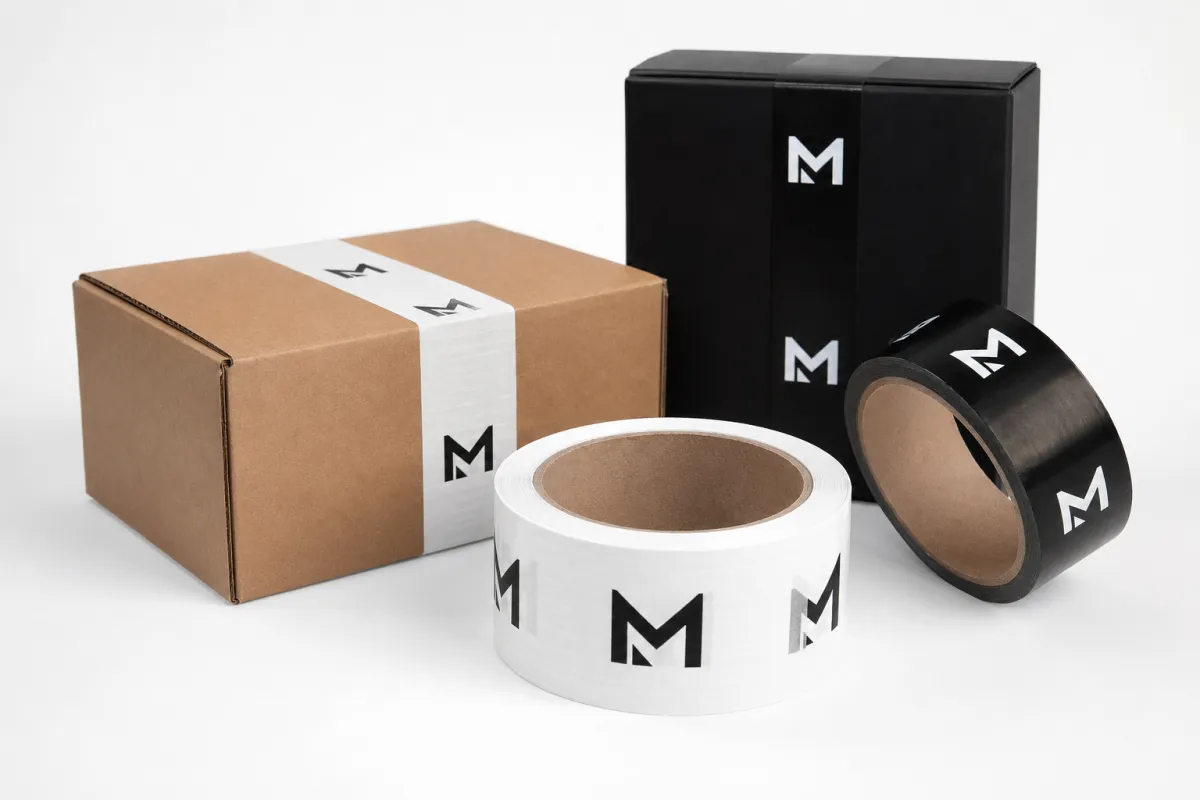
At its core, custom printed tape with logo is pressure-sensitive tape, water-activated tape, or a specialty packing tape that carries a brand mark, message, or pattern printed onto the surface before it reaches your facility. That sounds simple, but the material choice changes the result in ways buyers feel immediately. A 2-inch BOPP tape running through a case sealer behaves differently from a reinforced water-activated kraft tape applied by hand, and the look changes just as much as the seal strength. I have watched teams assume “tape is tape,” then spend the next two weeks figuring out why one roll peels nicely and another acts like it has a personal grudge. In Chicago and Dongguan, I have seen the same logo print beautifully on one substrate and blur slightly on another because the coating, not the artwork, was the real variable.
Here is the practical distinction I explain to plant managers: plain tape closes the box, while custom printed tape with logo closes the box and carries a visual job description. It can support carton identification, make inbound and outbound freight easier to sort, reinforce tamper evidence, and give unboxing a cleaner finish. In a fast-moving operation, that matters because a mislabeled or unbranded carton can steal time at the pack station and create headaches later in customer service. I have been in those postmortem meetings, and they are never fun. Nobody wants to hear, “We lost the order because the box looked like every other box in the building,” especially when the missing shipment was only 37 cartons out of a 1,200-carton batch.
There is a branding angle too. A package with one clean tape line tends to look tidy and intentional. A box with no branding can feel unfinished, even if the product inside is excellent. I have sat in client meetings where marketing spent three rounds debating Custom Printed Boxes, then operations solved half the presentation problem with custom printed tape with logo and a 1-color repeat that matched the master brand color within a Delta E of 2.0. That is one of the more underrated moves in packaging. It is not flashy. It just works, which is better than flashy nine times out of ten, especially on a line pushing 14 cartons a minute.
That is the part people miss. They assume tape is only a shipping supply. I would argue it is more useful than that, because the right custom printed tape with logo can do three jobs at once: seal, signal, and sell. The best choice still depends on the carton type, the shipping environment, the dispenser setup, and how visible you want the logo to be from 3 feet away or 30 feet away. The difference between those two distances is huge. At 3 feet, someone notices detail. At 30 feet, they notice attitude. On a dock in Phoenix at 102 F, they also notice whether the adhesive is still holding after the carton sat in the sun for 20 minutes.
- Pressure-sensitive tape is common for general shipping and works well on most carton-sealing lines, especially 2-inch by 110-yard rolls.
- Water-activated tape is often chosen for stronger seals and a more premium, fiber-based look, usually in 3-inch widths and 250- to 375-foot rolls.
- Specialty packing tape can include tamper-evident features, repeat patterns, or custom warning messages for chilled freight or higher-value goods.
“If I can read it from the back of a lift truck, I can trust the tape.” A warehouse supervisor told me that during a supplier walk-through in Atlanta, and he was not joking. He wanted a 2-color custom printed tape with logo that stayed legible on a 48-inch-wide pallet load after handling, stretch wrap, and two transfers across a 6,000-square-foot dock. I laughed at first, then watched the load disappear across the floor and understood exactly what he meant.
How Do You Choose Custom Printed Tape With Logo?
The simplest answer is to start with the carton, then work backward. If you know the carton board, the seal surface, the storage temperature, and the dispenser setup, you can narrow the tape type quickly. Custom printed tape with logo should fit the pack line first and the brand second, because a beautiful roll that slows the team down is not helping anyone. If the boxes are recycled corrugated, a stronger adhesive may matter more than a second color. If the cartons are clean and uniform, the artwork can carry more of the load. That order of operations keeps the decision practical instead of theoretical.
I also look at distance. If customers only see the carton at the doorstep, the logo can be simple and bold. If pallets move across a warehouse floor or through retail back rooms, the mark needs enough contrast to read quickly from across the aisle. That is where custom printed tape with logo starts behaving like signage, not just tape. I have seen a one-color roll outperform a more elaborate concept because the simpler version stayed legible on a moving carton. The best choice is usually the one that survives real handling, not the one that looks clever in a mockup. Clean lines beat clever tricks more often than design teams want to admit.
From there, ask whether the tape is doing one job or several. Some brands want branding only. Others want branded shipping tape that also signals tamper evidence, warehouse routing, or cold-chain handling. Once the goal is clear, the supplier can recommend pressure-sensitive tape, water-activated tape, or a specialty packing tape that fits the application. That is the point where a quote becomes useful. Before that, it is just a polite guess. A good spec sheet saves more time than a long email chain ever will. And yes, that part is a little boring. It is also the part that keeps the project from drifting.
How Custom Printed Tape With Logo Works on the Packing Line
The production flow for custom printed tape with logo usually starts with artwork cleanup, because a logo that looks crisp in a PDF can fall apart if the line weights are too thin or the repeat length is wrong. From there, the converter chooses the print method, the adhesive system, the film or paper base, and the roll format. On a normal program, I expect to see four checkpoints: artwork approval, press setup, conversion into roll stock, and a final inspection for color, registration, and edge quality. That sounds dry, but it is the part that keeps a good idea from arriving as a disappointment in a carton. In factories outside Chicago, Osaka, and Monterrey, I have seen that checklist save a launch that would otherwise have missed its ship date by 4 business days.
Flexographic printing is common for longer runs because it handles solid brand colors and repeat patterns efficiently. Digital print can work well for shorter pilot orders or smaller roll counts, especially when the schedule is tight and you need less setup waste. Water-activated tape often uses a different print path than pressure-sensitive BOPP, and that difference affects detail level, repeat length, and how many colors will reproduce cleanly without soft edges. If your logo includes tiny serif text or a fine outline, I would not approve it without a physical proof. Screen mockups lie. Paper does not. A 1-color proof on 300gsm matte stock and a press test on the actual tape substrate will tell you more than ten polished PDFs.
On the packing line, the tape has to fit the actual rhythm of the operation. A hand-applied 2-inch roll on a tabletop dispenser, a gum tape machine with a wetting system, and a case sealer running 18 cartons a minute each place different demands on the product. Tension, unwind, and adhesive tack need to match the operator’s motion, or the custom printed tape with logo becomes another source of rework instead of a time saver. I have seen operators do that little side-eye glance when a roll starts sticking too hard. That look says, “Great, now the tape has opinions.” A 3.5-ounce hand dispenser and a 20 kg case sealer do not forgive the same mistakes.
I once walked a fulfillment line in Phoenix where the team loved the look of their custom printed tape with logo, but the rolls had been spec’d for a warmer storage room than the actual dock area. At 42 F in the morning and 78 F by noon, the adhesive behavior changed enough that the first and last cartons of the shift did not seal the same way. That is the kind of detail nobody wants to find after a 4,000-box launch. It is also the kind of detail that makes people call me later and say, “Why did nobody mention temperature?” The answer is usually because the quote only listed width and color, not the 18 F swing between the dock and the packing table.
Humidity, cold storage, dusty warehouse air, and fast-moving fulfillment lines all affect tape performance. Recycled cartons can pull harder on the adhesive because the corrugated edges are rougher. In a chilled room, the tape can feel stiff until the roll warms up. The best custom printed tape with logo is chosen for the environment first and the artwork second, because a beautiful print means little if the seal fails under routine conditions. I would rather see a plain, reliable seal than a gorgeous roll that flaps off the carton on the truck. That judgment gets even sharper when the route runs from New Jersey to Minneapolis in January.
For teams that ship internationally or run rough distribution lanes, I like to compare tape decisions against recognized packaging test methods. The test language at ISTA helps explain how shipping abuse can affect a seal, and if the tape uses paper fibers or recycled content, the sourcing guidance from FSC can keep the sustainability story credible. You do not need to become a testing engineer, but you do need enough context to ask sharper questions. That alone can save a lot of awkward “Well, we thought it would hold” conversations, especially when the freight bill is $480 on a single pallet.
What Drives Cost and Pricing for Custom Printed Tape With Logo
Pricing for custom printed tape with logo usually comes down to a short list of variables: substrate, adhesive type, print colors, roll width, roll length, core size, and whether the design prints once per roll or repeats along the full length. A simple 1-color program on a standard 2-inch roll usually sits near the lower end of the market, while a reinforced water-activated solution with 2 colors and a premium finish moves higher quickly. Ask for a quote without roll dimensions, carton count, and monthly usage, and the result will be too vague to compare. I have seen buyers try to compare quotes that were not even speaking the same language. That is not comparison; that is chaos with line items. A quote for 5,000 rolls of 110-yard BOPP is not equivalent to 5,000 feet of 3-inch kraft.
Setup charges matter more on the first order than on reorders. Plates, dies, proofing, and press setup can add a few hundred dollars before a single roll ships, which is why the first buy often looks more expensive than the second. For a typical first run, I have seen a one-color pressure-sensitive order start around $85 to $150 in setup, while a more involved water-activated job can run $180 to $350 depending on print complexity and run length. That gap is one reason I push teams to think in yearly usage, not just the first PO. The first invoice can spook people. The second usually feels more sensible. In plants in Greensboro and Toronto, that difference has decided whether a tape program stays in procurement or moves back to the “maybe later” pile.
| Option | Best Fit | Typical Setup | Example Unit Cost at 5,000 Rolls |
|---|---|---|---|
| BOPP pressure-sensitive tape | General shipping, retail packaging, fast manual packout | $85 to $150 | $0.28 to $0.42 per roll |
| Water-activated kraft tape | Stronger carton seal, premium branding, recycled cartons | $180 to $350 | $0.48 to $0.92 per roll |
| Reinforced paper tape | Heavier cartons, higher security, stronger hand-applied seal | $220 to $400 | $0.60 to $1.10 per roll |
| Short-run digital tape | Pilot launch, seasonal art, lower minimum quantity | $120 to $250 | $0.52 to $1.05 per roll |
Those numbers are not universal, but they are close to what I see in real quotes for standard widths and common roll lengths. A 2-inch x 110-yard BOPP roll with a single black logo may price very differently from a 3-inch x 375-foot water-activated roll with a printed repeat and a tamper-evident finish. Roll count matters too: 2,000 rolls will not price like 20,000 rolls, and the per-roll spread can be wide enough to change the entire launch budget. I once watched a finance team stare at two columns for so long I thought the spreadsheet had won. The better-performing quote was not the cheapest; it was the one that aligned with a 6-month forecast and a second print run in quarter two.
Budget-friendly does not have to mean cheap-looking. I watched one procurement lead in Nashville cut the first order cost by 18% simply by moving from a 3-color art file to a bold 1-color logo on a kraft base. The box still looked intentional, the brand still read clearly, and the change let them spend more on the carton board where it really mattered. That is the kind of tradeoff that keeps custom printed tape with logo useful instead of decorative. It also kept the unit price under $0.35 on a 5,000-roll quote, which made the CFO stop frowning for once.
Another thing buyers miss is total cost of ownership. If custom printed tape with logo removes a separate sticker step, cuts mis-shipments by 2% on a small line, or reduces the chance that a plain carton leaves the dock, the tape can pay for itself in ways that never appear on the invoice. In that sense, it belongs in product packaging economics, not just on a supply spreadsheet. I think that is why operations people tend to care about it more once they have actually lived with it for a month. The savings are often counted in seconds per carton, not in glossy presentation slides.
If you are comparing options alongside other Custom Packaging Products, ask how the tape changes labor per carton, not just the unit price. A tape that saves 4 seconds on every seal can matter more than a tape that is 3 cents cheaper if your team ships 1,200 boxes a day. Add a dozen lines, a lunch break, a shift change, and suddenly those seconds feel very expensive indeed. At 1,200 cartons a day, 4 seconds each becomes more than 1.3 labor hours saved daily, which is the kind of number a plant manager remembers.
Custom Printed Tape With Logo: Step-by-Step Ordering and Timeline
The cleanest ordering process starts with three things: carton measurements, artwork files, and a clear idea of monthly usage. I like to ask for the carton width, the seal surface, and the dispenser setup before anyone touches the artwork, because a logo that looks perfect at 1-inch repeat may need to be scaled for a 72 mm carton seam. If the tape is meant to work with custom printed boxes or plain corrugated shippers, that detail should be in the brief from day one. Otherwise, someone will discover the mismatch while standing over a pallet cart, muttering at a tape gun. I have seen that exact scene in Miami, and it was not pretty.
Most standard programs move through a sequence like this: design cleanup in 1 business day, proof creation in 1 to 2 business days, production in 7 to 12 business days after approval, and shipping in 2 to 5 business days depending on the warehouse location. Some water-activated runs need an extra 24 to 48 hours for curing or finishing, especially if the ink system or adhesive needs more time before the rolls are packed. That is not a delay; it is part of making the tape behave properly on arrival. I have learned the hard way that “we can rush it” and “it will perform well” are not always cousins. A realistic timeline from proof approval to dock arrival is often 12 to 15 business days for standard domestic shipments from facilities in Ohio or New Jersey.
Clean vector art saves time. AI, EPS, and print-ready PDF files usually convert best because the logo stays sharp at tape scale, while low-resolution JPG files can blur edges or introduce fuzzy text. If your brand uses a precise Pantone, include it. If the repeat needs to land on the top seam in a certain way, say that too. Small instructions reduce back-and-forth and keep the custom printed tape with logo moving through production. Specifics feel fussy until they keep a whole production run from wobbling. A 0.25-inch shift on the repeat can be invisible in a mockup and obvious on 1,000 cartons.
There is a difference between a launch order and a pilot order, and buyers should respect that difference. A pilot of 250 to 500 rolls can reveal whether the tape feeds properly on the dispenser, whether the brand reads across mixed carton sizes, and whether the seal survives an actual receiving bay, all before you commit to a 5,000-roll run. If the first order is for a seasonal drop or a new fulfillment center, that extra week can be cheap insurance. Honestly, I think pilots are boring in the best possible way: they stop dramatic problems before they start. A 300-roll test in a Denver warehouse is a lot cheaper than 6,000 rolls that fail in July heat.
Rush jobs are possible, but they usually come with fewer revision cycles and tighter production windows. That means the art should already be clean, the dimensions should already be confirmed, and the quote should already match the exact tape type. If a supplier says a 4-day turnaround is possible, I still ask whether that includes proof approval, press time, and freight, because those details can shift the real delivery date by 2 or 3 days. The fastest way to miss a deadline is to assume everyone defines “fast” the same way. In practice, a rush from a plant in Shenzhen to a U.S. dock can still take 5 to 8 business days once freight is added.
The fastest projects I have seen all had three things in common: vector art, exact roll dimensions, and monthly usage that was honest rather than optimistic. If you estimate 3,000 rolls and end up needing 9,000 by the second month, the procurement team will feel it. I would rather hear a conservative number and plan a reorder than build a forecast on a guess. It is much easier to look smart after a conservative estimate than to explain why a warehouse is down to its last 14 rolls on Thursday afternoon. A reorder placed 10 business days early is not paranoia; it is arithmetic.
Common Mistakes When Specifying Custom Printed Tape With Logo
The first mistake is artwork that is too small, too detailed, or too low contrast. A logo with hairline strokes may look elegant on a screen, but once it is printed on a 2-inch tape strip and stretched across a carton seam, the thin parts can disappear. I have seen a serif font that looked fine at 100% on a PDF turn into unreadable noise after the repeat was reduced from 12 inches to 8 inches. It was the packaging version of squinting at a restaurant menu and pretending you can still read it. A mark that works at 96 dpi on a monitor may fail at 2400 dpi on press if the stroke is only 0.4 pt.
The second mistake is approving a design that never gets tested on the actual carton stock. A shiny mockup on white art paper does not tell you how custom printed tape with logo will behave on recycled kraft, double-wall corrugated, or a dusty case that has been sitting near a loading door. In one Detroit fulfillment center, the team loved the artwork until the first pallet of recycled cartons arrived with enough surface dust to weaken the initial tack on 1 out of every 12 seals. That is not a small miss. That is a line of cartons waiting to peel itself open at the wrong moment. A sample on 350gsm C1S artboard may look perfect and still tell you almost nothing about a C-flute carton in humid storage.
The third mistake is ignoring dispenser compatibility and carton width. If the tape is 48 mm wide and the carton seam is 3.5 inches with irregular overlap, the print may land too far off-center or wrap awkwardly around the edge. That can create a bad visual result even when the seal is technically fine. I have also seen operators struggle because the roll core did not fit the hand dispenser they were already using, which is the kind of error that costs time every single shift. Nobody wants a roll that makes the pack line feel like it needs a screwdriver and a prayer. A 3-inch core on a dispenser built for 1-inch cores is a small mistake with a loud daily cost.
The fourth mistake is treating the adhesive like a generic afterthought. A carton leaving a climate-controlled room at 68 F does not behave the same way as one leaving a cold dock at 42 F or a humid dock at 85 F. If the tack is too low, the tape lifts at the edge. If it is too aggressive for the application, it can string, wrinkle, or make manual application slower than plain tape. Custom printed tape with logo should always be spec’d as a performance item, not just a branding item. The print is the visible part, but the adhesive is the part that does the actual work. I have seen a simple acrylic adhesive outperform a more expensive natural rubber blend simply because the warehouse sat at 74 F with 58% humidity.
The fifth mistake is under-ordering the first run. A lot of teams buy exactly enough for the launch week, then discover they need a second run 10 days later and have to pay a premium for a small emergency order. I have watched that happen in subscription boxes, seasonal retail packaging, and even B2B industrial shipments. If the tape works, you want a little safety stock, not a 48-hour scramble. I can still hear one ops manager say, “I thought we were being careful.” That was not careful. That was optimistic. A 15% buffer is usually cheaper than a panic reprint.
“We thought 800 rolls would carry us through the quarter, and we burned through them in 19 shipping days.” A client told me that after a holiday launch, and the emergency reprint cost them 14% more than the planned order. The tape itself was fine; the forecast was the problem. I have heard versions of that story more than once, which is why I trust consumption data more than confidence. In one case, the second order shipped from a converter in Illinois, and the freight alone added $220 because the team waited too long.
Most of these mistakes are easy to prevent if someone owns the specification sheet instead of assuming the tape vendor will fill in the blanks. Give the supplier the carton measurements, the shipment environment, the dispenser type, and the exact visual priority, and custom printed tape with logo becomes much easier to get right on the first pass. It sounds almost insultingly basic, but the boring checklist is often the thing that saves the project. The best spec sheets I have seen fit on one page and include width, length, core size, adhesive, print colors, and ship-to city.
Expert Tips for Better Branding, Adhesion, and Shelf Appeal
My first rule is simple: keep the logo bold enough to read at a glance. If a person has to lean over a carton to understand the artwork, the design is doing too much. A one-color mark with strong contrast usually prints cleaner than a crowded 4-color badge, and it tends to hold up better when the tape crosses a seam or catches a little warehouse scuff. For custom printed tape with logo, readable beats ornate almost every time. I know designers sometimes hate hearing that. I also know the warehouse does not care about our design ego. A 24-point logotype with 70% contrast will usually outperform a tiny gradient-heavy lockup.
Place the most important brand element where the eye naturally lands, which is usually the top seam or the leading face of the box after closure. I have seen beautiful repeats disappear once the carton got stacked, while a simple top-line logo stayed visible on every pallet. If your goal is package branding, the best real estate is the part of the carton people actually see during handling, not the decorative edge no one notices. Half of good packaging is just refusing to waste the visible surfaces. On a 42-inch-high pallet, the upper third of the carton usually does more branding work than the side panel.
Test the tape on the actual carton stock before you approve a full run. That means the same board grade, the same recycled content, the same flute profile, and ideally the same storage condition. A tape that performs on fresh cartons in a clean sample room may lift at the edges after 24 hours on rough corrugated with a little dust. In my experience, that one test can save an entire batch from a bad launch. It is a boring step, sure, but so is not having to rework 5,000 cartons. I would rather spend 20 minutes testing than 2 days explaining a lift problem to operations.
It also helps to check seal strength after temperature swings. If a warehouse sees 40 F at night and 80 F during the day, the adhesive and substrate move differently, and the first carton of the shift is not always a good predictor of the last one. I like to see teams run a simple pull test on 10 cartons after a temperature change of 20 degrees or more. It is not fancy, but it is practical. Packaging people tend to respect practical long before they trust elegant. A 10-carton sample costs almost nothing compared with a failed pallet.
Operations discipline matters more than most marketing teams expect. Standardize the roll spec, keep spare tape and cartons on hand, and store rolls away from heat, sunlight, and the truck bay door. A pallet sitting under a skylight for 3 weeks can behave differently from one stored in a 68 F aisle, and that difference shows up in the field long before it shows up on a spec sheet. I have seen a whole pallet of tape get moody just from being left near a sunny loading bay. Packaging can be dramatic, apparently. In Guadalajara and Leeds, I have watched warehouse teams solve this with a simple FIFO shelf and a $40 humidity gauge.
For shipping abuse, the test methods outlined by ISTA are useful because they remind you that the box will face vibration, drops, compression, and temperature changes, not just a tidy desk demo. And if you are choosing a paper-based format, the chain-of-custody guidance from FSC can help you talk credibly about material sourcing without overpromising. I have had buyers ask for sustainability language that sounded good in a meeting but could not survive a supplier audit, so I prefer facts over slogans. If a tape contains 30% recycled paper fiber, say 30%, not “eco-friendly” and hope nobody asks questions.
If you are building retail packaging or direct-to-consumer product packaging, I would keep the artwork steady across the whole packout. Use the same logo version, the same color reference, and the same seal placement across all SKUs for at least the first 1,000 shipments. That kind of consistency makes custom printed tape with logo look intentional, not improvised. It also saves everyone from asking, “Which version are we using now?” every other day. One exact Pantone, one roll spec, one packing SOP is a lot easier to manage than five almost-the-same versions.
One more thing: do not overcomplicate the design just because the roll is a branding surface. A tape line that carries one bold mark can strengthen the whole box, especially if the carton already has strong custom printed boxes or a clean mailer. In many cases, the simplest custom printed tape with logo is also the one that ages best in daily use. I have a soft spot for the simple versions because they are usually the ones that keep working after the novelty wears off. A single-color logo on kraft tape from a supplier in Ohio often outlasts a crowded 3-color concept from a prettier presentation deck.
What to Do Next After Choosing Custom Printed Tape With Logo
The next step is a short checklist, and it saves a lot of backtracking. Measure the carton widths, note the dispenser type, gather the artwork in vector format, estimate monthly usage, and decide whether the shipment environment is dry, humid, cold, or mixed. Once those details are in one place, custom printed tape with logo becomes much easier to spec and much easier to price. It also makes the conversation with the supplier less of a guessing game, which is a relief for everyone involved. A 72 mm seam, a 3-inch core, and a 1-color logo are enough to start a real quote.
Then ask for 2 or 3 comparable quotes so you can compare print method, lead time, minimum order quantity, and performance details side by side. A good quote should tell you whether the tape is pressure-sensitive or water-activated, whether the logo prints once or repeats, what setup charges apply, and what the unit cost looks like at your real volume. If the supplier cannot answer those points cleanly, keep looking. A vague quote is not a quote so much as a polite shrug. The best vendors will tell you whether production is in New Jersey, Guangdong, or the Midlands, because location changes freight and timing.
I also recommend a pilot order before a full rollout. Send the first rolls to the warehouse that has the most shipping volume, inspect the first 100 cartons, and pay attention to seal quality, print clarity, and whether the brand reads the way you expected. A 300-roll test can reveal more than a dozen emails, especially if the operation runs fast and the cartons vary in size. I have seen a single pilot save a whole company from a very expensive “we should have checked that” moment. A pilot that costs $280 can prevent a $2,800 reprint and two emergency freight charges.
If the pilot goes well, you can roll the program into the broader packaging plan and align it with the rest of your Custom Packaging Products. That is often where the savings show up: fewer labels, fewer loose stickers, less hesitation at the packing station, and a cleaner handoff from warehouse to customer. I like solutions that reduce friction in more than one place; the good ones usually do. They are the packaging equivalent of a well-cut suit: practical, not precious, and noticeably better when worn every day.
My honest advice is to treat custom printed tape with logo as a practical production tool first and a branding tool second, because that order keeps the project grounded in reality. The best programs I have seen use the tape to support the whole shipping operation, from carton identification to brand presentation, and they do it with a level of discipline that makes the packaging feel calm instead of crowded. That calm is not glamorous, but it is profitable. A plant in Ohio shipping 8,000 parcels a week can feel that difference in both labor time and customer complaints.
If you are ready to move, compare a few specs, request a proof, and place a trial order. For a lot of teams, custom printed tape with logo is the simplest next step that improves both speed and presentation without forcing a full packaging redesign. That is exactly why it keeps earning a place in the line. I would call that a practical win, which is my favorite kind. It is also the kind that usually pays back in the first 60 to 90 days if the shipping volume is steady.
FAQ
How much does custom printed tape with logo usually cost per roll?
Price depends on the substrate, print colors, roll width, and order quantity, so a simple one-color BOPP roll often starts much lower than a reinforced paper option. In the quotes I see most often, a 5,000-roll run can land around $0.28 to $0.42 per roll for standard pressure-sensitive tape, while a heavier water-activated version may sit closer to $0.48 to $0.92. Setup charges can add another $85 to $350 on the first order, which is why reorders usually look better on paper. I have seen a procurement manager literally smile at the second PO because the setup charge had already been absorbed. If the quote is for 3-inch kraft tape with 2-color print, expect the higher end of that range.
What is the typical turnaround time for custom printed tape with logo orders?
Standard lead time usually includes artwork proofing, approval, production, and freight, so a realistic window is often 7 to 12 business days after proof approval, plus 2 to 5 days for shipping. Rush orders can be faster, but they usually reduce revision time and may raise the price because the schedule gets compressed. If you want the cleanest timeline, send vector art, exact roll specs, and a clear monthly usage estimate on day one. The fewer surprises, the fewer calendar arguments later. For domestic shipments from a converter in Illinois or Ohio, 12 to 15 business days from proof approval is a common planning window.
What artwork file works best for custom printed tape with logo?
Vector formats such as AI, EPS, or print-ready PDF are the safest choice because they hold edge sharpness at tape scale and convert cleanly for press work. High-resolution raster files can work in some cases, but fine lines, small text, and gradients need close review before approval. If your brand uses a Pantone match, include that reference too, because a clear color target helps the proof look closer to the final roll. I have seen more than one logo saved by a proper vector file and a decent color note. A 0.5 pt line may look fine on screen and vanish on a 2-inch roll.
Is custom printed tape with logo better than stickers or labels?
For many shipping programs, yes, because the tape seals the carton and brands it at the same time. That can remove a separate label step and keep the box cleaner, especially on high-volume packout lines where every extra motion costs time. Labels still make sense for variable data, compliance notes, or SKU-level information, but custom printed tape with logo is usually stronger for consistent brand presentation across every outbound box. If the goal is a clean shipper with less clutter, tape often wins by doing two jobs at once. On a 1,200-carton day, even a 3-second labor savings matters.
Which tape material should I choose for custom printed tape with logo?
BOPP pressure-sensitive tape is a common choice for general shipping because it is affordable, familiar, and easy to run on most packing lines. Water-activated kraft tape is often better when you want a stronger seal, a more premium feel, or better performance on recycled cartons. The right answer depends on carton quality, warehouse temperature, shipping stress, and whether the goal is presentation, security, or raw sealing power. If you are unsure, I usually tell people to start with the carton and the environment, not the art. A 44 F dock in Minneapolis and a 78 F line in Miami will not behave the same way.
Can custom printed tape with logo help with package branding in e-commerce?
Yes. It can make a plain shipper feel more intentional, support faster carton identification, and give customers a clearer first impression when the box arrives. For e-commerce teams, custom printed tape with logo is often a low-friction way to improve package branding without rebuilding the carton program. It is especially effective when the logo is bold, the artwork is simple, and the tape material fits the shipping environment. That combination usually looks better on the dock and better at the doorstep.

