Buyer Fit Snapshot
| Best fit | Custom Boxes with Embossing projects where brand print, material claims, artwork control, MOQ, and repeat-order consistency need to be specified before quoting. |
|---|---|
| Quote inputs | Share finished size, material target, print colors, finish, packing count, annual reorder estimate, ship-to region, and any compliance wording. |
| Proofing check | Approve dieline scale, logo placement, barcode or warning zones, color tolerance, closure strength, and carton packing before bulk production. |
| Main risk | Vague material claims, crowded artwork, missing packing details, or unclear freight terms can make a low unit price expensive after revisions. |
Fast answer: Custom Boxes with Embossing: Design, Cost, and Process should be specified like a repeatable production item. The safest quote records material, print method, finish, artwork proof, packing count, and reorder notes in one written spec.
Production checks before approval
Compare the actual filled-product size with the drawing, then confirm tolerance on folds, seals, hang holes, label areas, and retail display edges. Reserve space for logos, QR codes, warning copy, and material claims before decorative graphics fill the panel.
Quote comparison points
Review material grade, print process, finish, sampling route, tooling charges, carton quantity, and freight assumptions side by side. A quote is only useful when the supplier can repeat the same color, closure quality, and packing count on the next order.
Custom boxes with embossing do something ordinary print cannot: they turn a flat surface into a signal. The raised detail catches light, invites touch, and gives the package a sense of intention before the product has a chance to speak. Done with care, custom boxes with embossing can make a modest item feel closer to a premium purchase, the way a tailored coat changes the posture of the person wearing it.
That effect is not accidental. Custom boxes with embossing depend on a three-part relationship between structure, stock, and artwork. If one part is weak, the whole package looks strained. I have seen buyers ask for a luxury finish, then send artwork packed with tiny type, thin lines, and crowded icons. The press does not reward that kind of optimism. It turns it into a soft blur.
The useful way to think about custom boxes with embossing is this: the finish is not there to decorate every inch of the box. It is there to make one idea feel sharper. Choose the Right logo treatment, the right board, and the right box style, and the raised detail reads cleanly from a short distance while still holding up in transit, on a shelf, and in the hand.
Custom Boxes with Embossing: Why They Sell Before Opening
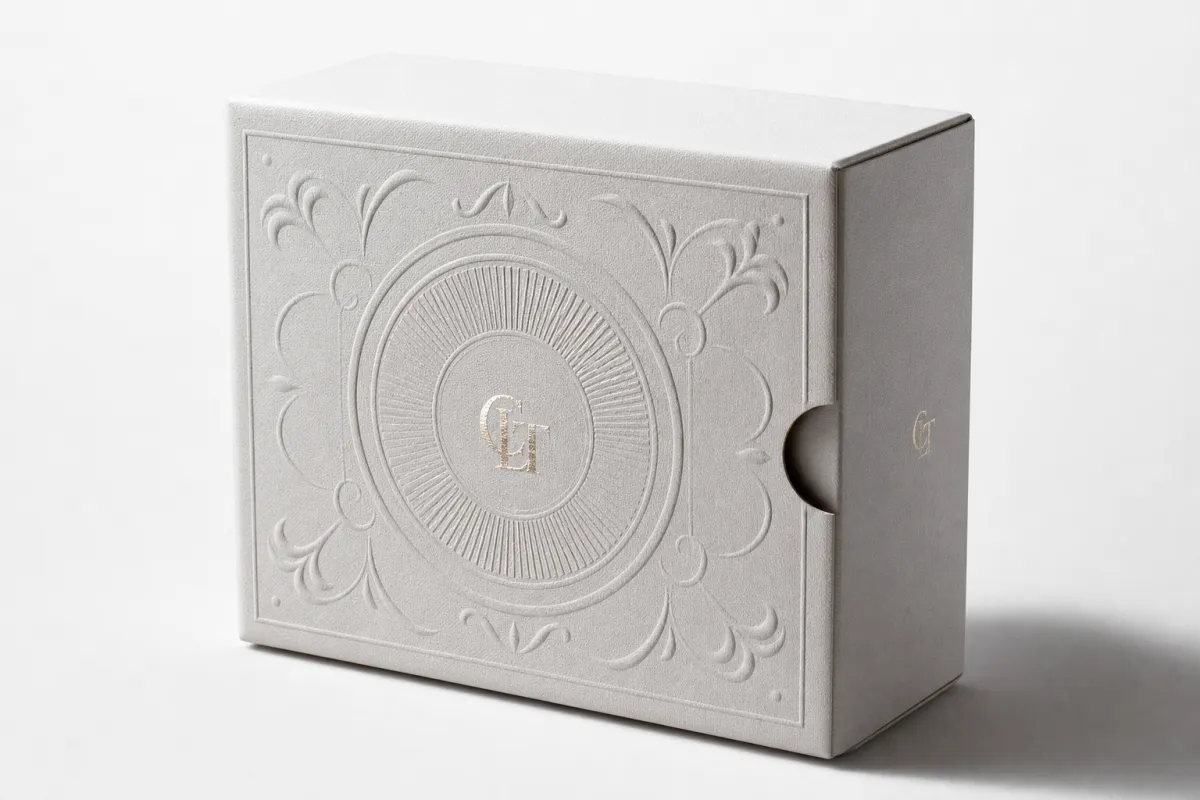
Custom boxes with embossing sell the story before the lid opens. That is their quiet power. The raised mark suggests care, and customers tend to read care as quality even when they cannot explain why. A logo that rises off the surface feels more deliberate than a flat print. The difference is subtle. Subtle is exactly the point.
Retail packaging lives or dies in that first contact. Put two similar products on a counter and the one with texture usually wins the glance, especially if the stock is matte and the logo has enough contrast to catch the light. Custom boxes with embossing give the surface a physical presence, and physical presence tends to register as premium. It is not mysticism. It is the way people handle objects when they have only a second to decide.
Embossing is straightforward in technical terms. A die presses paperboard upward so a logo, symbol, or pattern stands above the surface. The shape creates the effect; heavy ink coverage is not required. That is one reason custom boxes with embossing can look refined with very little artwork. Sometimes the absence of noise does more work than another layer of decoration ever could.
You see the finish often in cosmetics, specialty food, gift packaging, subscription kits, and presentation boxes for corporate use. Those categories live on presentation. If the package is part of the customer experience, custom boxes with embossing make sense. If the box only needs to move a product from warehouse to doorstep, the value is less dramatic and the budget should be treated with the same caution.
From a design perspective, the strongest embossing is rarely the most elaborate. A monogram, a simple icon, or a bold logotype usually reads better than a miniature scene. Custom boxes with embossing reward clear spacing and solid line weight. Fine detail often disappears once the board is pressed and trimmed. What looks elegant on a monitor can look undecided in production.
"If the design needs a paragraph to explain itself, embossing is probably the wrong tool."
That may sound blunt. It also saves money. Custom boxes with embossing should strengthen the brand, not complicate the box. When the surface already carries foil, spot UV, a dense illustration, and a complex pattern, embossing can lose its voice or start competing for attention. Restraint is not a compromise. Sometimes it is the most expensive-looking choice in the room.
For brands building packaging identity on a limited budget, this is one of the more efficient places to spend. The tactile effect can lift the entire presentation without flooding the box with ink. If you are comparing embossed packaging to other Custom Printed Box options, start with the structure, finish, and product weight before the decoration starts making too much noise. The box has to make sense before it can look impressive.
Customers also remember texture in a way they rarely remember color codes. Pantone numbers vanish quickly. The box that felt solid and structured tends to stay in memory. That is one reason custom boxes with embossing show up so often in repeat-purchase brands. The packaging becomes part of recognition, not just containment. A box can do that, and most people notice it only after the fact.
How Custom Boxes with Embossing Work
Custom boxes with embossing depend on a matched die set. One side pushes the board up, the other side receives the pressure and defines the form. Depending on the material, the process may rely on pressure alone or on controlled heat as well. The aim stays the same: raise the design without tearing the fibers or collapsing the surrounding panel.
The artwork has to be prepared with that in mind. Vector files are standard because the press needs crisp edges and predictable geometry. A logo filled with microscopic detail, hairline strokes, or cramped type usually turns muddy once custom boxes with embossing enters the production stage. Clean shapes survive. Busy art tends to argue with the machine and lose.
Registered embossing and blind embossing are the two common approaches. Blind embossing uses no ink or foil, so the form itself carries the design. Registered embossing aligns the raised area with printed graphics. Custom boxes with embossing often use blind embossing for a quiet luxury effect, while registered embossing makes more sense when the raised area has to sit in exact relation to printed art.
Material choice matters more than many buyers expect. Heavier paperboard, rigid construction, and coated stock usually hold detail better than flimsy cartons. If the board is too thin, the press can distort it or leave the surface too soft. For custom boxes with embossing, I usually want folding cartons in the 350gsm to 500gsm range, with much stiffer construction for rigid boxes. Thin stock is not frugal if it ruins the finish.
Press depth changes the result. A shallow emboss looks restrained and polished. A deeper emboss is bolder, though it also pushes the board harder and can strain the surface if the artwork is too fine. With custom boxes with embossing, the best depth is usually just enough to catch fingertips and throw a small shadow, not so much that the panel appears warped from across the table.
Line thickness matters as well. Something that looks elegant on screen can vanish in a press. Thin text and narrow rules should be thicker than they would be for flat print. Custom boxes with embossing are physical objects, not pixels, and they behave like one. That gap between digital image and paperboard is where many good-looking ideas fail.
If the box structure is still being developed, embossing needs to sit in the same conversation as die cutting. Creases, panels, glue areas, and the raised zone all influence each other. A panel near a fold behaves differently from a panel in the center of a rigid lid. Structural layout should be part of the packaging design from the start, not a detail introduced after the logo is approved and the deadline has become inconvenient.
For buyers who want a practical reference on sourcing and transit, the FSC site is useful for fiber sourcing, and ISTA covers transport testing standards. Neither one replaces a supplier’s judgment, but both give the discussion more weight than guesswork. Custom boxes with embossing should be beautiful and durable; those two things do not need to be in conflict.
I once reviewed a cosmetic carton where the emboss looked flawless in a PDF and oddly tired on press proof. The issue was not the die. It was the stock. The board fibers were too soft for the depth the brand wanted, so the detail flattened out under pressure. That kind of mismatch happens more often than people think, and it is exactly why physical samples matter.
Key Factors That Affect Custom Boxes with Embossing
Custom boxes with embossing are sensitive to material, layout, and finish. Two boxes with the same artwork can land very differently in production. One looks crisp and expensive. The other feels soft, vague, or oddly overworked. The gap usually comes from the decisions made before the quote was ever approved.
Material first. Board caliper, coating, fiber direction, and stiffness all shape how sharply the emboss reads. Heavier board keeps the raised detail cleaner. Coated stock can hold edges well, but slick coatings sometimes react unpredictably under pressure, which is why testing matters. For custom boxes with embossing, the substrate is part of the visual result, not just the backdrop.
Design complexity matters. Large logos, monograms, and simple symbols are the safest choice. Tiny text, dense patterns, and narrow illustration lines invite trouble. In practice, custom boxes with embossing performs best when the raised area has breathing room. You want shadow and shape, not a miniature relief sculpture that only works if the customer squints.
Box style changes the equation. Rigid boxes usually show embossing more clearly because they use thick board and stay square. Folding cartons can still look excellent, but the outcome depends on stock strength and panel size. Sleeves, mailers, and presentation boxes each respond differently. Custom boxes with embossing should be matched to the structure, not forced onto it as an afterthought.
Finish pairing can help or hurt. Soft-touch lamination often works well because the matte, velvety surface gives the raised detail more contrast. Foil stamping can add sharpness if the logo is large enough. Spot UV can work too, though too many effects at once start to crowd the design. Premium is not the same as crowded, and custom boxes with embossing usually look better when one finish leads and the others support.
Quantity affects the whole quote. The die setup cost and press preparation are fixed, so smaller runs carry a larger per-unit share of those charges. That is why custom boxes with embossing becomes more efficient as quantities rise. The labor does not scale in a neat straight line, but the math improves once the run moves out of the very small range.
A quick reality check helps. Ask whether the embossed area is doing a job. Is it reinforcing the logo? Helping the box stand out on shelf? Adding a tactile cue that matches the brand? If the answer is no, the effect may be decoration for its own sake. Packaging can survive a little vanity, but it should not be paying for it blindly.
| Box Type | Best Use | Embossing Result | Typical Cost Range |
|---|---|---|---|
| Rigid box | Luxury retail, gifts, premium kits | Very crisp, strong tactile depth | Higher; often $1.20-$4.50+ per unit depending on size and finish |
| Folding carton | Cosmetics, food, consumer goods | Good on heavier stock, moderate depth | Moderate; often $0.35-$1.25 per unit at volume |
| Mailer box | Subscription and ecommerce packaging | Works well with bold graphics and simple marks | Varies widely; often $0.80-$2.75 per unit |
| Sleeve or wrap | Retail presentation, layered branding | Best for a focused logo or icon | Usually lower than full rigid builds |
One more caution: not every printer or converter handles custom boxes with embossing the same way. Some shops are built for fast folding carton work. Others focus on premium rigid packaging. If you are comparing suppliers, ask what die system they use, what stock range they recommend, and whether they will send a proof or sample before production starts. That tells you more than a polished sales page and a nice logo on a brochure.
For broader Custom Packaging Products, it helps to compare embossing with other finishes before the specification is locked. Sometimes foil alone does the job. Sometimes a matte box with a restrained deboss or embossed logo is the cleaner choice. The strongest result usually matches the product instead of trying to impress an imaginary award jury.
Cost, Pricing, MOQ, and Quote Drivers
Custom boxes with embossing are priced from several pieces, not one. The quote usually includes board stock, print, finishing, labor, setup, the emboss die, proofing, packing, and freight. If a vendor gives you one vague number without explaining the components, expect surprises later. Packaging estimates have a habit of hiding the hard part until the invoice arrives.
The die is often the biggest fixed line. A simple emboss die may run about $120 to $350 for a straightforward logo, while a larger or more intricate die can climb to $400 to $800 or more depending on tooling complexity and material. Those figures are planning ranges, not universal truths; region, supplier class, and metal tooling requirements all shift the number. That is one reason custom boxes with embossing make more sense when the run is large enough to spread setup costs across more units. The finish is elegant; the math is not mysterious.
Minimum order quantity follows the same logic. Small runs can absolutely be done, but the unit price climbs because setup and tooling do not shrink just because the order is tiny. For custom boxes with embossing, the per-unit cost usually improves once the order moves from a few hundred pieces into the 1,000 to 5,000 range, then again as the run grows beyond that. Scale matters, even when the box looks delicate.
Structure changes the price too. Rigid boxes cost more than folding cartons because they use more material, more handwork, and more assembly steps. Inserts, magnetic closures, ribbon pulls, and custom partitions add labor. If the quote for custom boxes with embossing looks suspiciously low, check whether it covers the full structure or only the outer shell. The shell is never the whole story.
Artwork complexity affects cost in less obvious ways. If the design needs multiple plates, tight registration, or special alignment for finishing, setup time increases. That means custom boxes with embossing can get expensive quickly when the artwork is overdesigned. A strong logo with clean spacing is usually cheaper to make and better to look at, which is a rare kind of deal.
Here is a practical quote checklist that reduces back-and-forth:
- Exact box dimensions, including internal and external size
- Board thickness or rigid wrap specification
- Emboss area size and placement
- Whether the effect is blind embossing or registered embossing
- Print method, finish, and any foil or spot UV
- Quantity, shipping destination, and target delivery window
Ask for a line-item quote whenever possible. A transparent estimate makes supplier comparisons far easier. One shop may include die prep and a digital proof. Another may quote the base box and add tooling later. Those are not the same price, even if they look close at first glance. Custom boxes with embossing can hide that difference well, which is why clarity matters early.
As a planning rule, a simple folding carton with embossing at volume might land in the $0.35 to $0.95 range per unit, while a rigid presentation box with embossing can easily move into the $1.50 to $4.50 range depending on size, finish, and insert complexity. Smaller runs cost more per box. Specialty work costs more. That is not a surprise. It is the cost of turning paperboard into a branded object instead of a plain container.
For shipping-sensitive programs, ask whether the packaging is being tested against a transit standard. A box can look beautiful and still get battered in distribution. That is where reference points like ISTA packaging test methods become useful. Custom boxes with embossing should survive the journey to the customer, not just the photo session in the studio.
Step-by-Step Guide to Ordering Custom Boxes with Embossing
Start with the product, not the decoration. What does the box need to protect? How much weight does it carry? Is it sitting on a shelf, shipped directly to the customer, or handed over in store? Custom boxes with embossing should support the product's use case before they try to support the brand story.
Step 1: choose the structure. Mailer, rigid, tuck-end, sleeve, or a custom presentation format all do different jobs. A cosmetic kit may justify a rigid setup. A light retail item may belong in a folding carton. The wrong structure wastes money even when the embossing looks beautiful. Custom boxes with embossing only work when the box itself fits the product.
Step 2: simplify the artwork. Vector artwork is the starting point. From there, remove tiny details, tighten spacing, and avoid ultra-thin lines. If the logo carries a small tagline, consider leaving the tagline flat and embossing only the primary mark. That usually reads cleaner. Custom boxes with embossing reward discipline, not excess.
Step 3: request a dieline early. The dieline shows folds, glue areas, and panel placement. It also reveals whether the emboss area sits too close to an edge or crease. This is where a lot of problems get caught before they turn expensive. If you are buying custom boxes with embossing, the dieline is not a formality. It is the map.
Step 4: approve a proof or sample. A digital mockup helps, but a physical sample tells the truth about depth, color, and touch. There is no substitute for seeing how the raised area catches light. I have watched custom boxes with embossing look excellent on screen and only average in hand. That is why sample approval exists.
Step 5: confirm finish and packout. If you are using inserts, tissue, seals, or shipping cartons, decide those details before production begins. Packaging often fails in the final stretch because the run was approved too early and the rest was left to assumption. Custom boxes with embossing should sit inside a complete packaging system, not a one-off box decision made under pressure.
If you are ordering through a supplier like Custom Logo Things, the project file should include size, artwork, finish, target quantity, and delivery timing. The cleaner the brief, the fewer revisions, and the lower the odds that the quote balloons. That is the unglamorous side of packaging. It is also the part that saves the most money.
A practical workflow usually looks like this:
- Define the product and unboxing goal
- Pick the box style and target budget
- Prepare vector artwork for embossing
- Review dieline and sample proof
- Approve stock, finish, and quantity
- Run production and inspect the first output
Custom boxes with embossing are easiest to get right when everyone agrees on the job of the box. If the goal is premium retail presentation, the structure should feel stable and the raised mark should be simple and visible. If the goal is ecommerce protection with a branded lift, the design should be bolder and the insert plan should support shipping. Same phrase, different job, different outcome.
Process Timeline, Turnaround, and Production Steps
The usual sequence for custom boxes with embossing is straightforward: design review, dieline setup, die making, sample approval, production, finishing, packing, and shipping. The problem is not the sequence. The problem is where a job stalls. Most delays come from artwork changes, late approvals, or stock that is no longer available because someone waited too long to lock the spec.
Turnaround depends on complexity. A repeat order with an existing die may move in 10 to 15 business days after approval. A new emboss die, new print setup, and multiple finishes can stretch into 15 to 25 business days or more, especially on a large order. Custom boxes with embossing are not slow because the process is mysterious. They are slow because several steps have to line up in the correct order, and that rarely happens by accident.
Die making is usually not the longest step, but it can become one if the artwork changes late. Every revision can affect fit and registration. If the raised area shifts even a little, the box may need another proof. That is why custom boxes with embossing need a freeze point. At some stage, the file has to stop drifting around like a group project with too many cooks and not enough decisions.
Press queue time matters too. A supplier with a full calendar may be slower even on a simple run, while a shop with open capacity may move faster on a more complex one. That does not make one inherently better. It means production calendars are real. Custom boxes with embossing are tied to machine time, not wishful thinking or optimistic emails.
There are a few usual delay triggers:
- Last-minute artwork changes after the sample is approved
- Unclear emboss placement or inconsistent file dimensions
- Backordered board stock or special coating delays
- Multiple rounds of sample review because the first design was too detailed
- Shipping disruptions caused by missed lead-time buffers
If the launch date matters, build in a buffer. For retail drops, seasonal gift packaging, or subscription relaunches, an extra week in the schedule is worth more than a rushed approval that locks in a bad result. Custom boxes with embossing are worth the time if they improve the brand presentation. They are not worth panic at the finish line.
Ask the vendor how they inspect the first press sheets or the first finished units. A good production team checks alignment, depth, and surface quality before the run continues. That small checkpoint saves a lot of waste. Custom boxes with embossing are costly enough without printing 2,000 units of the wrong thing and hoping nobody notices.
Common Mistakes with Custom Boxes with Embossing
The biggest mistake is artwork that is too fine. On a screen, a delicate logo can feel elegant. In production, it can disappear or distort. Custom boxes with embossing need bold shapes and enough spacing for the board to move cleanly. If the details are tiny, the emboss has nowhere to breathe, and the result feels unfinished.
Another common issue is the wrong material. Thin stock, weak coatings, or a board with poor structure can make the embossed area look soft and uneven. The outcome is neither premium nor usefully inexpensive. It just looks off. Custom boxes with embossing deserve stronger stock because the finish depends on physical stability more than most buyers expect.
Skipping samples is a classic budget mistake. A buyer sees the render, approves the file, and assumes the box will look the same in hand. It will not. Not exactly. Depth, shadow, and tactile feel cannot be judged from a flat preview alone. For custom boxes with embossing, samples are cheap insurance against expensive disappointment.
Overcomplicating the finish stack causes trouble too. Embossing plus foil plus spot UV plus heavy print may sound luxurious in theory. In practice, it can look noisy. The eye gets tired. The texture gets buried. A better move is to let custom boxes with embossing carry the main visual idea and use one supporting finish, not three competing ones.
Vague specs also create damage. If the supplier has to guess box size, emboss area, or quantity, the quote will be fuzzy and the result probably will be too. Give exact dimensions, artwork placement, and target unit count. The more precise the brief, the easier it is to make custom boxes with embossing that match the expectation instead of the hope.
Shipping conditions matter as much as the print file. A beautiful embossed lid can scuff in transit if the packout is weak. Inner packing, outer cartons, and handling tests all matter. That is where product packaging crosses into logistics, and where a lot of brands discover friction they should have planned for from the start.
"Pretty packaging that arrives damaged is not premium. It is expensive disappointment."
If you want to avoid the common failures, think through the full path: artwork, board, press, assembly, packing, and shipping. That is more work, yes. It is also the reason custom boxes with embossing can outperform simpler packaging. They reward the teams that plan carefully instead of improvising after the proof stage.
Expert Tips for Custom Boxes with Embossing
Keep the design bold and restrained. That is the most useful advice and the one people ignore most often. Custom boxes with embossing look best when the mark is confident, not crowded. One strong logo on a clean panel usually reads better than a scattered layout packed with tiny decorative elements. Packaging buyers love to overdesign right before they have to pay for it.
Use contrast with purpose. A matte surface, a foil accent, or a dark printed field can make the raised area stand out more clearly. On lighter stocks, a blind emboss can still work, but the form has to be strong enough to catch light. The payoff comes from contrast between flat and raised surfaces. Custom boxes with embossing need that contrast, or the effect goes quiet and forgettable.
Test in hand, not just on screen. Hold the sample under standard office light and then under brighter retail lighting. The shadow changes. The perceived depth changes. Even the way fingers read the surface changes. That is why custom boxes with embossing can look modest in a PDF and impressive in person, or the other way around. Physical testing tells the truth faster than any mockup.
Ask for tolerances before production starts. You want to know how much alignment variation is acceptable, how much depth change is normal, and what finish variation counts as within spec. That is how you avoid arguments later. Good suppliers will discuss those ranges openly. For custom boxes with embossing, that conversation is not a warning sign. It is a sign the project is being handled like actual manufacturing.
Use embossing where the brand needs memory. A logo, monogram, seal, or small pattern on the lid often carries more value than embossing every panel. That focused use gives the package a clear point of recall. If you want customers to remember the box, custom boxes with embossing should give them one tactile anchor instead of a dozen competing impressions.
When comparing suppliers, ask three direct questions:
- What stock do you recommend for this emboss depth?
- Can you show a sample or proof before full production?
- Is the die cost included in the quote or listed separately?
Those questions cut through a lot of noise. They also reveal whether the supplier understands custom boxes with embossing as a production process or only as a sales feature. There is a difference. A large one.
If you are building a broader packaging program, coordinate the embossed box with labels, inserts, shipping cartons, and any secondary packaging so the whole presentation feels consistent. That is where branded packaging starts paying off in a way that is easy to miss on a spreadsheet and obvious in the hand.
For buyers browsing Custom Packaging Products, I would start with the structure that fits the product and the budget, then narrow the finish stack from there. More effects do not automatically produce a better result. Some of the cleanest custom boxes with embossing are also the least fussy. That is rarely an accident.
In the end, custom boxes with embossing work best when structure, artwork, and production plan all agree. If one of those pieces is fighting the others, the box will show it. If they line up, the result feels intentional, tactile, and harder to ignore than plain custom printed boxes. The practical move is simple: lock the dieline, simplify the raised artwork, and approve a physical sample before the full run starts. That order saves more money than any last-minute flourish ever will.
FAQ
How much do custom boxes with embossing usually cost?
Price depends on box style, stock thickness, emboss size, print coverage, and whether a new die is needed. For planning, many folding carton jobs land around $0.35 to $1.25 per unit at usable volume, while rigid boxes can move into the $1.20 to $4.50+ range. Small orders cost more per box because setup gets spread across fewer units. Ask for a line-item quote so you can see die prep, finishing, and shipping separately.
What kind of artwork works best for embossed custom boxes?
Use vector artwork with bold shapes, clean edges, and enough line weight to survive the press. Tiny text, hairline rules, and intricate patterns are risky because the press can flatten or blur them. Custom boxes with embossing usually look best when the embossed area is simple and deliberate, with room around it so the raised texture reads clearly from arm's length.
Are custom boxes with embossing better on rigid boxes or folding cartons?
Rigid boxes usually show embossing more cleanly because the board is thicker and holds detail better. Folding cartons can still work well if the stock is heavy enough and the artwork is simplified. The right choice depends on product weight, budget, shipping method, and how premium you want the box to feel. There is no universal winner.
How long does it take to produce custom boxes with embossing?
Lead time depends on artwork approval, die making, sample checks, and press availability. A repeat order with an existing die can move in about 10 to 15 business days after approval, while new tooling and multiple finishes can push the timeline to 15 to 25 business days or more. Build in extra time for revisions so a late file change does not hold up the whole run.
Can I combine embossing with foil or spot UV?
Yes, but the design needs to be planned so the effects support each other instead of competing. Foil and embossing can create a strong premium look when the logo is large enough and registration is tight. Spot UV can also work, but stacked effects should be sampled first because they can look sharp on proof and messy on the actual box if the layout is too busy.
Custom boxes with embossing are worth the effort when you want packaging that does more than hold a product. They shape the first impression, strengthen package branding, and add real tactile value without relying on overdone decoration. If you get the structure, artwork, and timing right, custom boxes with embossing can turn ordinary product packaging into something customers notice before they even open it.

