Buyer Fit Snapshot
| Best fit | Custom Drawer Boxes Supplier projects where brand print, material claims, artwork control, MOQ, and repeat-order consistency need to be specified before quoting. |
|---|---|
| Quote inputs | Share finished size, material target, print colors, finish, packing count, annual reorder estimate, ship-to region, and any compliance wording. |
| Proofing check | Approve dieline scale, logo placement, barcode or warning zones, color tolerance, closure strength, and carton packing before bulk production. |
| Main risk | Vague material claims, crowded artwork, missing packing details, or unclear freight terms can make a low unit price expensive after revisions. |
Fast answer: Custom Drawer Boxes Supplier: Board, Finish, Dieline, and Unit Cost should be specified like a repeatable production item. The safest quote records material, print method, finish, artwork proof, packing count, and reorder notes in one written spec.
Production checks before approval
Compare the actual filled-product size with the drawing, then confirm tolerance on folds, seals, hang holes, label areas, and retail display edges. Reserve space for logos, QR codes, warning copy, and material claims before decorative graphics fill the panel.
Quote comparison points
Review material grade, print process, finish, sampling route, tooling charges, carton quantity, and freight assumptions side by side. A quote is only useful when the supplier can repeat the same color, closure quality, and packing count on the next order.
A Custom Drawer Boxes supplier has a bigger job than most buyers first assume. The box is not just a container sitting around the product; it shapes the first pull, the little pause before the tray opens, and the way the whole package feels in the hand. That matters a great deal for cosmetics, candles, jewelry, apparel accessories, and gift sets, where packaging is part of the product experience and not a side detail.
What tends to surprise people is that the strongest box is rarely the flashiest one. A clean structure, the right board thickness, a well-matched sleeve, careful print registration, and a finish stack that fits the brand usually do more for perceived quality than piling on effects. A capable Custom Drawer Boxes supplier does not just build a carton; they turn product goals into packaging that looks sharp, travels well, and repeats cleanly on reorders. That is true whether the project is retail packaging or Custom Printed Boxes built for gift-driven e-commerce.
Drawer boxes also deserve a fair comparison against rigid setup boxes and mailers before anyone places an order. The format sits in a useful middle ground: more presentation-driven than a standard mailer, lighter than a full rigid setup box, and often more memorable than an ordinary folding carton. The format only works well, though, when the dimensions, materials, and finish choices are planned with care from the start.
Why a custom drawer boxes supplier can make or break shelf appeal
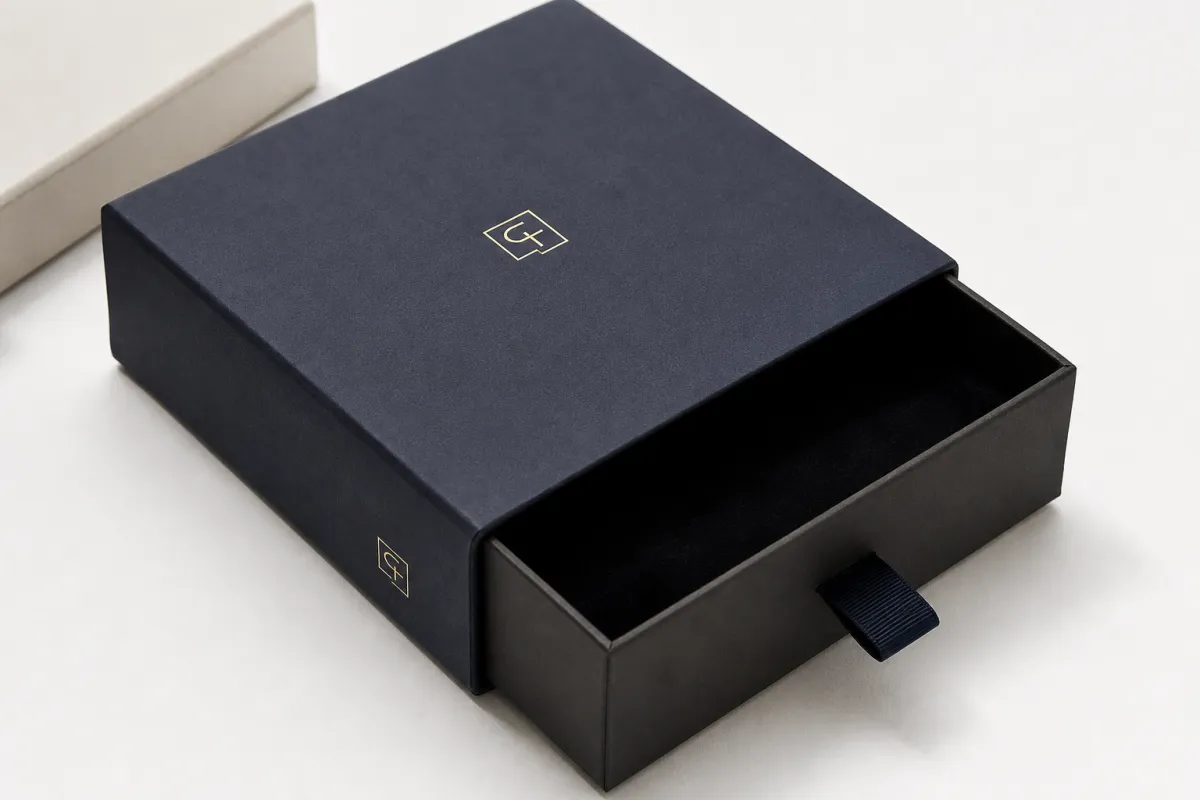
Drawer-style packaging gets attention quickly because it invites interaction. The sleeve stays still while the tray moves, and that small motion creates a moment of anticipation people notice even when they cannot explain why. A skilled custom drawer boxes supplier understands that the motion has to feel controlled. If the tray binds, rattles, or slides out too freely, the package loses some of its perceived value, even if the product inside is excellent.
That is one reason the format shows up so often in premium categories. Cosmetic brands use it for compact sets, lip products, and skincare bundles. Candle makers choose it for seasonal gifts and curated pairs. Jewelry lines rely on the reveal to create a sense of ceremony. Apparel accessory brands, from socks to ties to small leather goods, also benefit from the tidy presentation. In each case, the box becomes part of the product packaging experience, and the supplier’s decisions influence how polished the brand feels on a shelf or in a gift bag.
Three details usually matter the most: board grade, print finish, and the fit between Tray and Sleeve. A 1200gsm to 1500gsm greyboard wrapped in 157gsm art paper feels very different from a lighter paperboard structure. Add matte lamination, foil stamping, or embossing, and the tactile impression changes again. Those choices affect more than appearance; they shape how the box opens, how it holds up during handling, and how clearly it communicates package branding in the hand.
A thoughtful custom drawer boxes supplier also knows when restraint is the better choice. If the product is light and the order volume is high, a paperboard drawer box may be the most practical fit. If the product is heavier or the brand needs stronger shelf presence, a rigid structure with a well-fitted tray usually makes more sense. Not every program needs the most expensive build. The best one is the one that supports the product and the budget without creating avoidable waste or freight cost.
A drawer box should feel intentional from the first pull. If the motion feels awkward, the box is working against the product instead of supporting it.
Drawer packaging gets compared with mailers a little too casually. A mailer is built around shipping efficiency. A rigid setup box is built around premium heft and protection. Drawer packaging sits between those extremes, which can be the right place for retail packaging that needs presentation without the weight or bulk of a full rigid set. The right custom drawer boxes supplier helps you decide whether that balance is worth the investment for your line.
If you want to see how drawer structures fit into a broader packaging range, reviewing Custom Packaging Products side by side can help. A strong supplier should explain the tradeoffs plainly, not hide them behind broad claims.
Custom drawer boxes supplier process, timeline, and approvals
The best projects usually start with a disciplined intake process. A reliable custom drawer boxes supplier should ask for product dimensions, product weight, insert needs, artwork files, target quantity, budget range, desired ship date, and whether the box will be used for retail, gifting, or e-commerce. That is not paperwork for its own sake. Those details determine the structure, the board thickness, and the amount of hand assembly required.
Once intake is complete, the box gets engineered around a few core decisions. Sleeve and tray dimensions need to account for product clearance, coating thickness, and the pull method, whether that is a thumb notch, finger cutout, or ribbon pull. If the product has movement risk, the supplier may recommend a custom insert made from EVA foam, molded pulp, die-cut cardboard, or folded paperboard. A solid custom drawer boxes supplier will explain why one insert fits the job better than another instead of defaulting to the cheapest option.
The proofing path usually moves in stages. First comes dieline review, where the layout is checked for panel size, bleed, and glue flap placement. Then comes a digital proof, which helps catch artwork problems like low-resolution images, color shifts, barcode placement, and wrapped-edge alignment. Many buyers also request a physical sample or prototype, because tray fit and slide tension are hard to judge on a screen. That sample stage is where the real checks happen: closure tension, fit, finish feel, and how the box behaves with the actual product inside.
Timelines are often longer than buyers expect, especially for premium custom printed boxes. A simple drawer box program might move from proof approval to production in 12 to 18 business days, but foil, embossing, custom inserts, or late artwork changes can stretch that schedule quickly. More complex jobs can take longer if the supplier needs specialty board or staged hand assembly. A good custom drawer boxes supplier will map the sequence clearly: prepress, material sourcing, printing, lamination, die-cutting, assembly, quality control, and final packing.
Delays usually show up in a few predictable places. Artwork revisions are one of the biggest causes, especially when copy is still changing or too much information is being squeezed onto a small panel. Finish changes can also slow the job because matte laminate, soft-touch coating, or foil stamp setups may need adjustments. Sample feedback can uncover a fit issue, which is actually useful if it happens early. It is far less expensive to adjust tray depth or sleeve width at the prototype stage than after a full run has started.
For brands that need distribution testing, it is worth asking whether the pack should be evaluated against a transit method similar to ISTA procedures or a comparable ASTM transport standard. If the drawer box will ship through multiple handling points, vibration, compression, and drop performance matter just as much as shelf appearance. The supplier does not need to be a lab, but the supplier should understand that packaging has to survive the lane it is built for.
Clear approvals matter inside your own team too. I have watched projects slow down because marketing, operations, and procurement each wanted a different finish or closure style. A strong custom drawer boxes supplier can guide the technical side, but the buyer still needs a decision-maker who signs off on dimensions, artwork, and sample approval without delay. Without that, the schedule stretches and the box misses the launch window.
- Dieline review: confirm dimensions, glue flaps, bleed, and panel orientation.
- Digital proof: check spelling, barcodes, color consistency, and legal copy.
- Physical sample: test fit, tray movement, closure tension, and insert performance.
- Pre-production signoff: lock the spec so the full run matches the approved sample.
Custom drawer boxes supplier cost, pricing, and MOQ basics
Drawer packaging pricing is driven by a handful of practical factors. Board grade comes first, because thick greyboard or chipboard costs more than lighter paperboard. Print coverage matters too, especially if the design uses large dark solids, full wraps, or multiple inks. Specialty finishes such as soft-touch lamination, hot foil, embossing, debossing, and spot UV can move the box into a much higher bracket. A good custom drawer boxes supplier will itemize those pieces so you can see exactly what is driving the quote.
MOQ, or minimum order quantity, is another point buyers need to understand in plain terms. The supplier has setup costs for plates, die cutting, tooling, and production calibration. As quantity rises, those fixed costs spread across more units, and the per-box price usually falls. That is why a 1,000-piece run often carries a much higher unit price than a 5,000-piece run. The goal is not to chase the lowest unit price blindly. If the order is larger than your actual need, storage costs, obsolescence, or design waste can start eating into the savings.
For many premium programs, a simple paper-wrapped drawer box in a mid-range size might land around $0.70 to $1.60 per unit at higher volumes, while a rigid box with specialty printing, foil, and a custom insert can move into the $1.80 to $4.50 range or beyond, depending on quantity and complexity. Those are broad working ranges, not promises, and the actual quote will depend on the exact structure. A trustworthy custom drawer boxes supplier will give you a quote that matches the real spec, not a teaser number that changes later.
Here is a simple comparison that helps buyers judge cost and value more clearly.
| Drawer box option | Typical MOQ | Typical unit cost range | Best fit | Main tradeoff |
|---|---|---|---|---|
| Paperboard drawer box | 1,000-3,000 units | $0.45-$1.20 | Lightweight retail, promotional kits, larger programs | Less structural heft than rigid board |
| Rigid drawer box | 500-2,000 units | $0.90-$2.80 | Premium retail packaging, gifts, luxury items | Higher freight and assembly cost |
| Rigid drawer box with insert and specialty finish | 500-1,500 units | $1.80-$4.50+ | High-value sets, cosmetics, jewelry, curated gifts | More setup time and tighter approval needs |
Hidden costs are where many budgets get bruised. Sample charges can apply if the supplier builds a physical prototype. Tooling or die fees may be separate. Freight can make a bigger difference than expected, especially if the boxes ship flat, semi-assembled, or fully built. If the design changes after approval, rework charges may appear. If the order is rushed, a fast-track fee is common. A seasoned custom drawer boxes supplier will spell those out early, because surprises after approval tend to create friction for everyone involved.
One practical rule helps a lot during quote comparisons: compare only when every supplier is quoting the same size, board, finish stack, insert spec, assembly level, and delivery expectation. If one supplier is quoting a 1,500gsm board with a soft-touch wrap and another is quoting lighter paperboard with no insert, the cheaper line item is not actually cheaper. It is just a different product.
For teams that need to scale beyond one package format, reviewing the broader Custom Packaging Products lineup can help determine whether a drawer box is the best place to invest budget, or whether another structure would serve the program better. Good packaging design is about fit, not just appearance.
Materials, sizing, and finishes that shape the final box
Material choice changes both feel and performance. A rigid drawer box usually uses greyboard or chipboard as the core, then wraps it in printed paper. That gives the package a dense, premium feel and clean edge definition. Paperboard drawer boxes, by contrast, rely more on folded construction and lighter stock, which can make them a smart choice for high-volume retail packaging or lighter products. The right custom drawer boxes supplier should talk about this in terms of use case, not just in terms of what is cheapest to make.
Sizing is where many packaging mistakes begin. Buyers often measure the product itself and stop there, but the insert, tray movement, and slide clearance all need room too. If the tray is too tight, it scrapes or jams. If it is too loose, the item rattles and the package feels flimsy. A good rule is to size around the finished packed product, not the bare product. That means measuring the item plus any sleeve, wrap, pouch, insert, or accessory that sits inside the box. A careful custom drawer boxes supplier will ask for those measurements and may suggest a prototype if the product has irregular corners or a fragile finish.
Finishes carry a lot of the emotional load. Matte lamination gives a calm, modern look. Gloss brings more visual punch but can show scuffs faster. Soft-touch feels velvety and often signals higher-end branded packaging, though it is not the right fit for every print style. Foil stamping can highlight a logo or pattern beautifully, but it needs enough contrast and clean line work to avoid looking busy. Embossing and debossing add depth, and spot UV creates a crisp shine against a matte field. The supplier’s job is to help you choose a finish stack that fits the design, the budget, and the product category.
There is also a sustainability angle worth handling honestly. Recycled board, FSC-certified paper, and simpler coating stacks can reduce material impact without making the box look plain. If you want the packaging to align with a lower-waste program, ask whether a FSC-certified paper wrap is available and whether the design can avoid unnecessary lamination or oversized void space. In some cases, a cleaner structure and a tighter tray can reduce shipping volume as well. That matters more than many teams realize.
Print complexity deserves attention too. Dark solid backgrounds can show scratches, dust, and pressure marks if the finishing process is not well controlled. Very fine type can disappear against textured wraps. Metallic inks can shift under different light conditions. Large unbroken color fields can expose registration problems more clearly than people expect. A dependable custom drawer boxes supplier will warn you when a design choice raises the risk of visible defects, because not every premium effect behaves well in production.
One more practical point: if the box is going into a retail environment, the shelf face should be considered from a distance of three to five feet, not just from a design file on a screen. The logo size, contrast, and opening side all influence how quickly a shopper reads the package. That is where packaging design and package branding meet the realities of retail aisles. A good box does not need to shout, but it does need to read clearly.
In many programs, the best result comes from a disciplined balance: sturdy enough to feel premium, simple enough to produce consistently, and refined enough to match the product price point. That balance is exactly what a smart custom drawer boxes supplier should help you build.
Step-by-step: choosing the right custom drawer boxes supplier
Start with a clean internal brief. Include the product dimensions, product weight, target quantity, budget ceiling, launch date, and any non-negotiable features such as a ribbon pull, magnetic closure, foam insert, or recycled board requirement. The more precise the brief, the better the supplier can propose the right structure. A serious custom drawer boxes supplier should be able to look at that brief and tell you what is realistic, what is risky, and what is simply overbuilt for the product.
Then ask for sample work. Not just generic carton pictures, but actual drawer structures, close-up photos, or physical examples if they can provide them. You are looking for evidence that the supplier understands tray fit, sleeve tension, print wrap quality, and the details that separate ordinary custom printed boxes from packaging that feels deliberate. If the supplier only speaks in broad terms and cannot show similar projects, that is a warning sign.
Communication quality matters more than many buyers admit. Fast replies are good, but clarity is better. You want direct answers on board thickness, print method, finish compatibility, and approval steps. If the supplier answers every question with vague language, you may run into problems later when a prototype reveals a mismatch. A capable custom drawer boxes supplier does not need to sound fancy; they need to sound specific.
Compare suppliers on more than price. Look at lead time, sample process, quality control, shipping method, and reordering support. Can they repeat the same spec later without rebuilding the file from scratch? Do they document the approved dieline? Do they have tolerances for print alignment and box squareness? Those details matter when you need the same box again for a seasonal refill or an expanded product line. In packaging, repeatability is a form of quality.
It also helps to ask how they handle manufacturing checks. Good suppliers inspect tray fit, glue integrity, surface defects, color consistency, and corner squareness before packing the shipment. In a better-run program, they also have a final QC step for quantity count and carton labeling. If the boxes are being shipped into a distribution center, you want to know they are packed in a way that protects the finish during transit. A supplier who understands distribution is usually a safer bet than one who only knows how to print.
If you are shortlisting candidates, use the same spec sheet for all of them. That keeps the comparison fair. Send the same dimensions, the same artwork notes, the same insert requirements, and the same ship-to expectation. Then compare the answers. Which supplier suggests a cleaner structural choice? Which one explains the tradeoffs in plain language? Which one protects your budget without stripping out important quality cues? A competent custom drawer boxes supplier should earn trust through detail, not promises.
- Write the brief: capture size, weight, quantity, budget, and launch timing.
- Request proof points: ask for similar drawer box samples or photos.
- Check clarity: evaluate how directly the supplier explains materials, fit, and finish.
- Compare the same spec: use one sheet across all candidates so pricing is meaningful.
- Confirm reorder support: make sure the supplier can repeat the approved build later.
From a packaging buyer’s point of view, this process keeps the project grounded. It is tempting to focus on the most attractive render or the lowest number on a quote, but the better approach is to choose the custom drawer boxes supplier that understands how the box will function in production, in transit, and on the shelf.
Common mistakes when working with a drawer box supplier
The first mistake is measuring only the product. Drawer packaging has moving parts, and those moving parts need space. If you ignore the insert thickness, the slide clearance, or the extra room needed for a finger notch, you may end up with a tray that feels too tight or a sleeve that looks oversized. That is a classic place where a custom drawer boxes supplier can help, but only if the buyer shares complete measurements up front.
The second mistake is approving artwork before confirming the dieline. Once the fold lines, wrap lines, and seam positions are set, artwork has to respect them. If the barcode lands too close to a fold or a logo crosses a visible seam in an awkward way, the final box can look careless even if the print quality is fine. The artwork should be built after the structure is understood, not before.
The third mistake is choosing finishes for style without checking production fit. A deep emboss can look excellent on a mockup, but if it interferes with a fine logo or a heavy wrap, the result may not hold up. Soft-touch can feel expensive, yet it may show marks more readily on dark designs. Foil can elevate a box, but it also adds setup and can be less forgiving on tight deadlines. A good custom drawer boxes supplier will talk through those tradeoffs before you commit.
Shipping and handling are another common blind spot. A box might look great on a table and still fail in a warehouse if the trays are crushed by overstacking or the finishes scuff during freight. Ask how the boxes will be packed, how many fit per carton, and whether the shipment is designed for palletizing or direct-to-store handling. If the box is meant for e-commerce, it may need different protection than a box that stays on a retail shelf. The supplier should think about the full distribution path, not just the printed surface.
Finally, buyers sometimes chase the lowest quote without checking whether the specs are actually the same. One supplier may include manual insert placement, another may not. One may quote better board, another may quote thinner stock. One may include freight to your dock, another may not. That kind of comparison leads to false savings. The right custom drawer boxes supplier will welcome apples-to-apples comparison because their quote can stand on actual value.
A practical way to avoid these mistakes is to review a few trusted standards and ask whether your pack needs to align with them. Packaging.org offers useful context on package design and supply chain considerations, while FSC helps buyers understand certified fiber choices. If the box is going to travel, the testing conversation should also include transport and distribution performance, not only appearance. That is where good retail packaging becomes durable packaging.
And the most expensive mistake is often not the fancy finish or the thicker board. It is a package that delays launch because nobody locked the spec early enough. That problem is preventable, but only if the buyer and the custom drawer boxes supplier stay aligned from the first drawing to the final packed carton.
Next steps with your custom drawer boxes supplier
Before you request quotes, gather the exact product size, product weight, target quantity, desired delivery window, and any presentation features you want in the finished box. If an insert is needed, decide whether it is meant for protection, presentation, or both. That information lets the custom drawer boxes supplier build a recommendation that is useful instead of generic.
Then separate the must-haves from the nice-to-haves. A ribbon pull might be essential for a gift set, while a specialty foil effect might be something you can add on the next run. A foam insert may be necessary for a fragile item, while a paperboard insert may be enough for a lighter accessory. When you prioritize the structure first, the sample stage becomes much easier to evaluate. You are checking the decisions that matter most, not debating decorative extras too early.
Ask for a physical sample or prototype, a detailed quote, and a written production schedule. Those three pieces give you a practical view of what the project will cost, how it will feel, and when it will land. A good custom drawer boxes supplier should have no trouble explaining the path from proof approval to shipment. If they cannot give you a clear timeline, you are taking on unnecessary risk.
It helps to build a comparison sheet for two or three suppliers. Track price, MOQ, Lead Time, finish options, insert options, shipping method, and support quality in one place. That makes the differences visible fast, especially if one supplier is stronger on cost while another is stronger on finish control or reorder support. This is one of the simplest ways to make a smarter packaging decision without turning the process into guesswork.
When the order is ready to move, confirm the artwork, dieline, sample approval, and final schedule in writing. That last check sounds basic, but it prevents a lot of confusion later. Packaging runs are easier when everyone is working from the same approved file and the same approved sample. That is how you get consistency across launches, reorders, and related branded packaging programs.
For brands that want to keep growing, the value of a dependable custom drawer boxes supplier is hard to overstate. They help you turn product goals into a packaging structure that looks right, ships right, and repeats right. If you compare materials, pricing, fit, and approval discipline now, the finished drawer box will do more than hold the product. It will support the brand every time someone opens it.
Practical takeaway: build one packed-product spec sheet before you ask for quotes, then compare suppliers against that same sheet. Include size, weight, insert type, finish stack, MOQ, and ship date, and you will avoid most of the confusion that slows drawer box projects down.
What should I ask a custom drawer boxes supplier before ordering?
Ask about material options, finish choices, MOQ, sample availability, and whether the quote includes inserts, assembly, and freight. You should also confirm the production timeline and ask what variables can change the price, so you can compare suppliers on the same spec.
How much do custom drawer boxes usually cost?
Pricing depends on box size, board grade, print coverage, specialty finishes, insert work, and order quantity. Larger runs usually bring the unit price down because setup costs are spread across more boxes, but it is still smart to request an itemized quote so you can see exactly what is included.
What is a normal lead time for drawer boxes from a supplier?
Lead time usually covers proofing, sample approval, production, and shipping, so the total schedule is longer than print production alone. Simple builds move faster, while foil, embossing, custom inserts, or late artwork changes can add time, so it is wise to leave buffer room before launch.
Are rigid drawer boxes better than folding drawer boxes?
Rigid drawer boxes are usually the better fit for premium retail, gifting, and higher perceived value, while folding drawer boxes can work well for lighter products and tighter budgets. The right choice depends on product weight, shipping needs, and the brand experience you want the package to create.
How do I avoid sizing mistakes with a custom drawer box supplier?
Measure the product plus insert clearance, not just the bare item, so the tray can move smoothly without rattling. Ask for a dieline and a fit check before full production, and test the closure, pull tab, and tray movement with the actual product inside before approving the run.

