Buyer Fit Snapshot
| Best fit | Custom Branded Boxes with Corrugated Inserts projects where brand print, material claims, artwork control, MOQ, and repeat-order consistency need to be specified before quoting. |
|---|---|
| Quote inputs | Share finished size, material target, print colors, finish, packing count, annual reorder estimate, ship-to region, and any compliance wording. |
| Proofing check | Approve dieline scale, logo placement, barcode or warning zones, color tolerance, closure strength, and carton packing before bulk production. |
| Main risk | Vague material claims, crowded artwork, missing packing details, or unclear freight terms can make a low unit price expensive after revisions. |
Fast answer: Custom Branded Boxes with Corrugated Inserts: Board, Finish, Dieline, and Unit Cost should be specified like a repeatable production item. The safest quote records material, print method, finish, artwork proof, packing count, and reorder notes in one written spec.
Production checks before approval
Compare the actual filled-product size with the drawing, then confirm tolerance on folds, seals, hang holes, label areas, and retail display edges. Reserve space for logos, QR codes, warning copy, and material claims before decorative graphics fill the panel.
Quote comparison points
Review material grade, print process, finish, sampling route, tooling charges, carton quantity, and freight assumptions side by side. A quote is only useful when the supplier can repeat the same color, closure quality, and packing count on the next order.
Custom branded boxes with corrugated inserts do more than make a package look finished. They keep the product from drifting inside the carton, reduce abrasion and breakage, and set the tone before the lid even comes off. That matters because a lot of shipping headaches start with movement inside the pack, not with a visibly crushed outer shipper. For packaging teams, that makes the structure a design decision, not just a logistics detail.
Brands shipping skincare sets, electronics accessories, drink samplers, candles, or multi-item kits often rely on custom branded boxes with corrugated inserts at the point where product packaging, package branding, and transit protection overlap. The outer carton carries the visual message. The insert keeps every component in place, separates fragile pieces, and gives the pack-out process a repeatable rhythm. If either side misses the mark, the whole system feels less considered.
That is why custom branded boxes with corrugated inserts deserve the same attention buyers usually give to print finishes or dieline artwork. They are a branding choice, a shipping choice, a labor choice, and often a returns choice. A package that protects well but looks plain can leave value on the table. A package that looks polished but lets products rattle can cost far more than it ever saved.
What Are Custom Branded Boxes with Corrugated Inserts?
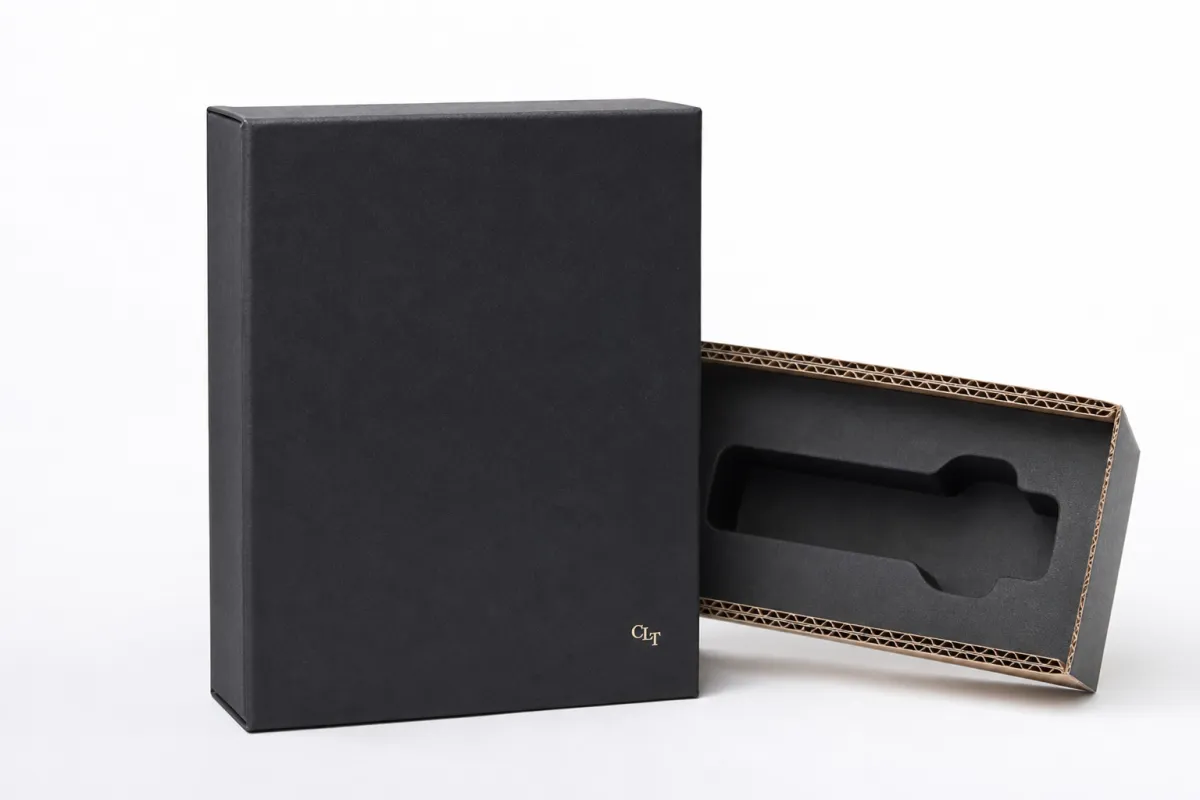
At the simplest level, custom branded boxes with corrugated inserts are a two-part packaging system. The outer box is printed for presentation and identification. The corrugated insert is shaped to prevent the product from shifting, tipping, scuffing, or colliding with adjacent contents. That insert might be a single tray, a die-cut cradle, a partition set, or a layered structure built around the product geometry.
The practical reason this matters is easy to overlook. Many damage claims start with motion. A bottle shifts, a corner rubs, an accessory punches through a divider, or a fragile component hits the wall after a small drop. The carton may look perfect from the outside. Inside, the product is already out of position and less protected. In that sense, custom branded boxes with corrugated inserts function as a controlled internal environment.
For premium kits, the presentation side carries equal weight. A skincare trio arriving in a plain mailer with loose filler can survive the trip and still feel flat. The same products placed in custom branded boxes with corrugated inserts arrive aligned, face-up, and easy to remove. That shift changes how a customer reads the brand in the first ten seconds.
Buyers compare this format with other forms of branded packaging and retail packaging rather than with ordinary shipping cartons for a reason. It is designed to handle both roles. The outer surface can carry Custom Printed Boxes style graphics while the structure inside still performs as a protective shipper. For brands that care about cleaner unboxing and fewer losses, that dual purpose is where the value sits.
A box can look premium and still fail if the contents move around. The smarter question is whether the structure supports the promise the graphics make.
If you are weighing different formats, review Custom Packaging Products alongside Custom Shipping Boxes. The right fit depends on how much presentation you need, how fragile the product is, and whether the carton will move through parcel, freight, or retail handoff.
How Custom Branded Boxes with Corrugated Inserts Work
The outer carton carries the visual story. The insert handles the physics. In custom branded boxes with corrugated inserts, those two layers work together instead of competing for attention. The printed box creates the first impression; the insert creates the fit. If the outer structure is a rigid mailer, folding carton, or tuck-top shipper, the insert often decides whether the package survives the last mile in one piece.
Several insert styles show up repeatedly. A die-cut tray uses openings and folds to capture products in precise positions. Fold-and-lock partitions split the interior into separate cells, which works well for beverage samples, cosmetics, or gift sets with multiple parts. Layered pads sandwich a product between top and bottom support pieces, which helps when the item is flat, heavy, or irregularly shaped. In custom branded boxes with corrugated inserts, the insert style usually follows the product geometry, not the other way around.
Board selection matters as much as shape. Corrugated flute profiles change stiffness and cushioning. An E-flute insert can feel tighter and print better for display-driven formats. B-flute and C-flute structures generally offer more crush resistance and deeper cushioning. Double-wall board can make sense for heavier or more fragile assemblies, although it adds bulk and can slow packing. The best spec protects the product without turning the pack station into a bottleneck.
Custom branded boxes with corrugated inserts also improve shipping efficiency because they standardize how the product is packed. A packer who knows exactly where each component goes can move faster and make fewer mistakes. That sounds small, yet saving 4 to 8 seconds per pack-out adds up quickly across a monthly run of several thousand units. Less movement inside the carton also supports better stack performance when boxes are palletized or loaded into mail bags.
The fit still has to be balanced. Too much friction and the product becomes hard to insert or remove, which slows labor and frustrates customers. Too much free space and the product can drift during vibration or drops. The sweet spot is tight enough to hold and loose enough to pack. That is why custom branded boxes with corrugated inserts usually need prototype testing instead of guesswork.
For brands that want packaging with a stronger technical backbone, the insert becomes a quiet signal of competence. It tells the buyer the company considered the journey, not just the shelf. In my own sample reviews, the packages that hold up best are rarely the most elaborate ones; they are the ones where the insert actually matches the way the item behaves in transit. That is the real difference. It also makes a strong case for custom branded boxes with corrugated inserts in categories where the contents are expensive, breakable, or assembled from several parts.
If you want a broader industry view of structure, graphics, and transport performance, the Packaging Machinery Manufacturers Institute and packaging industry groups at Packaging Matters offer useful context, while ISTA package testing standards explain how transit stress is evaluated in real shipments.
Key Design Factors That Affect Protection and Brand Impact
The first design input is the product itself. Measure length, width, height, weight, and any protrusions such as caps, cords, handles, or hinges. Those small features change the packing footprint more than many teams expect. Custom branded boxes with corrugated inserts should fit the real product profile, not the idealized version on a spec sheet. A 1 mm cord loop or a raised pump can be the difference between a clean cavity and a scratched surface.
Weight distribution matters too. A tall, top-heavy item needs side restraint and often bottom support. A flat, heavy object may need cushioning under it and stronger board around it. Multi-item kits need more than a snug cavity; they need a planned layout so the parts do not collide. Custom branded boxes with corrugated inserts are especially useful here because the insert can set orientation. That helps the packer, and it also helps the customer understand what goes where.
On the branding side, the printed outer carton should match the promise inside. High ink coverage, spot color accents, foil, embossing, or soft-touch lamination can elevate the tactile experience. Visual drama without structural discipline is still a weak trade. If the package opens awkwardly or the insert looks unfinished, the brand message breaks apart. Good packaging design links the look of the box with the way it opens and the way the product is removed.
Sustainability is not only a marketing claim in this context. Recyclable corrugated board, right-sized cartons, and reduced void fill can lower material use and shipping volume at the same time. That can reduce dimensional weight charges, which often matters more than the board cost itself. Brands working to cut plastic content also find that custom branded boxes with corrugated inserts fit neatly into paper-based packaging goals, especially when the insert replaces foam or molded plastic trays.
The shipping environment changes the spec as well. A box going direct to consumer by parcel faces different stresses from one moving through retail distribution, palletized freight, or subscription fulfillment. Temperature swings can change adhesive behavior. Long-haul vibration can loosen poorly supported items. If the package is likely to sit in a warehouse, it also has to retain shape under stack load. Custom branded boxes with corrugated inserts should be specified for the route, not only for the product.
For brands comparing formats, it helps to think in terms of product packaging and retail packaging goals at the same time. The carton should help sell the item, but it should also make the opening process intuitive. Easy removal, clear part orientation, and no unnecessary tugging all matter. The cleaner the reveal, the more premium the unboxing feels.
Color matters inside the box as well. A white insert can feel bright and clean, while a kraft insert can read as natural and understated. Neither choice is inherently better. The right one supports the brand story and keeps the contents visually organized. That is one reason custom branded boxes with corrugated inserts often outperform a generic shipper plus filler when the goal is package branding that feels deliberate.
Process and Timeline: From Dieline to Delivery
The production process usually starts with a brief, but the strongest briefs are concrete. Provide product samples, exact dimensions, approximate weight, ship method, artwork files, and target monthly volume. If the package must survive parcel vibration or stack in freight lanes, say so up front. That information helps the packaging supplier Choose the Right board, insert style, and print method for custom branded boxes with corrugated inserts.
After intake, the supplier typically develops a dieline and structural concept. That is followed by a prototype or sample, which may be printed, plain, or partially finished depending on the stage of the project. This is where delays often begin. A brand may discover the bottle closure is taller than expected, or a cable needs a larger cavity, or the insert flaps interfere with the opening sequence. Those are not minor edits; they affect the structure. First runs of custom branded boxes with corrugated inserts usually take longer because the fit has to be proven before volume begins.
A realistic timeline often looks like this: 3 to 7 business days for structural concept work, 5 to 10 business days for sampling, a few days for internal review, then 10 to 20 business days for production after approval, depending on order size and print complexity. Freight can add another 2 to 7 business days domestically, and more if the route is longer. Late artwork changes after sample approval can reset the clock quickly.
Approval bottlenecks are common. Marketing may want a richer finish, operations may want faster pack-out, and procurement may want the lowest unit cost. Those goals do not always align. The cleanest way to move the project forward is to define the priority order before the proof stage. Are you optimizing for shelf appeal, transit protection, labor speed, or all three? Custom branded boxes with corrugated inserts are easier to approve when the team agrees on the tradeoffs early.
Physical testing resolves arguments faster than meetings do. Many teams rely on drop tests, vibration checks, or transit simulations modeled after standards such as ASTM and ISTA. A package that looks good on screen can still fail after a corner drop or a short sequence of repeated impacts. If you are less familiar with the testing side, ask for guidance from the supplier and compare the design against accepted package engineering methods. That extra step often pays back later.
Some of the smoothest launches happen when pack-out is treated as part of the design. The insert is not only there to protect the product; it also has to fit the hand motion of the warehouse team. If a packer needs to twist, force, or align too many separate pieces, errors creep in. Custom branded boxes with corrugated inserts should make the packing motion feel natural. That is one of the easiest ways to improve consistency without adding labor.
Cost, Pricing, MOQ, and Quote Drivers
Pricing is rarely about the box alone. In custom branded boxes with corrugated inserts, the quote usually reflects board grade, insert complexity, print coverage, finishing, order quantity, and how much setup the tooling requires. A simple one-color kraft mailer with a basic insert may be quite affordable at scale. A rigid-feel printed carton with multiple cavities, specialty coating, and high-coverage graphics will land much higher.
Order quantity has a direct effect on unit cost. A short run can make sense for launches, limited editions, seasonal kits, or product tests, but the per-unit price is usually higher because setup costs are spread across fewer pieces. At larger quantities, tooling and print setup become easier to absorb. That is why buyers often ask for pricing at 1,000, 5,000, and 10,000 units. The breakpoints tell a clearer story than a single quote ever does.
Hidden cost levers are easy to miss. A larger box can increase dimensional weight charges. A bulky insert can raise storage cost. A design that packs slowly can add labor cost every day. On paper, two options may look close. In operations, the cheaper board spec can be the more expensive package. Custom branded boxes with corrugated inserts often justify a higher upfront price if they cut damage, reduce void fill, and speed pack-out.
| Packaging Option | Typical Use | Indicative Unit Cost | Notes |
|---|---|---|---|
| Printed folding carton with basic corrugated insert | Lightweight kits, samples, accessory sets | $0.55-$0.95 at 5,000 units | Good for simple layouts and moderate protection |
| Custom branded box with die-cut multi-cavity insert | Fragile products, multi-item bundles, premium unboxing | $0.95-$1.80 at 5,000 units | Better control of movement and presentation |
| Heavy-duty shipper with reinforced insert | Heavier electronics, glass, high-risk transit lanes | $1.40-$2.60 at 5,000 units | Higher board usage, stronger stacking performance |
| Short-run prototype or digital sample build | Launches, internal testing, retailer review | $1.50-$3.50 per unit | Useful for fit checks before committing to volume |
MOQ matters because it changes the economics of setup. A lower minimum can help if you are testing a product or running a short promotion. A higher minimum usually brings a better unit price. That is the tradeoff. Custom branded boxes with corrugated inserts become especially efficient once the team knows the design will be reused across multiple SKUs or replenishment cycles.
For sustainability-minded buyers, material choice can also affect pricing through certification and sourcing. FSC-certified board may carry a premium, but it supports a documented chain of custody. If that matters to your customers or retailers, the premium may be easier to justify. You can read more about responsible fiber sourcing through the Forest Stewardship Council. In parallel, brands trying to reduce excess packaging should review the EPA's guidance on waste reduction and recyclable materials.
A useful habit is to request three quote scenarios: a lowest-cost version, a balanced version, and a premium version. That makes the tradeoffs visible. It also helps procurement and marketing stop arguing about a single number without context. In many categories, custom branded boxes with corrugated inserts sit in a middle zone where they cost more than generic packaging but less than the combined price of damaged goods, filler materials, and rework.
Common Mistakes to Avoid When Specifying Inserts
The most common mistake is measuring only the product body and ignoring everything attached to it. Caps, cords, closures, lids, hoses, chargers, and handles change the real packing footprint. A package that fits the base product can still fail once the accessories are added. Custom branded boxes with corrugated inserts should be designed around the full shipping unit, not the marketing photo.
Overdesign is another trap. A very tight insert can look precise, but if the packer has to force the product into place, the carton becomes slower to fill and the contents may pick up scuffs on the way in. The same tightness can also frustrate customers during unboxing. A little restraint goes a long way. The best custom branded boxes with corrugated inserts protect the product without making the experience feel mechanical or difficult.
Under-testing creates expensive surprises. It is not enough to check the box on a desk and call it done. Real testing should include at least a basic drop sequence, vibration exposure, and a live pack-out trial with the people who actually assemble the order. If a package only works when handled gently by the design team, it is not ready. That sounds blunt, but it reflects the reality of parcel and fulfillment environments.
The wrong flute profile can also create trouble. A thin board may collapse under heavier contents or stack pressure. A board that is too thick may steal internal space or make the insert bulky enough to slow packing. If the box is too large to begin with, the company may pay more in freight and use more filler than necessary. Custom branded boxes with corrugated inserts work best when the board spec matches transit risk, product weight, and assembly speed at the same time.
Branding mistakes are easier to miss because they are visual rather than structural. A gorgeous outer carton paired with a dull, awkward, or mismatched insert can weaken the premium effect. Likewise, if the product opens in a confusing order, the customer may not notice the print finish at all. Custom printed boxes only feel complete when the insert color, shape, and sequence support the same story.
Another common issue is assuming one insert can solve every product line. It rarely does. A bottle, a jar, and a charger are not the same thing even if they fit inside the same outer footprint. That is where disciplined packaging design matters. Separate specs for separate product behaviors usually produce better results than forcing a universal insert to do a job it was never meant to handle.
Teams also forget the downstream labor effect. If the insert has too many folds, tabs, or orientation steps, the line slows down. A package that saves damage but doubles labor can still hurt margins. Custom branded boxes with corrugated inserts should protect the product and keep the workflow smooth. Both matter. Ignoring one usually means paying for it later.
Expert Tips and Next Steps for a Better Packaging Rollout
Start with one flagship SKU. That gives the team a clear reference point and keeps the first prototype cycle manageable. Once the fit is proven, the insert system can often be adapted across a related product family with minor changes. That is a smarter path than trying to engineer every variation at once. In practice, custom branded boxes with corrugated inserts are easier to scale after one version is stable.
Build a simple packaging checklist and use it every time. Include product dimensions, weight, fragility level, target ship mode, retail or direct-to-consumer use, photo-ready presentation needs, sustainability targets, and reorder thresholds. That checklist keeps the conversation focused on the actual business goal. It also helps your supplier quote the right structure instead of guessing. If your team wants more examples of formats and finished styles, the Case Studies page is a useful place to compare approaches.
Ask for a physical sample before you commit to volume. Paper drawings rarely capture the full feel of the pack-out process. A sample shows whether the product snags, wobbles, scratches, or opens in an awkward sequence. It also helps non-technical stakeholders make better decisions because they can hold the structure in their hands. For many buyers, that one sample separates an appealing concept from a dependable production spec.
A practical rollout sequence looks like this: review the current damage rate, measure where the pack line slows down, test two insert concepts, and choose the version that lowers total cost rather than only unit cost. That sequence is boring on paper. It works in the warehouse. If a design saves 2% in material cost but increases returns or labor, the savings disappear quickly. Custom branded boxes with corrugated inserts should be measured by the whole system, not just one line item.
It also helps to think about reuse. If the outer carton can serve as a shipping box and the insert can be adapted for multiple SKUs, the economics improve. A family of packages often lowers tooling duplication and creates a more consistent branded packaging experience. That consistency matters more than many teams realize because repeat customers notice it. They may not name the insert, but they notice the feeling of order.
For brands that want to compare structure, print, and performance in more detail, reviewing Custom Packaging Products alongside the current shipping formats can clarify where the budget really belongs. Some projects need more print. Others need stronger corrugate. Many need both, just in the right proportion. That is the part buyers sometimes miss when they focus only on aesthetics.
Here is the honest version: custom branded boxes with corrugated inserts are not the cheapest packaging option in the room. They are often the smartest one when the product is fragile, the order is multi-part, or the customer experience depends on an orderly reveal. The practical takeaway is simple: start with one SKU, request a sample, and test it against the actual shipping route before you lock in volume. If the insert protects the product, speeds pack-out, and matches the brand feel, you have a package that earns its keep.
Frequently Asked Questions
How do custom branded boxes with corrugated inserts protect fragile products?
They protect by reducing movement. The insert creates a cavity or partition that keeps the product from hitting the outer walls, and that matters because most damage begins with internal shifting rather than a dramatic crush event. Custom branded boxes with corrugated inserts also spread impact forces across the structure, which lowers the chance of corner damage, rubbing, and component collisions. They work best when the board grade and cavity size match the item's weight and transit route.
What size details do I need before ordering custom branded boxes with corrugated inserts?
Send the product's full dimensions, including caps, cables, closures, and any protrusions that change the footprint. You should also share how the package will be packed, opened, and shipped, because those workflow details affect the insert design just as much as the product shape. A physical sample is even better. With custom branded boxes with corrugated inserts, a sample usually reveals fit issues faster than a spec sheet alone.
Are corrugated inserts better than foam for branded shipping boxes?
Not always, but corrugated inserts are often easier to recycle and can fit better with paper-based branded packaging goals. Foam may offer different cushioning behavior, especially for very fragile items, yet corrugated can be the stronger choice when printability, presentation, and sustainability all matter. The right answer depends on fragility, shipping environment, and how much protection the product actually needs. For many brands, custom branded boxes with corrugated inserts strike the right balance.
What affects the price of custom branded boxes with corrugated inserts the most?
Quantity, insert complexity, board grade, and print coverage usually drive the biggest swings. A larger order often lowers the unit cost because setup is spread out, while a short-run launch usually costs more per piece. Freight size and storage space can also change the final number in ways buyers overlook. Custom branded boxes with corrugated inserts may cost more at the start, but they can save money through lower damage, less filler, and faster packing.
How can I speed up the quote and production process?
Send product measurements, artwork files, target quantities, and preferred ship dates together. That one move removes a lot of back-and-forth. Approve samples quickly, keep late-stage edits to a minimum, and ask for a timeline that separates concept, sample approval, and production. With custom branded boxes with corrugated inserts, clear inputs usually shorten the path from dieline to delivery.
For teams that want to see more finished examples before making a decision, the best next step is usually a sample review alongside a production quote. That is where the real tradeoffs become visible. Custom branded boxes with corrugated inserts should be chosen for the full business result: protection, presentation, and pack-out speed working together. If those three pieces line up, the packaging usually pays for itself in fewer problems and a better customer experience.

