Buyer Fit Snapshot
| Best fit | Custom Branded Paper Gift Bags projects where brand print, material claims, artwork control, MOQ, and repeat-order consistency need to be specified before quoting. |
|---|---|
| Quote inputs | Share finished size, material target, print colors, finish, packing count, annual reorder estimate, ship-to region, and any compliance wording. |
| Proofing check | Approve dieline scale, logo placement, barcode or warning zones, color tolerance, closure strength, and carton packing before bulk production. |
| Main risk | Vague material claims, crowded artwork, missing packing details, or unclear freight terms can make a low unit price expensive after revisions. |
Fast answer: Custom Branded Paper Gift Bags: Film, Print, MOQ, and Carton Packing should be specified like a repeatable production item. The safest quote records material, print method, finish, artwork proof, packing count, and reorder notes in one written spec.
Production checks before approval
Compare the actual filled-product size with the drawing, then confirm tolerance on folds, seals, hang holes, label areas, and retail display edges. Reserve space for logos, QR codes, warning copy, and material claims before decorative graphics fill the panel.
Quote comparison points
Review material grade, print process, finish, sampling route, tooling charges, carton quantity, and freight assumptions side by side. A quote is only useful when the supplier can repeat the same color, closure quality, and packing count on the next order.
Custom Branded Paper Gift Bags: Smart Packaging Guide Custom branded paper gift bags are the sort of packaging people register without really registering it, then keep carrying long after the purchase is done. That quiet usefulness is the whole point: the gift leaves the counter in seconds, while the bag keeps showing the brand in a mall, a lobby, a trade show aisle, or a dinner party across town.
Why Custom Branded Paper Gift Bags Get Remembered
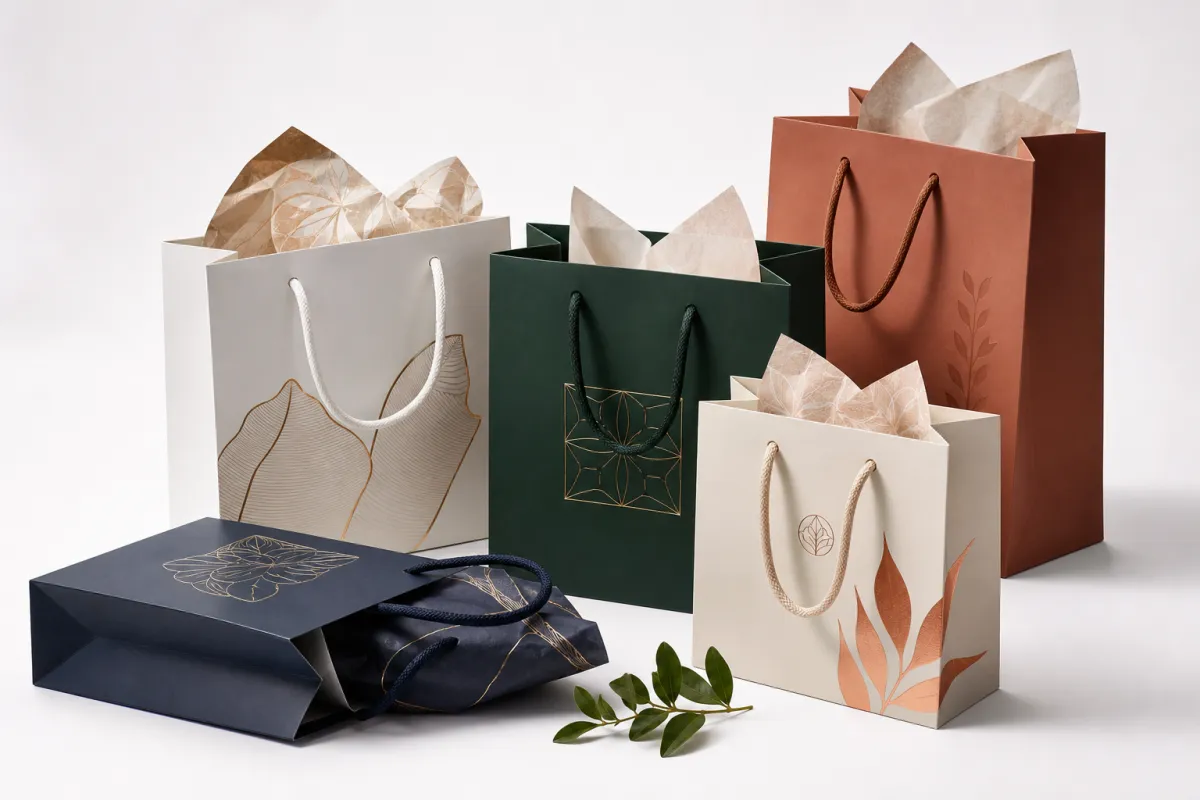
A bag usually stays visible longer than the item inside it. That is the understated advantage of Custom Branded Paper gift bags: they keep working after the handoff, after the tissue paper is gone, and after the customer has already moved on to the next stop. One purchase can create several impressions, and those impressions do not require an extra media buy.
At the basic level, custom branded paper gift bags are paper shopping or gift bags printed with a logo, color system, pattern, seasonal artwork, or short brand message. They show up in retail packaging, hospitality, event gifting, corporate kits, and premium take-home purchases. The job is larger than carrying an item. The bag needs to signal care, consistency, and higher perceived value before anyone opens it.
Buyers judge packaging in seconds. A clean bag with a well-chosen structure can make a modest item feel considered. A weak bag, even one with strong graphics, can drag the whole presentation down. I have seen that happen with packaging that looked polished in a proof and then folded awkwardly once the product went inside. The print did not fail. The experience did.
Custom branded paper gift bags also create repeat exposure without a recurring ad spend. A customer walking out of a store may carry the bag through a street, into a ride-share, or across an office lobby. That is branded packaging doing quiet field work. It is not flashy, but it stays in motion.
They are especially useful in these situations:
- Holiday gifting, where the bag becomes part of the unboxing moment
- Boutique retail, where retail packaging needs to feel polished and easy to carry
- Trade shows, where a printed bag helps visitors remember the booth
- PR kits, where the outer presentation supports the contents inside
- Corporate gifting, where a custom finish makes standard items feel more deliberate
The real question is not whether custom branded paper gift bags look good. It is whether they are built to balance brand impact, durability, budget, and lead time. That tradeoff is where the best decisions happen.
How Custom Branded Paper Gift Bags Work From Brief to Bag
The process starts with a practical brief, not with artwork. A buyer should share target size, approximate load weight, quantity, finish preferences, handle style, and the type of item the bag must carry. A bag meant for boxed skincare, a wine bottle, apparel, or several small items needs a different spec, and that difference is bigger than most first-time buyers expect. Good custom branded paper gift bags are matched to use first, visuals second.
From there, the supplier turns the idea into a dieline, print setup, material choice, and construction method. The dieline is the flat template that shows where panels, folds, gussets, and handles land. It sounds technical, but it is really the bridge between packaging design and production reality. A strong logo can still look awkward if it lands across a fold or too close to a glued seam.
Two broad paths usually appear. One is a stock-based customization route, where the bag format already exists and the brand is added through print or label work. The other is a fully bespoke build, where dimensions, paper weight, handle style, gusset depth, and finish are all tailored. The bespoke route gives more control over the final look, though it usually adds cost and setup time. That tradeoff matters for custom branded paper gift bags because the visual result depends on how much of the structure is truly custom.
Approval usually moves through a few gates:
- Digital proof review for layout, colors, and copy
- Material sample or swatch approval if the feel matters
- Production sample for complex jobs or new programs
- Final signoff before manufacturing starts
- Packing, carton labeling, and shipment planning
Process discipline matters more than most people expect. The best custom branded paper gift bags are not just designed well. They are specified well. Handle anchoring, fold direction, print bleed, base reinforcement, and top-edge strength all shape the final result. Those details may sound small on paper. In production, they decide whether the bag supports the brand or quietly weakens it.
I have watched more than one good-looking bag go sideways because the handle block sat too close to the fold or the base board was a hair too light for the actual product. That is the part people miss when they only look at a mockup. The mockup is useful, sure, but the sample is what tells the truth.
If you want to see how those choices change across different packaging formats, our Case Studies show how material and structure affect the final presentation.
Custom Branded Paper Gift Bags: Cost, Pricing, and MOQ
Pricing for custom branded paper gift bags comes from a handful of inputs that buyers can control once they know where the cost is coming from. The biggest variables are paper weight, bag size, handle style, print coverage, number of colors, and special finishing such as foil, embossing, matte lamination, or spot gloss. A simple one-color kraft bag and a high-gloss full-bleed presentation bag do not sit in the same cost bracket, even when both carry the same logo.
MOQ, or minimum order quantity, is the next factor that shapes budget. Smaller runs usually cost more per unit because setup and production overhead are spread across fewer bags. That is not a sales tactic. It is how print and converting economics work. If a buyer only needs 250 custom branded paper gift bags, the unit cost may feel high. If the same setup is spread across 5,000 pieces, the price often drops enough to change the decision.
Here is a practical comparison for a typical mid-size retail order. These are broad ranges, not promises, because artwork coverage, paper source, and freight can shift the final number.
| Bag Style | Typical MOQ | Approx. Unit Price at 5,000 pcs | Best For | Notes |
|---|---|---|---|---|
| Kraft paper bag, one-color print | 500-1,000 | $0.18-$0.30 | Retail carryout, events, simple branding | Lower setup cost, clean look, good for basic custom branded paper gift bags |
| Coated paper bag, two-color print | 1,000-2,000 | $0.28-$0.55 | Boutiques, seasonal gifting, premium retail packaging | Better print sharpness and richer color |
| Heavy art paper with lamination | 1,000-3,000 | $0.55-$0.95 | Luxury product packaging, PR kits, corporate gifts | More structure, better feel, longer shelf presence |
| Special finish bag with foil or embossing | 2,000+ | $0.65-$1.10+ | Premium launches, holiday sets, high-value brands | Elevates package branding, but setup and waste can increase |
Those numbers help because they show where the quote is likely coming from. The quote is not just the bag itself. It includes artwork cleanup, plates or screens if the print method requires them, proofing, shipping, and sometimes rush fees. Freight catches buyers off guard all the time, especially when cartons are bulky and air shipment becomes the only way to recover time. Imported custom branded paper gift bags can look inexpensive until the landed cost is added in full.
The cheapest quote is not always the best value. If the bag tears at the handle, arrives with weak color match, or uses paper that dents too easily, the brand pays in a much more expensive currency: perception. I would rather see a slightly higher unit cost on a bag that feels balanced and holds its shape than a bargain bag that looks fragile on day one.
For buyers comparing format options, it can help to compare custom branded paper gift bags against other Custom Packaging Products to see whether a bag, box, or hybrid presentation makes more sense for the campaign.
Production Steps, Timeline, and Lead Time for Custom Branded Paper Gift Bags
Production follows a chain, and each link can slow the order if the brief is incomplete. The usual path is request, specification review, dieline setup, artwork placement, digital proof, approval, manufacturing, finishing, quality check, and shipment. For custom branded paper gift bags, a buyer should know exactly where the clock starts and ends. If the supplier says "10 business days," ask whether that means from artwork approval, proof signoff, or the first email. Those are not the same thing.
Simple domestic orders with standard construction often land around 12-15 business days from proof approval. More complex builds, specialty finishes, or imported runs often need 20-30 days or more, especially during peak gifting seasons. That range is wide because print method, quantity, and finishing all change the pace. A small, one-color kraft bag can move much faster than a laminated bag with foil and custom handles.
Most delays come from a few predictable places:
- Missing artwork files or low-resolution logos
- Unclear bag dimensions or item weight
- Design changes after the proof has already been approved
- A finish that needs extra setup or curing time
- Shipping buffers that were not built into the calendar
The smartest way to plan custom branded paper gift bags is to work backward from the event date or launch date. Leave time for sampling, color correction, and a second proof if needed. One correction round can save a run. Two rushed corrections can wreck it. That sounds blunt because it is true.
For transit performance, buyers should also ask whether the bags have been packed and tested with a realistic load. Industry testing references often point to methods such as those published by ISTA, while paper sourcing questions may be guided by FSC certification claims. Those are not decorative acronyms. They are part of the trust layer behind branded packaging.
Practical rule: if the bags are going to launch alongside other product packaging, do not leave them for last. Custom branded paper gift bags need the same calendar discipline as custom printed boxes, because they are often the first thing a customer physically touches.
Key Factors That Change the Look and Performance
Paper choice is where the bag starts behaving like a brand asset instead of a simple carrier. Kraft paper gives a natural, grounded look. Coated paper sharpens print and often suits more polished retail packaging. Recycled paper can support sustainability goals, though recycled fiber content can slightly change surface smoothness and color appearance. Heavy art paper or board gives a more premium hand feel, but it can also raise cost and increase the bag's stiffness.
For custom branded paper gift bags, paper weight is not a cosmetic detail. It affects drape, crease sharpness, scuff resistance, and how the bag handles repeated use. A lightweight bag may work for a folded T-shirt. Put a glass jar or boxed candle inside, and the same bag may buckle at the base. Sizing and structure matter just as much as graphics. Gusset depth, base reinforcement, and top fold all influence whether the bag feels premium or flimsy.
Handles deserve more attention than they usually get. Rope handles feel more upscale and typically carry weight better. Paper twisted handles are economical and can still look clean when the print is restrained. Ribbon handles, flat tape handles, or die-cut openings each create a different customer experience. In practical terms, the handle is the part people test first. If it digs into the hand or twists under load, the brand loses polish no matter how strong the logo is.
Print and finishing choices also change the read of the bag. Offset printing works well for higher-detail graphics and larger runs. Flexographic printing often suits simpler artwork and efficient repeat runs. Digital print can be useful for smaller quantities or variable designs. Finish options such as foil, embossing, matte lamination, gloss lamination, and spot effects can elevate custom branded paper gift bags, but each option adds cost, setup complexity, and sometimes recyclability tradeoffs.
Sustainability deserves a careful, honest look. Recycled content can be a strong signal, but coatings, foils, and plastic laminations can affect end-of-life disposal. Not every bag marked "eco" is easy to recycle in every municipality. Buyers should check local guidelines before making claims, because packaging honesty matters more than marketing polish.
For a lot of brands, the goal is not perfection in every dimension. The goal is to make the bag right for the use case. That is the difference between generic packaging design and effective package branding.
Common Mistakes When Ordering Custom Branded Paper Gift Bags
The most common mistake is simple: choosing the bag before measuring the product. Oversized bags waste material and look loose. Undersized bags crush the item, wrinkle the top, or make the presentation feel rushed. Custom branded paper gift bags should be sized from the finished product, not from a rough guess.
Load weight is the next trap. A bag that works beautifully for apparel may fail for bottles, boxed goods, or multiple items. Buyers often think the answer is a stronger print. It is not. The answer is a stronger structure. Reinforced bottoms, sturdier handles, and better paper weight do more for performance than a louder logo ever will.
Design mistakes are just as common. Tiny text disappears once the bag is moving. Low-contrast logos fade against kraft stock. Overcrowded artwork can look busy when the bag is folded or viewed at an angle. If the logo sits too close to a seam or handle anchor, the design can look compressed even when the file was technically approved. That is why mockups matter for custom branded paper gift bags. A flat screen file does not always predict a real-world read.
Approval mistakes are expensive. Teams skip the proof, assume on-screen color will match print, or forget to check bleed and safe area. The result is usually not catastrophic, but it is almost always preventable. Print on paper is affected by ink absorption, coating, and press calibration. A Pantone reference or a well-managed CMYK setup can help, but there is still no substitute for reviewing a proof with the actual structure in mind.
Then there is the reorder problem. A brand launches a season with just enough bags, then discovers the exact spec is not documented. The next reorder turns into a scramble. Keeping the dieline, finish spec, handle details, paper weight, and print notes on file makes future custom branded paper gift bags easier to repeat without drift.
"The fastest way to weaken a packaging program is to treat the bag like an afterthought. In reality, it sits right beside the product in the customer's memory."
That is especially true in retail packaging, where the bag may be reused several times. A sturdy, well-sized bag can keep traveling. A weak one gets abandoned in the parking lot.
Expert Tips and Next Steps Before You Request a Quote
Start with the use case, not the artwork. Retail carryout, event giveaways, premium gifting, and corporate kits all ask for different bag specs. A bag for a light clothing purchase can be much simpler than a bag holding a bottle, a rigid box, and tissue. Once the use case is clear, custom branded paper gift bags become easier to spec and much easier to price.
Ask for a dieline and, if possible, a blank sample before final artwork. That gives the design team room to test margins, logo placement, and visual balance. It also exposes awkward proportions early. A good packaging buyer does not wait until the print stage to discover that the logo sits too low or the handle blocks the brand mark. That discipline saves money and prevents avoidable rework.
Ask for a quote that breaks out material, printing, finishing, shipping, and rush charges separately. That single step reveals where the cost pressure really lives. It also makes comparisons cleaner if you are reviewing multiple suppliers or weighing custom branded paper gift bags against other product packaging formats. If the shipping line is unusually high, you know where to push. If finishing is the expensive piece, you can decide whether foil or embossing is actually necessary.
Here is a short checklist that keeps the project grounded:
- Confirm the finished item size before choosing bag dimensions
- Choose the paper weight based on the real load, not the lowest quote
- Decide whether the finish should feel natural, polished, or luxury-oriented
- Build in time for proofing and one correction round
- Confirm whether the order needs one campaign drop or full-season inventory
For brands comparing formats, custom branded paper gift bags are often the simplest path to premium presentation. Simple does not mean generic. A well-made bag can do what custom printed boxes do in a different format: protect the item, support the message, and make the brand feel more deliberate. That is the sweet spot.
If you want to explore more examples and packaging options, the broader selection of Custom Packaging Products is a useful place to compare materials, finishes, and build styles before locking in a quote.
My advice is straightforward. Define the bag size, pick the finish, confirm the budget, request samples, and ask how the timing works from proof approval to delivery. Do that, and custom branded paper gift bags stop being a vague marketing idea and become a practical packaging tool. Done well, they support retail packaging, gift presentation, and repeat brand exposure in one piece of paper.
The practical next step is simple: measure the product, choose the paper and handle based on the actual load, and approve a sample before production starts. That keeps custom branded paper gift bags aligned with the item, the budget, and the timeline.
That is why I would never treat custom branded paper gift bags as an accessory. They are part of the brand system, part of the handoff, and often part of the memory.
What makes custom branded paper gift bags worth the investment?
They add perceived value at the point of sale, which makes the handoff feel more polished. They also keep carrying the brand in public when customers reuse them. In many cases, they cost less than a fully custom box while still delivering a premium presentation.
How do I choose the right size for custom branded paper gift bags?
Measure the finished product, including any tissue, inner box, or protective wrap, before choosing dimensions. Leave enough headroom so the top closes cleanly without crushing the item. If the load is heavy or awkward, test a sample with the real product before placing the full order.
What is a realistic turnaround for custom branded paper gift bags?
Simple orders usually move faster than bags with special finishes, complex structures, or multiple print colors. Lead time depends on proof approval, quantity, and whether the bags are made locally or overseas. Always ask when timing starts and ends so you know whether the clock begins at artwork approval, production start, or shipment.
Are custom branded paper gift bags recyclable or reusable?
Uncoated paper bags are often easier to recycle than heavily laminated versions, but local recycling rules vary. Coatings, foil, adhesives, and mixed materials can change the disposal path. Reuse depends on handle strength, paper weight, and whether the bag still holds up after the first use.
What artwork do I need for custom branded paper gift bags?
Vector artwork is best for logos and sharp linework because it scales cleanly. Confirm color mode, bleed, and safe area before sending files. If brand colors matter, ask for Pantone or CMYK guidance so the printed result stays consistent across repeat runs.

