Buyer Fit Snapshot
| Best fit | Custom Brochure Inserts for Boxes projects where brand print, material claims, artwork control, MOQ, and repeat-order consistency need to be specified before quoting. |
|---|---|
| Quote inputs | Share finished size, material target, print colors, finish, packing count, annual reorder estimate, ship-to region, and any compliance wording. |
| Proofing check | Approve dieline scale, logo placement, barcode or warning zones, color tolerance, closure strength, and carton packing before bulk production. |
| Main risk | Vague material claims, crowded artwork, missing packing details, or unclear freight terms can make a low unit price expensive after revisions. |
Fast answer: Custom Brochure Inserts for Boxes: Board, Finish, Dieline, and Unit Cost should be specified like a repeatable production item. The safest quote records material, print method, finish, artwork proof, packing count, and reorder notes in one written spec.
Production checks before approval
Compare the actual filled-product size with the drawing, then confirm tolerance on folds, seals, hang holes, label areas, and retail display edges. Reserve space for logos, QR codes, warning copy, and material claims before decorative graphics fill the panel.
Quote comparison points
Review material grade, print process, finish, sampling route, tooling charges, carton quantity, and freight assumptions side by side. A quote is only useful when the supplier can repeat the same color, closure quality, and packing count on the next order.
Custom Brochure Inserts for Boxes: Smart Packaging Tips
Custom brochure inserts for boxes look tiny on a quote sheet. Then they land in a customer’s hands and do the real work. A good insert explains the product, cuts support questions, nudges repeat orders, and makes the brand feel like somebody actually paid attention. A bad one gets skimmed, folded wrong, or tossed with the carton. That is a cheerful way to waste ink, paper, and budget.
From a packaging buyer’s point of view, custom brochure inserts for boxes sit between product packaging and sales support. They are not decoration with a better attitude. They are printed pieces built to fit inside a box, survive packing, and get the customer to read, act, or remember something useful. Sometimes that means a folded brochure. Sometimes it means a sell sheet, care card, warranty card, or onboarding piece. The format changes. The job does not: make the unboxing do more than protect the product.
What Custom Brochure Inserts for Boxes Actually Do
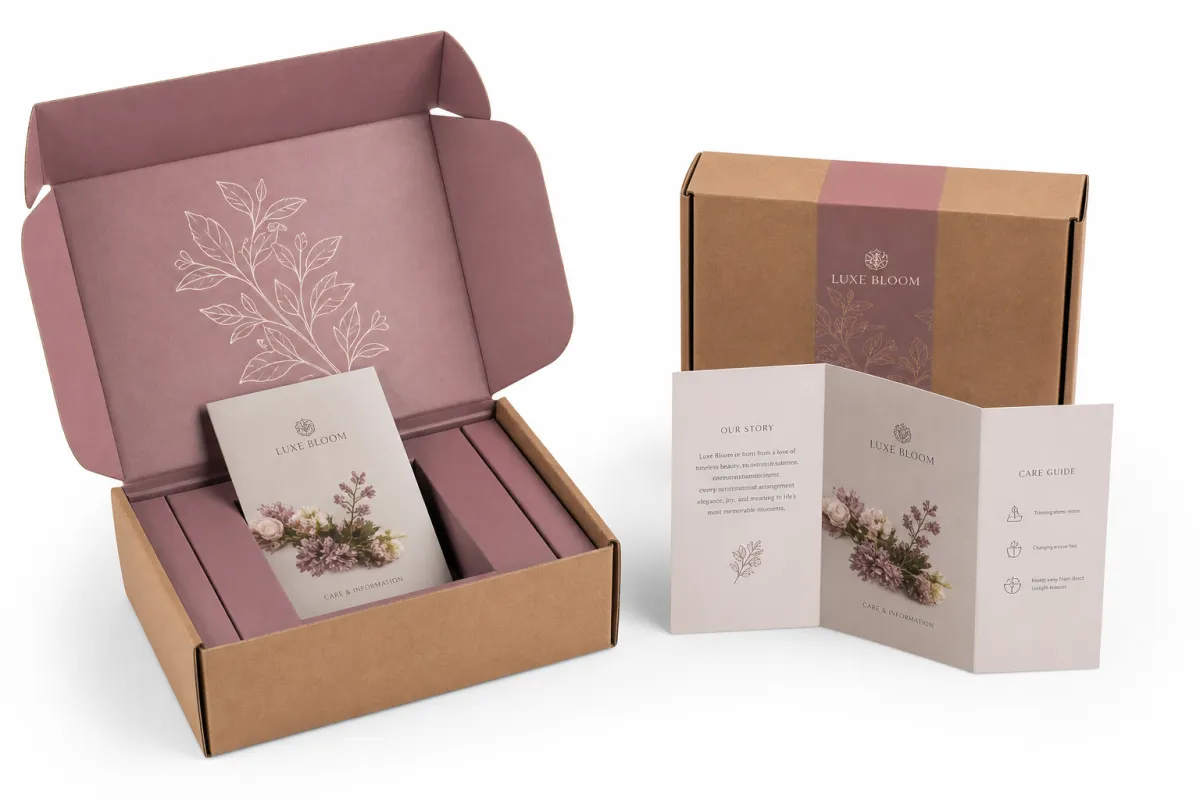
Custom brochure inserts for boxes do several jobs at once, which is exactly why they matter. They can welcome the buyer, explain the product, lay out care instructions, suggest add-ons, and point people to a QR code or website without forcing the box to carry the whole conversation. In practice, the insert often survives longer than the carton. The box gets recycled. The insert lands on a desk, in a drawer, or in a bag with warranty cards and receipts that somebody plans to deal with later.
A basic flyer is not always the same thing as custom brochure inserts for boxes. A flyer is often loose, one-note, and not designed around a packaging fit. A folded brochure gives you room for sequence and hierarchy. A sell sheet usually stays focused on one offer or product line. A support insert leans into instructions, assembly steps, or safety notes. Those differences matter because the structure should match the customer’s task. If the goal is education, the piece should read like education. If the goal is upsell, it should stop pretending to be a manual.
Custom brochure inserts for boxes are small pieces with specific jobs. They work for onboarding, post-purchase education, warranty registration, cross-sells, seasonal campaigns, subscription boxes, and branded packaging that needs the unboxing to do more than look tidy for five seconds. That is why I push buyers to define the purpose before they ask for artwork. If the insert is supposed to teach, sell, or reassure, pick one primary job first. A piece that tries to do all three usually does none of them well.
There is a brand side too. Custom brochure inserts for boxes can reinforce package branding in a way the outer carton rarely does. A box may carry the logo, but the insert can carry the story, the offer, the care instructions, and the tone. That matters in retail packaging and direct-to-consumer product packaging, where the customer has already paid and is judging the brand on details. A generic insert makes the whole package feel cheaper. A thoughtful one makes the product feel worth keeping.
My quick test is simple: if the customer could reasonably ask, “What do I do with this product next?” then custom brochure inserts for boxes make sense. They are especially useful for beauty, supplements, apparel, electronics, kits, and premium custom printed boxes where there is a need to explain use, prompt a reorder, or reduce returns. They are less useful when the product is obvious, the box is tiny, or the message is so thin that a business card would do the same job faster.
I’ve also seen them save a launch that would have otherwise looked half-baked. A small startup I worked with had a nice product, good carton, and zero post-purchase guidance. Customers were emailing basic questions they could have answered in thirty seconds. We added a simple insert with three steps, a care note, and one reorder link. Support volume dropped. Nothing magical. Just clear information in the right place.
One clear action beats three competing ones. If the insert is trying to educate, sell, and entertain at once, it usually reads like background noise.
How Custom Brochure Inserts for Boxes Are Produced
The production path for custom brochure inserts for boxes is not complicated, but sloppy planning punishes you fast. It usually starts with content. What should the customer know on day one? What should they do next? What information has to be legally accurate? Once that is settled, the layout gets built around the box size, the fold style, and the amount of room needed for copy and visuals. Then comes proofing, print setup, production, finishing, and packing. Miss one step and the schedule starts chewing itself up.
Common formats include flat sheets, half-folds, tri-folds, gate folds, accordion folds, and compact booklets. For most custom brochure inserts for boxes, the safest starting point is a size that fits inside the package without curling at the edges or shifting around during transit. A 4 x 9 inch trifold works well for many narrow mailers. A 5.5 x 8.5 inch folded insert fits plenty of medium cartons. Larger boxes can handle an 8.5 x 11 inch sheet folded down, but only if the content actually needs that much space. Bigger is not automatically better. More paper is not a personality.
Custom brochure inserts for boxes also need to match the fulfillment method. Hand-packed orders can tolerate a little more variation because a person is placing the piece in the box. Automated lines are less forgiving. If the insert is too stiff, too slick, or awkwardly folded, it may not sit right in the line or it may feed badly. That is why buyers should talk about the packaging line, not just the artwork. A brilliant layout that jams at fulfillment is an expensive spreadsheet problem.
There are two broad content styles. One is evergreen: the insert explains the product, brand, or care instructions and stays useful for a long time. The other is campaign-based: the insert promotes a seasonal offer, launch, or bundle and gets updated often. Custom brochure inserts for boxes support both, but the print plan should reflect the difference. Evergreen inserts can justify a better stock or coating because they will be handled more often. Campaign inserts can be cheaper and more flexible because they have a shorter life.
Delays usually show up in the same places. Copy approval drags. Dielines get revised three times because somebody discovered the box size changed. Proofs bounce back with “small edits” that are actually full paragraph rewrites. If you want custom brochure inserts for boxes to move quickly, lock the following before production starts:
- Final box dimensions and insert fit allowance
- Final copy and legal text
- Print side count and fold style
- Logo files, images, and QR destinations
- Quantity and shipping deadline
For brands building a coordinated kit, custom brochure inserts for boxes usually work best alongside the rest of the packaging system. That means the same typography, the same color language, and the same level of finish across the carton, the tissue, the label, and the insert. If you are already ordering Custom Packaging Products, it makes sense to plan the insert as part of the whole package instead of treating it like an afterthought.
One more production point: if the insert needs to travel well, it should be tested like packaging, not treated like office print. Transit handling matters. For general transit testing language, the ISTA site is a useful reference point for distribution and handling standards. The insert is not the box, obviously, but if it gets bent, crushed, or scuffed before the customer sees it, the message loses credibility fast.
Cost, Pricing, and What Changes the Quote
Cost is where custom brochure inserts for boxes either feel sensible or suddenly look like a bad idea because nobody asked the right questions. The biggest price drivers are quantity, size, paper stock, print sides, color count, fold complexity, and finishing. A simple flat insert printed in full color on both sides is usually far cheaper per piece than a folded brochure with coated stock and specialty finishing. That sounds obvious. People still ask for “something premium” and then act shocked when premium behaves like premium.
Low quantities cost more per piece because the setup cost does not disappear. Plates, file prep, machine setup, and proofing all happen whether you print 250 pieces or 25,000. That is why custom brochure inserts for boxes often drop hard in unit price once the run gets larger. A small run might land in the $0.50 to $1.50 range per piece depending on stock and folds. A bigger run, especially with simpler specs, can drop into the $0.10 to $0.35 range. Those are practical ranges, not promises. Every vendor and spec sheet has a different appetite for complexity.
Paper stock changes both price and feel. Thin text stock lowers cost and folds cleanly, which is useful for compact inserts or high-volume campaigns. Heavier text stock or light cover stock makes custom brochure inserts for boxes feel sturdier, but it can also increase thickness, shipping weight, and fold memory. Coatings like aqueous, satin, or soft-touch can improve durability and presentation, though they add cost. If the insert will be handled a lot, coated stock can be worth the spend. If it is meant to be read once and discarded, fancy surface treatment is not always smart.
| Insert Style | Typical Stock | Best Use | Approx. Unit Cost Range | Notes |
|---|---|---|---|---|
| Flat insert | 80lb-100lb text | Quick instructions, promo card, QR-based CTA | $0.10-$0.30 | Lowest setup complexity, easy to pack |
| Tri-fold brochure | 100lb text or light cover | Onboarding, product story, upsell offer | $0.18-$0.45 | Good balance of space and cost |
| Premium folded insert | 130lb cover or coated stock | Premium branded packaging, retail packaging, gift sets | $0.35-$0.90 | Better feel, higher freight and print cost |
| Special finish insert | Coated stock with foil, spot UV, or custom die-cut | Launch kits, luxury product packaging, campaigns | $0.70-$1.75+ | Great impact, but only if the message deserves it |
Hidden cost drivers show up too. Custom die lines, heavy ink coverage, large solids, metallic inks, and rush production all push the quote up. So does a last-minute layout change that forces a fresh proof. If you are comparing vendors for custom brochure inserts for boxes, ask for a line-item breakdown: unit price, setup fee, shipping, and reprint pricing. Otherwise you may think one quote is cheaper when all you really did was move the cost into another column.
My honest buyer advice: do not compare a premium folded insert to a bare-bones flyer and call it apples to apples. It is not. Compare format to format, stock to stock, finish to finish. If one quote includes reprint pricing or a better approval workflow, that matters. If another vendor gives you cheap custom brochure inserts for boxes but no clear proof process, you are buying risk with a nice font.
Key Factors That Make the Insert Work
Size and fold choice should follow the message, not the other way around. Custom brochure inserts for boxes work best when the customer can find the key point quickly. A compact piece with one strong headline and a clean action is often better than a larger brochure stuffed with clutter. If the insert needs to explain setup, safety, ingredients, or a bundle offer, give it enough space for hierarchy. If the message is short, keep the format short. Nobody gets bonus points for four panels of copy that say the same thing in slightly different ways.
Paper weight and coating shape how the insert feels in the hand. A flimsy sheet can make an otherwise premium product feel underfunded. A stock that is too heavy can fight the fold and add bulk inside the box. For many custom brochure inserts for boxes, 100lb text or a light cover stock is the sweet spot. It feels intentional without turning the package into a stuffed envelope. If the insert goes into custom printed boxes with limited headroom, test the thickness before you commit.
Messaging hierarchy is where a lot of inserts go wrong. The first panel should tell the customer what this is and why they should care. The middle should support that message with details, benefits, or instructions. The last panel should point to the action: scan, register, reorder, care for the product, or learn more. Keep the CTA obvious. If the insert has room for a secondary offer, fine. If not, skip it. Custom brochure inserts for boxes do not need five calls to action. They need one clear path and maybe a backup if the customer ignores the first one.
Brand fit matters more than most teams expect. Typography, image style, tone of voice, and spacing should match the box and the product. A playful skincare insert should not read like a tax form. A premium electronics insert should not look like a restaurant coupon. In branded packaging, the insert is part of the package branding, so its voice should sound like the brand’s other materials. That includes the product page, the carton, the email flow, and the fulfillment insert. Everything should feel like it belongs to the same company, not three different approvals pretending to be a system.
Compliance and accuracy are not optional. Custom brochure inserts for boxes may need ingredient lists, safety notes, care instructions, country-of-origin details, warranty terms, or setup steps that are exact enough to matter. If the product touches health, food, electronics, or regulated claims, the insert should be reviewed carefully before print. For paper sourcing, FSC certification can be a practical choice when the brand wants a more responsible material story, and it helps buyers answer sourcing questions without hand-waving.
There is also a sustainability angle. Brands that care about waste should think about whether the insert earns its place. If custom brochure inserts for boxes reduce returns, lower support tickets, or improve reorder rates, they may be worth the paper. If they are just there because somebody likes “more touchpoints,” that is a weaker argument. Good packaging design respects the box, the customer, and the budget. Fancy is not the same as useful.
I’m also a fan of keeping claims sober. If the insert promises results, the language should be specific and supportable. If it is a care guide, don’t dress it up like a mini commercial. Customers can smell overstatement a mile away, and it makes the whole package feel kind of fake. Clear beats cute more often than teams want to admit.
Step-by-Step Timeline for Ordering and Approving
A clean timeline makes custom brochure inserts for boxes much easier to manage. The process usually starts with a brief: what is the insert for, who is reading it, and what action should follow? After that comes content drafting, which is where the brand decides whether the insert is instructional, promotional, or both. Then the layout gets built, the proof is reviewed, and the file moves into production once everyone signs off. The order sounds simple because it is simple. The problem is that people keep changing things halfway through it.
For a straightforward insert, content and layout can often move in a few business days if the copy is ready. Proofing may take another one to three days, depending on how many people are touching the file. Printing can run from roughly five to ten business days after proof approval for standard work, while folded pieces, coated pieces, or specialty finishes may take longer. If you need custom brochure inserts for boxes on a launch deadline, build in extra time for corrections. The schedule usually slips at approval, not on press.
The fastest projects share the same traits: final copy, clear size, no mystery folds, and artwork that already fits the packaging system. Slower projects usually have vague copy, unapproved claims, missing images, or a box size that changed after the insert layout was built. That is why buyers should treat custom brochure inserts for boxes as part of the production plan, not a side task for “later.” Later is where deadlines go to die.
Approval checkpoints should include color, trim, fold order, readability, and placement of any QR codes or legal notes. If the insert has a scannable code, test it on a phone before approval and again after proof correction. If the insert includes instructions, read them out loud. Sounds silly. Saves embarrassment. If the insert has multiple panels, check the sequence carefully so the fold reveals the message in the right order. Nothing makes a brand look more careless than a brochure that teaches the customer the wrong step first.
For launch planning, work backward from the pack-out date. If custom brochure inserts for boxes need to land at the fulfillment center alongside custom printed boxes and coordinated inserts, the print deadline should arrive early enough to absorb freight delays and inspection time. For seasonal campaigns, add more slack. It is amazing how often a “simple” print job turns urgent because the promotion starts next week and nobody finalized the text last month.
A practical schedule looks like this:
- Brief and size confirmation: 1-2 days
- Copy and layout: 2-4 days
- Proof review and revisions: 1-3 days
- Print production: 5-10 business days
- Shipping and receiving: 2-5 days, depending on distance
Those ranges are normal for many custom brochure inserts for boxes, but they can move up or down based on quantity, stock, and finish. If the insert is part of a larger packaging order, schedule everything together so the box and the insert arrive at the same time instead of making the warehouse play detective.
Common Mistakes With Custom Brochure Inserts for Boxes
The most common mistake is oversized artwork. Buyers fall in love with a layout on screen and forget that the insert still has to fit inside a real box. Custom brochure inserts for boxes that are too large can curl, jam, or get bent during packing. If the insert is supposed to tuck under a product tray or sit on top of tissue, measure the actual cavity and give yourself a safe margin. Design for the package, not the PDF preview.
Another mistake is cramming too much text onto one sheet. Dense copy kills readability. Small type, weak contrast, and a busy layout turn custom brochure inserts for boxes into wall art. People will not study them. They will glance, sigh, and move on. If the goal is education, break information into clear sections. If the goal is a sale, lead with the offer and let the details support it. A lot of brands could improve results by cutting 30 percent of the copy and missing nothing important.
There is also the classic mistake of beautiful design with no action. The insert looks polished, the colors are right, and the logo is centered perfectly, but the customer still has no clue what to do next. That happens a lot with custom brochure inserts for boxes. The fix is simple: one headline, one message, one CTA. If the insert offers a QR code, explain what happens after the scan. If it asks for a reorder, show where. If it supports setup, give the first step in plain language.
Quantity mismatches cause real headaches. If the box run is 8,000 units and the insert run is 7,500, somebody will eventually notice. Then the packing floor is stuck counting leftovers and figuring out whether to reorder, substitute, or hold shipments. Custom brochure inserts for boxes should be ordered with the box run in mind, plus a sensible overage for spoilage, inspection, and pack-out errors. The overage is not waste. It is insurance against human beings being human beings.
Skipping proofing is another expensive shortcut. A typo in the headline is annoying. A wrong SKU, wrong QR destination, or wrong safety instruction is worse. Once custom brochure inserts for boxes are printed in bulk, those mistakes are your problem. Not the printer’s. Not the designer’s. Yours. That is why proof approval should include more than one set of eyes and at least one person who reads copy instead of just admiring the colors.
A few more problems show up often enough to deserve a warning:
- Using a paper stock that is too thick for the fold
- Ignoring color contrast and making text hard to read
- Forgetting to match the insert tone to the box and product
- Changing the offer after the print file is approved
- Leaving no room for legal or regulatory details
If the project has to pass durability tests or travel through rough distribution, it helps to think like a shipping buyer, not just a designer. The ISTA framework is useful because it keeps attention on handling, vibration, compression, and package integrity. Custom brochure inserts for boxes do not need their own laboratory report in most cases, but they do need to survive the same environment as the product.
One more mistake worth calling out: reusing a web brochure without rethinking the fold. Screen layouts and print layouts are not twins. They’re cousins. A page that looks fine online can become awkward once it has to fold, sit inside a carton, and reveal information in sequence. You want the reading path to feel deliberate, not like somebody got bored halfway through the file.
Expert Tips and Next Steps for Better Inserts
Start with one goal. That is the smartest way to build custom brochure inserts for boxes. If the goal is fewer support tickets, the insert should answer the top three questions clearly. If the goal is repeat orders, the insert should point to a reorder path and maybe a small incentive. If the goal is education, the content should be short, specific, and easy to scan. One insert, one primary job. That discipline saves money and makes the piece read better.
Use one primary CTA and one backup channel. That is enough. A QR code is fine. A URL is fine. A customer service number can be fine if the audience actually uses it. What does not work is putting five links and three offers on the same page and calling it strategy. Custom brochure inserts for boxes work best when the next step is obvious. If the customer has to solve a puzzle, the insert has already lost some of its power.
Testing two versions can be smart for customer-facing inserts tied to revenue. One version may be stronger on education. Another may be stronger on upsell. Small runs make this easier because the risk is lower. I would rather see a buyer test two versions of custom brochure inserts for boxes on 1,000-piece runs than commit to one guess and hope the results are flattering. Hope is not a production plan.
Reusable templates save time and money. If the layout system is built correctly, future launches become easier because the structure already exists. You update the offer, swap the art, adjust the legal copy, and move on. That is especially useful for recurring product packaging programs, subscription boxes, and seasonal campaigns where the insert changes but the core shape stays the same. A template also keeps branded packaging consistent across product lines.
Here is a simple practical checklist before you request a quote for custom brochure Inserts for Boxes:
- Measure the box interior and product stack height
- Decide whether the insert is flat, folded, or booklet-style
- Write the single most important message first
- Choose stock based on handling and brand position
- Confirm quantity, shipping location, and launch date
- Review the proof like a skeptical customer would
If you are ordering alongside other print items, it helps to think about the whole packaging lineup instead of one part at a time. The insert should visually belong with the carton, the labels, and the unboxing experience. That is where custom brochure inserts for boxes pay off: not as a random add-on, but as a controlled part of package branding that supports the sale long after the box is opened.
My practical advice is simple. Keep the format fit tight, the copy clear, the stock honest, and the approval process boring. That is how custom brochure inserts for boxes turn from an extra print item into a useful piece of branded packaging. If you want the insert to work, make it easy to read, easy to pack, and easy to act on. Everything else is decoration pretending to be strategy. And yes, boring approvals are a good thing. Nobody ever lost sleep because a proof looked exactly like the final file.
Frequently Asked Questions
How do custom brochure inserts for boxes differ from a simple flyer?
A flyer can be useful, but custom brochure inserts for boxes are usually built around the packaging job first. That means the size, fold, and placement all have to work inside the box without getting crushed or awkward. The best inserts support the product experience, not just the marketing message.
What size works best for custom brochure inserts for boxes?
The best size is the one that fits the box cleanly and still leaves room for the product. Small boxes often need compact formats like half sheets or tri-folds, while larger boxes can handle fuller brochures if the content actually justifies the space. Custom brochure inserts for boxes should always be sized from the package inward, not from a random template outward.
What affects the price of custom brochure inserts for boxes the most?
Quantity usually has the biggest effect because setup costs get spread over more pieces. Paper stock, print sides, fold complexity, and coating all change the quote too. For custom brochure inserts for boxes, rush schedules and late revisions can add cost fast, so clean specs save money.
How long does it take to produce custom brochure inserts for boxes?
Timing depends on whether the artwork is ready and how many approval rounds the project needs. Simple inserts move faster than folded or specialty-finished pieces. The safest approach for custom brochure inserts for boxes is to allow time for proofing, corrections, printing, and shipping instead of assuming everything will happen on the shortest possible timeline.
What should be included in custom brochure inserts for boxes?
Include one main message, one clear next step, and the details the customer actually needs. QR codes, care instructions, warranty information, and upsell offers can all belong there if they support the goal. If space is tight, cut the fluff and keep custom brochure inserts for boxes useful first.
Should custom brochure inserts for boxes be the same as a marketing brochure?
Not usually. A marketing brochure can be broader and more ambitious, while custom brochure inserts for boxes need to fit inside a package, survive handling, and work fast. If you try to squeeze a full sales deck into a box insert, the result gets clunky in a hurry.

