Buyer Fit Snapshot
| Best fit | Custom Foam Inserts for Boxes projects where brand print, material claims, artwork control, MOQ, and repeat-order consistency need to be specified before quoting. |
|---|---|
| Quote inputs | Share finished size, material target, print colors, finish, packing count, annual reorder estimate, ship-to region, and any compliance wording. |
| Proofing check | Approve dieline scale, logo placement, barcode or warning zones, color tolerance, closure strength, and carton packing before bulk production. |
| Main risk | Vague material claims, crowded artwork, missing packing details, or unclear freight terms can make a low unit price expensive after revisions. |
Fast answer: Custom Foam Inserts for Boxes: Design, Cost, and Fit should be specified like a repeatable production item. The safest quote records material, print method, finish, artwork proof, packing count, and reorder notes in one written spec.
Production checks before approval
Compare the actual filled-product size with the drawing, then confirm tolerance on folds, seals, hang holes, label areas, and retail display edges. Reserve space for logos, QR codes, warning copy, and material claims before decorative graphics fill the panel.
Quote comparison points
Review material grade, print process, finish, sampling route, tooling charges, carton quantity, and freight assumptions side by side. A quote is only useful when the supplier can repeat the same color, closure quality, and packing count on the next order.
Custom Foam Inserts for Boxes: Design, Cost, and Fit
One bad drop can wreck a premium shipment. The carton usually survives. The empty space inside is what causes the damage. I've seen that more times than I care to admit, and it's usually the same story: the box looked fine, the product moved a little too much, and a perfectly good order showed up looking tired.
That is why custom foam inserts for boxes matter. They take the hit, hold the product in place, and keep a small shipping mistake from turning into a replacement order. They also do something quieter but just as useful: they make packing more consistent, which is a big deal when different people are building the same order all day long.
From a packaging buyer’s point of view, custom foam inserts for boxes are shaped protective interiors built to fit the product and the carton together. Not separately. The point is simple: center the item, separate fragile surfaces, and stop it from bouncing, sliding, or grinding against hard board edges while it moves through the supply chain.
That matters in electronics, tools, cosmetics, medical devices, collectibles, and any product where damage costs more than the material. It also matters for branded packaging, because protection and presentation do not need to fight each other. They can work together, especially when the unboxing moment is part of the product story. If you are already comparing outer cartons, Custom Packaging Products is where the whole system starts making sense instead of treating the insert like a random add-on.
What Are Custom Foam Inserts for Boxes?
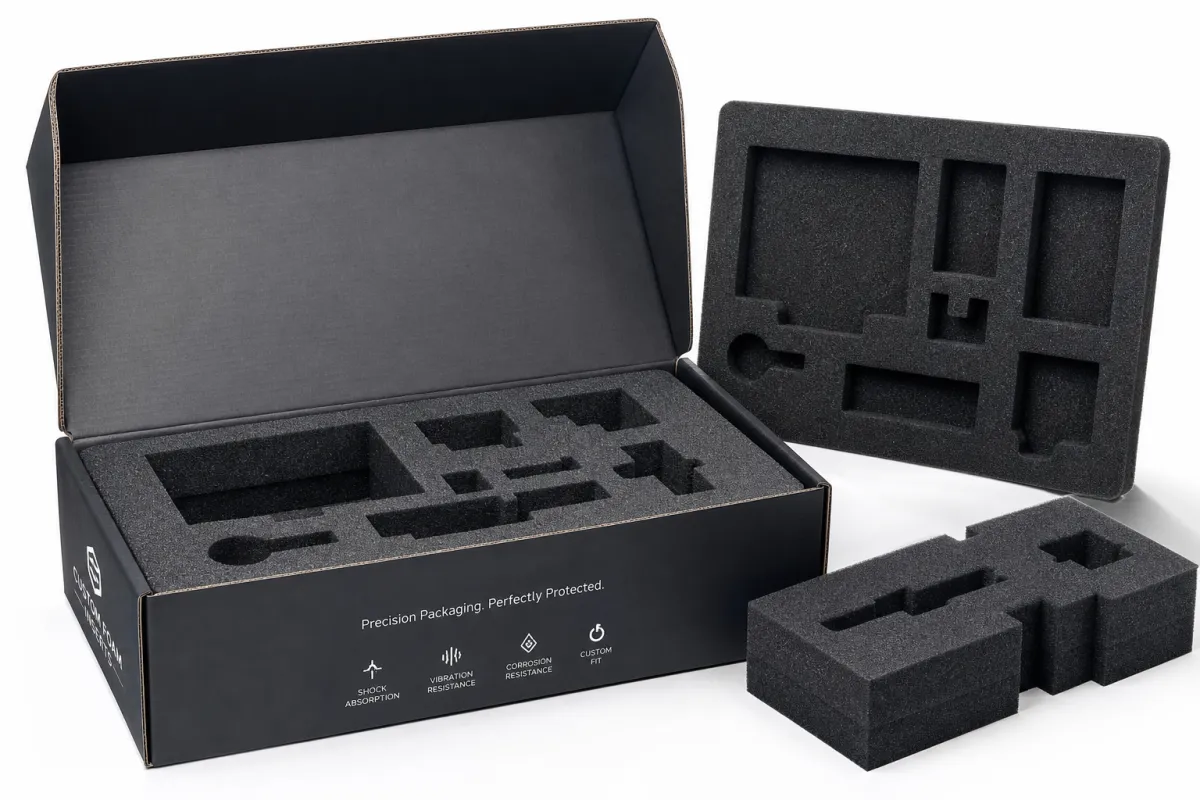
At the simplest level, custom foam inserts for boxes are protective pieces cut or shaped to match the item they carry. They can be one-piece blocks with a precise cavity, layered inserts with a top and bottom section, or multi-compartment trays that keep several components separated. A watch kit may need a main recess for the product, a slimmer slot for the charger, and a small cavity for paperwork. A power tool set may need a deeper cavity for the tool body and firmer support around the battery pack.
The surprise for many teams is that custom foam inserts for boxes are not only about softness. They are about control. The insert defines where the product sits, how much it can move, how load gets distributed if the carton is stacked, and where stress lands if a shipment is dropped. That is a different job from loose fill or void-fill paper, which can take up space but usually cannot hold a precise shape under repeated handling.
These inserts show up anywhere product fit matters more than bulk cushioning. That includes retail packaging for premium electronics, presentation boxes for cosmetics, reusable cases for equipment, and custom printed boxes where the inside has to look as intentional as the outside. In practice, the value of custom foam inserts for boxes is not just reduced damage. It is faster packing, cleaner inventory presentation, and fewer “special handling” headaches in the warehouse.
A lot of companies still underestimate how much the inside of the box shapes the first impression. If the outer structure looks polished but the product shifts around inside, the package feels cheap. If the foam fits correctly, the whole thing feels deliberate. Simple as that.
How Custom Foam Inserts for Boxes Protect Products
The protection mechanism is easier to understand if you think about the shipment as a system. The corrugated carton carries compression and stacking loads. The foam absorbs shock and cuts down vibration. Together, they help the product survive drops, conveyor jolts, pallet pressure, and the repeated impacts that happen long before a parcel reaches the door. Strong custom foam inserts for boxes do not just cushion a product; they manage the forces that travel through the package.
There are four main protection jobs. First is shock absorption, which reduces the peak force from a fall. Second is vibration damping, which matters more than people think because small repeated shakes can loosen fittings, scuff finishes, or crack brittle parts over time. Third is load distribution, where the foam spreads pressure away from a single fragile corner or button. Fourth is anti-movement fit, which stops the item from building momentum inside the box. A loose product can take a light impact and turn it into a hard one. A snug product cannot do that nearly as easily.
"If the carton has to do all the work, the carton is too cheap." That's how a lot of packaging teams describe a shipment that failed because the inside was underdesigned, not because the outer box was weak.
Compared with paper-based fillers, custom foam inserts for boxes offer much tighter control. Paper is fine for filling voids around general merchandise, and molded pulp is a smart choice for many sustainable packaging programs, but neither one gives the same exact cavity geometry. Foam wins when the product has delicate edges, polished surfaces, protrusions, or dimensional tolerances that leave little room for movement. A molded insert may be better for a simple rectangular item. A foam insert often wins when the product shape is irregular or the risk of cosmetic damage is high.
That is also why layered designs work so well. A softer top layer can touch scratch-sensitive finishes, while a denser base layer supports the product’s weight. Corner relief cutouts can protect painted edges. Finger recesses can help users remove the item without tugging on fragile parts. Small details like these can lower damage rates in real shipping conditions, especially if the package is tested against common transit methods through ISTA procedures and internal drop testing that matches your actual lane profile.
For companies selling premium goods, custom foam inserts for boxes often do one more job that gets overlooked: they protect finish quality. A polished surface that arrives unmarked protects margin and reputation at the same time. That is why the best designs are usually boring in the best possible way. They do not draw attention to themselves. They just keep the product where it belongs.
Key Factors That Shape Custom Foam Inserts
Dimensions and tolerances come first
The starting point for custom foam inserts for boxes is not the retail box artwork or the final shipper label. It is the actual product. Measure the widest points, deepest points, any protrusions, and any delicate zones that cannot touch hard material. That includes buttons, lenses, connectors, trigger guards, hinges, and decorative finishes. Nominal dimensions are not enough. Real packaging work depends on manufacturing tolerances, and a 1 mm shift can be enough to create rattle, crush force, or closure problems.
For irregular products, a supplier may need a physical sample, a CAD file, or both. If there is a bundle of accessories, the pack-out plan should show each item in the order it will be loaded. Custom foam inserts for boxes work best when the final arrangement is mapped before cutting begins, not after someone notices the accessory cable has nowhere to go. That part sounds obvious until you watch a launch slip because nobody left room for the charger.
Material choice changes the result
Foam family matters more than most buyers expect. Polyethylene is commonly used for firmer protection, better edge definition, and repeated use. Polyurethane is softer, more compressible, and often chosen for lighter items or lower-cost cushioning. EVA can sit in the premium middle ground: good appearance, clean cuts, and a smoother feel for presentation packaging. Density, resilience, and surface finish all play a role, and the wrong material can make even well-designed custom foam inserts for boxes underperform.
Heavier products usually need firmer support so the foam does not compress too far under load. Scratch-sensitive products may need a softer contact surface or a thin top layer that protects the finish. If the insert will be reused in a kit, case, or returnable shipping program, resilience becomes even more important. A material that collapses after a few cycles is a hidden operating cost, and not a small one.
| Foam family | Typical strength | Best fit | Tradeoff | Relative cost |
|---|---|---|---|---|
| Polyethylene | Firm, clean-cut, durable | Tools, electronics, reusable packs | Less forgiving on very delicate finishes | Moderate |
| Polyurethane | Softer, lighter cushioning | Lighter goods, short-run packaging | Can compress faster under heavy loads | Lower to moderate |
| EVA | Dense, smooth, presentation-friendly | Premium retail packaging, electronics, displays | Often priced above basic foam options | Moderate to higher |
Temperature and handling environment matter too. If the package is going through hot warehouses, cold trucks, or repeated fulfillment cycles, the insert has to keep its shape across those conditions. Custom foam inserts for boxes that perform in a climate-controlled sample room can still fail if the product is shipped in a lane with more vibration or more compression than expected. That is why the packaging design should reflect the real route, not just the ideal one.
Custom Foam Inserts for Boxes: Cost, Pricing, and ROI
Pricing for custom foam inserts for boxes depends on material, thickness, cavity complexity, finish requirements, and order volume. The quote is usually shaped by three things: how hard the foam is to cut, how many unique cavities it contains, and how much setup work is needed to make the part repeatable. A simple block with one recess is very different from a multi-compartment insert with cutouts, layered densities, and tight cosmetic tolerances.
At low volume, the sticker price can look high. That surprises a lot of buyers. A small run of custom foam inserts for boxes may cost several dollars per set if the design is detailed, while a larger order can bring the unit cost down sharply. For rough planning only, simple polyethylene inserts may fall around $0.90-$1.80 per set at higher volumes, while more complex multi-layer or presentation-grade designs can run $1.75-$4.00 or more depending on thickness and tooling. At lower quantities, the same parts can cost noticeably more because setup and labor are spread across fewer units. Those numbers are planning ranges, not quotes, so they should always be confirmed with a supplier.
What drives the quote
Expect pricing to reflect the foam family, CNC time or die-cutting time, sample count, freight, and any finish requirements such as lamination or color matching. If a design needs a custom die, there may be a separate tooling charge. If the insert needs exact repeatability for branded packaging or retail packaging, the supplier may also need tighter QA checks, which adds cost but lowers variation. The quote should spell out MOQ, sample fees, setup fees, and lead time so the team can compare apples to apples.
For a buyer, the most useful question is not “What is the cheapest insert?” It is “What does each option cost per shipped order after damage, labor, and returns are counted?” That is where custom foam inserts for boxes often start to make sense. A product with a high replacement cost, a fragile finish, or a high return rate can justify a more expensive insert quickly.
| Option | Indicative cost range | Best for | Main tradeoff |
|---|---|---|---|
| Loose fill / paper | $0.05-$0.25 per ship | General merchandise | Poor product control |
| Molded pulp | $0.30-$1.20 per set | Simple shapes, eco-focused programs | Less precise fit |
| Custom foam inserts for boxes | $0.90-$4.00+ per set | Fragile, premium, irregular products | Higher upfront spend |
| Multi-layer premium foam | $1.75-$6.00+ per set | Presentation kits, reusable cases | More design and sample effort |
How ROI actually shows up
ROI usually shows up in fewer returns, lower reshipment expense, fewer damaged replacement units, and less time spent repacking. One broken unit can cost much more than the insert itself once customer service time, freight, and the replacement product are included. If a damaged shipment costs $25-$45 to fix, a better insert that adds $0.80 or $1.20 per unit may be the cheaper decision overall. That is especially true for product packaging that carries a strong brand promise.
There is also a softer return: perception. Strong custom foam inserts for boxes make the package feel more valuable, which can matter in custom printed boxes, premium retail packaging, and subscription kits. That does not mean the foam should be overbuilt. It means the inside should match the promise made by the outside. If you are comparing packaging structures, it helps to review Custom Packaging Products alongside the insert, because the carton and the foam should be designed together, not treated as separate purchases.
Custom Foam Inserts for Boxes: Process and Timeline
The workflow for custom foam inserts for boxes is usually straightforward, but only if the brief is clear. A supplier generally needs product measurements, photographs, box size, handling requirements, and a target pack-out method. From there, the team can review CAD, pick the foam family, build a prototype, and move into production once the sample is approved. The process is easy to describe and easy to slow down if any detail is vague.
From brief to prototype
The first step is measurement, and it should include more than length, width, and height. Share tolerances, protrusions, delicate areas, and the pack order for accessories. If the product sits beside printed literature, cables, charging plugs, or spare parts, those items need their own spots. A good sample is not just a shape test. It is also a packing test. Custom foam inserts for boxes should be evaluated with the actual product, not a placeholder object that only looks close in size.
After the brief, the supplier may create a digital layout or a prototype insert. Simple die-cut foam may move from proof to sample quickly, while layered or CNC-profiled designs take longer. As a planning rule, straightforward inserts can sometimes be ready in about 10-15 business days after approval, but more complex designs often need 3-4 weeks or extra sample rounds. That range depends on tooling method, material availability, and how many revisions the fit requires.
Where the schedule slips
The biggest delays are usually not in cutting. They are in back-and-forth around fit. A small change in product dimensions can force a second prototype, and a second prototype can push the launch date. That is why clear photos, target drop criteria, and pack-out goals matter. If the product has to pass specific transit testing, say so early. Referencing common test methods, including packaging industry resources and recognized transit test standards, helps everyone speak the same language. For foam performance, many suppliers also look at ASTM foam property tests such as compression and density checks, then map those results back to real handling conditions.
- Send exact product dimensions and tolerances.
- Include every accessory that ships in the box.
- State the carton size and closure style.
- Describe the handling risk: drops, stacking, vibration, or reuse.
- Ask for sample approval before volume production.
That preparation pays off. Custom foam inserts for boxes are rarely expensive because they are hard to make; they become expensive when the wrong assumptions force a redesign. A little clarity at the start usually saves a lot of time later.
Common Mistakes When Specifying Foam Inserts
Most failures with custom foam inserts for boxes are not caused by bad foam. They come from bad assumptions. The first mistake is choosing by price alone. Cheap foam may look fine on a spreadsheet, but if it compresses too much, leaves the product loose, or wears out after a few cycles, the real cost goes up fast. Compression set is a quiet problem: the insert can look normal at first, then lose support after repeated use.
The second mistake is measuring the product but forgetting the rest of the pack-out. Cables, chargers, lids, accessories, instruction books, and surface protection all change the internal layout. If the insert ignores those items, the finished package will be awkward at best and nonfunctional at worst. For custom foam inserts for boxes, a pack-out drawing is often more useful than a single measurement sheet.
The third mistake is testing the wrong condition. A product that looks secure on a desk can still fail under vibration, stacking pressure, or a standard drop from conveyor height. That is especially true for long, narrow, or top-heavy items. If the shipment will ride through courier networks, the insert should be checked against realistic handling, not only a gentle hand test. One or two drops, one vibration cycle, and a compression check can expose issues early.
The fourth mistake is overengineering. It sounds harmless, but an overbuilt insert can slow packing, increase foam usage, and make the unboxing feel clumsy. A package that is so tight the user fights it every time is not elegant. It is annoying. The best custom foam inserts for boxes protect the product while still allowing a clean, intuitive reveal.
"The insert should disappear during use and reappear in the damage numbers." That is the standard many packaging teams quietly use when they review a design after launch.
Another mistake is separating foam design from the rest of package branding. If the carton is premium but the insert looks like an afterthought, the whole package feels inconsistent. If the brand wants a clean presentation, the foam color, finish, and cavity layout should support that story, not fight it. A good packaging design team thinks about the box, the insert, the print, and the unboxing sequence together.
Expert Tips and Next Steps for Custom Foam Inserts for Boxes
If you are trying to decide whether custom foam inserts for boxes are worth the effort, start with a protection brief. Write down product weight, fragility, finish sensitivity, shipping method, expected handling, and the damage threshold you are willing to accept. That gives the supplier a practical target instead of a vague request for “better protection.” It also helps your team compare foam against molded pulp, paper-based options, or a more protective carton structure.
Then request a prototype early. Do not wait until the final carton is printed and the launch is close. A sample lets you check the obvious things, like fit and closure force, and the subtle things, like whether the user can remove the product without damaging the finish. Custom foam inserts for boxes are much easier to improve on a prototype than on a live production run. If the sample stage feels slow, remember that it is the cheapest place to find a mistake.
- Measure the product and every accessory that ships with it.
- Confirm the inner carton dimensions before the insert is finalized.
- Ask for a sample and test it with the real product.
- Check the insert under drop, stack, and vibration conditions.
- Compare the options on protection, labor speed, unit cost, and presentation.
A simple scorecard helps. Give each option a score for damage reduction, packing speed, material cost, and brand presentation. That turns the decision into something the operations team and the marketing team can both understand. It also shows whether the business really needs premium custom foam inserts for boxes or whether a lighter solution can do the job. For broader sourcing, it often helps to review Custom Packaging Products while you compare box styles, insert materials, and printed finishes, because the best result usually comes from one coordinated package system.
The broader lesson is that packaging is not decoration. It is part of the delivery system. Good custom foam inserts for boxes reduce damage, speed packing, and improve the unboxing experience without forcing the carton to carry a burden it was never meant to handle. For premium products, that balance matters. For fragile products, it can decide whether the shipment earns praise or turns into a return. For a packaging team trying to control total landed cost, custom foam inserts for boxes are often one of the few line items that can cut waste while improving the brand at the same time.
So the practical move is this: measure the real product, include every accessory, test one sample under real handling, and only then lock the insert spec. That sequence keeps the design honest and saves you from paying for a fancy mistake.
How do I measure for custom foam inserts for boxes?
Measure the product at its widest points and include protrusions, corners, buttons, and any delicate finish that should not touch hard material. Measure the inside of the box too, because custom foam inserts for boxes must fit both the product and the carton without forcing the closure. Sharing tolerances with the supplier helps the foam account for real manufacturing variation.
What foam type is best for custom foam inserts for boxes?
Polyethylene is often chosen for firmer support, cleaner cut edges, and reuse. Polyurethane can work well for lighter cushioning needs. EVA is common when the insert needs a more premium look. The right choice depends on product weight, scratch sensitivity, and whether the insert will be used once or reused many times in custom foam inserts for boxes.
Are custom foam inserts for boxes expensive?
They can cost more than loose fill or molded pulp, especially at low volume or with detailed cavities. The real comparison is total loss cost, not just unit price. When returns, replacement units, freight, and labor are counted, custom foam inserts for boxes often lower the overall cost per shipped order for fragile or premium products.
How long do custom foam inserts for boxes take to produce?
Lead time depends on design complexity, sample approval, and the cutting method. Simple inserts can move quickly once the proof is signed off, while multi-layer or highly detailed designs take longer. If fit and appearance matter, build in time for a sample round before full production of custom foam inserts for boxes.
Can custom foam inserts for boxes be reused?
Yes. Many are designed for repeated use in storage, kit packaging, and returnable shipping systems. Reuse depends on foam durability, handling frequency, and whether the cavity stays tight after compression. If reuse matters, specify resilience and surface durability early so custom foam inserts for boxes hold up across more than one packing cycle.

