For a custom bucket Hats Bulk Order, the hat shape is only the starting point. The real variables are fabric weight, decoration method, trim, and the amount of wear the product has to survive before it starts looking tired. That is where most buyers either save money or create problems they will not see until the cartons arrive. The cleanest orders usually define use case first, then build the specification around it.
If the hats are for outdoor staff, a festival crew, a retail drop, or a giveaway that needs to last beyond one event, start with the wearer and the job. Shade, branding visibility, resale appeal, and budget do not lead to the same product. A cheap-looking hat can undermine a polished launch just as quickly as a weak box or an off-color print. A good quote reflects those differences instead of hiding them.
Why bucket hats are easier to scale than caps
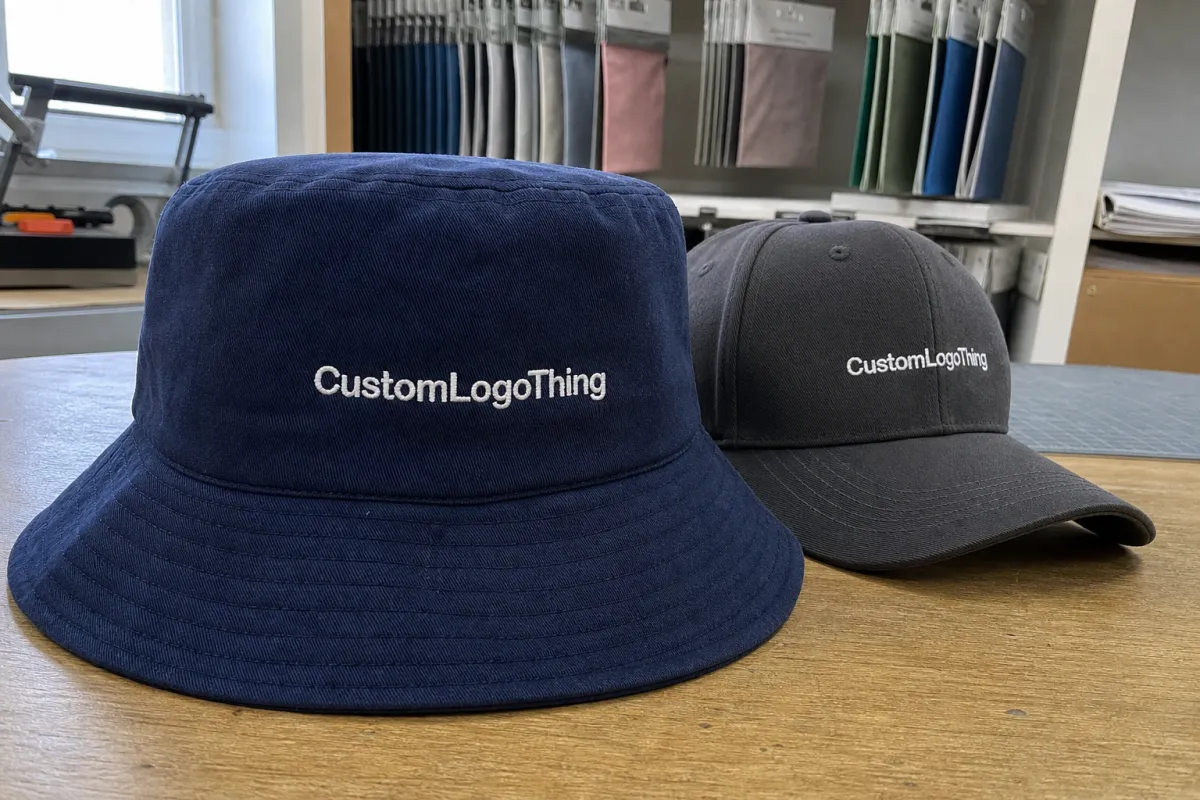
A custom bucket Hats Bulk Order is often simpler to produce than a cap run because the shape is forgiving. You are not asking the factory to balance a curved visor, a structured front panel, and a precise crown contour at the same time. The bucket silhouette gives the production team a broader surface and fewer structural pressure points. That matters once quantities rise and small inconsistencies start showing up across the line.
Buyers also get more visible real estate for branding. A bucket hat gives a logo room to breathe, which is useful for outdoor brands, resort staff, event crews, and merch programs that need the mark to be visible from a distance. On a small cap front, a logo can disappear into the panel seams or get crowded by the visor. On a bucket hat, the same mark usually reads more clearly.
There is another advantage that is easy to miss: fit tolerance. Bucket hats are commonly sold in one size or a shallow size range, so there is less pressure to maintain the tight dimensional control required by fitted caps. That does not make the order foolproof. It just means there are fewer points of failure if the fabric, brim weight, and stitch density are chosen well.
- Outdoor use: wider brim gives better shade and a more practical feel than a fashion-only cap.
- Event use: branding is easier to spot at a glance, especially with embroidery or a patch.
- Retail use: the softer silhouette works in streetwear, travel, and lifestyle assortments.
- Staff gear: casual enough for daily wear, but still branded enough to support team identity and package branding.
Scale helps here because the product tolerates variation better than a structured cap, but that does not mean any material will work. A thin fabric can make the hat collapse, and a weak brim can turn the silhouette flimsy. Cheap choices are obvious on this product. Very obvious.
Fabric, brim, and crown choices that change the final look
Fabric drives how the hat wears, how it photographs, and how long it holds its shape. For a custom bucket hats bulk order, the common starting points are cotton twill, washed cotton, nylon, ripstop, and denim-style builds. Cotton twill is the safest default: stable, familiar, and easy to decorate. Washed cotton feels softer and less rigid. Nylon and ripstop are lighter and better suited to outdoor use. Denim-style fabric looks more premium, but it usually pushes both cost and lead time upward.
The brim changes the mood more than many buyers expect. A wider brim improves shade and gives a looser profile, while a narrower brim feels cleaner and easier to wear in a city setting. Crown height matters too. A shallow crown gives a flatter, streetwear look. A taller crown can feel more traditional, and if the proportions are off it starts to look dated rather than intentional. Those are small decisions on paper; in production, they are the difference between a hat that sells and one that sits in inventory.
Stitching density is worth paying attention to only when the use case justifies it. Heavier stitching helps the brim keep its shape and adds a more substantial feel, but it also increases production time. Eyelets, sweatbands, chin cords, lining, and reversible construction are all useful in the right context. They are not automatically useful. If the hat is going to a summer promotion where people wear it once, a simpler build is usually smarter. If it is for retail or resale, the spec needs to be tighter and the finish more deliberate.
Color approval should happen early. Pantone references help, but fabric dye never behaves exactly like ink on a screen. If color is critical, request a lab dip, a physical swatch, or at least a daylight sample photo. That becomes especially important when the hats need to coordinate with custom printed boxes, retail packaging, or a larger branded kit. Matching across products is not a guess; it is a series of controlled approvals.
“If the fabric shade and logo contrast are not settled early, the order can look perfect in a mockup and disappointing in the carton. That failure is avoidable.”
A practical shortcut: pick the simplest fabric that still fits the environment. Cotton twill handles most promotional orders. Ripstop or nylon makes more sense for active outdoor use. Denim-style builds are better when the hat is part of a retail collection and needs to sit beside other branded packaging without looking disposable.
One more production detail gets overlooked often: seam placement. If the logo sits too close to a seam or dart, it can distort the artwork or interrupt the embroidery path. Ask for a proof that shows the hat flat and worn, not just front-facing on a white background. A flat proof can hide problems that become obvious once the crown takes shape.
Decoration methods and logo placement that survive wear
Decoration is where a custom bucket hats bulk order can move from simple to polished, or from polished to awkward. The main methods are flat embroidery, 3D puff embroidery, woven patches, printed patches, and direct print. Flat embroidery is the safest all-around choice because it handles most logos cleanly and wears well. 3D puff can look strong on bold marks, but it is not friendly to fine type or tiny details. Woven patches are useful when the artwork has small lines or text that embroidery would blur. Direct print works for larger graphics, provided the fabric and placement support it.
Placement changes both cost and visibility. Center front is the standard because it is easy to see and simple to quote. Side panel logos look quieter and more fashion-led. Back tab branding works well for streetwear. Brim-edge or under-brim art can make the piece feel more considered, but it adds setup complexity and inspection time. If the design depends on fine detail, the factory may need to simplify linework, raise the stitch count, or shift from embroidery to a patch. That is not the factory being difficult. That is production reality.
The best orders usually begin with the logo file and a hard look at negative space. A small logo on a wide brim can disappear. A crowded badge on a soft crown can wrinkle. If the mark has gradients, thin serif type, or micro lines, it may need a woven patch or printed treatment instead of embroidery. Asking the factory to “make it work” without changing the art is how sample rounds get wasted.
Request a digital proof before production. For larger runs, or for unusual placement, ask for a physical sample. You want to check contrast, scale, thread direction, and how the logo sits when the hat is worn, not only when it is laid flat. A proof that looks tidy on a screen can still fail in real use if the logo lands too low or the brim pulls it out of proportion.
For brands already managing merch kits, the same discipline applies to packaging design. The hat should feel connected to the rest of the set, whether that means custom printed boxes, product packaging inserts, or retail packaging for a store launch. If the logo treatment on the hat looks unrelated to the rest of the line, the whole program feels improvised.
Practical quality control matters here too. Ask whether the supplier trims loose threads after embroidery, checks patch alignment on every size run, and verifies that print colors stay inside the approved range. Those details sound small because they are small. They also separate a clean delivery from a shipment that needs hand-sorting before it can be used.
Custom bucket hats bulk order pricing and MOQ
Pricing for a custom bucket hats bulk order depends on the factors that actually move the needle: fabric choice, decoration method, logo size, stitch complexity, trim options, color count, and whether the order needs special packing. Buyers often focus on the unit price and ignore setup fees, sample charges, freight, and rush costs. That is how a quote looks attractive on paper and expensive on the invoice.
For planning purposes, simple cotton twill bucket hats with one-color embroidery often land around $2.20-$4.50 per unit at mid-sized quantities, depending on volume and location. Heavier fabric, woven patches, multiple placements, or specialty trims can move that into the $4.50-$7.50 range. Small runs are almost always more expensive per piece. That is not a supplier trying to be dramatic. It is setup math.
| Order type | Typical MOQ | Typical unit range | Best for |
|---|---|---|---|
| Basic cotton twill, flat embroidery | 100-300 pcs | $2.20-$4.50 | Promotions, staff gear, event merch |
| Washed cotton, woven patch | 300-500 pcs | $3.20-$6.20 | Lifestyle brands, retail-style giveaways |
| Nylon or ripstop, printed or sewn patch | 300-1,000 pcs | $3.50-$7.50 | Outdoor teams, travel, active use |
| Reversible or special-trim build | 500+ pcs | $5.50-$9.50 | Premium drops, resale, campaign kits |
MOQ is rarely just a number. It can shift depending on how much variation the order includes. Mixed colors may still count toward one run if the base hat stays the same. Mixed artwork often creates a second setup. Mixed sizes are less of a problem because many bucket hats are one-size or only lightly graded, but that still needs confirmation before approval.
Ask the supplier to separate the quote into line items:
- Base unit price: hat body, standard trim, and normal packaging.
- Setup fee: embroidery digitizing, patch tooling, print prep, or pattern adjustment.
- Sample cost: prototype or pre-production sample.
- Rush charge: only if the factory agrees to compress the schedule.
- Freight: domestic, air, sea, or split shipping.
If you need individual polybagging, retail hangtags, or branded packaging inserts, include those costs up front. They may be small per unit and still change the landed total enough to matter. A buyer who tracks product packaging carefully usually gets a cleaner budget than the one who accepts a single all-in number and hopes nothing shifts later.
Low MOQ is only useful if the decoration method supports it. A cheap-looking quote with a high digitizing fee or a stiff patch minimum can erase the advantage quickly. Ask for full math, not the headline number.
Another cost trap sits in packing. A hat packed in bulk with no shaping support is cheaper on paper and more likely to arrive crushed. A small insert or a better carton spec can save more money than it costs if the order is meant for resale or display. Freight is part of the product, not an afterthought.
Production steps, proofing, and turnaround you should expect
The production path for a custom bucket hats bulk order is usually straightforward, but only if the buyer keeps decisions moving. The sequence should be inquiry, quote, mockup, sample or proof approval, production, quality check, packing, and shipment. Skip a step or delay a sign-off, and the schedule starts drifting. Nothing mysterious is happening there; the work is simply waiting on information.
Realistic turnaround usually begins after artwork and specs are confirmed. For standard builds, many orders land in the 10-20 business day range after approval, while larger or more complex runs need longer. If you need a sample first, add time for that. If the hat uses a special fabric, add more time. If shipping is seasonal or the route is slow, add a cushion. The clock does not start when the first email goes out. It starts when the details stop changing.
Common delay points are predictable:
- Artwork revisions that never settle.
- Color approval that turns into a debate.
- Late payment or a missing deposit.
- Fabric not in stock.
- Quantity changes after the quote is already built.
A good proof should show hat shape, logo placement, approximate scale, stitching or print style, and any notes about trim or packaging. If the proof is vague, the production result will probably be vague too. Factories can only execute the information they receive.
For event-driven orders, build in buffer time for freight and rework. If the hats need to land with a larger launch that also includes retail packaging or custom printed boxes, align the schedule across all components. A late hat shipment can hold up the rest of the package branding plan, and that is a problem that cascades.
“If the deadline is real, work backward from the delivery date, not forward from the approval date. That habit saves more orders than any discount ever will.”
For shipping cartons, ask whether the supplier packs in a way that protects shape during transit. That sounds basic because it is basic. If the hats arrive crushed, the savings on unit price disappear fast. For shipping and distribution testing, ISTA standards are a useful reference point. For paper-based add-ons or carton components, FSC certification is worth considering if sourcing matters to the brand story.
Production control also includes inspection before packing. The useful checks are not glamorous: count consistency, seam integrity, symmetry in the brim, color matching across the run, and logo placement within tolerance. If the supplier does not mention those checks, ask directly. A run can look fine from five feet away and still fail under close review.
What a reliable supplier should prove before you pay
A reliable supplier does not hide behind pretty mockups. For a custom bucket hats bulk order, they should show material options, decoration guidance, and a quote that separates product cost from shipping and add-ons. If the math is buried, the order is usually buried too. That is irritating, but it is also a useful warning sign.
Look for these signals:
- Clear mockups: placement, size, and color shown in a way you can actually review.
- Direct answers: no vague “we can do anything” language that avoids specifics.
- Past production examples: similar fabrics or decoration methods, not random stock images.
- Replacement policy: what happens if the batch has defects or a visible color shift.
- Schedule honesty: realistic timing, not optimistic guesswork.
Ask how they handle defects, misprints, and off-color results. A low quote means little if the supplier disappears once the issue appears. Strong vendors have a process for corrective runs, credits, or partial replacement. Weak vendors have excuses. The difference matters more than a small price spread.
If the order is part of a larger launch, check whether the supplier understands how the hat fits into the wider retail packaging plan. That includes cartoning, labeling, branded packaging, and any inserts that need to ship with the hats. A team that can think beyond the hat body usually handles production with more discipline. The same standard applies to Custom Packaging Products and to broader sourcing through Wholesale Programs.
You should also ask about sampling discipline. Some suppliers treat samples as rough approximations; others use them to lock color, placement, and stitch count before mass production begins. The second approach is better, even if it adds a little time. A slightly slower sample stage is usually cheaper than correcting a full run.
When a supplier is serious, they can explain the difference between sample, bulk, and production approval in plain language. If they cannot, keep looking. Confusion at the quoting stage tends to become more expensive later, not less.
What to send so you can lock the order without delays
Good quotes come from clean inputs. For a custom bucket hats bulk order, send the following in one message:
- Quantity and any expected split by color.
- Target delivery date and shipping address.
- Fabric preference and color reference.
- Decoration method and exact logo placement.
- Artwork files in vector format if possible.
- Packing requirements, including polybags, hangtags, or retail labeling.
If the hats need to match a launch kit, say so. If the hats must coordinate with custom printed boxes or another piece of product packaging, include that visual reference early. That helps the supplier judge color temperature, logo contrast, and the level of finish expected across the full package branding set.
Do not approve a proof until three things are right: artwork scale, color callout, and final landed cost. If any of those is fuzzy, you are not approving an order. You are approving a problem with a polite font.
In some cases, a buyer also needs split delivery to multiple locations or different packing formats for wholesale and direct retail. Mention that up front. It affects carton counts, labels, and shipping cost. Small detail, large mess if it is forgotten.
If the logo file is not clean, fix it before the supplier starts digitizing or setting the artwork for print. Vector files reduce interpretation problems. Low-resolution raster files invite them. A tidy brief moves faster because the factory can schedule it with confidence.
Once the specs are tight, the order moves faster. That is the real advantage of doing the homework up front. A clear brief turns a custom bucket hats bulk order into a production job the factory can actually schedule instead of a long series of clarifications.
How many custom bucket hats do I need for a bulk order?
Most factories work with quantity breaks, so the best value usually starts around 100, 300, or 500 pieces depending on the decoration method. Ask whether mixed colors count toward one total and whether the MOQ changes if you want different logo placements.
What decoration works best for a custom bucket hat bulk order?
Flat embroidery is the safest all-around choice for clean logos. Woven or sewn patches are better for small details and sharper edges. Printed art can work for larger graphics, but only if the fabric and placement give the print enough room to stay readable.
How long does a custom bucket hats bulk order usually take?
Typical production starts after proof approval and often runs a few weeks. Rush jobs may be possible if the factory has capacity. Artwork changes, fabric shortages, and freight delays are the usual reasons a timeline slips, so build in buffer time.
Can I mix colors or sizes in one bulk bucket hat order?
Yes, if the base hat is the same and the factory can keep the production run shared across colors or size options. Always confirm whether mixed colors affect pricing, MOQ, or turnaround before you approve the quote.
What do I need to get an accurate quote for custom bucket hats bulk order pricing?
Send the logo file, quantity, color count, decoration method, target delivery date, and packing requirements. The cleaner the artwork and the clearer the specs, the faster the quote and the fewer unpleasant surprises later.
A custom bucket hats bulk order works best when it is treated as a production decision rather than a casual accessory purchase. Lock the fabric, confirm the logo method, check the proof, and make the supplier show the full math before you pay. That is how you get hats that wear well, ship cleanly, and do the job without drama.

