Buyer Fit Snapshot
| Best fit | Custom Canvas Tote Bag Printing Methods Explained Clearly projects where brand print, material claims, artwork control, MOQ, and repeat-order consistency need to be specified before quoting. |
|---|---|
| Quote inputs | Share finished size, material target, print colors, finish, packing count, annual reorder estimate, ship-to region, and any compliance wording. |
| Proofing check | Approve dieline scale, logo placement, barcode or warning zones, color tolerance, closure strength, and carton packing before bulk production. |
| Main risk | Vague material claims, crowded artwork, missing packing details, or unclear freight terms can make a low unit price expensive after revisions. |
Fast answer: Custom Canvas Tote Bag Printing Methods Explained Clearly should be specified like a repeatable production item. The safest quote records material, print method, finish, artwork proof, packing count, and reorder notes in one written spec.
Production checks before approval
Compare the actual filled-product size with the drawing, then confirm tolerance on folds, seals, hang holes, label areas, and retail display edges. Reserve space for logos, QR codes, warning copy, and material claims before decorative graphics fill the panel.
Quote comparison points
Review material grade, print process, finish, sampling route, tooling charges, carton quantity, and freight assumptions side by side. A quote is only useful when the supplier can repeat the same color, closure quality, and packing count on the next order.
Custom Canvas Tote Bag Printing Methods Explained Without the Fluff
Custom Canvas Tote bag printing methods sound straightforward until the first sample comes back looking tired, muddy, or weirdly expensive. A crisp logo can soften at the edges. A nice illustration can crack before it has even seen real use. And a tote that should feel like a considered brand piece can end up reading like a giveaway that nobody thought through. That is not cute.
The reason this matters is simple: a canvas tote is handled like a real object, not a brochure. People fold it, stuff it, drag it, wash it, and keep using it long after the event is over. So the decoration cannot just look fine in a mockup. It has to survive actual life. That is why custom canvas tote bag printing methods should be chosen with the same care buyers already give to Custom Printed Boxes, retail cartons, inserts, and every other branded surface that has to show up in the real world.
Pick the wrong process and the tote looks cheap. Pick the right one and it becomes something people use repeatedly, which is basically free brand exposure with handles. Not glamorous. Just effective.
What Custom Canvas Tote Bag Printing Methods Actually Are
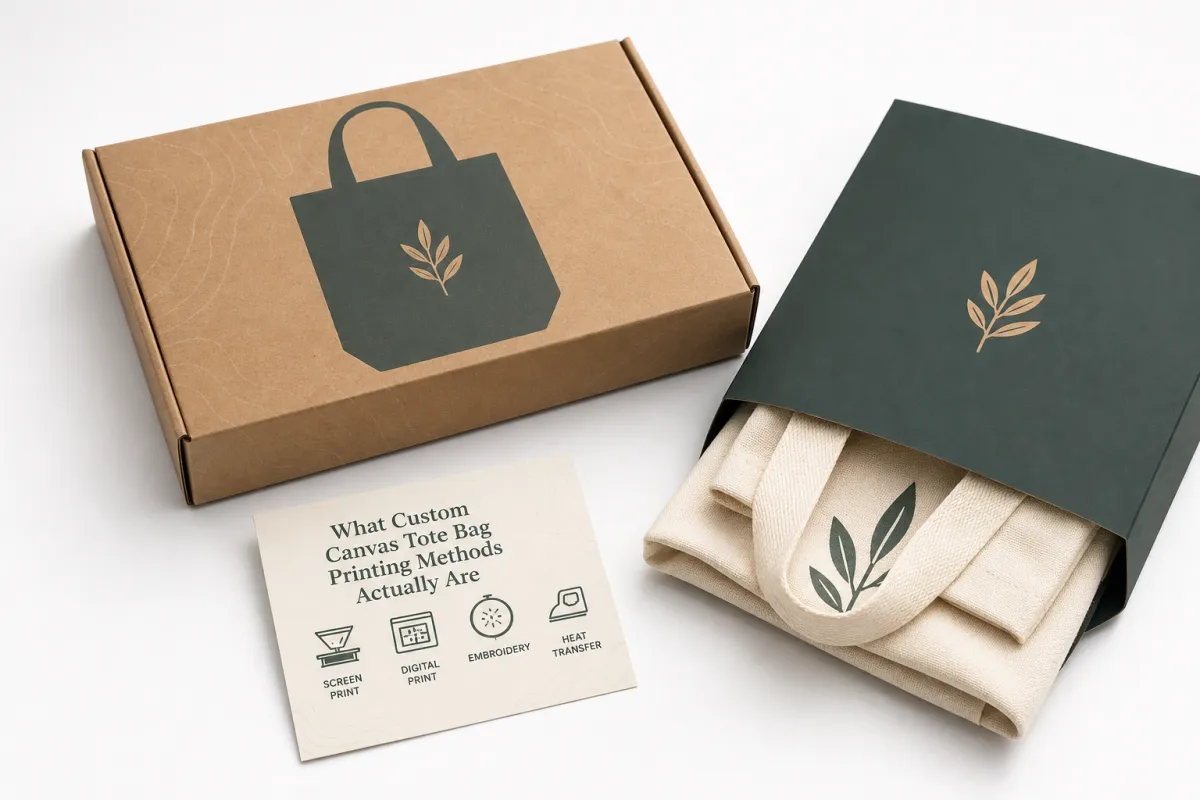
Custom Canvas Tote bag printing methods are the ways artwork gets onto a tote and stays there long enough to matter. That sounds obvious. It is not. The phrase covers several very different processes, and the differences show up fast once you move from a clean digital proof to a textured canvas surface. A one-color logo on a natural tote is not the same job as a full-color retail illustration on a dark bag with a tight weave. Same category. Very different outcome.
The main options are screen printing, digital printing, heat transfer, and embroidery. Specialty approaches also exist, like metallic effects, reflective film, puff ink, and discharge-style effects, but those are usually reserved for a very specific look rather than everyday tote programs. Each of the core custom canvas tote bag printing methods brings its own mix of setup time, detail level, hand feel, durability, and unit price.
Canvas is a better decorating surface than flimsy promo fabric because it has body. That said, it is still a woven textile, not a smooth panel or a coated carton. The weave shows. The fibers absorb differently from one bag to the next. That means the decoration has to work with the bag instead of pretending the bag is something else. When it does not, the result looks off fast. Very fast.
For a buyer planning branded packaging, a retail launch, or a giveaway that ties into a bigger package system, the first question should be basic: what is the tote supposed to do? A shopping bag needs wear resistance and repeated use. An event bag needs a fast turnaround and a friendly price. A premium gift tote needs a finish that feels intentional, maybe even a little elevated. Different job. Different method.
The cleanest way to approach custom canvas tote bag printing methods is to choose the process that supports the art, the run size, and the brand experience. Do not force a design into a method that cannot carry it. That mistake shows up in packaging all the time, whether it is offset printing on cartons or digital printing on custom printed boxes. The substrate always gets the final say.
"A tote is one of those rare branded items people keep using after the purchase is over, which means the print has to hold up in the wild, not just on a proof."
That is why custom canvas tote bag printing methods deserve more scrutiny than they usually get. A bag can look polished on screen and still fail in hand if the logo cracks, the thread puckers, or the color sinks into the weave. The process choice protects both appearance and lifespan. No magic. Just fewer regrets.
How Do Custom Canvas Tote Bag Printing Methods Work on Canvas?
The mechanics behind custom canvas tote bag printing methods are not mysterious. They are just unforgiving when the wrong method meets the wrong bag. Canvas flexes, absorbs, and shows texture under light. Paper behaves differently. Coated board behaves differently. Synthetic fabrics behave differently too. Each decoration method has to deal with coverage, registration, and finish in its own way.
Screen Printing
Screen printing pushes ink through a mesh stencil onto the tote. On heavier canvas, it can produce strong opaque color, sharp edges, and a clean look That Holds Up under regular handling. A well-executed screen print on a 10 oz or 12 oz tote often gives buyers exactly what they want: bold, readable, durable, and not trying too hard. Among custom canvas tote bag printing methods, screen printing is usually the safest answer for simple logos, flat spot colors, and designs that need visual punch.
Its biggest strength is repeatability. Once the screens are made and the ink is dialed in, large runs stay consistent. The tradeoff is setup. Each color typically needs its own screen, so a three-color design costs more than a one-color version. Fine gradients also do not play nicely here. For buyers ordering at scale, screen printing usually becomes the practical choice because the unit price improves as quantity goes up.
The one thing people sometimes miss is feel. A well-cured plastisol print can sit a little heavier on the fabric, while water-based systems can sink in more softly. Both can work. Which one is right depends on the bag, the artwork, and how premium or casual the piece is supposed to feel. That part gets ignored more than it should.
Digital Printing
Digital printing lays artwork directly onto the canvas with inkjet-style equipment or a similar fabric-printing system. It is the method that keeps gradients, fine type, photographic elements, and multi-color artwork from getting flattened just to fit production. Among custom canvas tote bag printing methods, digital printing is often the least annoying path when the art has a lot going on and nobody wants to turn it into something generic.
The canvas still has a say. A loose weave can soften tiny text or blur delicate shadows a bit, while a tighter weave usually holds the image better. Digital printing tends to work well for smaller runs, sample batches, and art-heavy merch because the setup is lighter than screen printing. It is also useful when every tote needs a small variation, like names, numbers, or event-specific personalization.
There is a catch, because of course there is. Very dark bags and very bright artwork can require more ink density or additional underlayers, depending on the equipment and ink system. If a supplier glosses over that, ask again. A sample on the actual canvas weight is worth more than a promise delivered with confidence and no proof.
Heat Transfer
Heat transfer uses a printed film or vinyl-style carrier that is pressed onto the tote with heat and pressure. It is one of the more flexible custom canvas tote bag printing methods for short runs, fast-turn jobs, and personalization. It can handle defined shapes, special effects, and quick deadlines without the setup load that screen printing brings along for the ride.
The feel is different from direct ink. A transfer can sit on top of the fabric and may feel a bit heavier, especially on soft canvas. Good transfer work can still be durable, but the result depends on the adhesive system, the bag surface, and the care expectations. If a tote is going to be folded often or washed regularly, the supplier should confirm that the transfer is built for that use instead of assuming all transfers behave the same way. They do not.
Heat transfer is also useful when a brand wants a short-term program with very specific personalization. Event names, limited edition marks, and small-batch custom runs can make sense here. It is not always the cheapest route in the long run, but for the right job it is fast, clean, and kinda hard to beat on schedule.
Embroidery
Embroidery is not printing in the strict sense, but it gets compared with custom canvas tote bag printing methods all the time because it is one of the main decoration choices. Thread gets stitched into the canvas, which creates a tactile finish with visible depth. It reads premium without needing a sales pitch. That makes it a strong fit for boutique retail, gift programs, and elevated event totes.
The limits are practical. Tiny text can fill in. Delicate lines can distort. Large fills can turn stiff or heavy. Stitch count matters a lot. A small logo may land around 6,000 to 8,000 stitches, while a larger mark can push much higher and raise the price quickly. Embroidery can look excellent, but it should be chosen with the art size, thread density, and canvas weight in mind.
One more thing people tend to forget: embroidery changes the surface. It does not just decorate the tote; it changes how the tote feels in the hand. That is part of the appeal for premium programs, but it can be the wrong move for a lightweight bag that needs to fold flat or stay soft. Experience says to check that early instead of pretending the bag will somehow sort itself out later.
For a real production decision, the easiest way to compare custom canvas tote bag printing methods is to ask three questions: how detailed is the artwork, how many bags are needed, and how much wear will the tote see after delivery? That simple filter clears away most of the noise before quoting even starts.
Key Factors That Shape Print Quality and Durability
Canvas is not one material. That is where a lot of confusion starts. A 6 oz tote behaves differently from a dense 12 oz or 14 oz bag. Heavier canvas usually holds its shape better and gives decoration a more polished presence. Lighter canvas can save money, but it tends to show more texture and more flex around the artwork. The same custom canvas tote bag printing methods can produce wildly different results depending on fabric weight and weave density.
Weave density affects edge sharpness. A tight weave helps hold small details. A looser weave can let ink sink unevenly or make tiny letters look soft. Surface finish matters too. Natural canvas often absorbs more, so the color can appear warmer or less saturated than the proof, especially if the artwork does not have enough opacity. Dark totes bring their own problems because the fabric can swallow color unless the print system is built to fight back.
Artwork complexity changes the answer as well. A simple one-color logo with open shapes is easy territory for screen printing and embroidery. A design with gradients, fine type, or thin strokes may do better with digital printing. A large art panel that covers most of the tote needs more care too, because canvas can shift slightly during printing or stitching. With custom canvas tote bag printing methods, the design should fit the bag instead of being squeezed onto it like an afterthought.
Intended use matters more than many buyers expect. A tote used for retail packaging may only need to look sharp for the first few uses. A grocery bag or daily commuter bag has to deal with abrasion, folding, and heavier loads. A brand giveaway for an event may care more about unit cost and consistency. A boutique merch piece may justify a higher price for a richer finish. Same product category. Different job.
Bag color and background tone also change the outcome. Natural canvas is usually the most forgiving base for custom canvas tote bag printing methods because almost any ink color can sit against it cleanly. Black, navy, and deep green need more thought. Light inks may require an underbase. Thread colors need stronger contrast. Transfers can look dull if the material choice is lazy. The same logo can read sharply on one bag and fade into the background on another.
Care and handling after delivery matter too. If the tote is going to be folded, washed, stored in a hot car, or packed with heavy items, that should influence the method from the start. A brand should think of the bag as part of the full packaging experience, not as a decorative extra that can survive on good intentions. The same logic applies to custom printed boxes and other branded packaging: the decoration has to survive the actual journey.
Physical testing is worth the hassle. Ask for samples on the actual canvas weight whenever possible. If the tote is part of a shipping or retail program, it can help to reference ISTA testing concepts for transit handling. If the broader program includes paper items like hang tags or inserts, the FSC label is useful for checking responsible fiber sourcing.
Custom Canvas Tote Bag Printing Methods: Cost, Pricing, and Value
Pricing gets messy because custom canvas tote bag printing methods are built from several moving pieces. Setup work, color count, print placement, art cleanup, stitch count, bag sourcing, and shipping all affect the total. A simple logo on one side of a tote is easy. A two-location design with specialty thread and exact Pantone matching is a different animal entirely.
Screen printing usually carries the most visible setup because films and screens have to be prepared. Once that is done, the unit cost improves as the run grows. Digital printing usually has a lighter setup and works better for smaller runs or artwork with many colors. Heat transfer can sit in a middle zone and is often attractive for personalization. Embroidery includes digitizing, stitch-path planning, and thread selection, which is part of why it feels more premium in both look and price.
How Order Size Changes the Quote
At very small quantities, custom canvas tote bag printing methods with lower setup often win. A run of 25 to 50 totes may favor digital printing or transfer decoration because the prep is lighter. Once the order climbs into the 100 to 500 range, screen printing often becomes more efficient, especially for one-color or two-color artwork. At higher volumes, the economics of screen printing get even better as long as the art stays simple enough to keep setup under control.
The point is not that one method is always cheaper. It is that the price curve shifts with volume. A process that looks expensive at 30 pieces can become the best value at 1,000 pieces. A method that looks efficient for 1,000 can be overkill for 20. That is why custom canvas tote bag printing methods should be quoted against the actual job size instead of some vague idea of cheap versus expensive.
Common Cost Drivers
Several line items can move the number quickly. Extra colors mean more screens or more passes. Bigger print areas use more ink and more time. Embroidery climbs with stitch count and dense fill areas. Specialty inks, metallic effects, puff prints, and reflective finishes usually cost more because they need closer handling. Even bag color can change the quote, since darker fabrics may need extra opacity or a different transfer system.
Artwork revision is another hidden cost. A clean vector file moves quickly. A file built from a low-resolution screenshot may need redraw work before production can even start. If the customer is still deciding on placement, another round of proofing lands on the schedule too. The smoothest custom canvas tote bag printing methods quotes usually come from buyers who lock in the bag style, the artwork, and the print area early.
It also helps to know what is not included. Some quotes cover decoration only. Others include the blank bag, packing, and freight. A low number on paper can become a less attractive number once the real costs show up. That is not a trick unique to totes. Packaging buyers see the same thing with cartons, inserts, and custom printed boxes all the time.
| Method | Best For | Typical Setup | Relative Unit Cost | Practical Notes |
|---|---|---|---|---|
| Screen Printing | Simple logos, repeat orders, bold spot colors | Film and screen prep per color | Low at volume | Strong opacity and durable when cured correctly |
| Digital Printing | Full-color art, gradients, small runs | Lower setup, file prep focused | Moderate | Good for detailed art; texture can soften very fine lines |
| Heat Transfer | Personalization, short deadlines, limited runs | Transfer preparation and heat application | Low to moderate | Can feel slightly heavier on canvas |
| Embroidery | Premium retail or gift presentation | Digitizing and stitch programming | Moderate to high | Very durable, but fine details may fill in |
| Specialty Transfer | Metallic, reflective, or effect-driven branding | Extra testing and material matching | High | Best for select campaigns, not every tote program |
Ballpark numbers help, but they should stay in the category of starting points. A one-color screen print on a larger tote order may land in a relatively low decoration range per unit once the run is efficient. Embroidery can be several times higher depending on stitch count and placement. Digital and transfer work often sit somewhere in between. The blank bag cost is separate, and it can swing more than people expect depending on bag weight, handle length, gusset style, and whether the tote is stock or sourced specifically for the job.
Value is not just the unit price. A slightly more expensive method can deliver a better hand feel, longer wear, and a stronger brand impression. That matters if the tote is part of retail packaging, a gift-with-purchase, or a repeat-use bag that walks around town carrying the brand for free. That is where custom canvas tote bag printing methods connect directly to package branding. The decoration stops being decoration and starts acting like a traveling billboard.
Buyers comparing budget against image should also think about repeat use. If a tote is likely to be carried fifty times, the cost per impression drops fast. A more durable method can beat a cheaper one that looks fine at pickup and falls apart early. Packaging buyers already know this from other categories. They spend more on a better closure, a stronger board grade, or a cleaner print on custom printed boxes because the product has to survive real life, not just a proof file.
Step-by-Step Process and Timeline for Ordering Tote Printing
The cleanest orders for custom canvas tote bag printing methods tend to follow the same path. First, the bag style gets locked in: size, canvas weight, color, handle length, gusset depth, and any structural details. Then the artwork gets reviewed so the supplier can check line thickness, color count, placement, and whether the file needs cleanup. After that, the method is chosen, a proof is prepared, and production is scheduled.
A typical timeline might start with one to two business days for art review and proof creation, assuming the file is ready. If the artwork needs redraw work or a brand color needs matching, that step gets longer. Once the proof is approved, production begins to line up. Simple screen print jobs may move quickly. Embroidery may need digitizing and stitch sampling before the full run starts. Custom canvas tote bag printing methods are only fast when the prep is done right.
Where Delays Usually Happen
The slowdowns are pretty predictable. Low-resolution art is a common one. So is the back-and-forth over Pantone matching, especially when the tote needs to coordinate with a box, hang tag, or broader packaging system. Placement uncertainty can stall the job too. If the logo might go front-center, lower corner, or both sides, each option needs its own proof. For custom canvas tote bag printing methods, every one of those choices changes the workflow.
Inventory timing matters as well. If the exact bag style is out of stock, the decoration plan may need to shift to a similar blank. That can affect texture, color, and lead time. For launches, trade shows, and seasonal campaigns, it is smarter to approve the art early and ask for a schedule with every milestone spelled out: proof approval
FAQ
What should I verify before ordering Custom Canvas Tote Bag Printing Methods Explained Clearly?
Confirm the product size, material, print method, quantity, sample route, packing count, and delivery date. A clear packaging spec is easier to quote, easier to approve, and easier to reorder.
How many samples should I review before bulk production?
At minimum, review one production-grade sample or proof that shows scale, color, logo placement, finish, and packing fit. For high-volume orders, keep the approved sample as the reference standard.
What usually changes the final cost?
Material grade, printing method, finish, tooling, quantity, packing method, revision count, and freight assumptions can all move the final price.

