Buyer Fit Snapshot
| Best fit | Custom Cardboard Tubes with Caps Wholesale for Packaging projects where brand print, material claims, artwork control, MOQ, and repeat-order consistency need to be specified before quoting. |
|---|---|
| Quote inputs | Share finished size, material target, print colors, finish, packing count, annual reorder estimate, ship-to region, and any compliance wording. |
| Proofing check | Approve dieline scale, logo placement, barcode or warning zones, color tolerance, closure strength, and carton packing before bulk production. |
| Main risk | Vague material claims, crowded artwork, missing packing details, or unclear freight terms can make a low unit price expensive after revisions. |
Fast answer: Custom Cardboard Tubes with Caps Wholesale for Packaging should be specified like a repeatable production item. The safest quote records material, print method, finish, artwork proof, packing count, and reorder notes in one written spec.
Production checks before approval
Compare the actual filled-product size with the drawing, then confirm tolerance on folds, seals, hang holes, label areas, and retail display edges. Reserve space for logos, QR codes, warning copy, and material claims before decorative graphics fill the panel.
Quote comparison points
Review material grade, print process, finish, sampling route, tooling charges, carton quantity, and freight assumptions side by side. A quote is only useful when the supplier can repeat the same color, closure quality, and packing count on the next order.
Custom Cardboard Tubes with Caps Wholesale for Packaging usually starts with one detail that gets rushed far too often: the fit between the tube body and the cap. I still remember standing at a packing table in Dongguan, Guangdong, watching a nearly finished tube wobble because the cap was off by about 1 mm. That tiny mismatch was enough to make the piece feel unfinished, and it would have shown up on shelf as a crooked edge, a scuffed label, or a closure that sounded loose. In packaging, 1 mm is not a rounding error. It is the difference between a product that feels considered and one that feels improvised.
Brands that source Custom Cardboard Tubes with caps wholesale are rarely buying "just a tube." They want protection in transit, a stable structure during fill and packing, and a clean surface for graphics or branding. A 60 mm x 180 mm tube can hold posters, tea, cosmetics, candles, or light hardware, but only if the wall, cap, and interior fit are built as one system. That is why tube packaging behaves more like a small engineering project than a simple print order. The artwork may get the attention, but the measurement keeps the whole thing honest.
At Custom Logo Things, the strongest programs are the ones built around repeatability, accurate dimensions, and closure control. A well-made tube can carry 4-color graphics, feel substantial in the hand, and support posters, cosmetics, tea, candles, apparel, supplements, and lightweight industrial parts without pushing buyers toward rigid plastic or heavy metal packaging. That flexibility matters when a brand is comparing a 5,000-piece launch in Ningbo with a 20,000-piece seasonal run in Suzhou. The same format can serve both, but the specification changes underneath it. I have seen a tube replace three other pack types and still come in under $0.40 per unit at volume, which is either good design or a very practical kind of luck.
Why Custom Cardboard Tubes with Caps Wholesale Make Sense
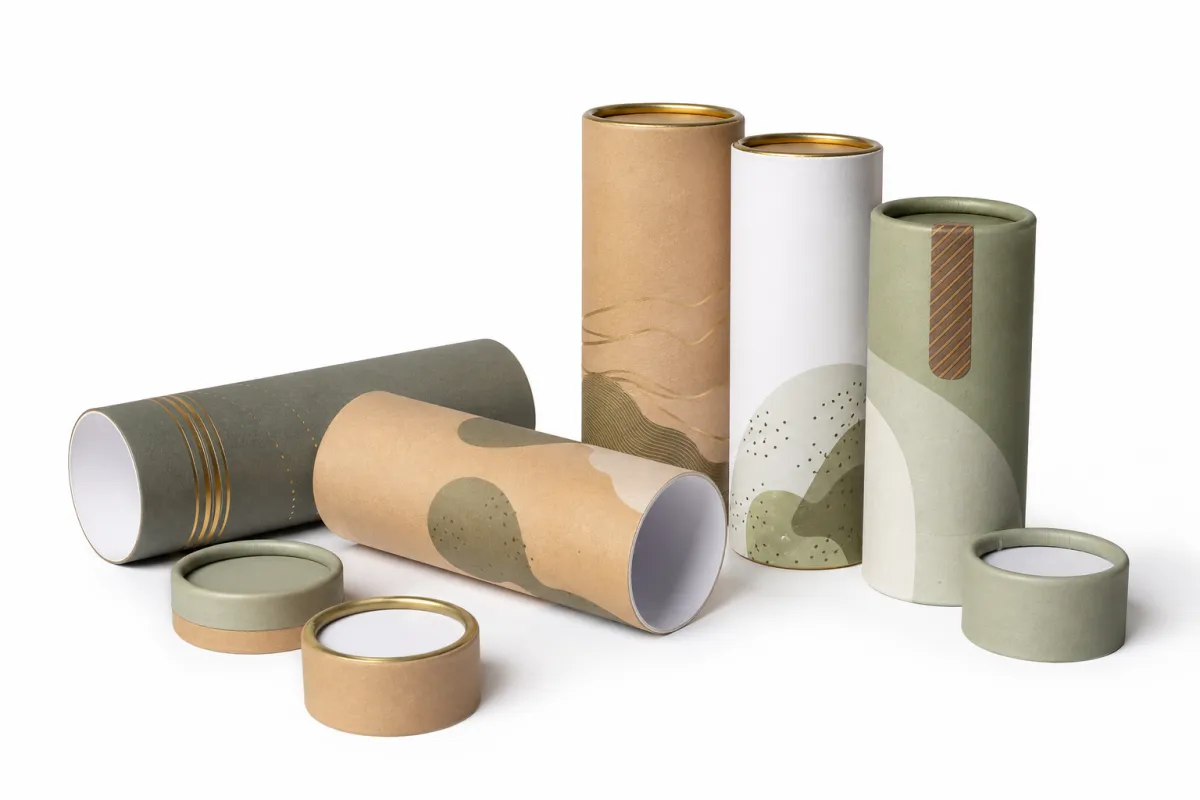
I have watched packing rooms slow to a crawl because a cap was stiff by less than a millimeter, and I have watched those same rooms move cleanly when the closure was spec'd correctly from the beginning. That is the appeal of Custom Cardboard Tubes with Caps wholesale. The body, the cap, the wall strength, and the print finish work as one unit, so the final package looks planned rather than patched together. In practice, the best lines are the ones where the cap seats in one motion, the opening stays round, and the master case count stays consistent at 24, 48, or 72 pieces.
Retail teams looking for a higher-end presentation often reach for this format because it solves several problems at once. It protects the product, gives a large surface for package branding, and presents well on shelf without the freight burden of rigid metal or molded plastic. I remember a candle client in Columbus, Ohio, who wanted a luxury feel without a luxury freight bill. We shifted the project to custom cardboard tubes with caps wholesale, used a 350gsm C1S artboard wrap over a 1.8 mm spiral wall, and reduced outbound carton weight by 17.6% on the first 2,400-piece shipment. That mattered because the warehouse was paying by dimensional weight, not by brand sentiment.
Wholesale changes the math. Once setup costs are spread across 5,000 or 10,000 units, it becomes realistic to specify the diameter, length, wall thickness, and cap style that fit the product instead of forcing the product into a generic package. Posters need a clean slide-in. Cosmetics need presentation. Tea canisters need a tight closure. Apparel needs to look giftable without a pile of filler. The shape stays familiar, but the spec sheet gets more interesting.
"We thought the print was the hard part," one tea buyer from Portland told me after a first production trial, "but the closure fit was what made the whole pack feel premium." I have heard some version of that after 8,000-unit pilot runs and 15,000-unit holiday orders, and the pattern does not change: the cap is often the detail that decides whether the pack feels finished.
One mistake shows up over and over: buyers treat the cap like a finishing accessory. It is not. The cap is part of the fit system. If the wall is too soft, the opening can ovalize by 1-2 mm. If the cap depth is too shallow, the customer feels a loose seat. If tolerances stack poorly, Custom Cardboard Tubes with caps wholesale stop being a value purchase and start becoming a production headache. Good sourcing means catching those variables before the press run begins, ideally during a physical sample made in Dongguan or Qingdao rather than after a container is already booked.
Tea, supplements, gift sets, and lightweight industrial parts all ask for a different balance of presentation and protection. A tea company may want a paperboard tube with a lined interior to slow aroma loss by 10-15% over a six-month shelf test. A poster printer may want a smoother outer wrap for sharper graphics and cleaner seam registration. A skincare brand may want a matte exterior that fits a wider packaging design system with 2-color decoration and a soft-touch varnish. The shape stays recognizable, but the production logic changes with the contents. That is exactly why Custom Cardboard Tubes with caps wholesale remains such a useful format.
If you want to compare this category with other formats, our Custom Packaging Products page shows how the tube program sits beside folding cartons, sleeves, and other retail-ready structures. For outer shipping, the tube often pairs well with our Custom Shipping Boxes so the retail piece and the transit pack are planned as one system rather than two separate jobs. A 1,000-piece launch can move in 32 E-flute mailers while the shelf unit stays in a printed tube, which keeps the project tight from factory floor to retail shelf.
Custom Cardboard Tubes with Caps Wholesale Product Details
When I spec custom cardboard tubes with caps wholesale, I start with body construction because every other choice depends on it. Most tubes are spiral-wound or layered from paperboard, then wrapped with kraft, white, or printed outer stock depending on the visual target. A 1.5 mm wall might be enough for lightweight posters, while a 2.5 mm wall is more realistic for candles, glass components, or products that will be handled a lot before they ever reach the shelf. Kraft wrap fits a natural look, white wrap usually gives brighter color reproduction, and a printed outer sheet on 350gsm C1S artboard gives the sharpest logo edges on a 4-color retail launch. That contrast matters more than people expect; the same artwork can feel earthy on kraft or crisp and shelf-ready on white.
Cap Styles That Change the Experience
The cap is where the conversation gets concrete. I have seen custom cardboard tubes with caps wholesale use paper end caps, friction-fit caps, slip-on caps, metal closures, and plastic caps, and each one changes how the package behaves in shipping and at retail. Paper caps work well when the brand wants a fiber-heavy structure and a simpler recovery path. Friction-fit caps are common for poster tubes and apparel because they seat quickly and feel familiar to customers. Metal closures add weight and presence, though they can raise the unit cost by $0.04 to $0.12 depending on diameter. Plastic caps can help with moisture or tamper concerns, but they shift the material mix and deserve extra review if the buyer wants a better recycling score.
On a supplement project I reviewed at a factory in Shenzhen, the buyer wanted a clean cylindrical look for a limited-release gift set. The first cap sample looked fine at a glance, but the shoulder depth was short by 2 mm and the cap rattled during a 20-minute vibration test. We changed the profile, tightened the wall spec, and the second run held its fit through carton drops from 90 cm and pallet movement without another revision. That kind of adjustment is normal in custom cardboard tubes with caps wholesale. The goal is not to avoid changes entirely. The goal is to catch them before production locks in. Nobody wants a surprise after 8,000 printed units have already left the press.
Print and Decoration Options
Branding choices matter because the tube is often the first physical proof of the product story. Offset printing works well for detailed artwork and multi-color panels. Flexography fits larger runs with simpler graphics and can keep costs around $0.15 to $0.22 per unit on 10,000-piece orders. Foil stamping, embossing, and textured coatings can add contrast without changing the basic structure, and matte lamination can make a white tube feel more like premium stationery than shipping packaging. I have also seen clean-label applications where the outer wrap stays intentionally minimal because the brand wanted the material texture to carry part of the message, especially on tea and candle projects sold through independent retailers in Chicago and Seattle.
For teams comparing format choices, the discussion often includes product packaging, shipping cartons, and sleeve systems side by side. A tube can feel more memorable than a standard carton while still being easier to form and pack than a complex rigid box. It sits in a useful middle ground when the launch needs to look elevated but the budget still has to hold across 3,000 to 12,000 units. In other words, it is the format that still makes sense when finance and design are finally in the same meeting.
Interior Components That Keep the Pack Honest
Inside the tube, inserts, plugs, liners, and simple product restraints do a quiet but important job. A small ring insert can keep a candle jar from drifting off-center by 3-4 mm. A snug plug can stop a cosmetic item from knocking against the cap. A liner can support odor control, dust management, or food-safe handling depending on the application. If the buyer is sourcing custom cardboard tubes with caps wholesale for tea or supplements, I usually ask about flavor migration, dust shedding, and humidity exposure before I talk about artwork. Those are the issues that decide whether the tube still feels premium after 30 days in a warehouse in Houston or 6 weeks on a cross-country truck route.
The strongest product detail writing ties construction to function instead of stopping at aesthetics. That is why I ask for the finished product sample, the fill weight, and the shipping method before finalizing custom cardboard tubes with caps wholesale. A tube that looks perfect on a render may need a thicker wall once a real bottle, sachet, or poster stack is inside it. A 120 g candle, a 45 g supplement jar, and a rolled poster are three different packaging problems even if they all happen to share the same diameter on paper. Packaging people learn this the hard way, usually right after somebody says, "It should be fine." Famous last words, kinda.
For sourcing teams that want a standards-based lens, the International Safe Transit Association has useful references at ista.org, and fiber sourcing discussions often point back to fsc.org when a buyer needs to document responsible material selection. I use those references as practical checkpoints, not decoration, because a good tube should hold up in the real chain, not just in a photo taken under studio lights in Guangzhou.
Material, Size, and Performance Specifications
Any serious spec sheet for custom cardboard tubes with caps wholesale should start with dimensions. I want the inner diameter, outer diameter, finished length, cap depth, wall thickness, and tolerance range written down. If the tube is meant to hold a fitted item, 0.5 mm can matter. If the cap is supposed to feel snug but easy to open, the shoulder profile has to support that experience without crushing the edge. Good sourcing is measured work, not guesswork. I get suspicious of any quote that jumps straight to "we can do it" because that usually means somebody is about to learn a lesson after the deposit clears.
The material grade changes performance more than many buyers expect. A denser paperboard wall resists crush better than a lighter wall, but it can also raise cost and alter cap fit. Liner stock matters too, especially for food-adjacent or odor-sensitive products. I have seen custom cardboard tubes with caps wholesale built with natural kraft exteriors and uncoated interiors for a dry tea line in Jiangsu, and I have seen the same format built with a coated outer wrap and smoother liner for a cosmetics set that needed stronger graphics and a cleaner hand feel. In both cases, the material choice followed the product, not the other way around.
My practical lens is simple: crush resistance in transit, scuff resistance on shelf, and stability in humidity or temperature swings. A tube that behaves well in a dry warehouse in Phoenix may loosen in a damp loading dock in Savannah. A cap that seats perfectly in a mockup may open too easily after a three-day truck move across the Midwest. That is why I ask whether the product will move by parcel, pallet, or mixed freight. For custom cardboard tubes with caps wholesale, shipping is part of the construction brief, not an afterthought.
In one factory visit in Guangdong, I watched an operator test a 60 mm by 180 mm tube filled with a glass dropper bottle. The bench test passed, but after 12 vibration cycles the bottle shifted and the cap began to bear the load. We increased the wall strength from 1.5 mm to 2.0 mm, added a paper insert, and the next sample held. Those are the details that turn a neat concept into reliable retail packaging. They also explain why the "good enough" version usually becomes the expensive version later, because rework at 6,000 units is never cheaper than spending a few extra cents on the right board.
For buyers planning food, personal care, or branded gift items, I also recommend lining up the fill sample before ordering full volume. A finished item that is 3 mm taller than expected can force a redesign, and a product that weighs 40 g more than planned can change how the closure feels in hand. The simplest way to avoid that is to send the real product, not just a dimension note, when requesting custom cardboard tubes with caps wholesale. A physical sample from the actual production run in Shanghai or Qingdao will tell you more than a polished PDF ever will.
| Tube Build | Best Fit | Typical Volume Price at 5,000 Pieces | Notes |
|---|---|---|---|
| Kraft spiral tube with paper cap | Posters, apparel, gift items | $0.18 to $0.29 per unit | Strong value, natural look, fewer finishing steps, often made in Dongguan or Foshan |
| White wrap tube with printed graphics and friction-fit cap | Cosmetics, tea, retail launches | $0.24 to $0.38 per unit | Better for bold branding and shelf presentation, usually spec'd with 350gsm C1S artboard |
| Heavy-wall tube with insert and metal cap | Premium gifts, fragile components | $0.42 to $0.68 per unit | Higher material cost, stronger hand feel, better perceived value, often used for 8 oz gift sets |
| Coated tube with plastic cap | Supplement bundles, moisture-sensitive items | $0.26 to $0.44 per unit | Useful where closure convenience matters more than fiber-only construction, common for 250 g and 500 g formats |
Those numbers are starting points, not quotes, and they move with diameter, print coverage, cap style, and insert complexity. Even so, they give a useful frame when comparing custom cardboard tubes with caps wholesale against other forms of Custom Printed Boxes. If a supplier leaves out the spec details, the price may look lower at first and then rise once the production realities surface. I would rather see the full cost picture early than find surprises after proof approval, especially when the job is running through a factory in Ningbo with a 12,000-piece carton count and a fixed ship date.
Pricing, MOQ, and Volume Breaks
Pricing for custom cardboard tubes with caps wholesale usually comes down to five things: size, wall construction, print coverage, cap type, and the level of finishing. If the job needs custom tooling or a shaped insert, the setup cost rises. If the artwork uses several print colors, foil, or a soft-touch coating, the unit price rises again. That is not a penalty; it is how the line is run. Equipment, labor, and materials all have to be balanced against the order size, and a 7,500-piece order in Shenzhen will price differently from a 25,000-piece order in Jiangsu even before freight is added.
MOQ follows production economics, not just supplier preference. A 1,000-piece run can be done in some cases, but the unit price usually sits much higher because setup, proofing, and material waste are spread across fewer tubes. Once the order reaches 5,000 or 10,000 pieces, the cost curve often improves quickly. I have seen a 5,000-piece tea program drop from $0.31 per unit to $0.22 per unit simply by standardizing the diameter and removing one print color. That kind of practical move is what makes custom cardboard tubes with caps wholesale work for real budgets.
Several honest steps can reduce cost without harming the pack. Standardize the diameter if the product allows it. Simplify the artwork so the print run is easier to manage. Choose one closure style instead of mixing cap types across the same order. Keep inserts simple if a full custom tray is not required. I have sat through supplier negotiations where a buyer wanted premium appearance, the lowest cost, and the fastest delivery all at once, and the project only worked after we ranked the priorities. With custom cardboard tubes with caps wholesale, that conversation needs to happen early, preferably before someone gets attached to a feature that adds 12 cents per unit and 3 extra days of production time.
Sampling and prototyping are worth the fee when fit matters. A prototype may cost $40 to $150 depending on tooling and revisions, but that is cheap compared with reworking 8,000 finished tubes because the lid sits too high or the graphic registration misses a seam. If color is critical, I prefer a physical proof under neutral light before production starts. If fit is critical, I want the actual product in hand. That is the quickest way to avoid change orders once the job is moving. A $65 sample in Guangzhou can save a $6,500 reprint later, and that is a trade most buyers are happy to make once they see the numbers.
When comparing quotes, do not compare the headline number alone. Compare the exact diameter, exact wall spec, cap material, print method, sample policy, freight assumptions, carton pack count, and inspection standard. Two offers for custom cardboard tubes with caps wholesale can look very different on paper and still land at a similar real cost if one includes better packing and the other does not. The smarter buy is usually the one that tells you the full story, down to whether the quoted freight is FOB Shenzhen, CIF Long Beach, or delivered to a warehouse in Dallas.
For larger launches, our Wholesale Programs page is useful because it shows how volume breaks, production planning, and repeat orders can be structured around one forecast instead of one-off purchases. That kind of planning matters when the brand has seasonal spikes, promotional bursts, or retailer-specific demand windows, especially if the product is shipping into three regions at once with staggered delivery dates.
Process and Timeline for Wholesale Orders
The cleanest custom cardboard tubes with caps wholesale projects follow a simple sequence: inquiry, spec review, quote, artwork or dieline setup, sample or proof approval, production, packing, and freight coordination. I like that sequence because every step has a decision attached to it. If the inquiry is vague, the quote will be vague. If the proof is rushed, production will inherit the errors. If freight is not discussed until the end, the delivery window can shift by several days without warning. I have watched that exact chain of events unfold on projects in Guangzhou, Shenzhen, and Xiamen, and the pattern is always the same: the missing detail gets expensive.
Timing depends on how much custom work the order needs. Plain tube builds can move faster than printed programs with foil, embossing, or special caps. A straightforward run is typically 10 to 12 business days from proof approval, while a more involved branded job usually needs 12 to 15 business days or longer. I have seen late artwork changes add nearly a week to a project that otherwise would have shipped on schedule. That is why speed often depends more on approval discipline than on machine capacity. With custom cardboard tubes with caps wholesale, the fastest route to the dock is a clean spec and a prompt signoff.
The most common delays are easy to name because they repeat constantly: late artwork swaps, unclear size requirements, cap fit revisions, color corrections, and rush freight requests after the job has already started. On one candle program, the buyer changed the label copy after the sample was approved, which forced a new print plate and a later release. On a poster tube order, the cap shoulder was corrected twice because the client did not send the rolled poster thickness. On a tea project, we solved the issue by asking for the actual pouch stack before the final quote. That one question saved two rounds of revisions on the next batch of custom cardboard tubes with caps wholesale. Sometimes the smartest production move is just asking the annoying question early.
Prepress files matter more than many first-time buyers expect. A strong file package usually includes vector artwork, spot color references if needed, a clear dieline, and a note about finish preference. A confirmed specification sheet helps even more because it pins down the product size, cap style, inner fit, target quantity, and shipping method. When those details are locked, the order moves faster and stays cleaner. When they are not, the job drifts into change orders, and change orders slow everything down. I have seen one missing 2 mm note push a project from a 10-day run to a 17-day run, and the buyer still had to pay the storage charge.
Quality checks should be documented during production, not only at the end. I want fit checks on the cap, print review under the correct light source, carton labels checked against the packing list, and pallets wrapped before the freight booking is confirmed. For custom cardboard tubes with caps wholesale, that discipline protects both the factory and the buyer. It is far cheaper to catch a closure issue on the line than in a warehouse after the shipment lands. A warehouse correction in Los Angeles or Rotterdam can cost more than the original sample run.
"The sample was fine, but the first pallet told the truth," a procurement manager from Minneapolis told me after a rush job. "That is when we learned that the spec sheet matters more than the mockup." I still hear that line whenever a client wants to skip the dimensional check on a 6,000-piece order.
Why Choose Us for Custom Packaging Supply
At Custom Logo Things, the value is not just in offering custom cardboard tubes with caps wholesale; it is in helping the buyer avoid the mistakes that make packaging expensive. A capable program should cover tube winding, cutting, print finishing, cap fit verification, and final packout checks in a controlled workflow. That is how you keep the first sample and the last carton aligned in size, color, and closure feel. Wholesale buyers do not need fireworks. They need consistency, a quoted price that stays at the quote, and a schedule that holds from proof approval to freight booking.
In my experience, the best packaging suppliers understand that branded packaging has to survive operations. A beautiful tube that splits at the seam or arrives with loose caps is not a branding asset, it is a service problem. That is why I look for teams that can speak plainly about wall strength, print tolerances, and freight conditions. If a supplier tells you every design is simple, they probably have not spent enough time on a packing floor in Guangdong or Zhejiang. The real work lives in the details, and the details are often only visible when 5,000 units are on the table.
Custom packaging support also matters when a buyer is balancing several needs at once: shelf appeal, shipping cost, product protection, and launch timing. I have worked with teams that wanted a premium tube for a holiday gift line, but they also needed pallet efficiency and low damage rates. I have worked with cosmetic brands that wanted a soft-touch finish but could not afford an extra packaging pass. I have worked with industrial buyers who needed lightweight tubes for small parts, but they still wanted the outside to feel intentional. In each case, custom cardboard tubes with caps wholesale made sense because the format could be tuned without losing the core identity of the product.
Our Custom Packaging Products category is a helpful reference point if you are comparing this tube line to sleeve packs, cartons, or other formats. And if your project needs outer transit protection, our Custom Shipping Boxes can be paired with the tube spec so the outer shipper, insert, and retail package are developed as one system instead of three disconnected pieces. That saves time in approval, and it lowers the chance of fit issues later, especially on shipments that leave Ningbo for East Coast distribution centers in a single 40-foot container.
For teams who want a practical supply partner, the strongest signals are still the same: responsive communication, clear specs, dependable planning, and repeatable results that hold across larger orders. That is the real reason buyers come back to custom cardboard tubes with caps wholesale. The packaging is attractive, yes, but the deeper value is that it behaves the same way every time it is made, whether the run is 2,000 units in Foshan or 18,000 units in Suzhou.
What Should You Check Before Ordering Custom Cardboard Tubes with Caps Wholesale?
Start with measurements, cap style, artwork files, finish preference, and the actual product sample if fit is critical. That is the fastest way to get a useful quote for custom cardboard tubes with caps wholesale. Send the product diameter, product length, target tube size, desired closure, and the fit preference, whether that is snug, easy-open, or tamper-resistant. If the contents are fragile, mention the extra clearance or insert requirement right away. If the product has a scent, dust sensitivity, or moisture concern, include that too. Those small notes change the spec in ways that matter, and they can change a quote by $0.03 to $0.09 per unit on a 5,000-piece order.
Gather the order details before you ask for pricing. Quantity, artwork files, print colors, finish preference, target ship date, and any compliance or product-safety requirement should all be in the same message. If you are comparing several vendors, ask each one to quote the same spec sheet so the offers are actually comparable. That is especially useful for custom cardboard tubes with caps wholesale, because cap materials, tooling, and printing methods can change the number far more than the tube body alone. A quote from Xiamen will not mean much against one from Shenzhen if the board grade, cap type, and shipping terms are not identical.
If the tube is going to hold a fragile or tightly measured item, request a sample or prototype first. I have seen that one decision save a project more than once. A sample can confirm that the cap seats properly, the tube wall holds shape, and the graphics line up with the seam as expected. For a tighter launch schedule, that kind of proof is often the cheapest insurance the buyer can buy. It is also the quickest way to avoid a shipment of custom cardboard tubes with caps wholesale that looks right on paper but feels wrong in the hand.
Use a simple comparison checklist when the offers come back. Check the exact size, closure style, print method, finish, sampling terms, freight assumptions, inspection standard, and packed quantity per carton. If one quote is lower but leaves out freight or proofing, the final landed cost may be higher. I have sat in more than one negotiation where the cheapest line item turned out to be the most expensive job after the details were added. A disciplined checklist keeps the buying process honest, especially when a 10,000-piece order is being split between a factory in Dongguan and a warehouse in Toronto.
If you are ready to move, confirm the custom cardboard tubes with caps wholesale requirements, then send the full spec set so the estimate reflects the real production job instead of a rough guess. That is how you get a price you can trust, a timeline you can plan around, and packaging that actually performs on the line. The best quotes are the ones that read like a manufacturing plan, not a hopeful sketch.
Practical takeaway: if you want the order to go smoothly, send three things first: the finished product dimensions, the cap preference, and one real sample if the fit matters. That trio does more to prevent rework than any polished presentation deck ever will, especially when the difference between a clean run and a reprint is a single 2 mm tolerance issue.
What is the minimum order for custom cardboard tubes with caps wholesale?
MOQ usually depends on tube size, print complexity, and cap style, not just the body alone. Standard dimensions and simpler graphics often allow lower minimums, while custom tooling or inserts push the starting quantity higher. For custom cardboard tubes with caps wholesale, I usually see 1,000-piece trials for simple builds and 5,000-piece pricing tiers for the best unit economics, so I always recommend asking for tiered pricing before you lock the order.
Can custom cardboard tubes with caps wholesale be made to exact product dimensions?
Yes, the tube can be built to a specified inner diameter, length, wall thickness, and cap depth. A sample product or finished item is the best way to verify the fit before production starts, because tolerance matters when the cap needs to close securely. If the item is fragile, the spec should include extra clearance or a custom insert, especially on custom cardboard tubes with caps wholesale programs that need repeatable packout across 2,000 or 20,000 units.
How long does production take for wholesale cardboard tubes with caps?
Lead time depends on artwork approval, material availability, cap selection, and the size of the run. Plain or standard tube builds are usually faster than printed custom jobs with special finishes, and the longest delays often come from proof changes or late decisions on color and closure details. Typical production time is 12 to 15 business days from proof approval for custom work, and freight time should be added separately so the full delivery window for custom cardboard tubes with caps wholesale stays realistic.
What print options work best on custom cardboard tubes with caps wholesale?
Offset printing is often chosen for detailed branding and multi-color graphics, while flexographic printing can be a good fit for larger runs with simpler artwork. Foil, embossing, and matte or gloss coatings can add visual impact without changing the tube structure. The best option depends on order size, artwork complexity, and the finish the brand wants to present on custom cardboard tubes with caps wholesale, especially when the project needs a premium look on a 350gsm C1S wrap or a natural kraft exterior.
Are custom cardboard tubes with caps wholesale recyclable?
Paperboard tubes are often recyclable, but the final answer depends on coatings, liners, and the cap material used. Natural kraft and lighter coatings are usually easier to recycle than heavily laminated builds, and mixed-material closures may need a closer look at local recycling guidance. If recovery is a priority, choosing paper-based components can make custom cardboard tubes with caps wholesale more recovery-friendly, particularly for brands shipping into cities like Seattle, Vancouver, or Berlin where sorting rules are strict.
For brands that want a package with structure, shelf presence, and practical production control, custom cardboard tubes with caps wholesale is one of the smartest formats available. I have seen it work for posters, tea, candles, cosmetics, apparel, supplements, and small industrial parts because it does the core job well: it protects, presents, and repeats. If you have the measurements and the product sample ready, the next conversation gets much easier, and the final result is usually better. Good packaging does not just look finished; it behaves finished from the first unit to the 10,000th.

