Buyer Fit Snapshot
| Best fit | Custom Cardboard Tube Packaging Wholesale projects where brand print, material claims, artwork control, MOQ, and repeat-order consistency need to be specified before quoting. |
|---|---|
| Quote inputs | Share finished size, material target, print colors, finish, packing count, annual reorder estimate, ship-to region, and any compliance wording. |
| Proofing check | Approve dieline scale, logo placement, barcode or warning zones, color tolerance, closure strength, and carton packing before bulk production. |
| Main risk | Vague material claims, crowded artwork, missing packing details, or unclear freight terms can make a low unit price expensive after revisions. |
Fast answer: Custom Cardboard Tube Packaging Wholesale: Specs & Pricing should be specified like a repeatable production item. The safest quote records material, print method, finish, artwork proof, packing count, and reorder notes in one written spec.
Production checks before approval
Compare the actual filled-product size with the drawing, then confirm tolerance on folds, seals, hang holes, label areas, and retail display edges. Reserve space for logos, QR codes, warning copy, and material claims before decorative graphics fill the panel.
Quote comparison points
Review material grade, print process, finish, sampling route, tooling charges, carton quantity, and freight assumptions side by side. A quote is only useful when the supplier can repeat the same color, closure quality, and packing count on the next order.
The first time I watched a pallet of 90mm x 250mm tube-packed posters survive a rough dock transfer in Ningbo, I remember waiting for the damage report that never came. The square cartons beside it split at the corners while the round loads stayed intact after a 1.2-meter forklift drop test. The contrast was almost funny, if you enjoy watching packaging prove a point with no subtlety at all. One stack looked tired before it had even reached the truck; the other kept its shape as if the route from Zhejiang to the warehouse had barely happened. That is the kind of test that explains why custom cardboard tube packaging wholesale keeps showing up in serious buying plans: the structure is simple, the protection is real, and the presentation looks deliberate before anyone opens the shipper.
Buyers often underestimate tubes because they read as plain on a sample table. I get it. A tube sounds like the kind of thing you would use for a school project, not a fragrance launch or a limited-edition art print run. The numbers usually correct that impression. On a 5,000-piece order, damage claims can fall from 3.2% to under 1%, pack-out can move 18% faster, and the printed surface can carry full-wrap branding that a flat mailer simply cannot. For teams comparing custom cardboard tube packaging wholesale against other product packaging options, the real question is not whether the tube looks pretty. It is whether the item survives handling, whether the print space earns its keep, and whether the order still protects margin after freight, labor, and rework enter the picture.
Factory floors in Dongguan, client meetings in Shanghai, and supplier calls across Suzhou tend to produce the same lesson, which is a little annoying because it means everybody has to learn it the hard way. Buyers who define dimensions carefully, Choose the Right board grade, and ask for line-item pricing usually get cleaner results. Buyers who say “make it look nice” tend to pay for that vagueness later. Custom cardboard tube packaging wholesale works best when the spec is exact and the goal can be measured in defects, freight performance, and conversion value. Honestly, that is what separates a packaging purchase from a packaging headache.
Why Custom Cardboard Tube Packaging Wholesale Works
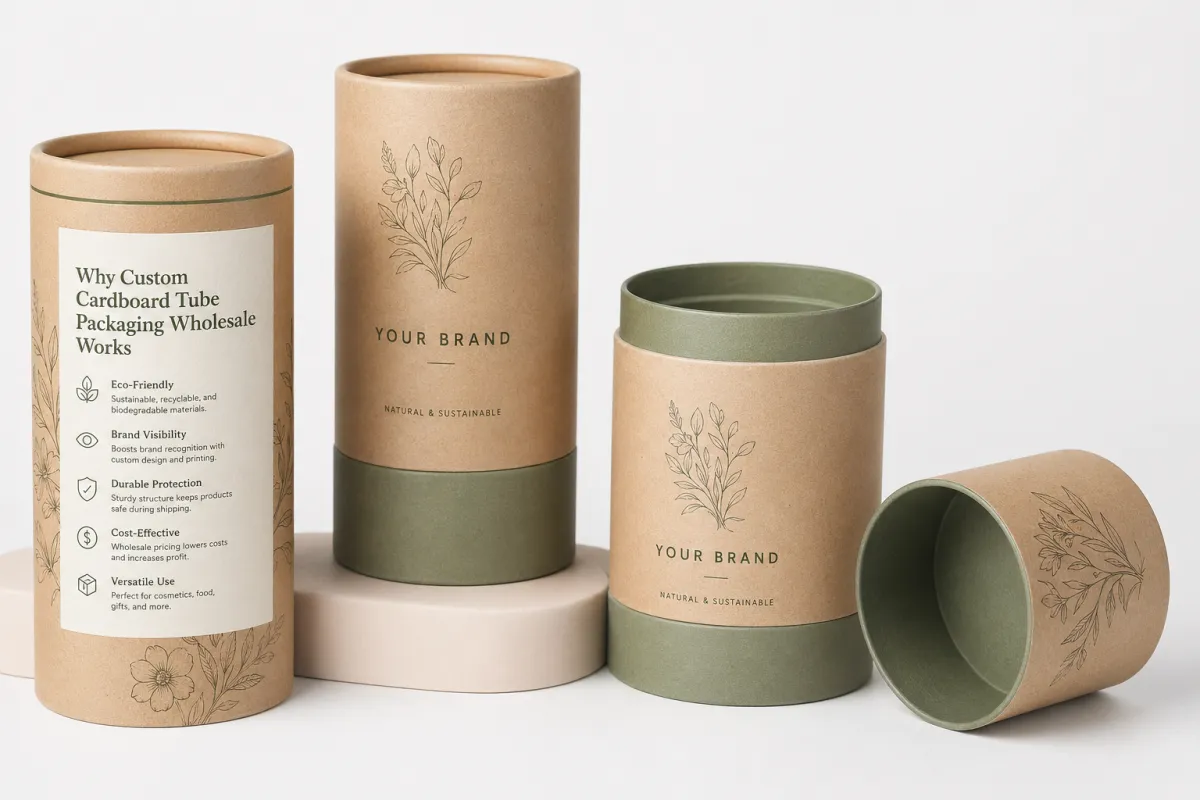
Round tubes distribute pressure differently from square cartons. A box takes its first hit at the corners; a tube sends the force across the wall. I saw that pattern up close on a fulfillment line in eastern China, where a cosmetics client in Guangzhou was losing gift sets in transit on the Shenzhen-to-Hong Kong corridor. The rigid cartons looked better in theory, yet the tubes handled compression more cleanly when pallets were stacked three high and wrapped with 3mm stretch film. One switch cut the damage rate enough to pay for itself inside a single reorder cycle that moved 12,000 units. I still remember the operations manager looking at the returns pile like it had personally offended him.
Custom cardboard tube packaging wholesale solves another problem brands rarely discuss openly: consistency. A retail program with six SKUs needs packaging that arrives looking the same in February, July, and November, not one batch with a slightly warmer white and another with a lid that sits 2mm high. A tube with steady print registration, a controlled diameter, and repeatable closure tolerance keeps the visual story stable. That is the quiet strength of custom cardboard tube packaging wholesale; it protects the margin story and the brand story at the same time. When a package keeps behaving the same way, everybody downstream stops improvising, which is a bigger win than most teams admit out loud.
The product categories that benefit most are easy to spot. Posters and art prints need rigidity. Candles need a premium silhouette and shelf appeal. Tea and supplements need clean labeling and room for compliance copy. Apparel accessories, perfume samplers, and premium mailers often need a structure that feels more intentional than a basic mailer. I have seen custom cardboard tube packaging wholesale work especially well for branded packaging programs where the unboxing moment matters almost as much as transit protection. If your package has to do two jobs, tubes are often the least fussy way to get both done.
I still see teams compare tubes to folding cartons too early. If you are also reviewing Custom Shipping Boxes or other formats, stack the options against damage claims, pack speed, and print real estate, not unit price alone. A cheaper box that needs two extra sheets of tissue paper and a 0.5mm insert can cost more in labor than a properly sized tube that drops straight into the fulfillment line. That is one reason custom cardboard tube packaging wholesale stays competitive even when the board grade moves upward. I have watched a “cheap” solution turn expensive by lunchtime, which is a special kind of corporate comedy.
“We stopped treating packaging as a line item and started treating it as a shipping control,” one operations manager told me after a launch in Rotterdam that had been bleeding refunds at roughly $4,800 a week. “The tube paid for itself in two months because the returns stopped.”
That comment matches what I have seen in retail packaging reviews from Melbourne to Minneapolis. Once the structure is right, the whole process gets calmer. Fewer crushed edges. Less rework. Better display value. Custom cardboard tube packaging wholesale is not the flashiest option in the room, but it is often the most practical one. And practical, in packaging, usually means profitable by the third reorder, not just the first sample.
What Is Custom Cardboard Tube Packaging Wholesale?
Custom cardboard tube packaging wholesale is bulk-made paper tube packaging built to a brand’s exact size, print, and finish requirements. In plain terms, it is a rigid paperboard tube designed for shipping, display, or gifting, then ordered in volume so the per-unit cost drops as quantity rises. That makes it useful for Product Packaging That needs structure, branding, and repeatability in the same format.
The wholesale part matters because setup costs spread across a larger run. A 500-unit pilot and a 10,000-unit production order may use the same spiral-wound tube structure, but the economics change fast once the press, tooling, and finishing work are divided across more pieces. For brands comparing retail packaging formats, custom cardboard tube packaging wholesale often delivers a better balance of durability and presentation than a basic folding carton.
It is also a flexible format. A tube can hold art prints, tea, candles, cosmetics, or premium mailers, and it can be built with kraft paper, printed wraps, inserts, or barrier liners depending on the product. That range is what makes custom cardboard tube packaging wholesale useful for both everyday fulfillment and higher-end launch programs.
In practice, buyers usually care about three things: how the tube performs in transit, how it looks in a retail setting, and how often the supplier can repeat the same result without drama. The last part gets ignored too often. A beautiful sample is one thing. A thousand identical tubes with no lid wobble and no color drift is the real test. That is where wholesale manufacturing earns its keep, and why some packaging programs feel calm while others feel like a weekly rescue operation.
Custom Cardboard Tube Packaging Wholesale Product Details
A tube is not just a rolled sheet with a cap on it. The stronger programs use a rigid paperboard wall, a controlled inner liner, and an end closure matched to product weight. Depending on the use case, custom cardboard tube packaging wholesale can include telescoping construction, fixed-length bodies, fitted plugs, paper caps, metalized lids, or kraft shoulder wraps for premium gifting. A 100mm x 200mm tube for candles will not be built the same way as a 70mm x 300mm poster tube, and that difference matters on the line. I have a soft spot for simple structures that do more than they appear to do; tubes fit that category neatly.
For lower-cost runs, kraft finishes are common because they read cleanly and hide scuffs better than bright white surfaces. For retail packaging, wrapped paperboard with a printed outer layer gives tighter control over color and texture. I have watched buyers spend an extra $0.08 to $0.14 per unit just to move from a plain label to a full-wrap print surface, and that move made sense because the product sat beside higher-end competitors in stores in Seoul and Singapore. That is the kind of trade-off custom cardboard tube packaging wholesale should support. Not every extra dollar is waste. Sometimes it is the price of not looking like the bargain shelf no one wanted to stand near.
Branding options vary more than most people expect. Offset printing tends to suit larger runs with strong color consistency, especially on 8,000-unit and above orders. Digital printing gives smaller orders more flexibility and is useful for 500 to 2,000 sample or pilot runs. Foil stamping, embossing, matte lamination, gloss lamination, and spot UV all change the final feel. If you are building package branding for a launch, the tube surface can carry more visual weight than a small carton panel, which makes custom cardboard tube packaging wholesale useful for both display and shipping programs. I would rather have one strong visual surface than three mediocre ones fighting each other.
The interior matters too. Some tubes use a plain liner; others need a moisture-resistant coating, a food-safe barrier, or an insert that keeps the item centered. Tea canisters may need an inner liner to control aroma and humidity for 30 to 60 days on shelf. Cosmetics may need a separator so the bottle does not rattle during courier transit. Supplement brands may want a tighter seal and a tamper-evident approach. I have seen one buyer switch from a generic liner to a fitted insert and cut breakage from 3.4% to under 1% across a repeat run of custom cardboard tube packaging wholesale. Three-point-four percent may not sound dramatic until you multiply it by 40,000 units and realize you are financing a tiny disaster.
If you are comparing formats, our Custom Packaging Products page is useful for seeing how tube packaging fits alongside other structures. The best packaging design choices usually happen when the tube is compared with the rest of the line, not treated as a standalone decision. Custom cardboard tube packaging wholesale is strongest when it is planned as part of the full product packaging system, from shelf-ready display to final carton count. That broader view matters more than most teams think, especially once reorders begin in month two or month three.
For larger programs, the tube build can also be tuned to the market. A fragrance tube for gifting in Dubai might use a soft-touch wrap and gold foil accent. A poster tube for a gallery run in Berlin might use a heavy kraft body with a simple one-color logo. A tea brand in Toronto might choose a matte wrap with a food-contact insert. That is the practical appeal of custom cardboard tube packaging wholesale: the structure stays stable while the finish shifts with the brand. It is a surprisingly elegant kind of flexibility, especially when the SKU count climbs past eight.
Custom Cardboard Tube Packaging Wholesale Specifications
The clearest spec sheet is the one that leaves no room for guesswork. Buyers should confirm diameter, height, wall thickness, board grade, closure type, print coverage, finish, and any barrier requirement before asking for a final quote. For custom cardboard tube packaging wholesale, the difference between 60mm and 65mm in diameter can decide whether the product fits without filler or rattles in transit. Five millimeters sounds tiny until a shipment is bouncing around in the back of a truck on the way from Shenzhen to Guangzhou.
I once sat with a tea buyer who sent “tube size needed” but never defined the inner diameter. The supplier quoted against the outer size, the lids were off by 4mm, and the whole schedule slipped by nine business days. That was not a packaging failure; it was a spec failure. Custom cardboard tube packaging wholesale rewards buyers who treat dimensions like a contract, not a suggestion. The machine cannot read minds, no matter how many meetings you schedule or how polished the slide deck looks.
Wall thickness matters just as much. A 1.5mm tube wall may work for lighter retail items, while 2.5mm or 3mm makes more sense for heavier, high-value products. If the tube must survive rough handling, ask for the board grade in writing and make sure the closure is tested against the product weight. I usually recommend a small tolerance so the item fits securely without too much void fill. That balance helps custom cardboard tube packaging wholesale stay efficient on the packing line. Too loose, and the item rattles like a tiny maraca. Too tight, and the packers start inventing new words.
- Diameter: confirm inner and outer dimensions separately.
- Height: include the finished height, not just the body length.
- Wall thickness: specify 1.5mm, 2.0mm, 2.5mm, or 3.0mm as needed.
- Board grade: request the exact paperboard or spiral-wound construction.
- Closure style: paper cap, metal lid, telescoping top, or plug.
- Print coverage: full-wrap, partial, label-applied, or logo-only.
- Compliance: food-safe, FSC-certified, or moisture-resistant if needed.
Sampling files matter as well. Send a dieline if the packaging is new, artwork in editable format, a Pantone reference if color is critical, and a physical sample if you are matching an existing tube. For regulated categories, note whether the product needs food-contact consideration or a material declaration. If the tube is part of a larger launch, connect the spec to the broader custom cardboard tube packaging wholesale program so every SKU shares the same production logic. That keeps one department from quietly changing the rules on everybody else, which happens more often than anyone wants to admit.
For buyers comparing board sourcing or chain-of-custody requirements, the FSC framework is a useful reference point. For shipments that must hold up under distribution stress, I also look at ISTA testing methods. Those standards do not replace good design, but they give the team a language for risk. That is useful when custom cardboard tube packaging wholesale has to move from a prototype in Dongguan to a repeatable program in North America or Europe.
One more practical point: tighter tolerances usually cost more, but they can save money in fulfillment. If the spec is too loose, the packing line burns time on inserts and extra tissue. If the spec is too tight, rejections rise and the rework bin fills fast. The best custom cardboard tube packaging wholesale orders land in the middle, where fit, cost, and speed all stay under control. That middle ground is not glamorous, but it is where operations teams actually sleep at night.
And yes, there are times when a rougher spec is fine. If you are sending a low-value poster insert to a trade show, you probably do not need a premium closure system or a three-layer insert. If you are shipping a candle collection to retailers with strict damage policies, you absolutely do. The trick is matching the engineering to the risk, not padding the quote because it sounds safer. That is where a little experience saves a lot of money.
Custom Cardboard Tube Packaging Wholesale Pricing and MOQ
Pricing moves with size, board grade, print complexity, finishing, insert requirements, and freight. A small kraft tube with one-color print is a different order from a full-wrap premium retail tube with foil and soft-touch lamination. That is why custom cardboard tube packaging wholesale should never be quoted as one flat number without context. Flat numbers are usually where trouble hides, especially when the carton is shipping from Shenzhen and the buyer expects Chicago delivery by Friday.
For a 5,000-piece run of a simple 90mm x 250mm kraft tube with one-color branding, I have seen pricing land around $0.15 to $0.38 per unit before freight, depending on board thickness and closure style. For 10,000 pieces, a premium retail version with full-color wrap, foil, and an insert can move into the $0.79 to $1.35 range. Those are not promises; they are the kind of numbers that make planning possible when custom cardboard tube packaging wholesale is being compared against other product packaging formats. I like ranges like this because they force everyone to think instead of daydreaming about impossible savings.
| Tube Type | Typical MOQ | Typical Unit Price | Best Use | Notes |
|---|---|---|---|---|
| Kraft spiral-wound tube | 3,000-5,000 pcs | $0.15-$0.29 | Posters, apparel accessories, mailers | Low decoration, faster setup, lower risk |
| Printed retail tube | 5,000-8,000 pcs | $0.39-$0.74 | Tea, cosmetics, candles, gifts | Better shelf appeal, more print control |
| Premium tube with foil and insert | 8,000-10,000 pcs | $0.79-$1.35 | Luxury sets, seasonal campaigns | Higher setup cost, stronger retail impact |
| Food-contact or barrier-lined tube | 5,000-10,000 pcs | $0.26-$0.52 | Tea, supplements, dry goods | Requires material confirmation and testing |
MOQ changes with production method. Digital print usually supports smaller runs because setup is lighter, while offset and wrapped finishes need enough volume to spread tooling costs. If you want to compare small-run and full wholesale options, our Wholesale Programs page shows how repeat orders often improve the unit economics. That is a major reason custom cardboard tube packaging wholesale becomes more attractive after the first launch cycle. The second order is usually where the math stops pretending and starts cooperating.
Ask for quotes in a line-by-line format. Unit price, sample cost, setup fees, freight estimate, and timeline impact should all be separate. I learned that lesson during a supplier negotiation where the headline quote looked sharp, but the “extra” print plate, lid tooling, and freight insurance were buried in the margin. By the time those were added, the true cost was 17% higher. Custom cardboard tube packaging wholesale only helps margins when the buyer can see the full stack of costs. Hidden line items are where optimism goes to die.
Shipping distance matters too. A carton-style pack might be lighter, but a well-sized tube can reduce dimensional waste and cut filler material. That means the savings may show up in packing labor rather than in the box price. If your tube replaces a heavier Custom Printed Boxes program or trims damage claims, the business case gets stronger. In my experience, custom cardboard tube packaging wholesale often wins by improving total cost, not just carton cost. That distinction is easy to miss and expensive to ignore.
There is also a timing cost that buyers forget to price. A low MOQ can look attractive, but if the run is too small, the per-unit cost spikes and the next reorder arrives with a different shade or closure batch. A larger wholesale run can reduce those swings, which is why some teams choose to produce enough inventory for two launch cycles at once. It is not always the right move, but it is worth modeling before you pick the cheapest headline quote and hope the rest sorts itself out.
Custom Cardboard Tube Packaging Wholesale Process and Timeline
The cleanest ordering path is simple: request quote, confirm spec, review dieline, approve sample, move to production, then inspect and ship. Custom cardboard tube packaging wholesale gets delayed when any one of those steps is vague. A buyer who approves artwork before the size is locked creates rework before the machine even starts. I have seen that happen more than once, and yes, it always feels avoidable after the fact.
For a basic order, I would expect sampling in 5 to 7 business days, prepress checks in 1 to 2 days, production in 12 to 15 business days after proof approval, and freight depending on destination. More complex jobs with foil, embossing, or special coatings can stretch to 18 to 25 business days. That timeline is realistic, and it gives teams enough room to plan launch windows around custom cardboard tube packaging wholesale without pretending shipping is instant. I wish packaging could move at the speed of a mood board, but it simply does not.
What slows projects down most? Unclear dimensions, late artwork changes, and missing compliance notes. A food brand that forgets to define barrier requirements can lose a week to spec review. A cosmetics brand that changes Pantone targets after the sample is approved can restart color matching. I have seen one launch slip because the buyer sent vector art in the wrong color mode and did not realize the print file was flattened. That is avoidable. Good custom cardboard tube packaging wholesale projects are won in proof review, not in the apology email afterward.
Use the production schedule to separate the work into parts. Sampling is for fit and closure. Prepress is for artwork and color checks. Manufacturing covers body forming and printing. Finishing adds lamination, foil, or inserts. Freight is the last variable, and it should never be guessed. If the cargo needs to survive long-haul distribution from Guangdong to the U.S. West Coast, I ask whether the team wants packaging verified against ISTA methods or a similar transport test profile. That question often saves the buyer from a quiet but expensive surprise later. It also keeps custom cardboard tube packaging wholesale aligned with actual shipping conditions instead of wishful thinking.
I visited a plant in Foshan where the operator could build 8,000 plain tubes a day, but the output fell by nearly a third once the line added foil-stamped lids and a tight insert spec. The buyer had not budgeted for that slowdown, so the schedule became the issue, not the packaging itself. That is the kind of detail most sales decks ignore. In custom cardboard tube packaging wholesale, production speed is tied to decoration complexity, not just to the shape of the package. Shape matters, but process matters more than the brochure would like to admit.
There is a simple sanity check I use with teams: if the sample stage feels rushed, production will feel worse. The best launches I have seen had one thing in common. Somebody slowed the process down just long enough to confirm fit, print, and freight assumptions. That tiny pause saved the kind of money that never shows up on a design mood board, but absolutely shows up in a finance report.
Why Choose Us for Wholesale Tube Packaging
Buyers do not stay with a supplier because of a glossy pitch. They stay because the supplier answers spec questions quickly, catches mistakes before production, and keeps repeat orders consistent across a 3,000-piece pilot and a 30,000-piece reorder. That is the standard I would want for any custom cardboard tube packaging wholesale program. The value is not hype. It is predictable output, measured against the same drawing, the same board grade, and the same finish every time.
At Custom Logo Things, the advantage is practical support around the details that drive cost. If a buyer sends a vague size, we push for the inner and outer dimensions. If the artwork file is risky, we flag the issue before it hits the press. If the closure style will add tooling, we say so early. That kind of review saves money because mistakes in custom cardboard tube packaging wholesale usually show up after the order is already locked. Nobody wants the “surprise” phase of a packaging launch, especially when the freight is already booked from Shenzhen to Los Angeles.
I once watched a supplier agree to a faster lead time simply because the buyer did not understand the impact of a soft-touch wrap and a 2-color foil pass. The result was a rushed press run and a color shift that neither side liked. A broker-only model might have hidden that risk behind a lower quote, but the problem would still exist. In-house support is better when the customer needs straight answers on tooling, lead time, or freight planning. That is why custom cardboard tube packaging wholesale programs work best with direct production oversight and not just sales promises. Straight talk saves more money than cheerful guessing ever will.
Consistency matters on reorders. A first run can be forgiven for a little learning curve. A second or third run cannot. When the color drifts, the lid fit changes, or the print registration wanders, the brand pays for the inconsistency. If the buyer is also standardizing Custom Packaging Products across multiple lines, the supplier must keep the tube spec stable enough to fit a broader package branding strategy. That is where custom cardboard tube packaging wholesale becomes a repeatable asset rather than a one-off buy.
The strongest programs also include sample support and color matching. A small proof can reveal if the finish is too matte, if the lid is too loose, or if the wrap is stretching around the seam. I would rather catch a 2mm visual shift on a sample than on 20,000 finished units. For brands that care about retail packaging, that level of control is not a luxury; it is a safeguard. And it is exactly what custom cardboard tube packaging wholesale should provide.
One more comparison helps. If your product needs a hybrid solution, we can align tube packaging with Custom Shipping Boxes so the outer carton, inserts, and tube all work as one system. That matters in subscription kits, promotional bundles, and premium mailers. The more coordinated the packaging design, the fewer surprises in fulfillment. In my experience, the best custom cardboard tube packaging wholesale partner is the one that thinks beyond the tube itself and considers the carton count, pallet pattern, and retail shelf impact together.
That is especially true for brands that are moving from local fulfillment to international distribution. A package that survives one courier network in one city can still fail once the pallet pattern changes, the humidity shifts, or the route adds another transfer point. Good suppliers ask about those variables early. Great ones ask before the buyer has thought to mention them. That kind of attention is not glamorous, but it saves real money.
What to Do Before You Request a Quote
If you want a faster and more accurate quote, gather the basics first: product dimensions, target quantity, artwork files, preferred finish, closure style, and shipping destination. That small amount of prep can save several back-and-forth emails and a lot of avoidable correction work. For custom cardboard tube packaging wholesale, the quote is only as good as the spec behind it. If the spec is vague, the number will be vague too, and that is how budgets start drifting.
Here is the list I recommend sending in one clean file, not spread across six messages:
- Inner diameter, outer diameter, and finished height
- Product weight and whether the item is fragile, food-contact, or moisture-sensitive
- Closure preference, such as paper cap, plug, telescoping lid, or metal top
- Artwork files in editable format, plus Pantone references if color matters
- Target quantity, reorder forecast, and any launch deadline
- Shipping destination and whether the route is domestic, air freight, or ocean freight
- Any matching sample, photo, or existing packaging reference
The reason I insist on all of that is simple: packaging is built from trade-offs. If you want premium print, you may need a slower run. If you want faster production, you may need to simplify the finish. If you want a tighter fit, you may need to adjust the insert. There is no magic switch, and anyone who says otherwise is usually selling something. Custom cardboard tube packaging wholesale works best when the team accepts that reality early and designs around it.
One honest caution: not every product should go in a tube. Heavy, square, or oddly shaped items may do better in a different structure, and a tube can be a poor fit if the contents need a broad flat display face. I would rather say that plainly than pretend tubes solve every packaging problem on earth. They do not. What they do well, they do very well, and that is enough for a lot of brands.
Before you send a request, check the inner diameter against the product’s widest point, not the prettiest point in the design. That is the detail people miss. A tube that looks perfect on paper can still fail because the closure eats up a few extra millimeters or the insert compresses more than expected. Fixing that early is cheaper than fixing it after production. If you remember only one thing, make it this: custom cardboard tube packaging wholesale gets easier and cheaper when the size, closure, and print spec are locked together before quoting, not after.
FAQ
What products are best for custom cardboard tube packaging wholesale?
Posters, candles, tea, cosmetics, supplements, premium mailers, and branded gifts are the most common fits. Anything that benefits from a rigid round structure and a strong printed surface is worth considering.
How do I reduce damage in transit?
Match the wall thickness to the product weight, confirm the closure fit, and test the package with the route in mind. A tube that survives one local shipment may need a thicker wall or insert for longer courier or export routes.
What MOQ should I expect?
For simple kraft tubes, 3,000 to 5,000 pieces is common. Printed retail runs often start around 5,000 pieces, while premium finishes usually need 8,000 pieces or more to keep costs sensible.
Can I order food-safe or barrier-lined tubes?
Yes, but the material spec needs to be clear from the start. Tea, dry goods, and supplements often require a barrier layer or material declaration, and those requirements affect both cost and lead time.
How long does production usually take?
Simple jobs can move from sample to shipment in roughly 2 to 3 weeks after approval, while premium finishes, special coatings, or tighter color matching can stretch the schedule. Freight is a separate variable and should be planned on its own.
What information should I send first?
Send the product dimensions, target quantity, artwork, preferred finish, closure type, and shipping destination. If you have a physical sample or reference photo, include that too. It cuts out a lot of guesswork.
Can custom cardboard tube packaging wholesale be used with other packaging formats?
Yes. Many brands use tubes alongside shipping boxes, inserts, and retail cartons so the whole system works together. That approach is especially useful for kits and subscription packaging where consistency matters.
If you are moving ahead with a tube program, start with the dimensions and closure, then build the print and finish around them. That sequence keeps the quote honest, the sample useful, and the production run a lot less annoying. For most brands, that is the real win: a package that protects the product, looks intentional on shelf, and can be reordered without a redesign every single time.

