Buyer Fit Snapshot
| Best fit | Custom Clear Stickers for Packaging projects where brand print, material claims, artwork control, MOQ, and repeat-order consistency need to be specified before quoting. |
|---|---|
| Quote inputs | Share finished size, material target, print colors, finish, packing count, annual reorder estimate, ship-to region, and any compliance wording. |
| Proofing check | Approve dieline scale, logo placement, barcode or warning zones, color tolerance, closure strength, and carton packing before bulk production. |
| Main risk | Vague material claims, crowded artwork, missing packing details, or unclear freight terms can make a low unit price expensive after revisions. |
Fast answer: Custom Clear Stickers for Packaging: Brand It Cleanly should be specified like a repeatable production item. The safest quote records material, print method, finish, artwork proof, packing count, and reorder notes in one written spec.
Production checks before approval
Compare the actual filled-product size with the drawing, then confirm tolerance on folds, seals, hang holes, label areas, and retail display edges. Reserve space for logos, QR codes, warning copy, and material claims before decorative graphics fill the panel.
Quote comparison points
Review material grade, print process, finish, sampling route, tooling charges, carton quantity, and freight assumptions side by side. A quote is only useful when the supplier can repeat the same color, closure quality, and packing count on the next order.
Custom Clear Stickers for Packaging: Brand It Cleanly
Custom clear Stickers for Packaging do a quiet kind of work. They change the way a product feels before anyone has time to read the copy, and that first impression carries a lot more weight than most brands admit. A candle jar, cosmetic tube, mailer, or folding carton can feel finished and intentional when the label lands in the right place with the right material and just enough restraint. The surface still looks like the surface, which is exactly the point. The branding sits on top without crowding out the package itself.
From a buyer’s side, the appeal is easy to see. Custom clear stickers for packaging can add logo presence, tamper indication, ingredient details, or seasonal messaging without forcing a full packaging redesign. From a production side, though, the job gets technical pretty fast. Substrate choice, adhesive behavior, white ink coverage, and cut style all decide whether the label blends in beautifully or looks like it was added at the last minute. Get those pieces aligned and the result feels tidy, polished, and ready for real use.
I’ve seen more than one beautiful mockup fall apart in the hand because the label was treated like an afterthought. The file looked good on screen. The real package told a different story.
What Custom Clear Stickers for Packaging Actually Do
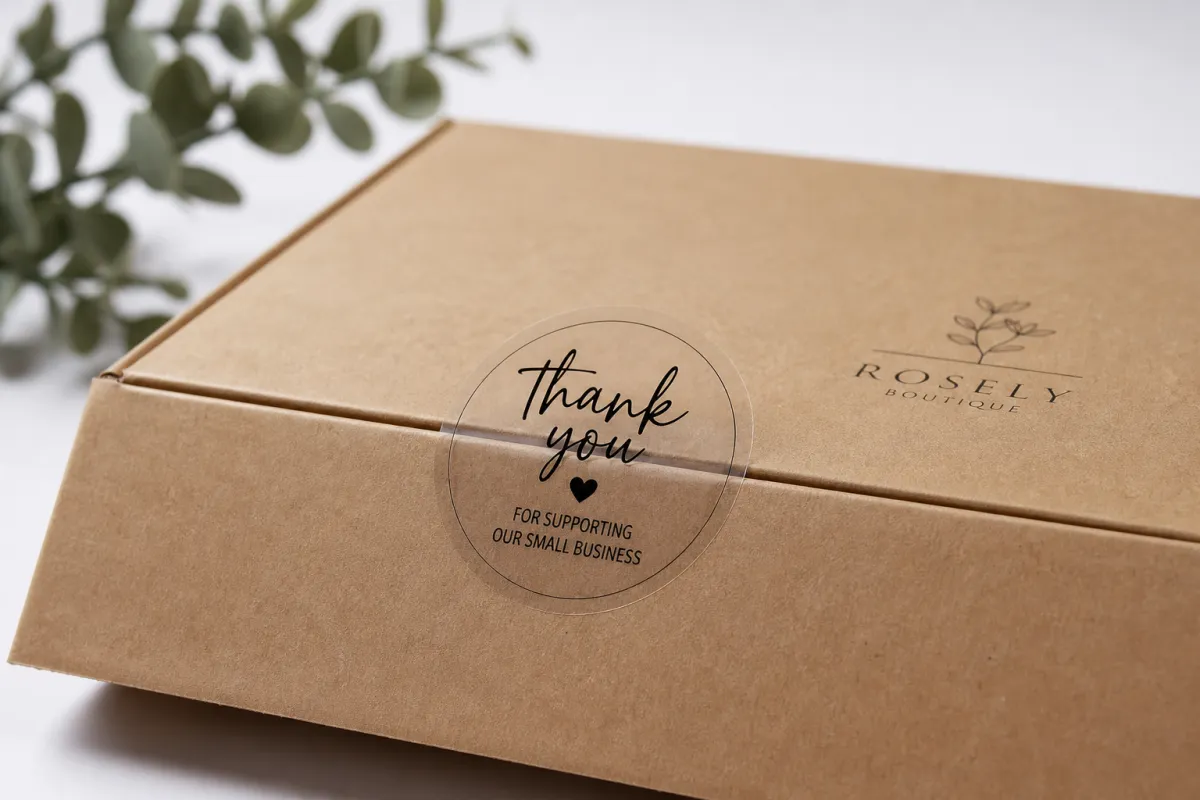
Clear does not mean invisible, and that misunderstanding causes a lot of disappointment with custom clear stickers for packaging. Transparent film can disappear into a light bottle or a white mailer, but edge shape, printed opacity, adhesive clarity, and surface finish all affect how the eye reads the label. On a bright glass jar, a clear sticker may look almost printed into the material. On a dark kraft carton or amber bottle, the same label will read more clearly unless the artwork is built to handle contrast on that surface.
The best use for custom clear stickers for packaging is integration. The label should make the branding feel like part of the package architecture, not a cover-up. A strong logo, a small seal, an ingredient note, or a promotional callout can sit neatly on the front panel or back panel and still let the package materials do their own visual work. Minimalist brands tend to get the most out of them because the label supports the packaging instead of fighting it.
They show up in a few especially useful places:
- Candle jars: the label can float visually on glass while the wax color remains part of the presentation.
- Cosmetics and beauty tubes: clear labels keep compact packaging from feeling crowded.
- Mailer boxes: a transparent seal or logo sticker closes the box without covering the printed carton finish.
- Retail packaging: clear stickers let shelf appeal come from the package itself rather than a heavy label block.
- Windowed cartons: a clear sticker can reinforce branding without blocking the window view.
The most common use case is simple. The packaging already looks decent, but it needs one more visual or functional touch. Maybe a logo on the front panel. Maybe a tamper seal. Maybe an ingredient callout on the back. In that situation, custom clear stickers for packaging are often a better fit than changing the entire box or container system. They are faster to produce, easier to reorder, and usually easier on the budget than a full custom print run for the whole pack.
Clear stickers still ask for discipline. Busy layouts, tiny type, and weak color contrast tend to look worse on transparent film because the package underneath keeps showing through. Strong logo. Clean spacing. Enough margin around the edge. Those basics matter more with clear film than they do with an opaque label, and the cleanest results usually come from the simplest artwork.
Packaging teams also think about how the label performs, not only how it looks. A clear sticker on a shipping carton may need different adhesive behavior than one on a cosmetic bottle. Moisture, refrigeration, abrasion, and repeated handling all affect the result. The Environmental Protection Agency has long encouraged smarter materials choices and source reduction, which lines up well with packaging work that uses only as much material as the task requires: EPA sustainable materials and products guidance. That said, a sustainability claim should always be checked against the actual package mix; clear films are not automatically recyclable just because the label is transparent.
How Custom Clear Stickers for Packaging Are Printed and Cut
The base film matters more than many buyers expect. For custom clear stickers for packaging, clear BOPP and clear vinyl are the most common paths. BOPP is popular for product labels because it offers moisture resistance, solid print quality, and predictable pricing at volume. Vinyl can make sense on curved surfaces or in handling conditions that ask for a little more durability, though the right choice depends on the actual use case. If a supplier cannot explain why a film is being recommended, keep asking. A transparent sticker is a material system, not just a shape.
Adhesive choice comes next. Permanent adhesive is the default for most custom clear stickers for packaging, especially on retail packaging and shipping cartons that need the label to stay put. Removable adhesive fits temporary promotions, limited campaigns, or seasonal packaging where the label may need to come off cleanly later. Cold storage, damp environments, and condensation change the equation fast. A label can look perfect on the proof and still fail on a chilled bottle if the bond was chosen casually.
White ink is the part that quietly decides whether the sticker disappears or reads clearly. Clear film by itself has very little opacity, so artwork can sink into a dark, tinted, patterned, or textured surface. White ink underprint adds a contrast layer beneath the color artwork and helps the design stay visible. No white ink means more transparency and a lighter visual effect. White ink means stronger visibility and better readability. Most custom clear stickers for packaging use a partial white layer under logos or text while leaving some zones open so the transparent quality still shows through.
That choice changes the final look in practical ways:
- No white ink: best for light packaging, glass, or designs that should feel airy and understated.
- Partial white ink: useful when only selected parts of the artwork need contrast.
- Full white ink underprint: strongest contrast, better for dark packaging, though less invisible.
Cut style matters just as much. Custom clear stickers for packaging can be produced as kiss-cut singles, die-cut shapes, sheets, or rolls. Kiss-cut stickers are cut through the top layer while leaving the liner intact, which makes peeling easy. Die-cut labels follow the exact outline of the artwork or border. Sheets work well for hand application, sample sets, and internal packing stations. Rolls are the practical choice when the application needs speed, repeatability, or machine compatibility.
Here is the simple way to sort the formats:
- Sheets: good for low-volume packing stations and sample kits.
- Rolls: better for speed, consistent orientation, and automation.
- Kiss-cut: easy for teams that apply labels one at a time.
- Die-cut: strong for premium presentation and unusual shapes.
The production flow is fairly standard, though the problems usually begin with the file. Artwork should be built with clean dielines, proper bleed, and enough margin so the edge never feels cramped. The printer then checks the proof, confirms size, material, ink layers, and cut path, and moves into production. Printing, curing or drying, optional finishing, and cutting follow after that. Alignment problems, white ink registration issues, and edge placement mistakes usually point back to the file stage, not the press itself.
For brands that need the rest of the packaging system to match, it helps to compare the sticker plan with other components like Custom Packaging Products and Custom Labels & Tags. That keeps the sticker from becoming a detached piece and gives the whole brand presentation a more consistent structure.
Industry testing matters as well. If the labels are going on shipping packs or products that face rough handling, it helps to know whether the spec can survive transit stress. The ISTA test standards are widely used for distribution testing, and they are useful whenever the label has to stay intact through the actual route instead of only looking good on a bench.
Cost Factors for Custom Clear Stickers for Packaging
Pricing for custom clear stickers for packaging follows real inputs, even if some quotes make the process feel arbitrary. Size, shape complexity, quantity, finish, white ink coverage, adhesive type, and turnaround time are the main variables. If a supplier gives you a price without matching those details, the comparison does not tell you much.
Small runs usually cost more per piece because the setup cost gets spread across fewer units. A 250-piece test order may land around $0.35-$0.90 per unit depending on size and print complexity. A 1,000-piece order often drops into the $0.12-$0.30 range. A 5,000-piece order can move lower still, sometimes to roughly $0.05-$0.18 per unit if the design is modest and the white ink coverage is not heavy. That is normal. Setup costs do not disappear just because the order is small.
White ink coverage can be one of the less obvious cost drivers for clear labels. More passes mean more ink, more attention, and more press time. A simple transparent logo with a small white underprint usually costs less than a design that needs broad white flood coverage. Shape complexity matters too. A circle or rectangle is easier to produce than a die-cut silhouette with tight turns and tiny details. Fancy shapes can look great, but they raise production cost in a very ordinary way.
Comparing quotes fairly means lining up the same spec on both sides. Match the dimensions. Match the film. Match the finish. Match the adhesive. Match the ink layers. If one quote includes full white underprint and another assumes no white ink, the cheaper number is missing part of the job. It may look lower, but it is not actually the same product.
| Format | Best For | Typical Unit Range | Notes |
|---|---|---|---|
| Small sheet labels | Launches, sample packs, low-volume hand application | $0.20-$0.60 | Easy to store and peel, but slower in high-volume packing lines |
| Roll labels | Faster fulfillment, repeated application, semi-automated packing | $0.08-$0.25 | Usually better value as quantities rise |
| Die-cut premium labels | Retail packaging, cosmetics, candles, presentation-heavy brands | $0.12-$0.40 | Shape complexity and white ink can move pricing quickly |
| Clear tamper seals | Mailer boxes, food containers, seals, short promo runs | $0.04-$0.15 | Small size keeps cost low, but strong adhesive still matters |
That table is only a buying lens, not a quote sheet. Even so, it helps explain why custom clear stickers for packaging can cost more than paper labels while still saving money elsewhere. If a transparent label lets you avoid a box redesign, skip a separate print layer, or simplify secondary packaging, the total packaging cost can still come out ahead. Smart buyers look at the whole system instead of counting only sticker cost.
Finish changes the picture too. Gloss usually suits clear film because it reinforces the polished, glass-like effect. Matte creates a softer and more restrained feel, though it can reduce contrast on already subtle artwork. Soft-touch films can be beautiful on paperboard, yet they are not an automatic answer for custom clear stickers for packaging. Every finish changes the visual result, and the right choice depends on the surface underneath.
If your packaging supports sustainability messaging, it is worth checking whether the rest of the system matches that story. FSC certification often relates to cartons or paper components around the label rather than the clear film itself, but the broader point still stands: the material story should fit the brand story. For more on responsible fiber sourcing, see FSC.
"The cheapest quote is usually the one that forgot white ink, adhesive quality, or the actual pack-out conditions."
Step-by-Step Timeline for Ordering Custom Clear Stickers for Packaging
Start with the real package, not the idealized mockup. Measure the surface. Note whether it is glass, coated paperboard, plastic, or metal. Decide whether the sticker is decorative, functional, or both. Gather logo files, brand colors, ingredient copy, and any legal text that has to fit. Curved bottles, textured boxes, and cold storage should be mentioned early. Custom clear stickers for packaging are much easier to spec when the actual surface is part of the conversation from the start.
Choose the format that matches the production line next. Hand packing in small batches often works well with sheets. Faster, more repeatable packing usually points toward rolls. A die-cut shape can add a refined edge if the design calls for it. Good packaging work is not only about how the sticker looks on a mockup. It is also about how the sticker behaves when a real person applies it in a real facility under real time pressure.
The proofing stage is where careful buyers save themselves from rework. A digital proof should confirm the size, shape, placement, white ink plan, and bleed. If the label relies on transparency or if the surface is dark, request a physical sample. That matters a lot for custom clear stickers for packaging because opacity and contrast can shift the entire appearance once the material is in hand. There is a real gap between a screen preview and a label sitting on an actual container.
A practical schedule often looks like this:
- Artwork prep: 1-3 business days if files are clean, longer if cleanup is needed.
- Proof review: 1-2 business days for standard digital proofing.
- Sample or revision round: 2-5 business days if color or adhesion testing is required.
- Production: often 5-10 business days after approval for straightforward runs.
- Shipping: 1-5 business days depending on service level and destination.
Rush orders can shorten the timeline, but they usually raise the price. That is simply the cost of moving a job ahead in the queue. If the labels are tied to a product launch, approving artwork earlier is usually the calmer and cheaper move. Emergency printing tends to be expensive and often creates the very label errors everyone hoped to avoid.
Before a full production run, do one basic test. Apply the sticker to the actual packaging, press it with normal force, and check for bubbles, edge lift, and readability from one to two feet away. If the label goes on a jar or bottle, check the curve. If it goes on a carton, check the corners. If the product will be cold, let the package sit and watch for condensation or bond issues. That small test can save a lot of inventory from becoming a lesson. It is kinda boring, but it beats a pallet of rejected packs.
For buyers managing a larger packaging rollout, this is also the moment to check the sticker against the rest of the line. Does it match the box print? Does it sit well beside shrink bands or inserts? Does it complement the rest of the retail packaging instead of creating a visual clash? If the answer is no, the spec still needs work.
Common Mistakes That Make Clear Stickers Look Cheap
The quickest way to ruin custom clear stickers for packaging is to use tiny type and then hope the transparency will somehow make it work. Thin strokes vanish. Low-contrast colors fade into the background. Overcrowded layouts feel messy once the package underneath becomes visible. Clear labels are not forgiving, and they reward confident artwork while exposing clutter.
Ignoring the package color or finish is another easy mistake. Transparent film on white glass can look elegant. The same film on dark kraft board can look muddy if the artwork was not planned with white ink. Matte boxes, textured cartons, and recycled papers change how the label reads too. Custom clear stickers for packaging work best when the artwork respects the actual surface instead of pretending every substrate behaves the same.
Size errors are just as costly. Too small and the label feels cramped or unreadable. Too large and the package loses the refined look that made clear film appealing in the first place. In practice, many brands land in the 1.5-inch to 3-inch range for small candle or cosmetic labels, while larger boxes or mailers may need wider applications depending on the front-panel footprint. There is no universal perfect size. There is only the size that suits the package in front of you.
Skipping white ink when it is needed creates a different kind of problem. If the logo sits on dark packaging, white underprint often makes the difference between clear branding and a mark that disappears in low light. Some buyers choose transparency because they want the label to vanish, then discover the brand mark vanishes too. That is not a print defect. That is a design choice that should have been tested earlier.
Real-world surfaces matter as much as the artwork. Curved bottles, dusty cartons, cold refrigeration, and textured recycled materials all influence adhesion. A label that sticks cleanly on a sample sheet may behave badly on a rough or damp package. Custom clear stickers for packaging need surface testing before full production, especially when the product will move through shipping, storage, and retail handling.
One more thing gets overlooked: the label edge. If the border is too tight or the cut line sits awkwardly close to the artwork, the piece can look cheap even when the print is clean. Leave breathing room. The eye reads that margin as care.
Expert Tips for Better Packaging Results
Keep the artwork bold and simple. Custom clear stickers for packaging handle a strong logo, a short seal, or a clean product name far better than a crowded arrangement of tiny elements. If the design works at arm’s length on screen, it has a fair chance in production. If it only makes sense when zoomed in, it probably needs simplification.
Match the finish to the brand mood and the package material. Gloss reads crisp and polished. Matte softens the effect and can feel more understated. On clear film, gloss often strengthens the printed-on illusion. On a more restrained luxury package, that slight shine may be exactly right. On a calm natural brand, matte may fit better, but it should still be tested on the actual substrate before a large order goes out.
Use the transparency on purpose. Good packaging design makes room for the material underneath. Let the jar color show through. Let the carton texture contribute to the look. Let the sticker frame the logo rather than cover the package beneath it. Custom clear stickers for packaging do their best work when they support the packaging instead of trying to replace it.
Application speed matters more than buyers often expect. If the label shape slows down packing, labor can wipe out the savings from the sticker itself. Simple shapes tend to apply faster and more consistently. A roll format can speed things along even more. For brands packing hundreds or thousands of units, a few seconds per application becomes real time very quickly. That is just arithmetic.
Test one sample on every packaging substrate you use. One sticker spec rarely behaves the same on glass, paperboard, plastic, and coated metal. A label that holds well on a bottle might not like a recycled box. A label that looks perfect on white plastic might nearly disappear on amber glass. If you sell multiple SKUs, treat each surface as its own test case. That approach is plain, but it saves money and avoids complaints.
Packaging standards matter too. If your products ship through rough channels, the label is part of the durability story. ISTA testing helps show what happens in transit, which is more useful than guessing. If the package must survive distribution without peeling, curling, or scuffing, the sticker spec should be judged in that context rather than only on a clean proof sheet.
One practical detail I keep coming back to: a label that looks fine on a desk can fail once a packing team starts moving fast. Ask the people applying it what slows them down. If they have to peel, align, and smooth every piece twice, the spec is probably too fussy.
Even if you already use custom printed boxes, custom clear stickers for packaging still have a useful role. They are not redundant. They can handle seals, batch codes, seasonal notes, and compliance details without forcing a change to the box inventory. That kind of flexibility reduces waste when artwork changes mid-cycle.
Next Steps: Choosing Custom Clear Stickers for Packaging That Work
Start with the single job the sticker has to do. Does it need to brand the front panel? Seal a carton? Add ingredients? Carry a promotion? Once that is clear, the rest of the spec gets much easier to shape. Custom clear stickers for packaging are not decoration alone. They are a production tool, and the tool should fit the task.
Shortlist two or three sizes and ask for quotes using the exact same spec. Same dimensions. Same film. Same finish. Same white ink plan. That is the only fair way to compare pricing. If one quote is for a transparent BOPP roll label and another is for a vinyl sheet label with partial white underprint, the prices are describing different products, not competing versions of the same one.
If the packaging surface is dark, curved, textured, or refrigerated, order a short run or a sample pack before you scale. That is a cheap insurance policy and one I would take every time. A small test order is easier to absorb than a warehouse of labels that looked perfect online and misbehave in the field. Custom clear stickers for packaging should earn their place on the product, not just pass a digital mockup review.
Build a simple application checklist for the packing team. Mark the placement zone clearly. Set the pressure standard. Decide whether the labels need a short curing window before boxing or shipping. If the team applies labels by hand, a one-line instruction sheet can prevent crooked placement and wasted units. Good package branding often comes down to repeatable execution as much as it does to design.
If you want a practical benchmark, think in ranges: a small, clean clear label can stay in the low cents per unit at volume, while premium custom clear stickers for packaging with white ink, special shapes, or low quantities can climb quickly. That is normal. The real goal is to buy the spec that fits the product, the surface, and the shipment path instead of paying for features you do not need.
For brands building a fuller system, it helps to review the rest of the lineup too. The strongest results usually happen when custom clear stickers for packaging, retail packaging, and product packaging all feel like they belong to the same family. That is the moment when a label stops looking like a patch and starts doing real branding work. Chosen carefully, custom clear stickers for packaging can clean up presentation, reduce friction in fulfillment, and make the whole package look more expensive without pretending to be something it is not.
Here is the most practical takeaway: define the surface, choose the film for that surface, ask for white ink only where contrast is needed, and test a real sample before you commit to volume. Do those four things and custom clear stickers for packaging stop being a guessing game.
FAQs
Are custom clear stickers for packaging fully transparent?
Not always. The film is clear, but white ink, printed areas, adhesive, and the package finish all affect how invisible the sticker looks. They appear most transparent on smooth, light, or glass surfaces. On dark or textured packaging, custom clear stickers for packaging are usually more visible, especially if the design uses white underprint.
What surfaces work best for custom clear stickers for packaging?
Smooth glass, coated paperboard, rigid plastic, and clean metal usually give the best bond and the cleanest look. Dusty, curved, heavily textured, or recycled surfaces can reduce adhesion. If your packaging has those traits, test custom clear stickers for packaging before you place a full order.
Are custom clear stickers for packaging waterproof?
Many clear BOPP and vinyl options are water-resistant, but that is not the same as indestructible. Condensation, heavy moisture, and cold storage can still create problems if the adhesive or film is not suited to the job. For refrigerated products or packaging that may get wet, ask for waterproof custom clear stickers for packaging with permanent adhesive.
How long does it take to produce custom clear stickers for packaging?
Simple digital runs can move quickly, while complex die cuts or orders that need multiple proof rounds take longer. A realistic plan usually includes artwork cleanup, proof approval, production, and shipping. Rush service is possible in many cases, but it usually costs more. Custom clear stickers for packaging are faster when the artwork is clean from the start.
What is the minimum order for custom clear stickers for packaging?
It depends on the printer and the format, but many suppliers offer small runs for launches, seasonal packaging, and test batches. The unit price drops as quantity rises, so it helps to compare a short test order against a larger production quote. That way you can decide whether custom clear stickers for packaging should stay small or move into a full production run.

